
Fen Grass of Parnassus (Parnassia glauca)
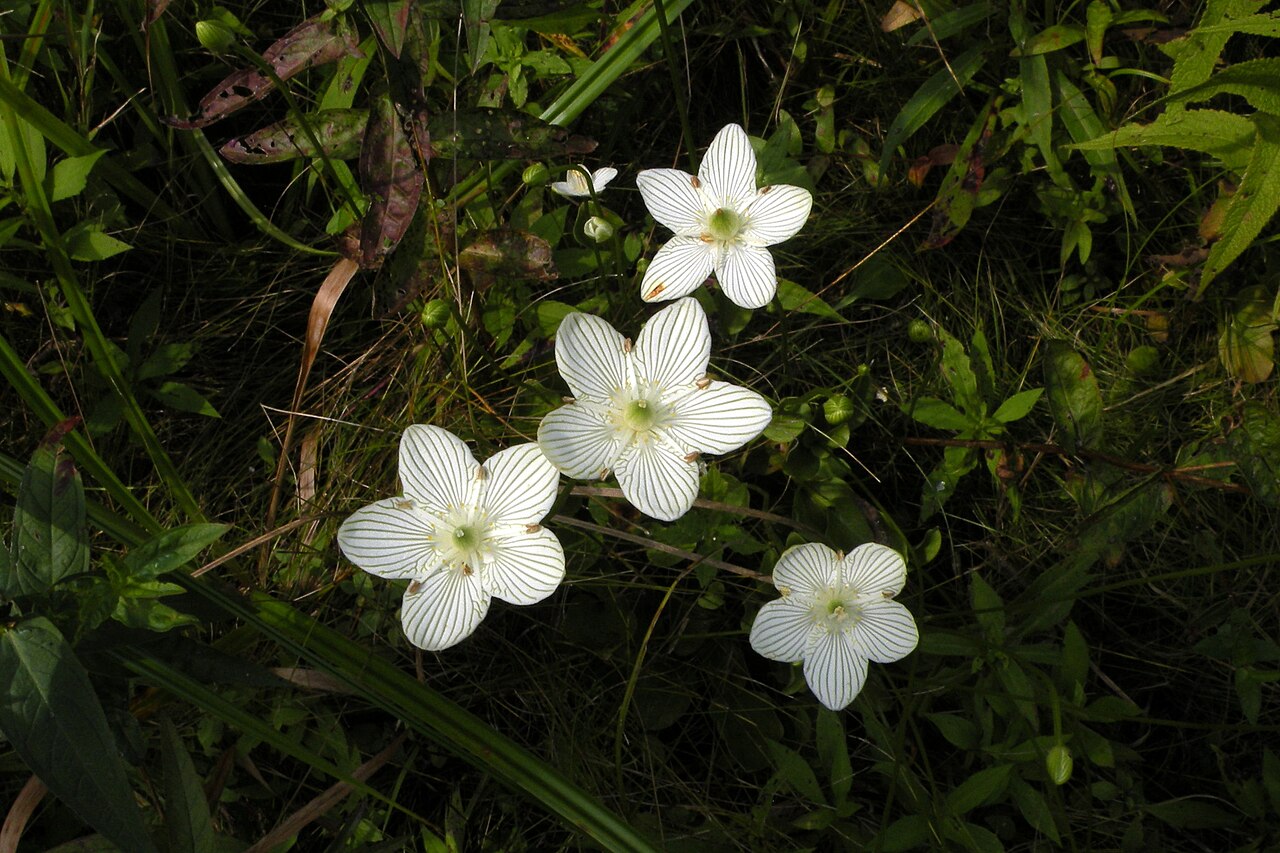
Parnassia glauca, known as Fen Grass of Parnassus, and also as American grass-of-Parnassus or glaucous grass-of-Parnassus, is a late-blooming wildflower of calcareous fens, wet meadows and limy shores in northeastern and north-central North America. Despite its name, it is not a grass. It is now placed in the bittersweet family (Celastraceae), although older books list it in the saxifrage family or its own family, Parnassiaceae.
From late July into October it produces single, white flowers about an inch across on leafless stalks 8 to 20 inches tall. The petals are marked with fine green veins, and between the five true stamens are curious, three-pronged structures called staminodes, each tipped with a shiny, gland-like knob. The basal leaves are rounded, thick and slightly blue-green (“glaucous”), on long stalks.
Fen grass of Parnassus is a classic indicator of fens and other wetlands fed by cold, lime-rich groundwater. These habitats are rare and fragile, and the plant is uncommon or protected in several states. Never dig it from the wild; it can only be grown in a constantly wet, limy garden setting.
Identification
Look for a single, white, five-petaled flower with green-striped petals on a tall stalk that has one small, clasping leaf, rising from a rosette of rounded, blue-green leaves in a wet, open fen in late summer.
Growth Habit
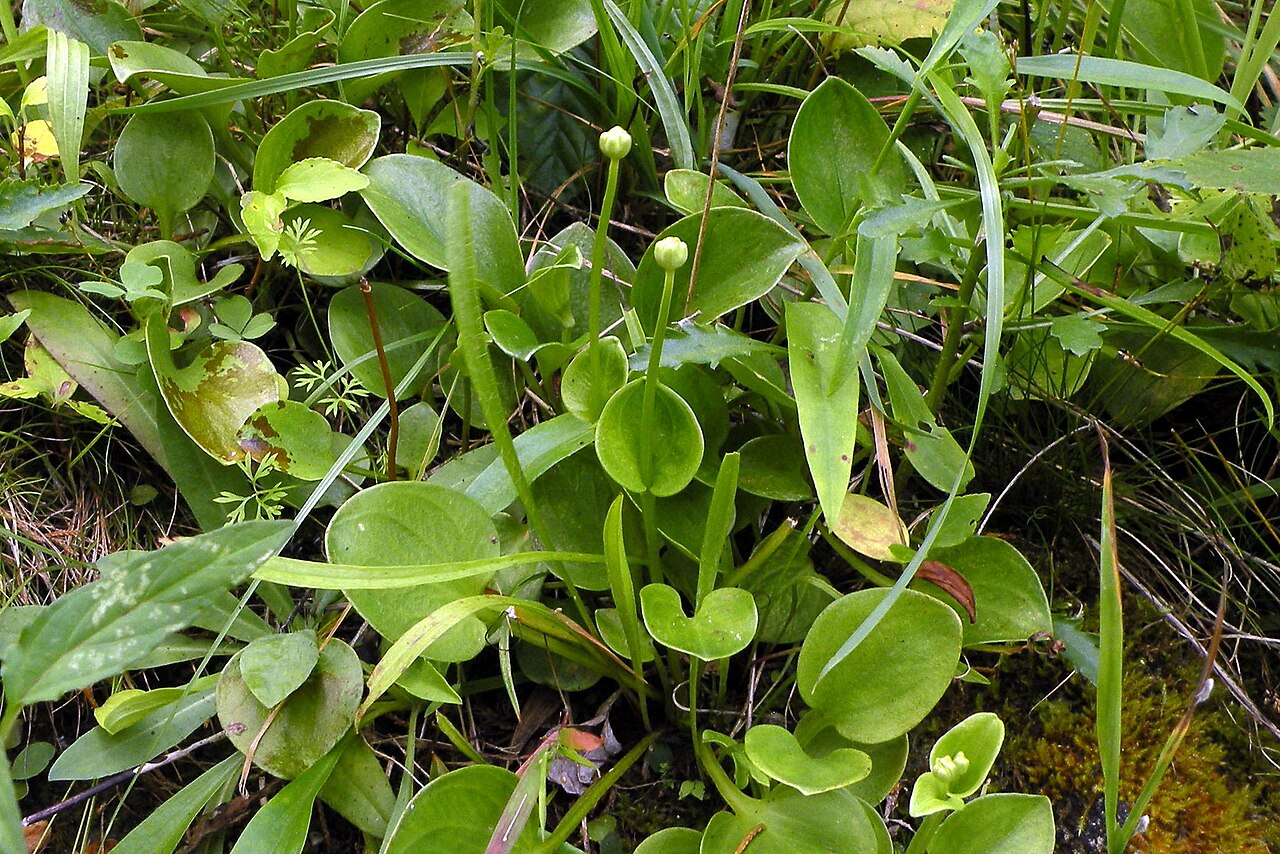
A clump-forming perennial with a rosette of basal leaves and one to several flowering stalks 8 to 20 inches tall. Each stalk bears a single flower and one small, stalkless leaf that clasps the stem, usually below the middle.
Leaves
The basal leaves are round to broadly oval, 1 to 2 1/2 inches long, thick and smooth, with a slightly bluish-green, waxy surface. They sit on stalks as long as or longer than the blade. The single stem leaf is smaller and clasps the stalk.
Flowers
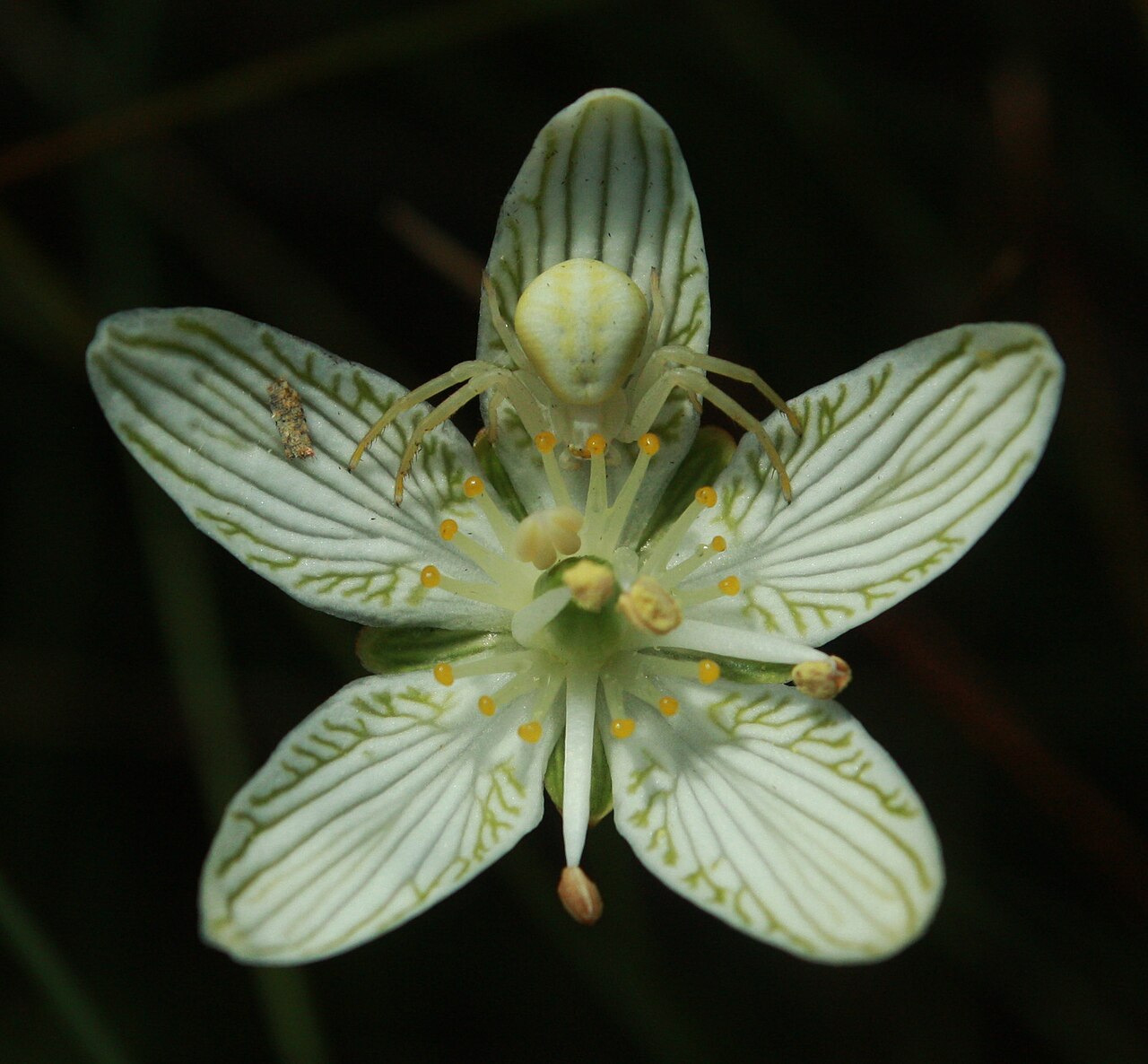
The flowers are about 3/4 to 1 1/4 inches across, with five white, oval petals, each marked with about 5 to 9 green or greenish veins. Five fertile stamens alternate with five staminodes, sterile stamens that are split into three short prongs, each ending in a yellowish, gland-like knob. The staminodes look like nectar droplets and attract insects. In the center is a plump, greenish ovary. Flowers open from late July to October.
Fruit & Seeds
The fruit is an egg-shaped capsule about 1/2 inch long that splits into four parts to release many tiny, winged seeds in fall.
Look-alikes
Carolina grass-of-Parnassus (Parnassia caroliniana) and large-leaved grass-of-Parnassus (P. grandifolia) grow farther south, mainly in the Southeast, and differ in leaf shape and in the size and division of their staminodes. Marsh grass-of-Parnassus (P. palustris), of more northern and western areas, has staminodes divided into many thread-like segments and heart-shaped leaves.
Quick Facts
| Scientific Name | Parnassia glauca |
| Family | Celastraceae (bittersweet family); formerly Parnassiaceae |
| Plant Type | Herbaceous perennial |
| Mature Height | 8–20 in |
| Mature Spread | 4–8 in |
| Growth Rate | Slow |
| Sun Exposure | Full sun to light shade |
| Water Needs | High; constantly wet |
| Soil Type | Wet calcareous peat, marl, muck or gravel |
| Soil pH | Neutral to alkaline (about 7.0–8.5) |
| Bloom Time | Late July–October |
| Flower Color | White with green veins |
| Fall Color | None notable |
| Fruit | Egg-shaped capsule with tiny seeds |
| Deer Resistant | Moderate |
| USDA Hardiness Zones | 3–7 |
Native Range
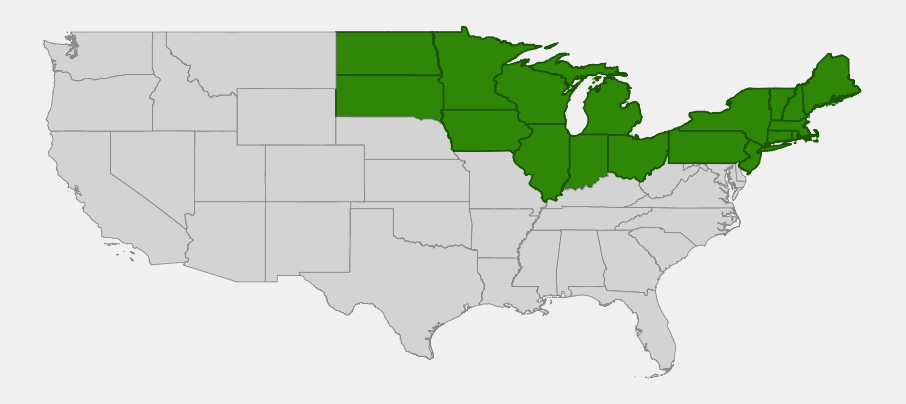
Fen grass of Parnassus is native to northeastern and north-central North America. USDA PLANTS lists it from Maine, New Hampshire, Vermont, Massachusetts, Rhode Island and Connecticut west through New York, New Jersey, Pennsylvania, Ohio, Indiana, Illinois, Michigan, Wisconsin, Iowa and Minnesota to North Dakota and South Dakota. In Canada it grows from Newfoundland and New Brunswick west through Quebec and Ontario to Manitoba and Saskatchewan.
It is most common around the Great Lakes, in northern New York and in western New England, where limestone, dolomite and lime-rich glacial deposits feed many fens and seeps. It becomes local and rare to the south and west, where suitable fens are scattered. In Minnesota and the Dakotas it grows in fens and wet meadows of the prairie region, including western Minnesota.
It grows in open, wet, calcium-rich places: calcareous fens, sedge meadows, marly lakeshores, spring seeps, wet limestone ledges, interdunal swales along the Great Lakes and wet ditches over limy soil. It needs constant moisture from cold groundwater and full or nearly full sun.
📋 Regional plant lists featuring Fen Grass of Parnassus: New York, Pennsylvania & Northern New Jersey · Ohio & Indiana · Michigan, Wisconsin & Eastern Minnesota · Connecticut, Massachusetts & Rhode Island · New Hampshire, Maine & Vermont · Delaware, Southern New Jersey & Long Island · Illinois, Iowa & Missouri · North Dakota, South Dakota & Western Minnesota
Growing & Care Guide
Fen grass of Parnassus is a choice plant for a sunny fen or bog garden built with limy, constantly wet soil. It is seldom sold by nurseries and does not tolerate dry or acidic conditions. Buy nursery-propagated plants or grow it from responsibly collected seed; never dig wild plants.
Light
Full sun to light shade. In shade it flowers poorly and is easily crowded out.
Soil & Water
Constantly moist to wet, neutral to alkaline soil, such as a mix of sand, marl or limestone grit and peat, fed by clean, cool water. It must never dry out. Unlike most bog plants, it needs lime rather than acid peat.
Planting Tips
Plant small plants in spring in an open, low-growing setting such as a fen garden, a spring-fed pond edge or a seep, among sedges and other small wetland plants. Do not plant it among tall, vigorous perennials that will shade it.
Pruning & Maintenance
Keep competition from tall plants, cattails and invasive reed grass and buckthorn under control. Leave the seed capsules to ripen so plants can self-sow. Avoid fertilizers, which favor weedy competitors.
Propagation
From seed. Sow the tiny seeds on the surface of moist, limy mix in fall, or cold-stratify them for about two to three months and sow in spring, without covering them. Keep them wet. Seedlings grow slowly and may take two or three years to bloom.
Landscape Uses
- Fen and bog gardens: an elegant late-season flower for wet, limy ground
- Pond and stream edges: for spring-fed, constantly wet margins in sun
- Wetland restoration: a characteristic plant of calcareous fens and sedge meadows
- Pollinator gardens: late flowers for flies and small bees
- Natural areas: an indicator of healthy, groundwater-fed wetlands
Wildlife & Ecological Value
Fen grass of Parnassus is part of the rich plant community of northern fens, one of the most species-rich wetland types in North America.
For Pollinators
The flowers are visited mainly by flies, including syrphid flies, and by small bees. The shiny knobs on the staminodes look like drops of nectar and guide insects to the real nectar at their base. Crab spiders often hide in the flowers to catch visiting insects.
For Birds
It has little direct value for birds.
For Mammals
It is occasionally browsed by deer, but it is too small and scattered to be an important food.
Ecosystem Role
Fen grass of Parnassus is a reliable indicator of calcareous fens and other wetlands fed by lime-rich groundwater. These communities support many rare plants and insects and are threatened by drainage, groundwater pumping, nutrient pollution and invasion by reed grass and glossy buckthorn.
Cultural & Historical Uses
The name “grass of Parnassus” goes back to the Greek physician Dioscorides, who described a plant growing on Mount Parnassus, in Greece; the word “grass” was then used for many kinds of fodder plants. Linnaeus later used the name Parnassia for the European species, and glauca refers to the blue-green leaves.
The species was named by Constantine Samuel Rafinesque, an eccentric and prolific early American naturalist. Its family placement has changed several times: it has been put in the saxifrage family, in its own family Parnassiaceae, and, based on DNA studies, in the bittersweet family, Celastraceae.
Because calcareous fens are rare, fen grass of Parnassus is listed as rare or protected in several states at the edges of its range. Protecting fens and the groundwater that feeds them is the most important step for its conservation.
Frequently Asked Questions
Is fen grass of Parnassus a grass?
No. It is a flowering herb in the bittersweet family. The name “grass” comes from an old use of the word for plants grazed by livestock.
When does fen grass of Parnassus bloom?
From late July into October, later than most wildflowers. Each stalk carries a single white flower with green-veined petals.
What are the yellow knobs in the flower?
They are staminodes, sterile stamens split into three prongs with gland-like tips. They look like nectar droplets and help attract and guide pollinating insects.
Where does fen grass of Parnassus grow?
In open, wet, lime-rich places such as calcareous fens, sedge meadows, marly shores and spring seeps, mainly in the Northeast and around the Great Lakes.
Can I grow fen grass of Parnassus?
Yes, but only in a constantly wet, sunny, limy site such as a fen garden or spring-fed pond edge. It fails in dry or acidic soil.

Looking for a nursery that carries Fen Grass of Parnassus?
Browse our native plant nursery directory: Connecticut · Illinois, Indiana & Iowa · Maine, Massachusetts, Michigan & Minnesota · New Hampshire, New Jersey, New York, North Dakota & Ohio · Pennsylvania, Rhode Island, South Dakota & Vermont · Wisconsin

