
Showy Lady’s Slipper (Cypripedium reginae)
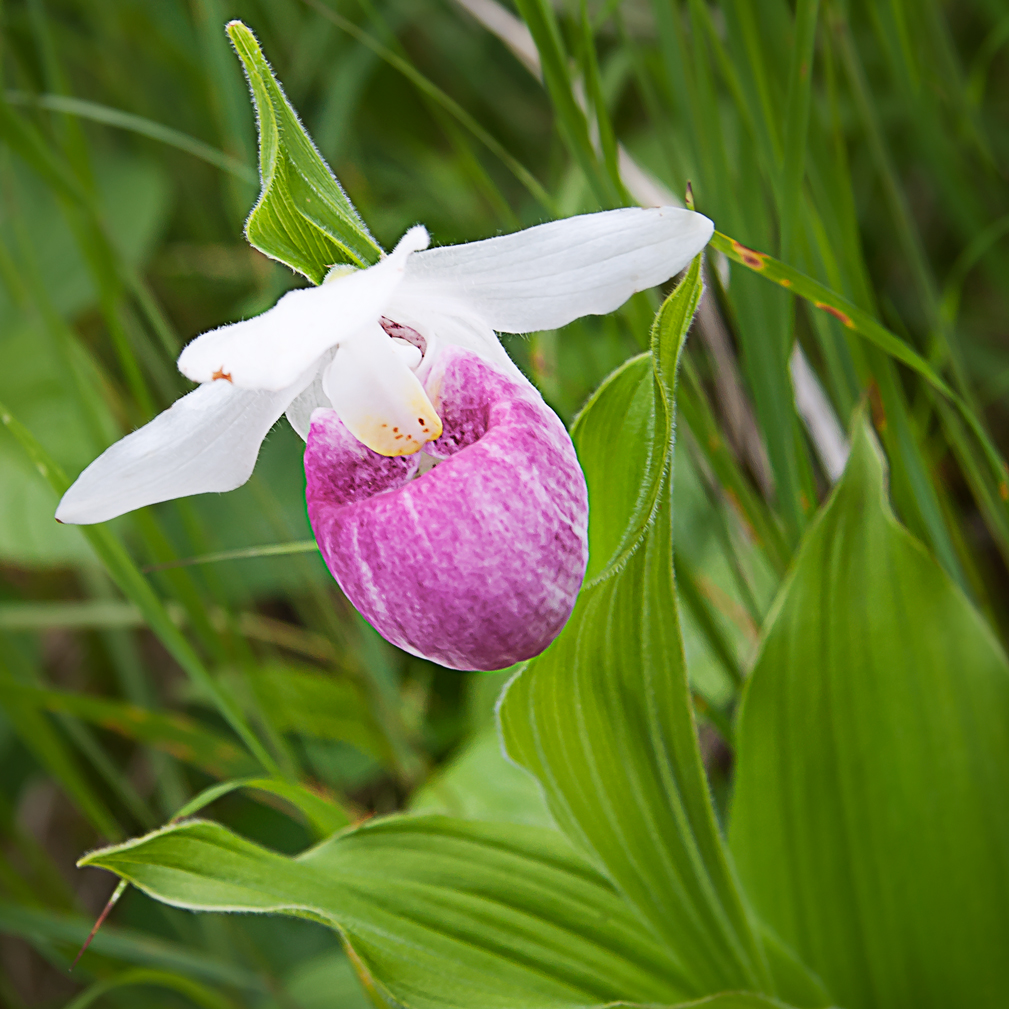
Cypripedium reginae, known as Showy Lady’s Slipper or queen lady’s slipper, is the largest and many say the most beautiful of the native lady’s slipper orchids of North America. It is a long-lived perennial orchid of the orchid family (Orchidaceae) and the state flower of Minnesota.
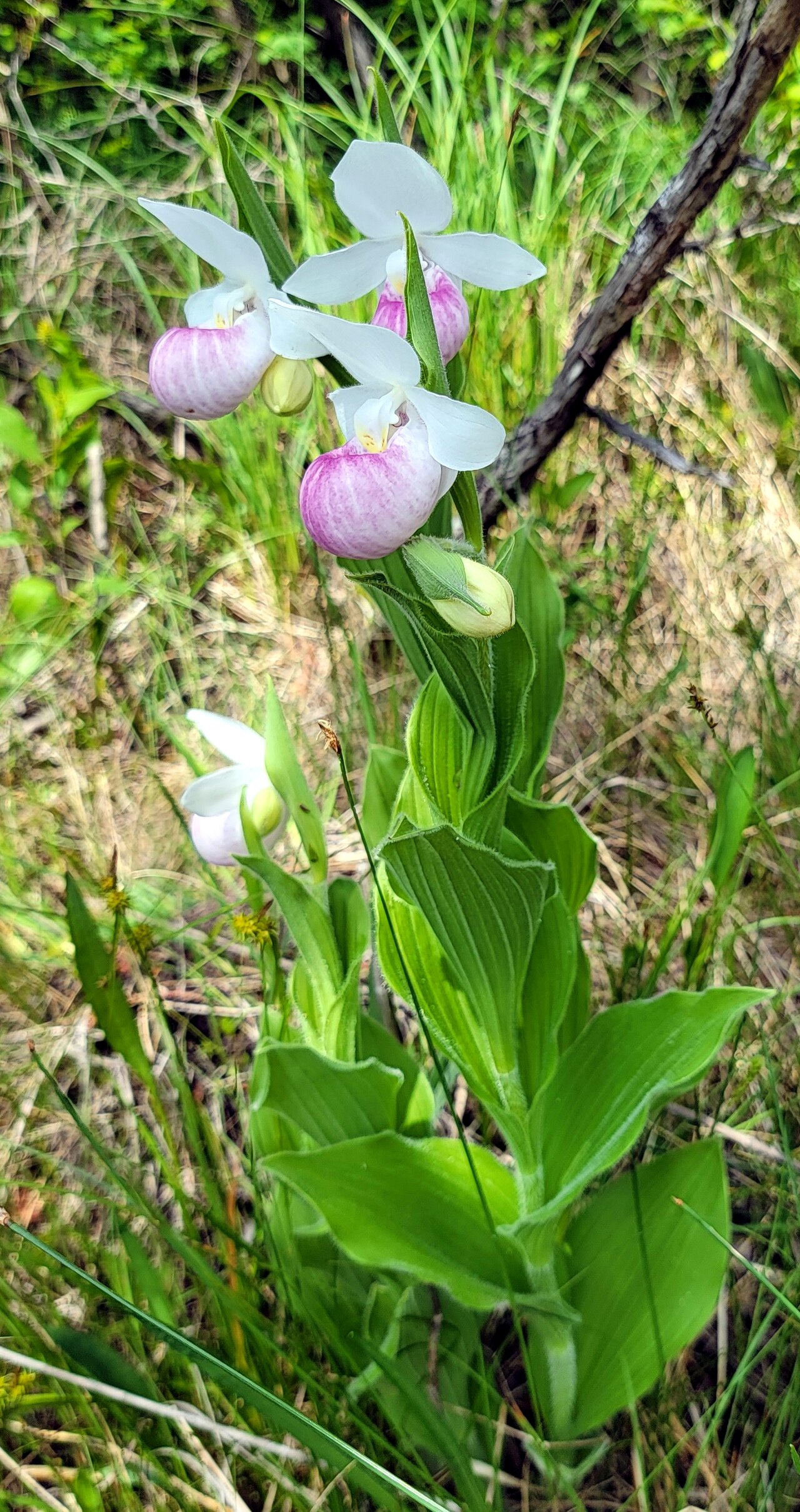
In early summer, leafy stems 1 to 3 feet tall carry one to three flowers, each with pure white sepals and petals and a large, inflated pouch (the slipper) flushed and streaked with rose-pink. The broad, pleated leaves are covered in fine hairs. A healthy colony with dozens of blooming stems in a fen or cedar swamp is one of the great sights of the northern wildflower season.
Showy lady’s slipper grows in cool, wet, open places with neutral to limy soil: fens, cedar and tamarack swamps, wet meadows and seepy slopes. It is rare or protected in many states. Never dig it from the wild. Wild-dug plants almost always die, and collecting harms the remaining populations. Gardeners who want to grow it should buy only laboratory- or nursery-propagated plants from reputable growers.
Identification
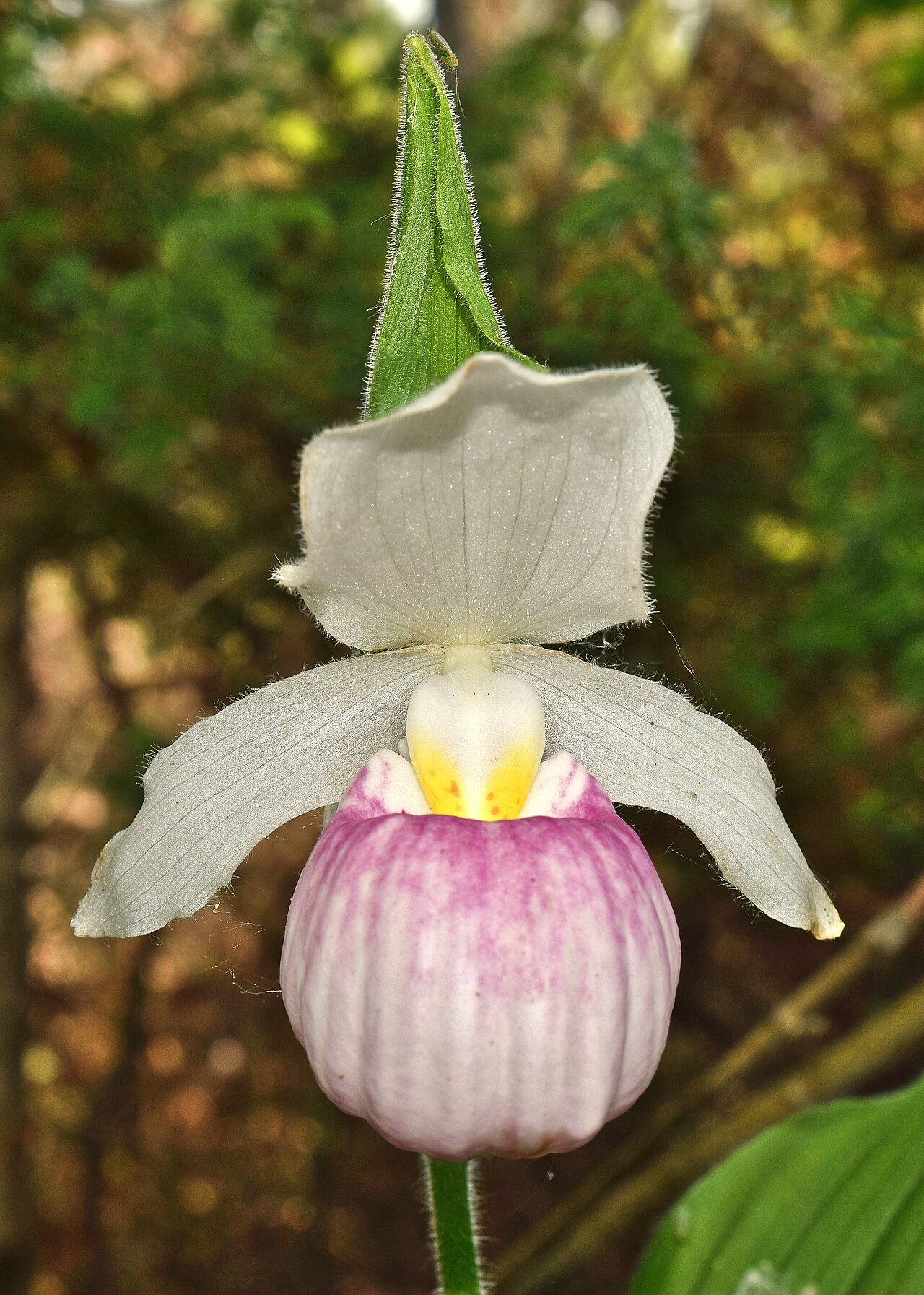
Look for a tall, leafy orchid of wet, open places with broad, hairy, pleated leaves along the stem and large flowers with white petals and a pink-and-white pouch.
Growth Habit
Showy lady’s slipper is a herbaceous perennial that grows from a short underground rhizome with long, fleshy roots. Mature plants form clumps of several to many stems, each 1 to 3 feet tall. The stems die back in fall, and plants can live for decades, slowly enlarging their clumps.
Leaves
Each stem bears three to seven alternate leaves along its length, not just at the base. The leaves are broad, oval to elliptical, 4 to 10 inches long, strongly ribbed or pleated, and clasp the stem at the base. Both the leaves and stems are covered in soft, glandular hairs.
Flowers
Flowers open from about late May to early July, usually one or two per stem, sometimes three. The rounded upper sepal and the two side petals are white and spreading. The lip is a large, inflated pouch about 1 to 2 inches long, white with rose-pink to magenta streaks or flushes; rarely the pouch is all white. A leaf-like bract stands behind each flower.
Fruit & Seeds
Pollinated flowers develop an upright, ribbed capsule that ripens in late summer and fall. Each capsule releases thousands of dust-like seeds. Like other orchid seeds, they have almost no stored food and can only germinate with the help of specific soil fungi, so very few become new plants.
Look-alikes
Pink lady’s slipper (Cypripedium acaule) has only two leaves at ground level and a single, leafless flower stalk; it grows in acid woods. Yellow lady’s slipper (Cypripedium parviflorum) has a leafy stem but a yellow pouch and twisted brown or greenish petals. Small white lady’s slipper (Cypripedium candidum), a prairie and fen plant, is much smaller, with a small, all-white pouch. No other native orchid combines the large size, white petals and pink pouch.
Safety Notes
The glandular hairs on the leaves and stems can cause an itchy skin rash similar to poison ivy in sensitive people. Avoid handling the foliage with bare skin. The plant is not a food or medicinal plant.
Quick Facts
| Scientific Name | Cypripedium reginae |
| Family | Orchidaceae (orchid family) |
| Plant Type | Herbaceous perennial orchid |
| Mature Height | 1–3 ft |
| Mature Spread | 1–2 ft (clumps) |
| Growth Rate | Slow |
| Sun Exposure | Part shade to full sun with moist soil |
| Water Needs | High; constantly moist to wet soil |
| Soil Type | Wet, peaty or mucky; neutral to limy |
| Soil pH | About 6.5–8.0 |
| Bloom Time | Late May–early July |
| Flower Color | White with a rose-pink pouch |
| Fall Color | Leaves turn yellow before dying back |
| Fruit | Upright capsules with dust-like seeds |
| Deer Resistant | No; deer browse the stems and flowers |
| USDA Hardiness Zones | 3–7 |
Native Range
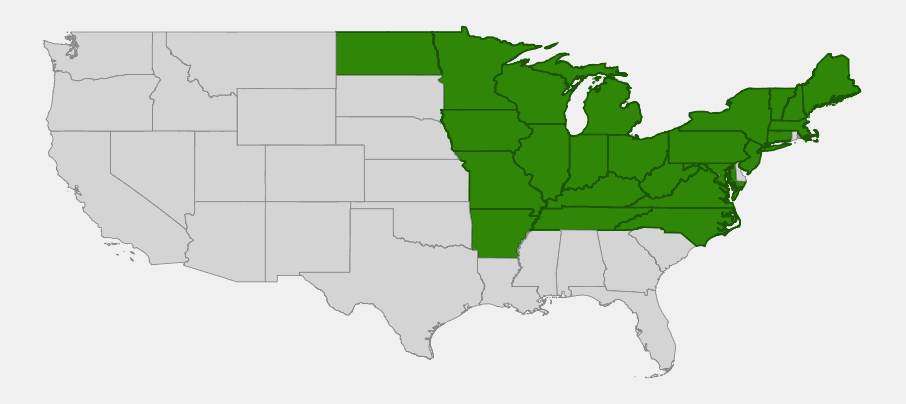
Showy lady’s slipper is native to eastern and central North America, from Saskatchewan, Manitoba and Newfoundland south through the Great Lakes and New England. USDA PLANTS lists it as native in Arkansas, Connecticut, Illinois, Indiana, Iowa, Kentucky, Maine, Maryland, Massachusetts, Michigan, Minnesota, Missouri, New Hampshire, New Jersey, New York, North Carolina, North Dakota, Ohio, Pennsylvania, Tennessee, Vermont, Virginia, West Virginia and Wisconsin. In Canada it grows in Manitoba, New Brunswick, Newfoundland, Nova Scotia, Ontario, Prince Edward Island, Quebec and Saskatchewan.
It is most common in the northern Great Lakes region, especially northern Minnesota, Wisconsin and Michigan, and in parts of New England and southern Canada. Farther south it is rare and local. Records in the southern Appalachians of Virginia, West Virginia, Kentucky, Tennessee and North Carolina, in Missouri and in the Arkansas Ozarks are scattered, outlying populations, and it is very rare or historical in several of those states.
Typical habitats are open to lightly shaded wetlands with cold, mineral-rich water: calcareous fens, northern white cedar and tamarack swamps, wet meadows, seeps on limestone slopes and the wet edges of bogs and lakes. It has also colonized wet roadside ditches in some northern areas. It needs light and constant moisture, and it declines when wetlands are drained or grow over with shrubs.
📋 Regional plant lists featuring Showy Lady’s Slipper: North & South Carolina · Maryland, Virginia & West Virginia · Kentucky & Tennessee · Arkansas, Louisiana, Eastern Oklahoma & Eastern Texas · Illinois, Iowa & Missouri · Ohio & Indiana · North Dakota, South Dakota & Western Minnesota · Michigan, Wisconsin & Eastern Minnesota · New York, Pennsylvania & Northern New Jersey · Delaware, Southern New Jersey & Long Island · Connecticut, Massachusetts & Rhode Island · New Hampshire, Maine & Vermont
Growing & Care Guide
Showy lady’s slipper can be grown in gardens, but only from laboratory- or nursery-propagated plants. Never dig plants from the wild or buy plants of unclear origin: wild-collected orchids rarely survive, and collecting has eliminated many populations. Several specialist nurseries now raise it from seed in the lab.
Light
Give it bright, dappled shade or morning sun with afternoon shade. In cool northern gardens it tolerates more sun if the soil stays moist. Deep shade weakens plants and reduces flowering.
Soil & Water
It needs soil that is constantly moist but not stagnant, rich in organic matter and neutral to slightly alkaline. A mix of peat-free compost, coarse sand or grit and some limestone chips works well. Keep the soil moist all season and never let it dry out; summer drought and hot, soggy soil are the most common causes of loss.
Planting Tips
Plant dormant, nursery-propagated rhizomes in fall or early spring, with the buds just below the soil surface and the roots spread out flat. A moist, shady spot near a pond, a bog garden with limy rather than acid soil, or a cool woodland bed with regular watering are good choices. Mulch lightly with leaf litter and mark the spot so the plant is not disturbed while dormant.
Pruning & Maintenance
Let the foliage die back naturally in fall, then remove it. Do not fertilize heavily; a light, dilute feeding in spring is enough. Protect plants from slugs in spring and from deer, which readily eat the stems. Once established, leave the clump undisturbed.
Propagation
Home propagation is difficult. The seeds need specific fungi or sterile laboratory culture to germinate, and seedlings take several years to reach flowering size. Large, established garden clumps can be carefully divided in fall, keeping several buds and plenty of roots on each piece. Leave wild plants in place, and buy only propagated stock.
Landscape Uses
- Shade and woodland gardens: a spectacular early summer focal plant in moist, limy soil
- Bog and pond edges: for gardens with neutral to alkaline, constantly moist soil
- Conservation: protect existing wild colonies and their wetland habitat
- Wildflower viewing: fens and cedar swamps in bloom in June
- Specialty orchid collections: nursery-propagated plants only
Wildlife & Ecological Value
Showy lady’s slipper depends on other organisms at every stage of its life, from the fungi that feed its seedlings to the bees that pollinate its flowers.
For Pollinators
The pouch is a trap flower that offers no nectar. Bees, mostly medium-sized bees such as leafcutter bees, enter the pouch through the large opening at the top and can only leave through one of two small openings at the back, brushing past the stigma and picking up pollen as they go. Many flowers are never pollinated, so seed set is often low.
For Birds
Birds do not feed on the plant, but the fens and cedar swamps where it grows are important breeding habitat for warblers, sparrows and other wetland birds.
For Mammals
White-tailed deer browse the stems and flowers and can seriously damage colonies where deer are abundant.
Ecosystem Role
Like all orchids, showy lady’s slipper relies on mycorrhizal fungi to germinate and grow as a seedling. It is an indicator of high-quality, mineral-rich wetlands such as fens and cedar swamps, and its presence often signals a site worth protecting.
Cultural & Historical Uses
Thomas Walter described the species in 1788 in Flora Caroliniana. The genus name Cypripedium comes from the Greek Kypris, a name for the goddess Venus, and pedilon, sandal or slipper. The epithet reginae means “of the queen,” a fitting name for the most regal of the lady’s slippers. Older books often call it Cypripedium spectabile.
Showy lady’s slipper was adopted as the state flower of Minnesota in 1902, and Minnesota has protected it by law since 1925. It is also listed as rare, threatened or endangered in a number of other states, and picking or digging it is prohibited or restricted in many places.
Over-collecting for gardens, the draining of wetlands and the loss of open fens to shrubs and trees have all reduced its numbers. Today, laboratory propagation from seed has made legitimately grown plants available, which removes any reason to take plants from the wild.
Frequently Asked Questions
Can I dig up a showy lady’s slipper and move it to my garden?
No. It is protected in several states, and wild-dug plants almost always die because they depend on soil fungi and very specific conditions. Buy only laboratory- or nursery-propagated plants from reputable growers.
Is showy lady’s slipper rare?
It is locally common in parts of the northern Great Lakes region and southern Canada, but it is rare, threatened or endangered in many states, especially at the southern edge of its range.
Why is it Minnesota’s state flower?
It was adopted in 1902 for its beauty and because it grows in the state’s many cedar swamps and fens. Minnesota has protected it by law since 1925.
Can showy lady’s slipper cause a rash?
Yes. The glandular hairs on its leaves and stems can cause skin irritation similar to poison ivy in some people, so avoid handling the foliage with bare skin.
How long does it take to flower from seed?
Several years. Seedlings grow slowly underground with the help of fungi before producing leaves, and they need several more years of growth before they bloom.

Looking for a nursery that carries Showy Lady’s Slipper?
Browse our native plant nursery directory: Arkansas · Connecticut · Illinois, Indiana & Iowa · Kentucky, Maine, Maryland, Massachusetts, Michigan, Minnesota & Missouri · New Hampshire, New Jersey, New York, North Carolina, North Dakota & Ohio · Pennsylvania, Tennessee, Vermont & Virginia · West Virginia & Wisconsin

