
Purple Nightshade (Solanum xanti)
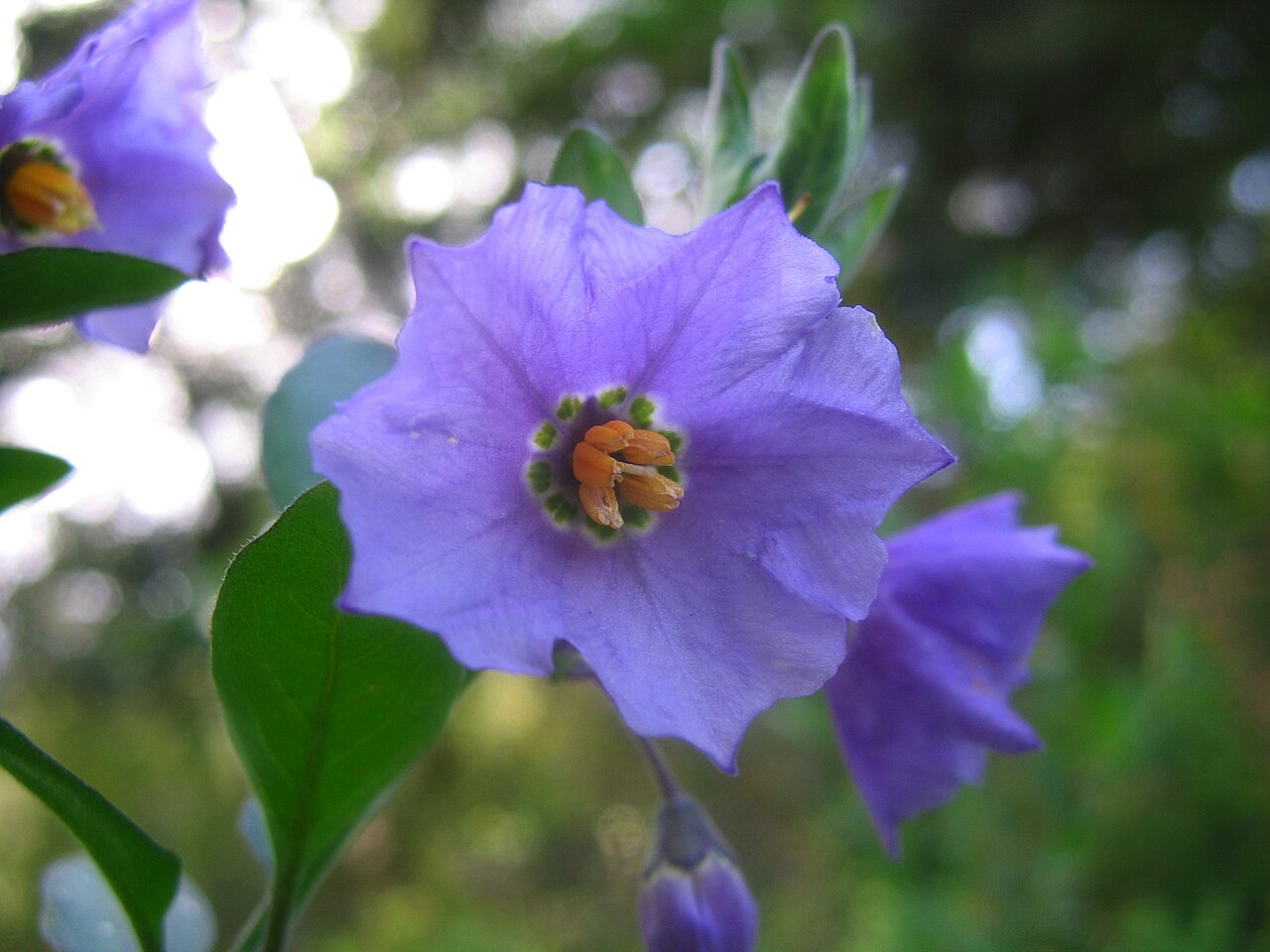
Solanum xanti, known as Purple Nightshade or chaparral nightshade (its USDA name), is a native perennial subshrub of the potato and tomato family (Solanaceae). It is one of the most common and showy wildflowers of California’s chaparral, oak woodland and coastal sage scrub, and it grows from southwestern Oregon through California to Arizona and Baja California. From late winter into summer it produces clusters of broad, saucer-shaped, violet to lavender flowers about 1 inch across, each with a bright yellow cone of anthers in the center.
It is a bushy, somewhat sprawling plant, usually 1 to 3 feet tall, with soft, often hairy, oval leaves. After flowering, it forms round green berries the size of small marbles. Like many members of the nightshade family, its leaves and especially its unripe berries are poisonous if eaten.
Purple nightshade is a good, fast-growing garden plant for dry gardens in California and nearby regions, with a long bloom season and few demands. It thrives in sun or light shade, needs little summer water, and is often among the first plants to bloom after a fire. This guide covers how to identify it, where it grows, how to grow it safely, and its value to pollinators.
Identification
Purple nightshade is easy to recognize as a native nightshade by its flower shape. Telling it from its close relatives can take a closer look at the hairs on its leaves and stems.
Growth Habit
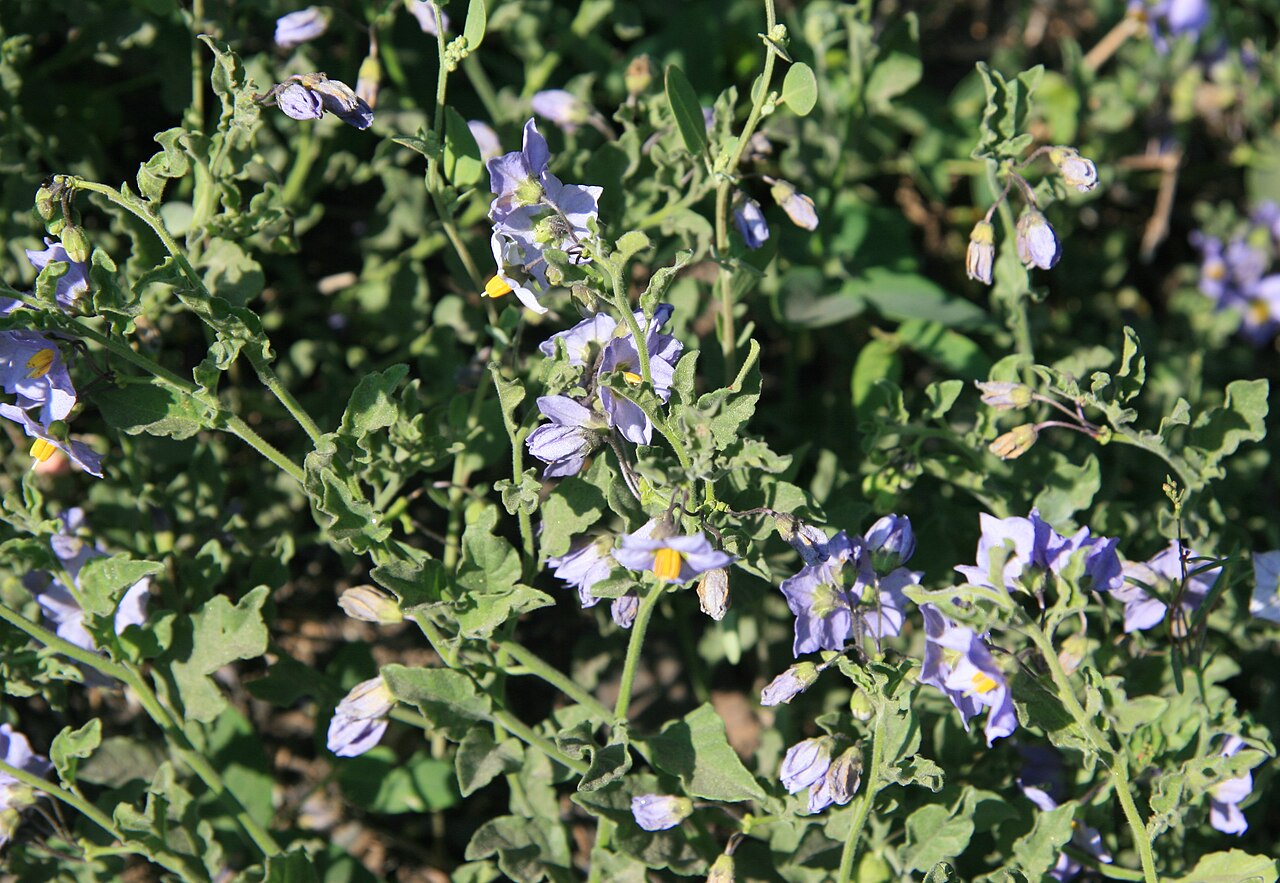
It is a woody-based perennial or subshrub, usually 1 to 3 feet tall and as wide, with many branching, green to purplish stems. Plants may be upright and bushy or loose and sprawling, especially in shade. It is often short-lived, lasting a few years, and reseeds where conditions suit it.
Leaves
The leaves are alternate, simple and oval to lance-shaped, usually 1 to 3 inches long, with smooth or slightly wavy edges, sometimes with small lobes at the base. They range from nearly smooth to densely hairy and are often slightly sticky with glandular hairs.
Flowers
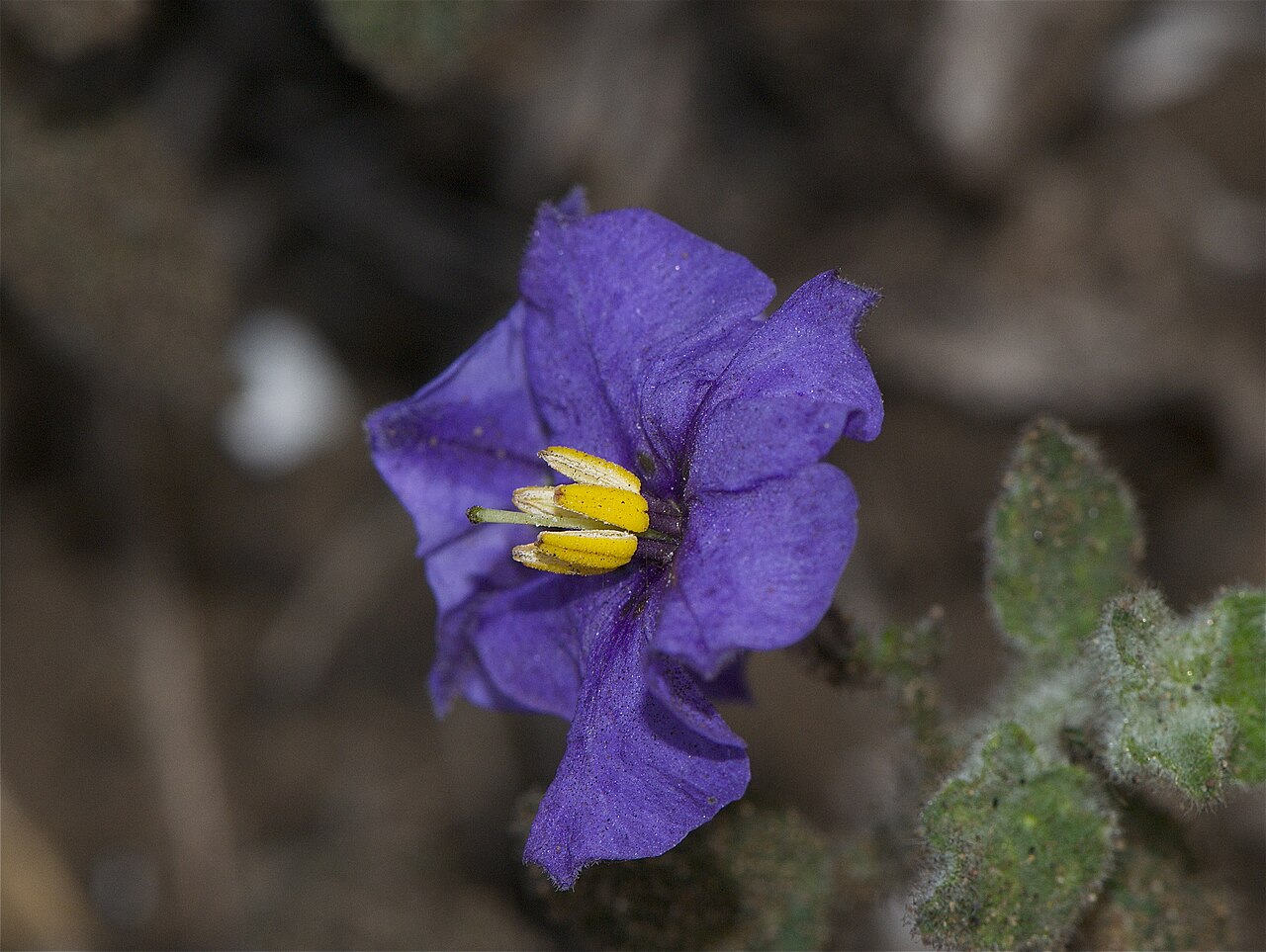
The flowers are borne in small, umbrella-like clusters along the stems. Each has a broad, five-angled, saucer-shaped corolla about 3/4 to 1-1/4 inches across, violet to lavender or deep purple, rarely white. At the base of each lobe is a pair of small green spots edged in white, and the five yellow anthers form a cone around the style. Bloom runs mostly from February to June, and longer in mild coastal areas.
Fruit & Seeds
The fruit is a round berry about 1/2 inch across, green and shiny, ripening to a greenish or purplish color. Each berry holds many small, flat seeds. The berries are toxic and should never be eaten.
Look-alikes
Bluewitch nightshade (Solanum umbelliferum) is very similar, and some botanists treat purple nightshade as a variety of it. Bluewitch has branched (star-shaped) hairs on its leaves and stems, while purple nightshade has simple, unbranched hairs. Parish’s nightshade (S. parishii) is another close relative with smaller, narrower leaves. The non-native bittersweet nightshade (S. dulcamara) is a vine with swept-back petals and red berries.
Quick Facts
| Scientific Name | Solanum xanti A. Gray |
| Family | Solanaceae (nightshade family) |
| Plant Type | Perennial subshrub with a woody base |
| Mature Height | 1–3 ft |
| Mature Spread | 2–4 ft |
| Growth Rate | Fast |
| Sun Exposure | Full sun to part shade |
| Water Needs | Low; occasional summer water in hot areas |
| Soil Type | Well-drained sandy, loamy, rocky or clay soils |
| Soil pH | About 6.0–8.0 |
| Bloom Time | February–June (longer near the coast) |
| Flower Color | Violet to lavender or deep purple, rarely white |
| Fall Color | None; semi-evergreen in mild areas |
| Fruit | Round green berries about 1/2 in (toxic) |
| Deer Resistant | Yes; usually avoided by deer |
| USDA Hardiness Zones | 8–10 |
Native Range
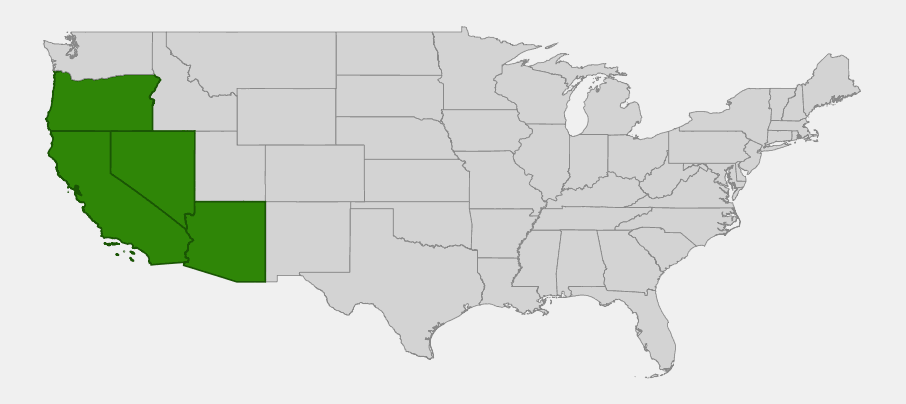
Purple nightshade is native to the far western United States and northwestern Mexico. USDA PLANTS lists it in Arizona, California, Nevada and Oregon, and it extends south into Baja California. It is by far most common in California, where it grows from the North Coast Ranges and the Sierra Nevada foothills south through the Coast Ranges, Transverse Ranges and Peninsular Ranges.
In Oregon it reaches its northern limit in the Siskiyou Mountains and the valleys of Jackson and Josephine counties, west of the Cascades. Nevada records come from the Carson Range near Lake Tahoe, at the eastern edge of the Sierra Nevada, and are best treated as outlying. In Arizona it grows in the central mountains, such as the Pinal Mountains east of Phoenix.
Typical habitats are chaparral, oak and pine woodland, coastal sage scrub, open slopes and canyons, and forest edges and clearings, from near sea level to around 8,000 feet in the Sierra Nevada. It is often abundant after wildfires, when it sprouts from its base and from seed.
📋 Regional plant lists featuring Purple Nightshade: Western Oregon & Western Washington · Arizona & New Mexico · California & Nevada
Growing & Care Guide
Purple nightshade is an easy, fast-growing native for dry gardens in California and other mild-winter areas of the West. It is sold by many native plant nurseries, including the compact selection ‘Mountain Pride’. Because it is toxic, plant it away from where small children play and where livestock graze.
Light
It grows in full sun to part shade. In hot inland gardens it looks best with some afternoon shade; in cool coastal gardens it flowers most heavily in full sun.
Soil & Water
It tolerates most well-drained soils, from sand to clay. Once established, it needs little or no summer water near the coast; inland, an occasional deep watering in summer keeps it greener and blooming longer. Avoid frequent watering and rich, soggy soil, which shorten its life.
Planting Tips
Plant in fall or winter so roots establish with the rains. Space plants 3 to 4 feet apart, or let one fill a gap between larger shrubs. It combines well with sages, buckwheats, manzanitas and California fuchsia, and its purple flowers contrast nicely with yellow-flowered natives.
Pruning & Maintenance
Cut plants back by about a third to half after the main bloom, or in late fall, to keep them compact and encourage new growth and flowers. Plants are often short-lived, but they reseed modestly, and new plants are easy to start from seed sown in fall or from cuttings taken in spring. Wear gloves when handling plants and berries.
Safety Note
All parts of purple nightshade, especially the unripe berries and leaves, contain toxic glycoalkaloids (such as solanine). Eating them can cause stomach upset, vomiting, diarrhea and, in larger amounts, more serious symptoms in people, pets and livestock. Never eat the berries, teach children not to pick them, and call Poison Control (1-800-222-1222 in the U.S.) or a veterinarian if any part is swallowed.
Landscape Uses
- Dry native gardens: long bloom season with little summer water
- Pollinator gardens: a favorite of buzz-pollinating bumble bees and carpenter bees
- Woodland edges and partial shade: blooms well under oaks and taller shrubs
- Post-fire and slope plantings: fast-growing native cover on dry slopes
- Deer-resistant plantings: usually left alone by deer
Wildlife & Ecological Value
Purple nightshade is an important nectar and pollen plant in chaparral and woodland, especially for native bees.
For Pollinators
Like tomatoes and other nightshades, its anthers release pollen only through small pores at their tips. Bumble bees, carpenter bees and other large native bees “buzz pollinate” the flowers, grabbing the anther cone and vibrating their flight muscles to shake the pollen out. Honey bees cannot do this, so these flowers depend on native bees.
For Birds
Some birds may eat the berries, and the dense, bushy plants provide cover for small birds such as towhees and wrentits in chaparral and woodland.
For Mammals
Its toxic foliage is generally avoided by deer and rabbits, which makes it useful in gardens with heavy deer pressure. Some small mammals may eat the berries and help disperse the seeds.
Ecosystem Role
Purple nightshade is a fire-follower that resprouts and germinates quickly after wildfires, helping to cover burned slopes and providing early flowers for pollinators in the years after a fire. It is part of the diverse understory of California’s chaparral, woodlands and coastal scrub.
Cultural & Historical Uses
The species is named for John Xantus (János Xántus, 1825–1894), a Hungarian naturalist who collected plants and animals in California and at Cabo San Lucas, Baja California, in the 1850s and 1860s. The botanist Asa Gray named the species in his honor, and Xantus’s hummingbird and Xantus’s murrelet also carry his name.
The genus Solanum is one of the largest plant genera in the world and includes potatoes, eggplants and many wild species. Tomatoes are also included in Solanum by many botanists. Despite these well-known edible relatives, the leaves and green fruits of most nightshades, including this one, are toxic.
‘Mountain Pride’ is a compact, deep purple selection that has been widely sold by California native plant nurseries. Purple nightshade is a popular choice for gardeners who want a long-blooming native that thrives in poor soil with little water.
Frequently Asked Questions
Is purple nightshade poisonous?
Yes. Its leaves and berries, especially unripe berries, contain toxic glycoalkaloids. Never eat any part of the plant, and keep children and pets away from the berries.
What is the difference between purple nightshade and bluewitch nightshade?
They are very similar. Purple nightshade (Solanum xanti) has simple, unbranched hairs, while bluewitch nightshade (S. umbelliferum) has branched, star-shaped hairs. Some botanists treat them as one species.
Is purple nightshade deer resistant?
Yes. Deer usually avoid it because of its toxic foliage.
How long does purple nightshade bloom?
Mostly from February to June, and nearly year-round in mild coastal gardens with occasional water.
Why is it also called chaparral nightshade?
USDA uses the name chaparral nightshade because it is a common plant of California’s chaparral. Purple nightshade refers to its violet flowers.

Looking for a nursery that carries Purple Nightshade?
Browse our native plant nursery directory: Arizona · California · Nevada · Oregon

