
Hoary Puccoon (Lithospermum canescens)
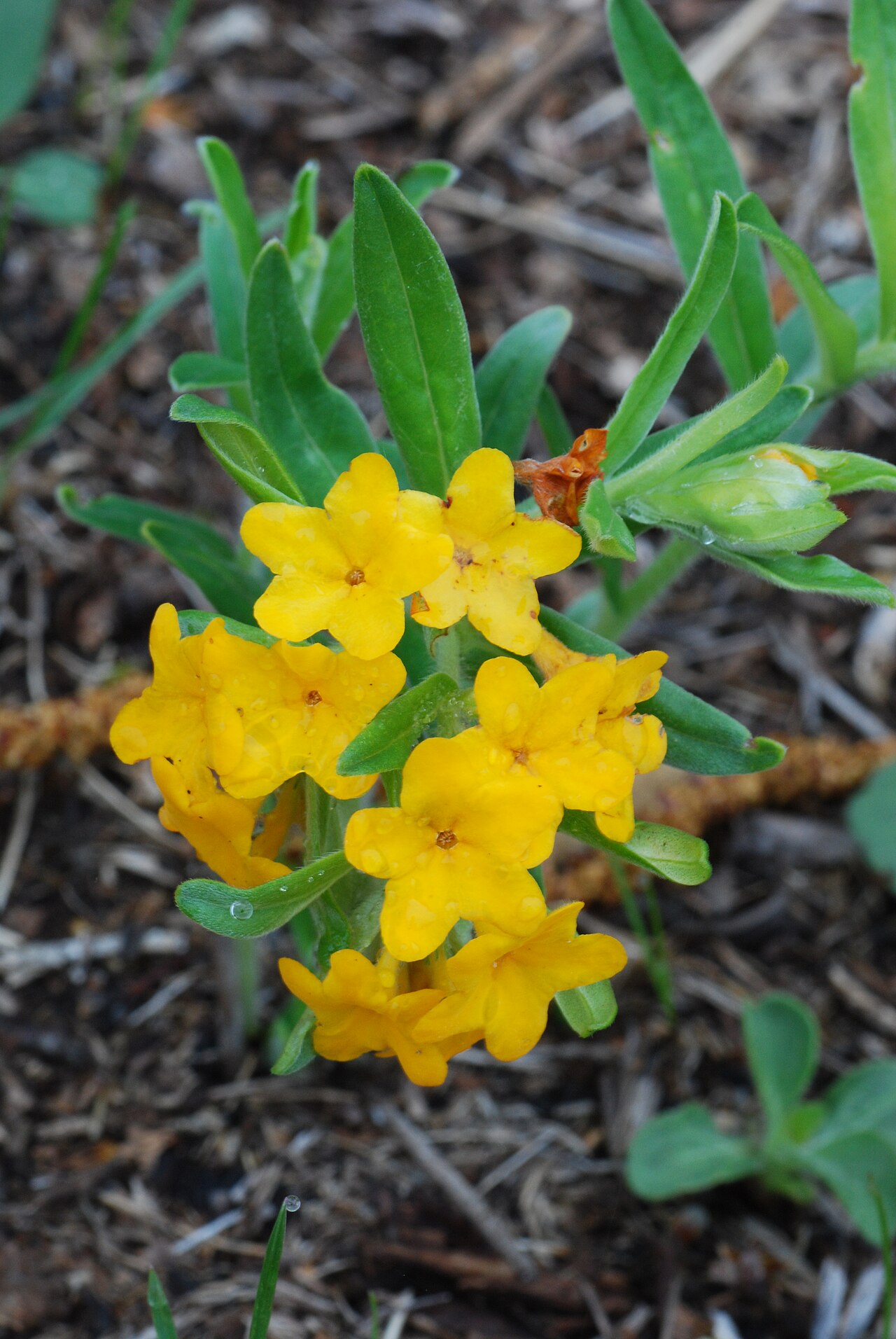
Lithospermum canescens, Hoary Puccoon, is one of the signature spring wildflowers of North American prairies and open oak woodlands. A member of the borage family (Boraginaceae), it forms small clumps of leafy stems 6 to 18 inches tall, topped in April and May with dense clusters of bright yellow-orange, trumpet-shaped flowers. The whole plant is covered in fine, soft, grayish hairs, which give it a “hoary” (frosted) look and its species name, canescens, meaning “becoming gray.”
Hoary puccoon is a long-lived perennial anchored by a deep, woody taproot that is stained red-purple. That root is the source of the name “puccoon,” an Algonquian word applied to several plants used for dye. It is also why hoary puccoon is so durable in the wild and so difficult to move: established plants should never be dug up, because they rarely survive transplanting.
Because it grows mostly in prairies and savannas that have never been plowed, hoary puccoon is often regarded as an indicator of high-quality remnant habitat. This guide covers how to identify it, where it grows, how to grow it from seed or nursery stock, and its value to pollinators.
Identification
Several puccoons grow in the central and eastern United States. Hoary puccoon is recognized by its soft, grayish hairs, its rounded, untoothed flower lobes, and its preference for prairies and open woods with loamy soil rather than pure sand.
Stems & Roots
Hoary puccoon grows from a stout, deep, woody taproot with reddish-purple bark. Each spring it sends up one to several unbranched or sparingly branched stems, usually 6 to 18 inches tall, forming a small clump that enlarges slowly over many years. The stems are covered with soft, spreading hairs.
Leaves
The leaves are alternate, narrowly oblong to lance-shaped, about 1 to 2 inches long, with smooth edges and no stalks. They are bright to grayish green and densely covered on both sides with short, soft, silky hairs, which make the plant look silvery in some lights. Leaves near the flower clusters are smaller.
Flowers
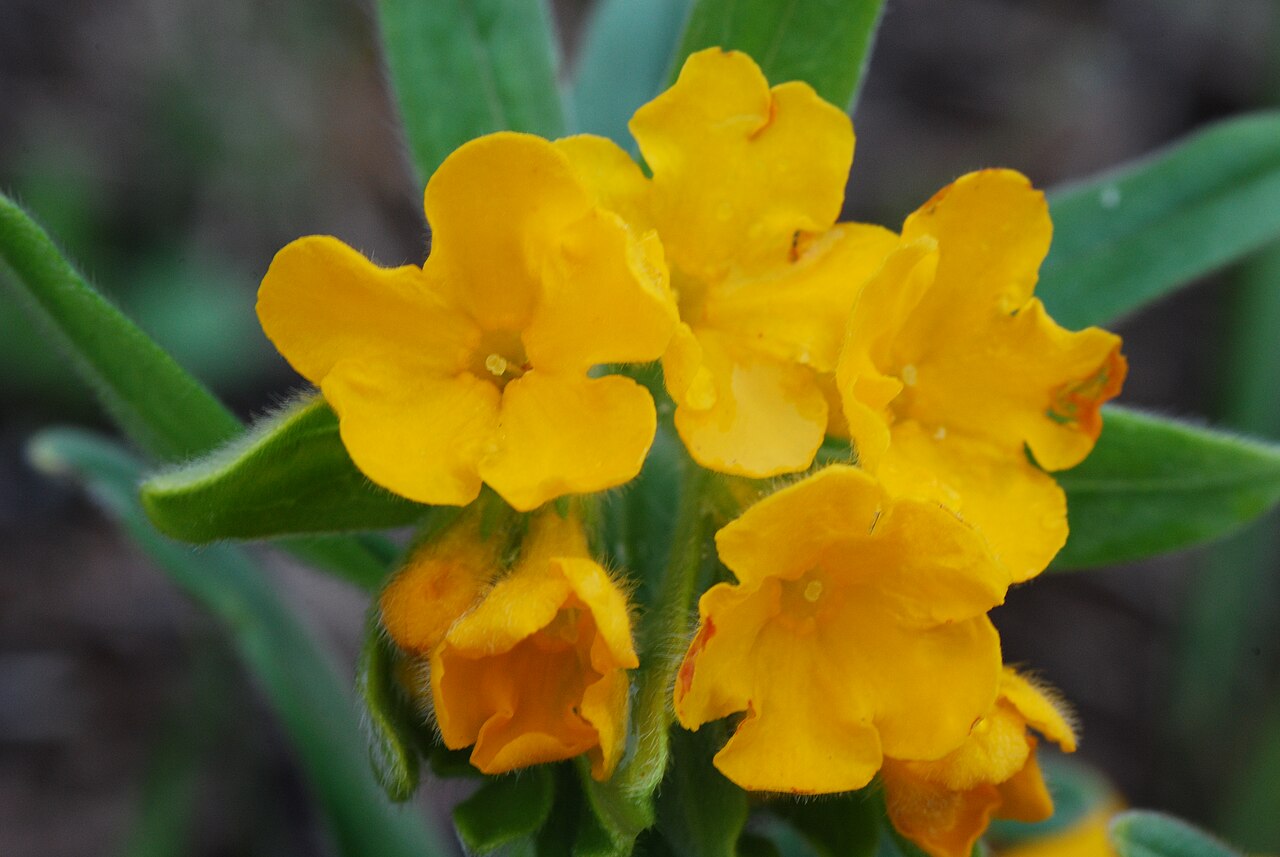
The flowers are borne in dense, leafy clusters at the tips of the stems; the clusters are curled at first and straighten as they open. Each flower is about ½ inch across, yellow to deep yellow-orange, and trumpet-shaped, with five rounded, spreading lobes and a smooth margin. Plants are heterostylous: some have flowers with long styles and short stamens, and others the reverse, a system that promotes cross-pollination between plants. Flowering is mainly from April to June.
Seeds & Look-alikes
Each flower can produce up to four smooth, hard, shiny white to ivory nutlets. These stony seeds give the genus its name, Lithospermum, from Greek words meaning “stone seed.” Hairy puccoon (L. caroliniense) has larger flowers, stiff, rough hairs and grows mainly in sandy habitats. Fringed puccoon (L. incisum) has paler yellow flowers with fringed, ruffled lobes and long tubes.
Quick Facts
| Scientific Name | Lithospermum canescens (syn. Batschia canescens) |
| Family | Boraginaceae (borage family) |
| Plant Type | Herbaceous perennial with a deep taproot |
| Mature Height | 6–18 in |
| Mature Spread | 6–12 in |
| Growth Rate | Slow |
| Sun Exposure | Full sun to part shade |
| Water Needs | Low to moderate; drought tolerant once established |
| Soil Type | Dry to moderately moist, well-drained loam, gravel or rocky soils |
| Soil pH | About 6.0–7.5 |
| Bloom Time | April–June |
| Flower Color | Yellow to yellow-orange |
| Fall Color | None; foliage dies back in summer or fall |
| Fruit | Up to four hard, shiny, white nutlets |
| Deer Resistant | Moderate; hairy foliage is rarely heavily browsed |
| USDA Hardiness Zones | 3–8 |
Native Range
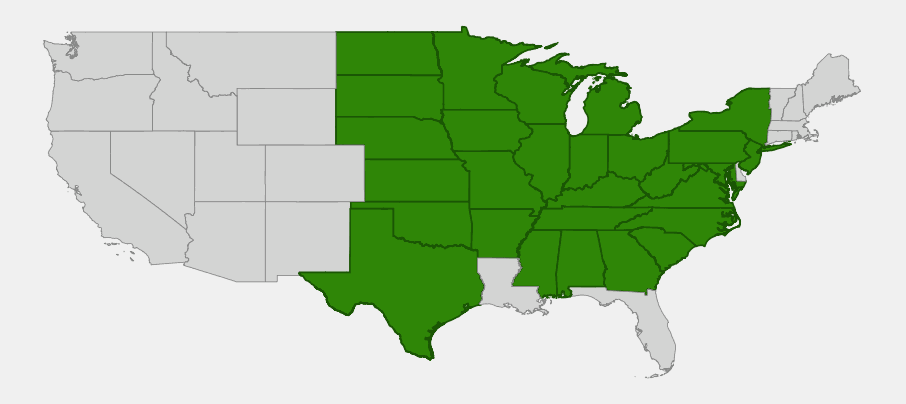
Hoary puccoon is native across a large part of central and eastern North America. The Lady Bird Johnson Wildflower Center summarizes its range as “NJ to Sask., s. to n.c. NC & TX.” USDA PLANTS lists it as native in 28 states and the District of Columbia, from New York and New Jersey west to the Dakotas, Nebraska and Kansas and south to Georgia, Alabama, Mississippi, Arkansas, Oklahoma and Texas. In Canada it grows in Ontario, Manitoba and Saskatchewan.
It is most common in the tallgrass prairie region of the Midwest and Great Plains, in Iowa, Illinois, Minnesota, Wisconsin, Missouri and the eastern Dakotas, Nebraska and Kansas. Farther east and south it is scattered and often rare, growing in remnant prairies, barrens, glades and open oak woodlands, and several eastern states consider it uncommon. In Texas it grows mainly in the northeastern part of the state.
The Lady Bird Johnson Wildflower Center describes its habitat as dry to mesic, rich prairies and open woods, and notes that it is usually not found in sands. Because it rarely recolonizes plowed land, it is most often found in prairie and savanna remnants that have never been cultivated.
📋 Regional plant lists featuring Hoary Puccoon: New York, Pennsylvania & Northern New Jersey · Ohio & Indiana · Michigan, Wisconsin & Eastern Minnesota · Kentucky & Tennessee · Nebraska, Kansas & Eastern Colorado · Maryland, Virginia & West Virginia · Delaware, Southern New Jersey & Long Island · Illinois, Iowa & Missouri · Alabama, Georgia & Mississippi · North & South Carolina · Arkansas, Louisiana, Eastern Oklahoma & Eastern Texas · North Dakota, South Dakota & Western Minnesota
Growing & Care Guide
Hoary puccoon is a rewarding, long-lived perennial for prairie gardens and sunny, well-drained beds, but it is slow to establish. Buy nursery-propagated plants or start it from seed. Never dig plants from the wild: the deep taproot is almost always damaged, the plants rarely survive, and wild populations in remnant prairies are irreplaceable.
Light
Grow hoary puccoon in full sun or light part shade, as in an open savanna. It flowers best in full sun and declines when shaded by taller, aggressive plants.
Soil & Water
It needs well-drained, dry to moderately moist soil, such as loam, gravelly or rocky soil. Avoid wet, heavy soils where the taproot can rot. Once established it is drought tolerant and needs no extra water or fertilizer. Rich soil mainly benefits its competitors.
Planting Tips
Plant small container-grown plants in spring or early fall, setting them at the same depth they grew in the pot and disturbing the root ball as little as possible. Choose the site carefully, because established plants should not be moved. Plant it among short to medium prairie grasses and wildflowers such as little bluestem, prairie phlox and violets, where it will not be overshadowed.
Pruning & Maintenance
Little care is needed. Remove weeds and aggressive neighbors around young plants while they establish. The foliage often goes partly dormant in late summer. In prairie plantings, a dormant-season burn or mowing helps keep competition in check.
Propagation
Propagation is by seed or root cuttings, best left to experienced growers. Seeds have hard coats and deep dormancy. The Lady Bird Johnson Wildflower Center recommends soaking seeds overnight in hot water (about 135°F) and planting immediately; germination is often slow and erratic, and long periods of cold, moist stratification also help. Seedlings grow slowly and may take two or three years to flower.
Landscape Uses
- Prairie and meadow gardens: bright spring color among short prairie grasses
- Prairie and savanna restoration: within its native range, using local-origin seed or nursery plants
- Rock gardens and dry slopes: for well-drained, sunny sites
- Pollinator gardens: early nectar for butterflies, bee flies and long-tongued bees
- Native plant collections: a classic indicator species of remnant prairie
Wildlife & Ecological Value
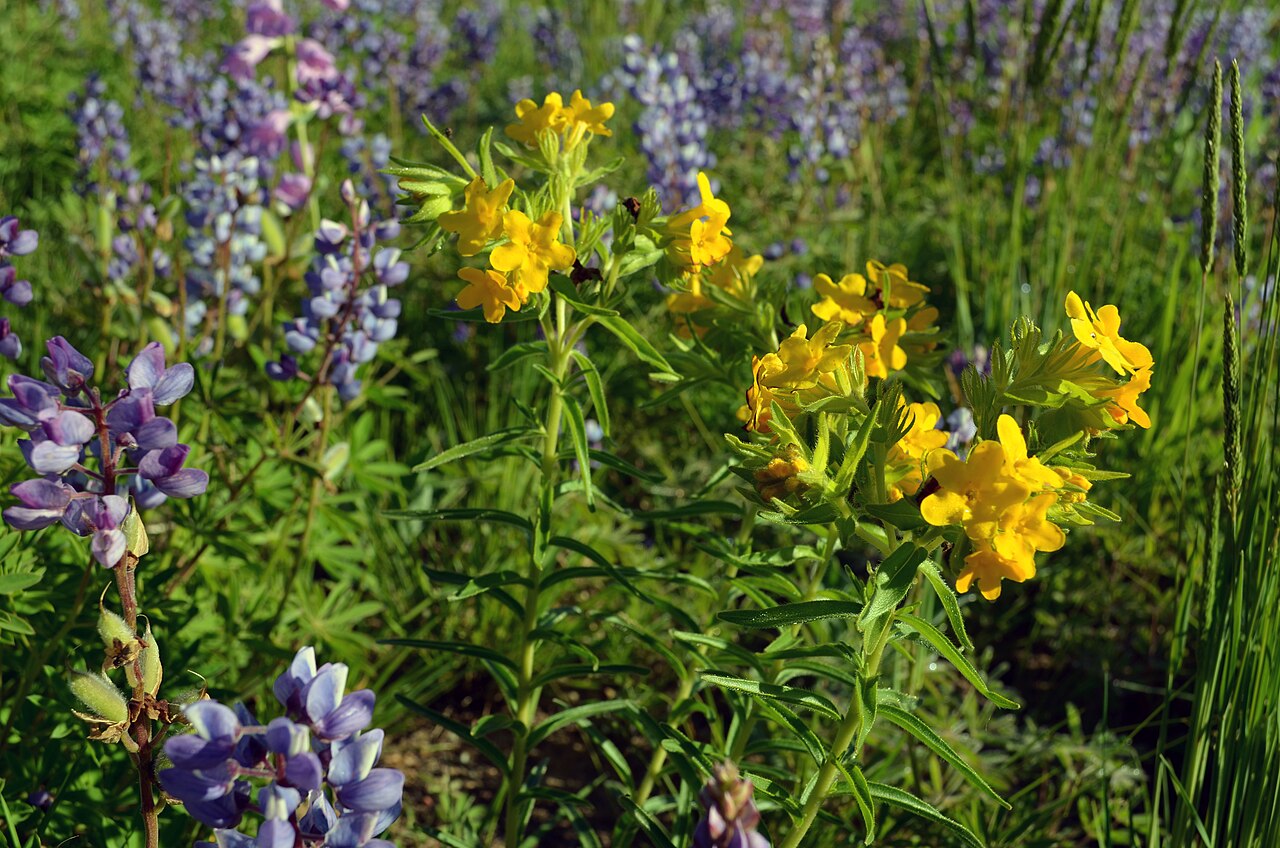
Hoary puccoon blooms in early to mid spring, when prairies still have relatively few flowers, so it is an important early nectar source for insects emerging after winter.
For Pollinators
The narrow flower tubes hold nectar that is best reached by insects with long mouthparts: butterflies (including swallowtails, sulphurs and skippers), bee flies and long-tongued bees such as bumblebees and mason bees. Its heterostylous flowers depend on these visitors to carry pollen between plants with different flower forms.
For Birds
Ground-feeding birds such as wild turkeys and some sparrows may eat the hard nutlets. The plant’s greatest value to birds is indirect, as part of the diverse prairies that grassland birds depend on.
For Mammals
Its soft, hairy leaves are not a favored browse, though rabbits and deer occasionally nibble the stems. Small rodents may eat the fallen nutlets.
Ecosystem Role
Hoary puccoon is a long-lived, deep-rooted perennial that tolerates fire and drought well, which suits it to prairies maintained by fire. It is sensitive to plowing and heavy disturbance, and its presence often signals a prairie or savanna remnant that has kept much of its original plant community.
Cultural & Historical Uses
The word “puccoon” comes from an Algonquian language and was used by early English colonists in Virginia for several plants whose roots yield a red dye, including bloodroot. Puccoon roots contain red-purple pigments, and Indigenous peoples of the Great Plains and Great Lakes used them to make dyes for decorating skins, quills and other materials.
Hoary puccoon also appears in the ethnobotanical record as a medicinal plant of several Indigenous nations. Those uses are part of a cultural tradition and are not recommendations: like many members of the borage family, puccoons contain compounds that can be harmful, and the plants should not be used at home.
For prairie enthusiasts today, the bright orange-yellow clumps of hoary puccoon are one of the first signs of spring on the prairie. Because the plant is long-lived, slow to establish and dependent on undisturbed ground, protecting the remnants where it still grows, and planting nursery-grown stock in restorations, are the best ways to keep it on the landscape.
Frequently Asked Questions
What does “hoary” mean in hoary puccoon?
“Hoary” means covered with fine, grayish-white hairs. The stems and leaves of hoary puccoon are coated with soft hairs that give the plant a frosted look.
Can I transplant hoary puccoon?
It is best not to. Hoary puccoon has a deep, woody taproot and rarely survives being dug. Never collect plants from the wild; buy nursery-propagated plants or grow them from seed.
When does hoary puccoon bloom?
Mainly from April to June, depending on location, with the peak in late April and May in the Midwest.
How is hoary puccoon different from hairy puccoon?
Hairy puccoon (Lithospermum caroliniense) has larger flowers, rougher, stiffer hairs and usually grows in sandy soils. Hoary puccoon has soft, gray hairs, smaller flowers and grows in loamy prairies and open woods.
Is hoary puccoon hard to grow from seed?
It can be. The hard-coated seeds germinate slowly and irregularly and need pre-treatment such as hot-water soaking or long cold stratification. Seedlings may take a few years to flower, so patience is required.

Looking for a nursery that carries Hoary Puccoon?
Browse our native plant nursery directory: Alabama & Arkansas · Georgia · Illinois, Indiana, Iowa & Kansas · Kentucky, Maryland, Michigan, Minnesota, Mississippi & Missouri · Nebraska, New Jersey, New York, North Carolina, North Dakota, Ohio & Oklahoma · Pennsylvania, South Carolina, South Dakota, Tennessee, Texas & Virginia · West Virginia & Wisconsin