
Hoe a Māui (Elaphoglossum crassifolium)
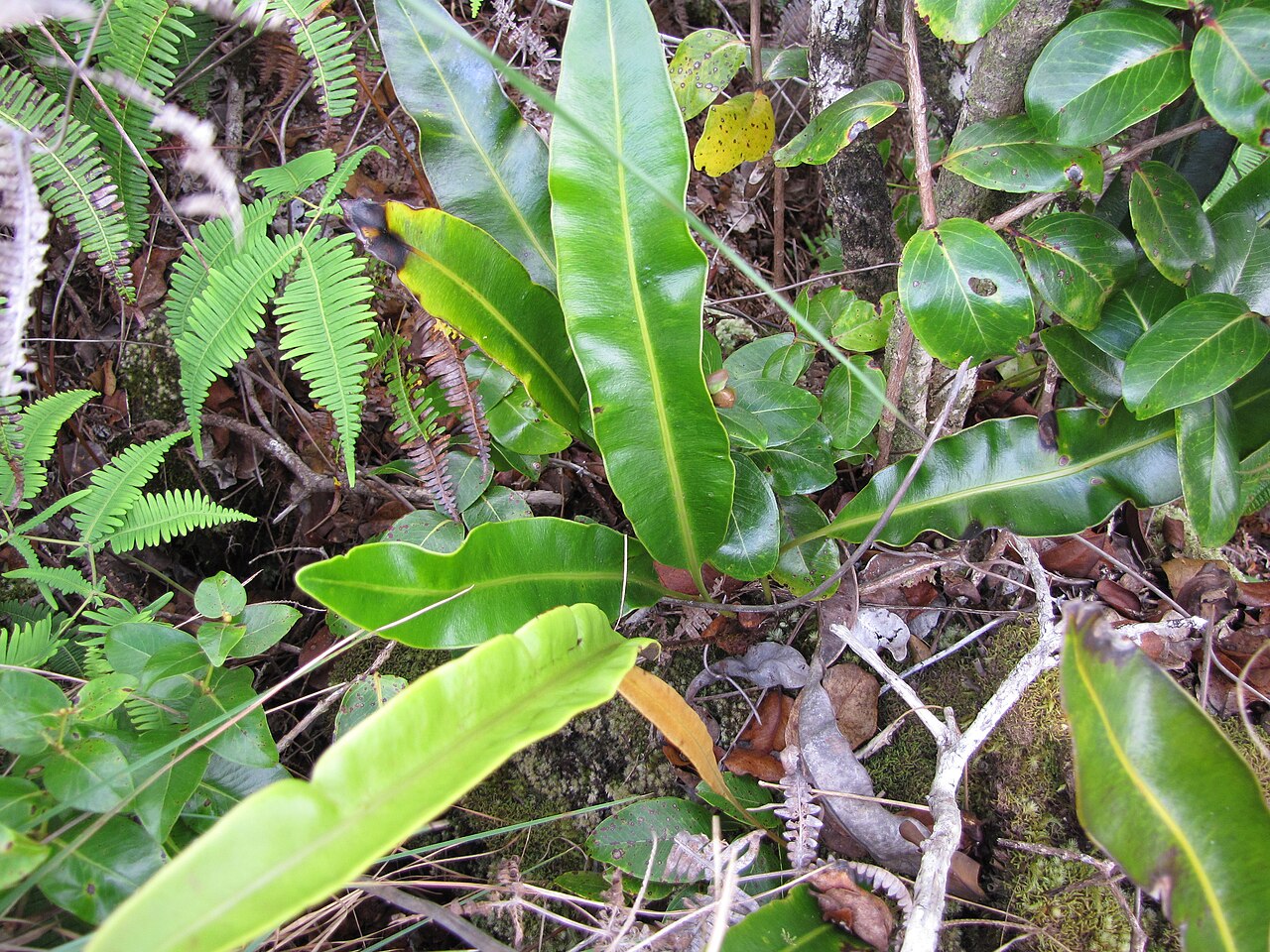
Elaphoglossum crassifolium, known in Hawaiian as hoe a Māui (“Māui’s paddle”) and also by the general name ʻēkaha, is an evergreen fern of the wood fern family (Dryopteridaceae) found only in the Hawaiian Islands. Instead of the lacy fronds most people picture, it has simple, undivided, leathery, paddle- or tongue-shaped fronds, glossy green and up to about 2 feet long, which grow in dense clumps on mossy tree trunks, logs and the forest floor. In English it is sometimes called the royal tonguefern.
It is the most common Elaphoglossum in Hawaiʻi and grows on all the main islands except Niʻihau and Kahoʻolawe, from about 1,000 to 4,300 feet in open mesic woods, wet forests and dense rainforest. It can grow either as an epiphyte on trees or on the ground. It is endemic to Hawaiʻi and is not federally listed.
Hoe a Māui is seldom seen in gardens, but growers who have tried it describe it as easy to keep with enough shade and moisture. It is best suited to shade houses, pots and humid upland gardens in Hawaiʻi. Buy only nursery-propagated plants from a Hawaiʻi native plant nursery, and never collect ferns from the wild.
Identification
Hoe a Māui is one of the easiest native ferns to recognize because its fronds are simple straps rather than divided leaves. Hold a frond up to the light: it is the only Hawaiian Elaphoglossum whose veins form a fine net.
Growth Habit
A clump-forming fern with short, creeping rhizomes that produce close-set tufts of upright to arching fronds, usually 8 inches to 2 feet tall. It grows on mossy trunks and branches, on logs, or on the forest floor.
Fronds
The sterile fronds are simple, undivided, strap- to paddle-shaped, with smooth edges and a prominent midrib. They are thick and leathery (crassifolium means “thick-leaved”) and glossy dark to medium green. Held against bright light, they show a network of netted veins, which separates this species from the other Hawaiian Elaphoglossum. The stalks and rhizomes carry small brown scales.
Spores
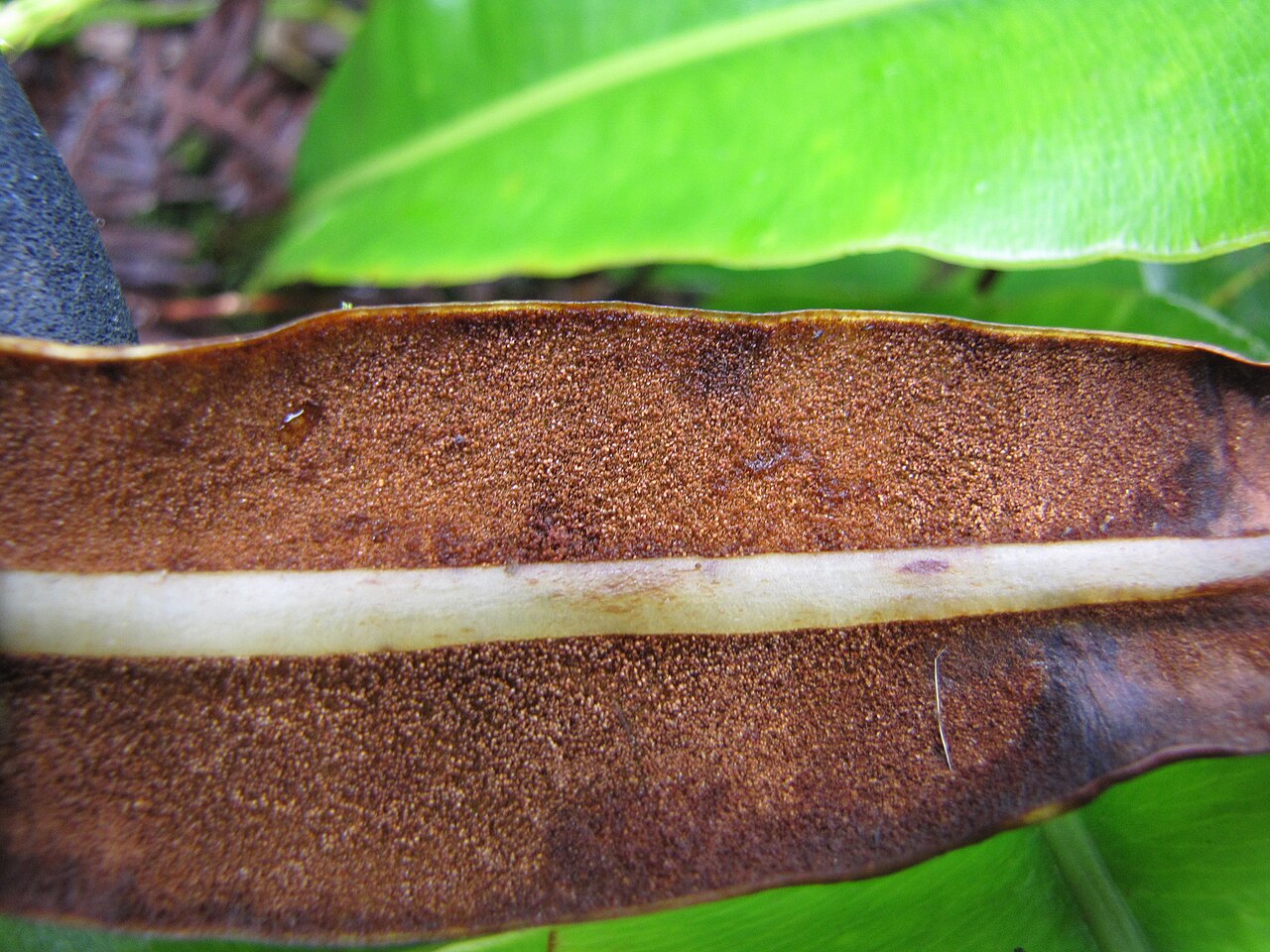
Like all ferns, it has no flowers or seeds. The fertile fronds are usually narrower and longer-stalked than the sterile ones, and their entire underside is covered in a continuous layer of brown spore-bearing tissue, a pattern called acrostichoid that is typical of the genus.
Look-alikes
Other Hawaiian Elaphoglossum species have similar strap-shaped fronds but free, unconnected veins, and some are hairy or scaly. Young bird’s nest fern, also called ʻēkaha, has broader, bright green fronds arranged in a nest-like rosette, with spores in narrow lines along the veins.
Quick Facts
| Scientific Name | Elaphoglossum crassifolium (Gaudich.) W.R. Anderson & Crosby |
| Family | Dryopteridaceae (wood fern family) |
| Plant Type | Evergreen epiphytic or terrestrial fern; Hawaiian endemic |
| Mature Height | 8 in–2 ft |
| Mature Spread | 1–2 ft clumps |
| Growth Rate | Slow |
| Sun Exposure | Partial shade to full shade |
| Water Needs | High; constant moisture and humidity |
| Soil Type | Loose, organic, well-drained mix; moss or bark on trunks |
| Soil pH | Acidic |
| Bloom Time | None (fern; spores year-round) |
| Flower Color | None (fern) |
| Fall Color | None; evergreen |
| Fruit | None; reproduces by spores |
| Deer Resistant | Unknown; epiphytic plants are out of reach |
| USDA Hardiness Zones | 10–12 (humid, shaded sites in Hawaiʻi) |
Native Range
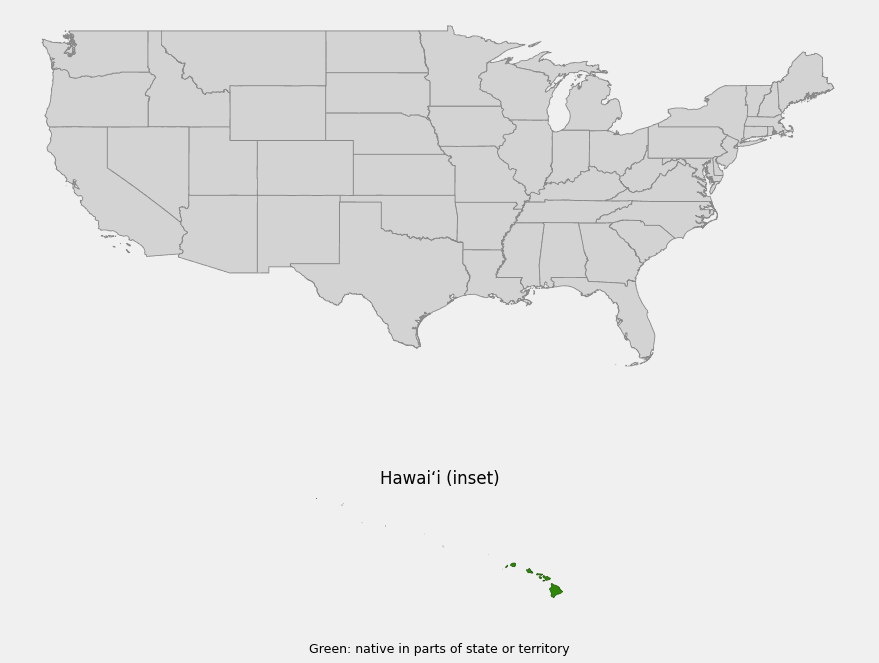
Hoe a Māui is endemic to the Hawaiian Islands. USDA PLANTS lists it as native only in Hawaiʻi, and the Smithsonian’s Flora of the Hawaiian Islands records it from all the main islands except Niʻihau and Kahoʻolawe: Kauaʻi, Oʻahu, Molokaʻi, Lānaʻi, Maui and Hawaiʻi Island.
It grows from about 1,000 to 4,300 feet in habitats ranging from open mesic woods and open wet forest to dense rainforest, where it often forms large, close-set clusters. It is equally at home as an epiphyte on mossy ʻōhiʻa trunks and tree fern stems and as a terrestrial fern on the forest floor, logs and banks.
It is the most common of Hawaiʻi’s nine native Elaphoglossum species, and the Smithsonian rates it apparently secure. It depends on intact, humid native forest, so the loss of ʻōhiʻa to Rapid ʻŌhiʻa Death and the spread of invasive plants and feral pigs affect it along with the rest of the rainforest community.
📋 Regional plant lists featuring Hoe a Māui: Hawaii
Growing & Care Guide
Hoe a Māui is not a common garden plant, and like most epiphytic ferns it needs conditions close to its rainforest home: shade, high humidity and steady moisture with excellent drainage. Native plant growers report that it is easy to keep in those conditions, though it grows slowly. It is suited to shade houses, containers and sheltered, humid gardens in Hawaiʻi, roughly USDA zones 10–12, and it is very difficult in hot, dry or windy sites. Buy only nursery-propagated plants from a Hawaiʻi native plant nursery, and never remove ferns from trees or the forest floor in the wild. Hawaiʻi restricts bringing plants in from other states, so look for local growers.
Light
Partial to full shade. Bright, indirect light under trees or shade cloth is ideal; direct sun bleaches and burns the fronds.
Soil & Water
Use a loose, airy, organic mix, such as bark, tree fern fiber, sphagnum and a little cinder, or mount it on a slab or log with moss. Keep it constantly moist but never waterlogged, and mist or water often in dry weather to keep humidity high.
Planting Tips
Grow it in a pot, hanging basket or mounted on a log in a shade house, lanai or humid fern garden. It also looks natural tucked into the base of a tree fern. Growers have found that a monthly or bimonthly foliar feed with half-strength kelp or fish emulsion helps.
Pruning & Maintenance
No pruning is needed except removing old, spent fronds. Thrips can occasionally infest plants; check the fronds and treat if needed. Protect it from slugs and snails.
Propagation
It can be divided by carefully splitting established clumps, or grown from spores, which is slow and best left to experienced growers. Home gardeners should propagate only from their own nursery-bought plants.
Landscape Uses
- Shade houses and fern collections: a distinctive strap-leaved native fern
- Mounted plants: grows naturally on trunks, logs and slabs
- Humid upland gardens: tucked among tree ferns and mossy logs
- Containers and baskets: a slow, tidy fern for shaded lanai
Wildlife & Ecological Value
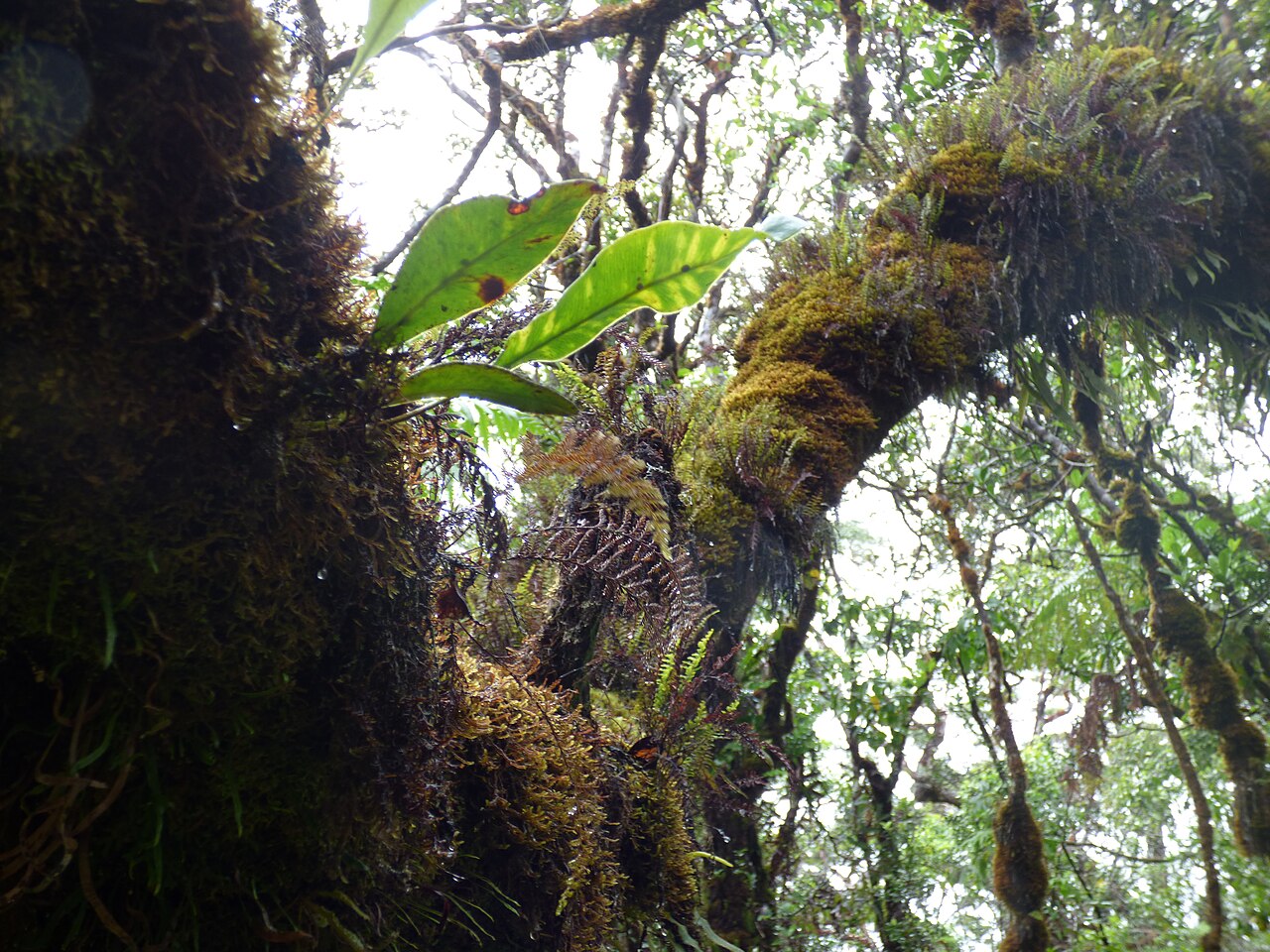
Hoe a Māui is part of the dense epiphyte layer that drapes the trunks and branches of Hawaiʻi’s rainforests.
For Pollinators
As a fern, it produces no flowers or nectar and does not support pollinators directly.
For Birds
Its clumps add to the mossy, fern-covered trunks where native forest birds such as the ʻelepaio and ʻamakihi forage for insects.
For Mammals
Hawaiʻi’s only native land mammal, the Hawaiian hoary bat, hunts insects over these forests. Feral pigs damage terrestrial plants and the forest floor.
Ecosystem Role
Epiphytic ferns like hoe a Māui hold moisture and organic matter on trunks and branches, helping create the damp microhabitats used by native snails, insects and mosses.
Cultural & Historical Uses
The name hoe a Māui, “Māui’s paddle,” compares the frond to a canoe paddle and links it to the demigod Māui, famous in Hawaiian tradition for fishing up islands and snaring the sun. ʻĒkaha is a broader name used for the eight endemic Hawaiian Elaphoglossum, and also for the bird’s nest fern and a moss of rotting wood.
The genus name Elaphoglossum comes from the Greek elaphos, “deer,” and glossa, “tongue,” after the shape of the fronds, which is also the source of the English name tonguefern. The species was first described by Charles Gaudichaud-Beaupré from his 1819 visit to Hawaiʻi, and was long known as Elaphoglossum reticulatum, a name referring to its netted veins.
With some 600 species worldwide, mostly in tropical mountains, Elaphoglossum is one of the largest fern genera. Hawaiʻi has eight endemic species and one indigenous species, and hoe a Māui is the one most hikers will see.
Frequently Asked Questions
Is hoe a Māui a fern?
Yes. Although its fronds are simple straps without divisions, it is a true fern that reproduces by spores borne on the underside of fertile fronds.
Is it endangered?
No. Elaphoglossum crassifolium is not federally listed and is the most common Elaphoglossum in Hawaiʻi.
Where does it grow?
Only in Hawaiʻi, on all the main islands except Niʻihau and Kahoʻolawe, in mesic and wet forests from about 1,000 to 4,300 feet.
Can I grow it at home?
Yes, with shade, high humidity and a loose, moist, well-drained mix or a mount. It is slow and needs conditions close to a rainforest; it struggles in hot, dry places.
How do I tell it from other tongue ferns?
Hold a frond to the light. Hoe a Māui is the only Hawaiian Elaphoglossum with netted veins.

Looking for a nursery that carries Hoe a Māui?
Browse our native plant nursery directory: Hawaii

