
Illinois Bundleflower (Desmanthus illinoensis)
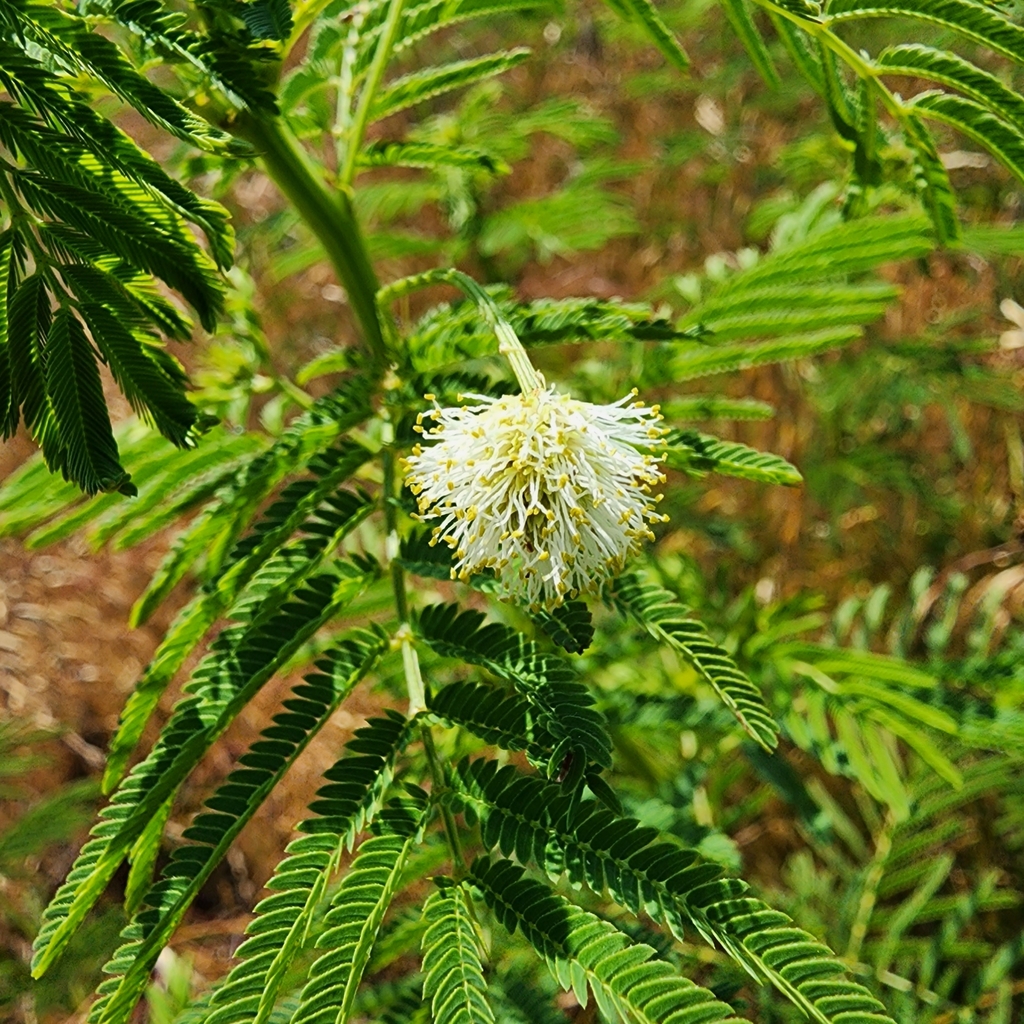
Desmanthus illinoensis, known as Illinois Bundleflower, prairie mimosa or prickleweed, is a native perennial legume of prairies, open woods, stream banks and roadsides in the central and southern United States. It forms a bushy, upright plant 2 to 4 feet tall with finely divided, fern-like leaves that look much like those of a mimosa. From June to August it bears small, round, white puffball flower heads, and these turn into its most memorable feature: tight, rounded bundles of curved brown pods that persist into winter.
Illinois bundleflower belongs to the legume family (Fabaceae) and the mimosa group within it. Like most legumes it hosts nitrogen-fixing bacteria in its root nodules, which lets it thrive on poor soil and enriches the ground around it. Its seeds are unusually rich in protein, and The Land Institute in Salina, Kansas, has spent years studying it as a possible perennial grain crop.
For gardeners and land managers, Illinois bundleflower is a tough, drought-tolerant addition to prairie plantings, meadows and wildlife areas. Its seeds feed quail and other birds, its foliage is high-quality forage for deer and livestock, and its dried seed heads add interest to fall and winter gardens. This guide covers identification, range, growing conditions and wildlife value.
Identification
Illinois bundleflower is easiest to recognize by its combination of feathery, twice-divided leaves, small white ball-shaped flower heads, and especially the clusters of curved pods that follow. Several related native legumes, such as the sensitive briars (Mimosa) and prairie acacia (Acaciella angustissima), have similar leaves but differ in flowers, pods and prickles.
Stems & Roots
Plants grow from a woody crown and a deep, tough taproot, sending up several erect to arching stems each spring. Stems are green to reddish, angled or ridged, usually smooth, and become somewhat woody at the base by late summer. Mature plants are 2 to 4 feet tall, occasionally 5 feet, and about as wide. The stems are not prickly, unlike those of the sensitive briars.
Leaves
The leaves are alternate and twice-pinnately compound, 2 to 4 inches long, with 6 to about 15 pairs of side branches (pinnae), each carrying 20 to 30 pairs of tiny, narrow leaflets. A small round gland sits on the leaf stalk below the lowest pair of pinnae. The leaflets fold together at night and in very hot weather, though they are not as quick to fold when touched as true sensitive plants. The overall effect is soft and lacy, like a fern or a small mimosa tree.
Flowers
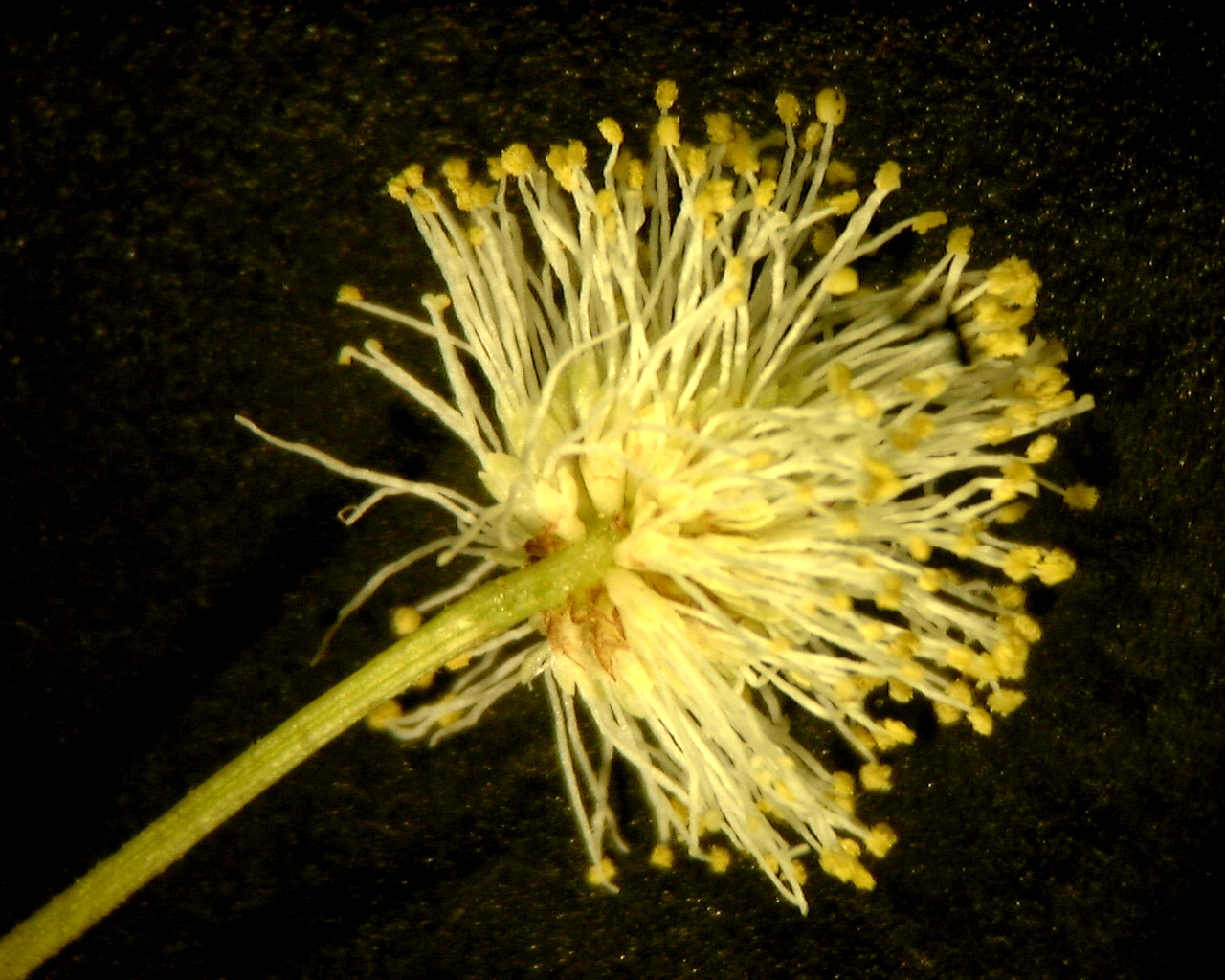
Flower heads are round, about ½ inch across, held on slender stalks 1 to 3 inches long from the leaf axils. Each head contains 20 to 50 tiny flowers with small greenish-white petals and five long, white stamens tipped with yellow pollen, which give the head its fuzzy, pompon-like look. Bloom typically lasts from late May or June into August, with a few heads appearing later in the season.
Fruit & Seeds
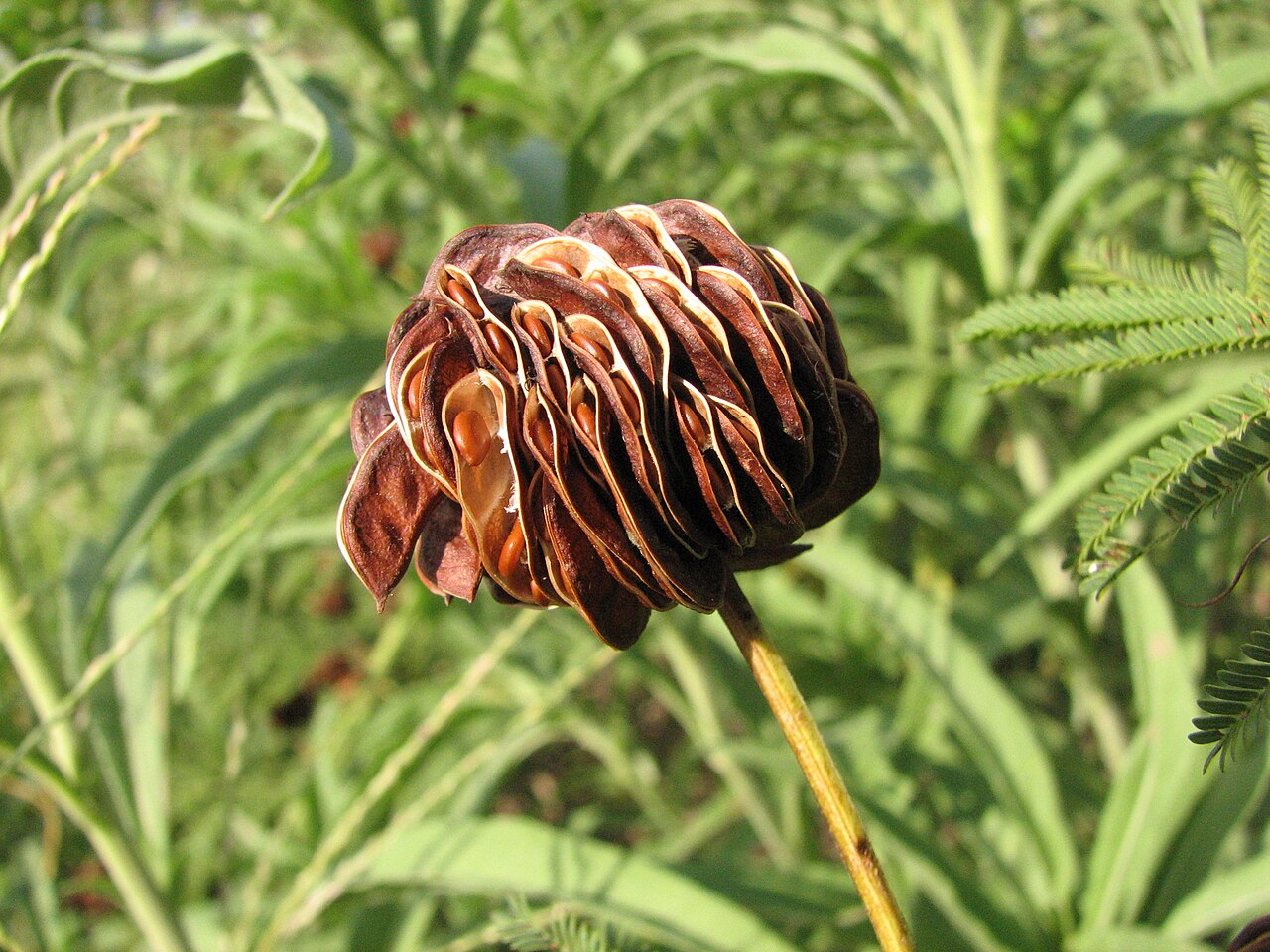
Each flower head develops into a dense, rounded cluster of 20 to 40 flat, curved, sickle-shaped pods, about ¾ to 1 inch long. The cluster looks like a twisted brown ball or rosette, which is the “bundle” of the common name. Pods are green at first, turn dark brown as they ripen in late summer and fall, and split to release 2 to 6 small, hard, shiny brown seeds. The dry pod clusters often remain on the stems through winter.
Quick Facts
| Scientific Name | Desmanthus illinoensis (syn. Mimosa illinoensis, Acuan illinoense) |
| Family | Fabaceae (legume family) |
| Plant Type | Herbaceous perennial legume, somewhat woody at the base |
| Mature Height | 2–4 ft (occasionally to 5 ft) |
| Mature Spread | 2–3 ft |
| Growth Rate | Moderate to fast |
| Sun Exposure | Full sun |
| Water Needs | Low to moderate; drought tolerant once established |
| Soil Type | Clay, loam, sandy or rocky soils; tolerates caliche and limestone |
| Soil pH | About 6.0–8.0 |
| Bloom Time | June–August |
| Flower Color | White to greenish-white |
| Fall Color | Leaves yellow; dark brown pod clusters persist into winter |
| Fruit | Rounded cluster of curved, flat pods |
| Deer Resistant | No; highly palatable to deer and livestock |
| USDA Hardiness Zones | 4–8 |
Native Range
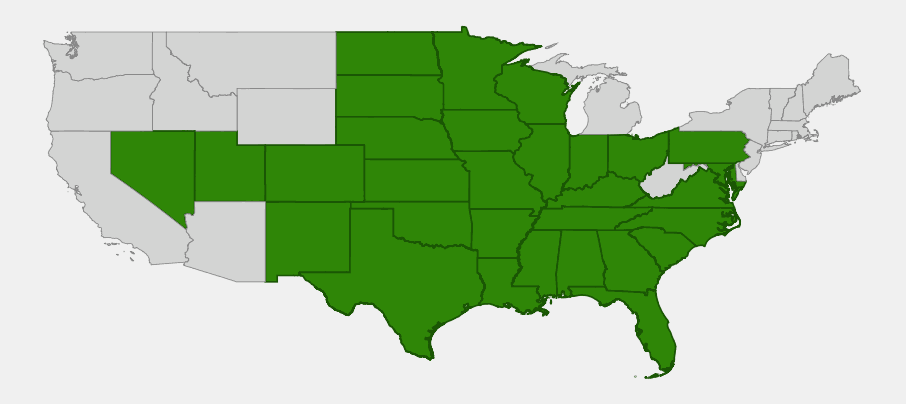
Illinois bundleflower is centered on the prairies and open woodlands of the Mississippi Valley and southern Great Plains. The Lady Bird Johnson Wildflower Center describes its native range as South Carolina to Alabama, Texas and eastern Colorado, north to Illinois, southwestern Minnesota and North Dakota, and it is frequent in North Central Texas. USDA PLANTS records it in 30 states and the District of Columbia.
It is most abundant in tallgrass and mixed-grass prairie country, from Iowa, Missouri and Kansas south through Oklahoma and Texas, and along the lower Mississippi Valley. East of the Appalachians and in the Great Basin it is much more scattered. USDA lists it from Pennsylvania, Maryland, the District of Columbia, Virginia, North Carolina, Georgia, Florida, Nevada and Utah, but many of these records are few in number and are typically from roadsides, railroads and other disturbed places, where the plant may have spread from elsewhere.
Within its range it grows in prairies (especially on disturbed spots and slopes), open rocky woods, glades, stream banks, floodplain edges, pastures and roadsides. It favors full sun and tolerates clay, caliche and limestone soils that many other wildflowers find difficult.
📋 Regional plant lists featuring Illinois Bundleflower: New York, Pennsylvania & Northern New Jersey · Idaho, Eastern Oregon & Eastern Washington · Ohio & Indiana · Michigan, Wisconsin & Eastern Minnesota · Kentucky & Tennessee · Nebraska, Kansas & Eastern Colorado · Utah & Western Colorado · Maryland, Virginia & West Virginia · Illinois, Iowa & Missouri · Alabama, Georgia & Mississippi · North & South Florida
Growing & Care Guide
Illinois bundleflower is one of the easiest native legumes to grow. Give it sun and room for its deep taproot, and it will return reliably for years with very little attention.
Light
Plant it in full sun. It tolerates light shade at the edge of open woods, but it flowers and sets pods best in sun, and shaded plants become leggy.
Soil & Water
It adapts to a wide range of soils, including heavy clay, loam, rocky limestone ground and sand, as long as water does not stand for long periods. Once established, its deep taproot makes it quite drought tolerant, although plants look fuller with occasional summer moisture. Because it fixes its own nitrogen, it needs no fertilizer.
Planting Tips
Plant seed or young plants in spring, setting them about 2 to 3 feet apart. The taproot makes older plants hard to move, so choose the site carefully. In prairie and meadow seedings it is often included in mixes at a modest rate, where it establishes quickly and helps fill gaps in the first few years.
Pruning & Maintenance
Little care is needed. Leave the stems and pod clusters standing over winter for birds and visual interest, then cut them back in early spring before new growth. Plants self-sow in open ground. If you want fewer seedlings, clip off some pod clusters before they split. Deer, rabbits and livestock browse it heavily, so protect young plants where browsing is intense.
Propagation
Grow it from seed. The hard seed coat needs to be scarified before planting, either by nicking it, rubbing it lightly with sandpaper or soaking it in hot water, and the seed is often inoculated with nitrogen-fixing rhizobia for legumes in agricultural plantings. Seed sown in late spring in warm soil germinates within a couple of weeks. Plants can also be started in deep pots and transplanted while small.
Landscape Uses
- Prairie and meadow plantings: a reliable native legume for mixes in sunny, open sites
- Wildlife food plots: seeds for bobwhite quail and other birds; forage for deer
- Pastures and range improvement: high-protein native forage for livestock
- Pollinator gardens: summer pollen and nectar for bees
- Dry flower arrangements: the twisted brown pod clusters are decorative
Wildlife & Ecological Value
Illinois bundleflower is valuable well beyond its modest flowers. Its protein-rich seeds and foliage make it one of the more important native legumes for wildlife and grazing animals in the prairie states.
For Pollinators
The fuzzy flower heads provide pollen and some nectar for native bees, including sweat bees, leafcutter bees and other small bees, and for honey bees. Small butterflies and flies also visit. Because it blooms over a long period in summer, it helps fill the gap between spring and late-summer prairie flowers.
For Birds
The hard, shiny seeds are eaten by northern bobwhite and other quail, wild turkeys, mourning doves and various songbirds, particularly in fall and winter when the pods split. The bushy plants also provide cover for ground-nesting birds in prairies and fields.
For Mammals
Deer, rabbits and livestock eat the foliage readily, and range managers consider it a high-quality native forage plant that declines under heavy grazing. Small mammals eat the seeds. The root bark is reported to contain alkaloids, including gramine, that are toxic to some animals, but the foliage itself is widely browsed.
Ecosystem Role
As a nitrogen-fixing legume, Illinois bundleflower adds nitrogen to prairie soils, benefiting neighboring grasses and wildflowers. Its deep taproot draws water and nutrients from well below the surface and helps stabilize soil on slopes and stream banks. It often appears quickly in disturbed prairie and roadsides, making it an early colonizer that helps vegetation recover.
Cultural & Historical Uses
André Michaux first described the plant in 1803 as Mimosa illinoensis, from specimens collected in the Illinois country during his travels in the interior of North America. It was later moved to Desmanthus, a genus name from the Greek desme, bundle, and anthos, flower, referring to the clustered flowers and fruits.
Records of Native American use are limited, though some Plains peoples are reported to have used the plant medicinally. In modern times, it has attracted attention for its seeds. The Land Institute has studied Illinois bundleflower as a perennial grain legume that could be grown together with perennial grains, and analyses there found the dry seed to contain about 38 percent protein, close to soybeans.
Today Illinois bundleflower is a common ingredient in prairie restoration and wildlife seed mixes across the Midwest and southern Plains. It is valued as an easy, long-lived legume that improves soil, feeds wildlife and provides a pleasant, feathery texture among prairie grasses.
Frequently Asked Questions
Why is it called bundleflower?
The name comes from the dense, rounded “bundles” of curved seed pods that form after each flower head fades. The genus name Desmanthus also means “bundle flower” in Greek.
Is Illinois bundleflower a sensitive plant?
Not quite. Its leaflets fold up at night and in hot weather, but they do not respond quickly to touch like the true sensitive briars (Mimosa). The two are close relatives in the mimosa group of legumes.
Is Illinois bundleflower good for wildlife?
Yes. Its seeds are eaten by quail, turkeys, doves and songbirds, its foliage is browsed by deer, and its flowers feed small bees. As a legume, it also improves soil by fixing nitrogen.
How do I grow Illinois bundleflower from seed?
Scarify the hard seeds by nicking them or soaking them in hot water, then sow in warm soil in late spring in full sun. Seedlings grow quickly and often flower in their first or second year.
Can people eat bundleflower seeds?
The seeds are high in protein and have been studied as a potential crop, but they are not a traditional food, and the roots contain alkaloids. It is best enjoyed as a wildlife and prairie plant rather than a food plant.

Looking for a nursery that carries Illinois Bundleflower?
Browse our native plant nursery directory: Alabama & Arkansas · Colorado, Florida & Georgia · Illinois, Indiana, Iowa & Kansas · Kentucky, Louisiana, Maryland, Minnesota, Mississippi & Missouri · Nebraska, Nevada, New Mexico, North Carolina, North Dakota, Ohio & Oklahoma · Pennsylvania, South Carolina, South Dakota, Tennessee, Texas, Utah & Virginia · Wisconsin