
Puttyroot (Aplectrum hyemale)
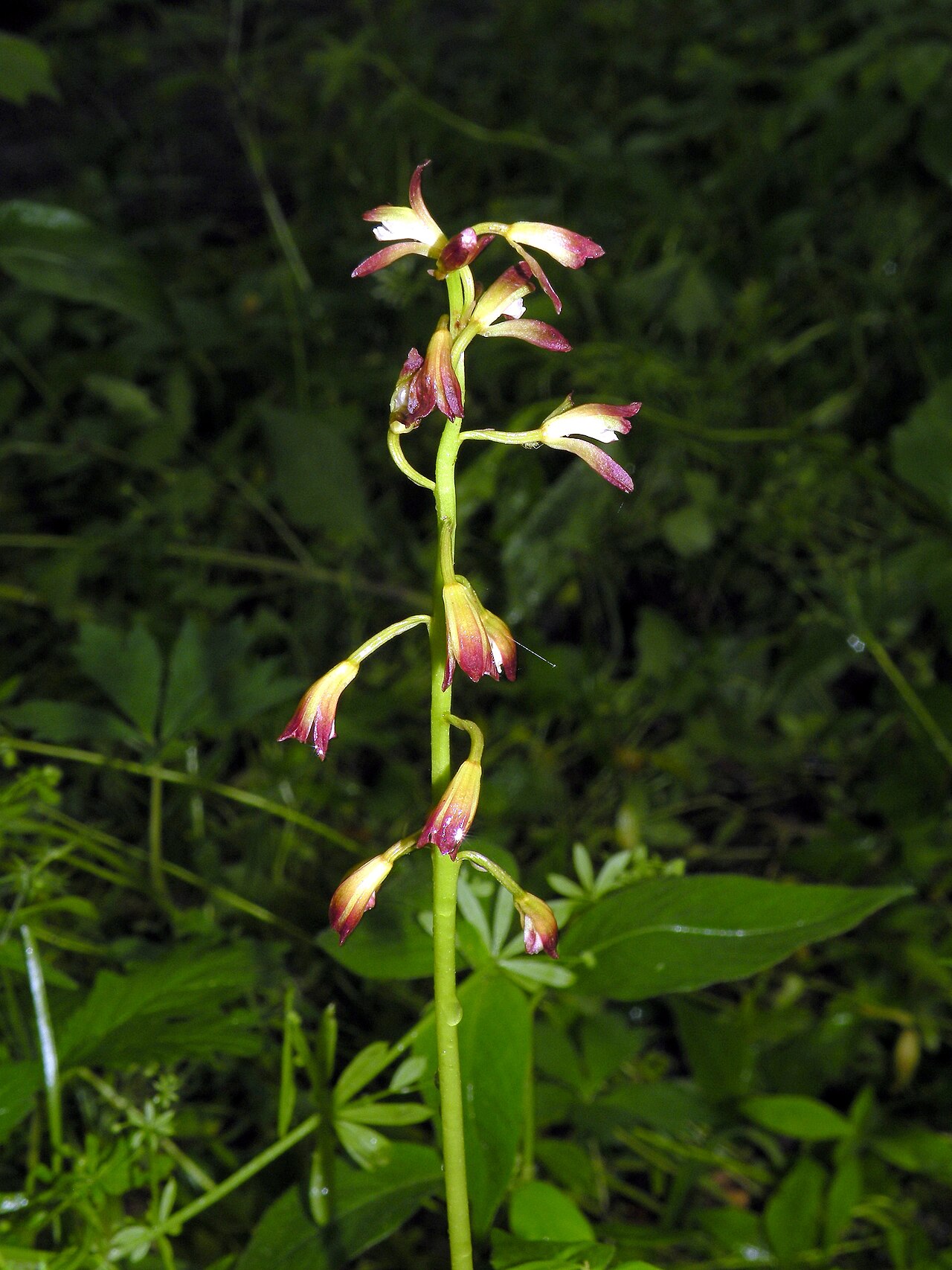
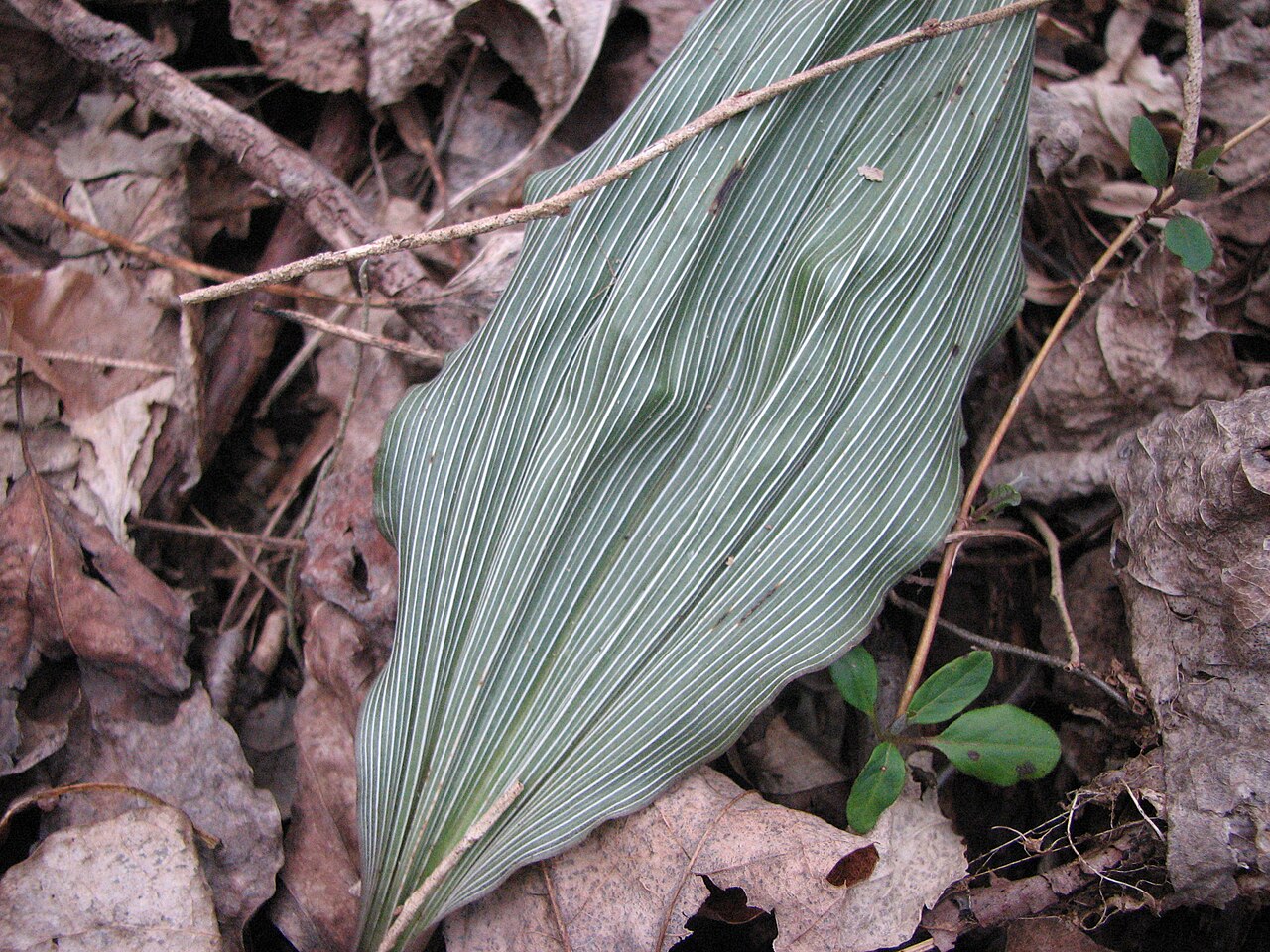
Aplectrum hyemale, known as Puttyroot or Adam-and-Eve, is a native woodland orchid with an unusual, upside-down calendar. Its single leaf appears in late fall and stays green all winter on the forest floor, broad, pleated and marked with fine silvery-white pinstripes. The leaf withers in spring, and in May or June a leafless stalk 10 to 16 inches tall rises from the ground with a loose spike of small, yellowish to greenish flowers washed with brownish purple.
Puttyroot is the only species in its genus and a member of the orchid family (Orchidaceae). It grows from a chain of rounded underground corms, a new one formed each year beside the old. Pairs of connected corms gave rise to the name Adam-and-Eve, and the sticky, glue-like substance in crushed corms gave rise to the name puttyroot: Native Americans and early settlers are said to have used it to mend broken pottery.
It is found in rich, moist deciduous forests across much of the eastern United States and southern Ontario and Quebec, from Massachusetts and Minnesota south to Georgia and Oklahoma. It is often overlooked, because its leaves are visible mainly in winter and its flowers are dull-colored. Like all native orchids, it depends on soil fungi and should never be dug from the wild.
Identification
Puttyroot is easiest to identify in winter, when its single striped leaf is one of the few green things on the forest floor. In bloom, its leafless stalk of muted flowers can be confused with crane-fly orchid.
Leaf
Each corm produces one leaf in late fall. It is elliptic, about 4 to 7 inches long and 2 to 3 inches wide, grayish to bluish green, and pleated lengthwise with many fine, raised, silvery-white veins that look like pinstripes. The underside is often purplish. The leaf lies flat or arches over the leaf litter through winter and withers in spring, usually before or as the flower stalk appears.
Flower Stalk
In late spring a single leafless stalk 10 to 16 inches tall (occasionally to about 20 inches) rises from the corm. It has a few sheathing scales near the base and carries a loose raceme of about 7 to 15 flowers.
Flowers
The flowers are about ½ inch across, with narrow sepals and petals that are yellowish green to whitish and tinged or streaked with brownish purple. The white lip is three-lobed and marked with purple spots and ridges. There is no spur, which is what the genus name Aplectrum (Greek for “without a spur”) refers to. Flowers open from May to early June in most of the range. A rare form, var. pallidum, lacks the purple coloring.
Fruit & Corms
Flowers often pollinate themselves and form drooping, ribbed capsules that ripen in summer and release dust-like seeds. Underground, the plant forms a chain of round corms about ½ to 1 inch across, connected by short rhizomes. Each year’s new corm grows next to the old one, which may persist for a year or more.
Look-alikes
Crane-fly Orchid also has a single winter leaf and a leafless summer flower stalk, but its leaf is smooth and plain green above, often with dark spots, and bright purple underneath, without pinstripes. Its flowers have long spurs and appear in mid to late summer. The pleated leaf of puttyroot is also sometimes mistaken for a young lily or false hellebore, but those plants have several leaves on a stem.
Quick Facts
| Scientific Name | Aplectrum hyemale |
| Family | Orchidaceae (orchid family) |
| Plant Type | Terrestrial orchid; herbaceous perennial from corms; winter-green leaf |
| Mature Height | 10–16 in in flower (occasionally to about 20 in) |
| Mature Spread | 4–8 in per leaf; slowly forms colonies |
| Growth Rate | Slow |
| Sun Exposure | Part shade to shade |
| Water Needs | Moderate; evenly moist, well-drained soil |
| Soil Type | Rich, humusy forest loam, often over limestone |
| Soil pH | About 5.5–7.5 (slightly acidic to neutral) |
| Bloom Time | May–June |
| Flower Color | Yellowish green to whitish, tinged brownish purple; white lip with purple marks |
| Fall Color | The leaf appears in fall and stays green through winter |
| Fruit | Drooping ribbed capsules with dust-like seeds |
| Deer Resistant | No; deer browse the leaves and stalks |
| USDA Hardiness Zones | 4–8 |
Native Range
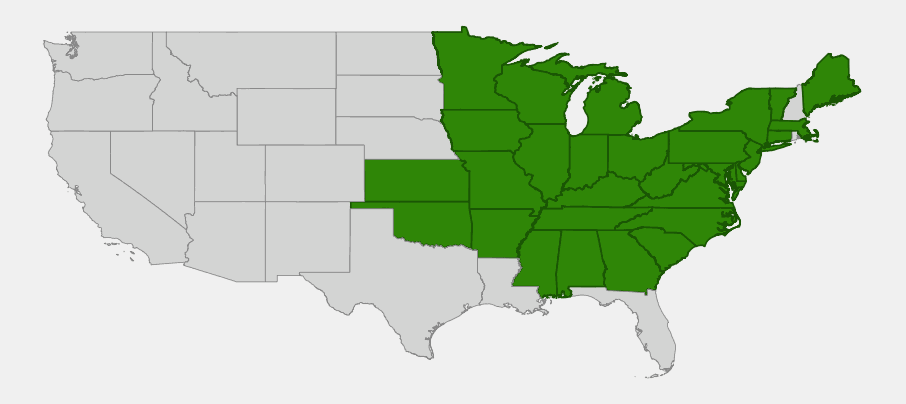
USDA PLANTS lists puttyroot as native in 29 states and the District of Columbia, from Maine, Vermont, Massachusetts and Connecticut west to Michigan, Wisconsin, Minnesota and Iowa, and south to Georgia, Alabama, Mississippi, Arkansas, Oklahoma and Kansas. In Canada it grows in southern Ontario and Quebec.
It is most frequent in the Appalachian Mountains, the Ohio and upper Mississippi valleys and the southern Great Lakes region, where rich hardwood forests on limestone or other fertile soils are common. Toward the Coastal Plain, northern New England and the western prairie edge it becomes scattered and local, and it is considered rare in several states at the edges of its range.
Its habitat is moist, rich deciduous woods: slopes, coves, ravines, floodplain terraces and the bases of bluffs, under trees such as sugar maple, beech, tulip tree, basswood and oaks. It often grows in colonies, which can be large in undisturbed forests.
📋 Regional plant lists featuring Puttyroot: New York, Pennsylvania & Northern New Jersey · Ohio & Indiana · Michigan, Wisconsin & Eastern Minnesota · Kentucky & Tennessee · Nebraska, Kansas & Eastern Colorado · Connecticut, Massachusetts & Rhode Island · New Hampshire, Maine & Vermont · Maryland, Virginia & West Virginia · Delaware, Southern New Jersey & Long Island · Illinois, Iowa & Missouri · Alabama, Georgia & Mississippi
Growing & Care Guide
Puttyroot is not a common garden plant, and it should never be dug from the wild. It depends on soil fungi, and moved plants usually fail. A few specialist nurseries offer propagated corms. If puttyroot grows on your land, the most valuable thing you can do is protect its forest habitat.
Light
It grows in part to full shade under deciduous trees. Its winter leaf gets plenty of light after the canopy drops its leaves in fall, so it does well under deciduous trees but not under dense evergreens.
Soil & Water
It needs rich, moist but well-drained woodland soil full of humus, slightly acidic to neutral. Leave fallen leaves in place as natural mulch. Avoid compacting the soil and keep heavy foot traffic away from colonies.
Planting Tips
Plant propagated corms in early fall, an inch or two deep, in a shady woodland bed where they will not be disturbed. Mark the spot, because the plant has no leaves in summer. Plant among ferns and spring wildflowers.
Pruning & Maintenance
No pruning is needed. Do not rake leaves away in fall, which can damage the new leaf as it emerges. Remove invasive plants such as Japanese honeysuckle, garlic mustard and multiflora rose, which can smother colonies. Protect from deer where browsing is heavy.
Propagation
Colonies spread slowly through new corms. In gardens, corm chains can be divided carefully when dormant in late summer. Growing from seed requires laboratory culture with fungi or sterile media and is best left to specialists.
Landscape Uses
- Winter nature walks: its pinstriped leaf is a rewarding winter find on the forest floor
- Woodland gardens: a curiosity for shady beds, using propagated corms only
- Forest stewardship: a sign of rich, intact deciduous forest worth protecting
- Nature study: an example of a plant that grows mainly in winter
- Photography: striking striped leaves in winter and subtle flowers in late spring
Wildlife & Ecological Value
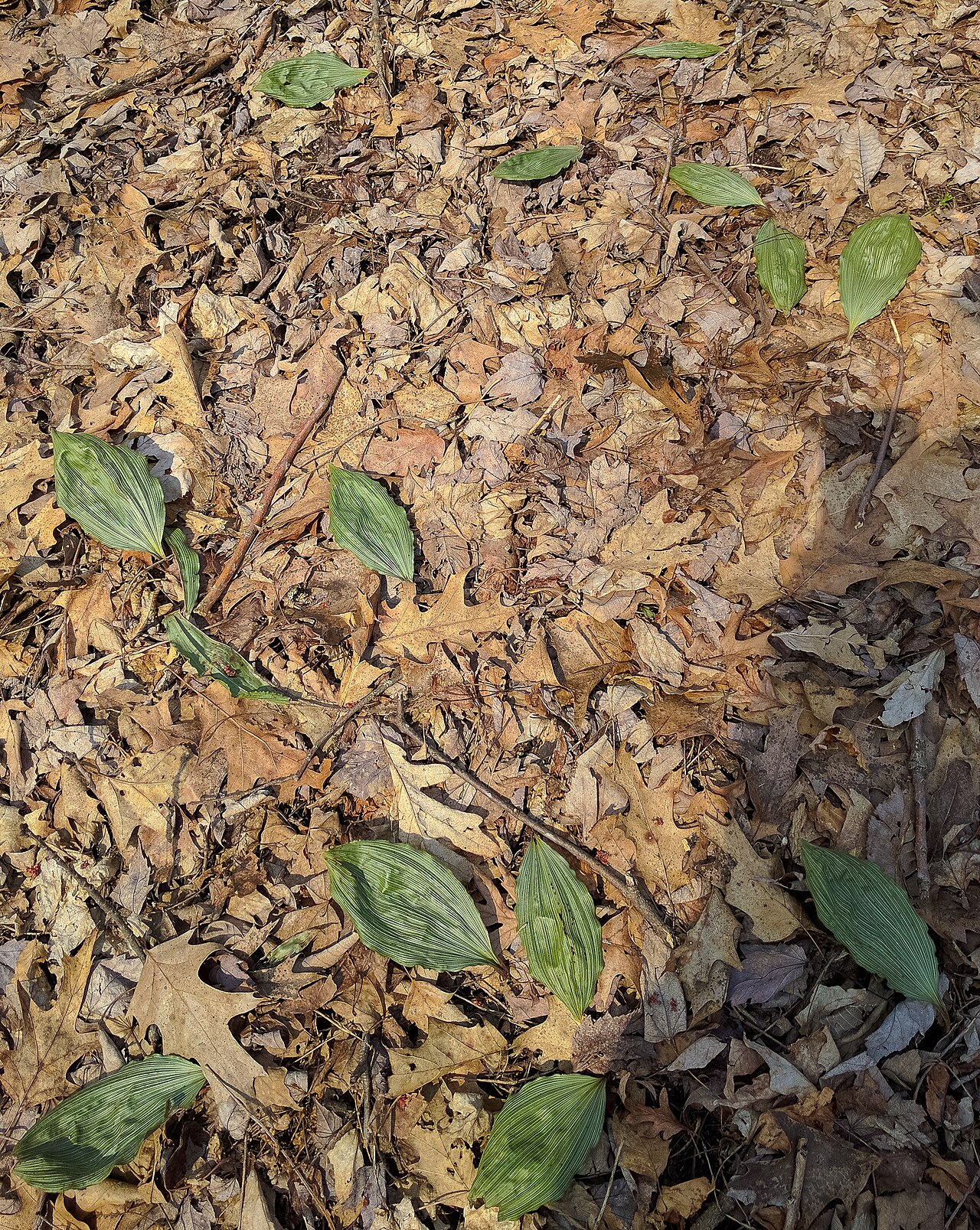
Puttyroot has an unusual relationship with the seasons. It photosynthesizes mostly in winter, when the canopy is bare, and flowers after its leaf is gone.
For Pollinators
The flowers have no nectar and attract few insects. Bumblebees have been reported visiting them, but much of the seed set comes from self-pollination, which lets the plant produce seed even without visitors.
For Birds
Birds make little direct use of puttyroot. It shares its rich forest habitat with many woodland songbirds.
For Mammals
White-tailed deer eat the winter leaves, when little else is green, and heavy browsing may be one reason the plant has declined in some areas.
Ecosystem Role
Puttyroot depends on soil fungi for germination and early growth, linking it to the fungal networks of the forest floor. Its winter-green leaf captures light during the months when deciduous trees are bare, a strategy shared with crane-fly orchid and a few other forest plants.
Cultural & Historical Uses
The genus name Aplectrum means “without a spur,” and the species name hyemale means “of winter,” a reference to its winter leaf. It is the only species in its genus.
The common name puttyroot comes from the sticky, mucilaginous material in crushed corms, which Native Americans and early settlers reportedly used as glue to mend broken pottery. The name Adam-and-Eve comes from the way the corms grow in connected pairs, the old and the new. These folk uses are part of its story, but the plant should not be dug or collected.
For many naturalists, the first puttyroot leaf found on a winter walk is a memorable discovery. The plant is a good reminder that eastern forests are not dead in winter, and that some native plants do their main growing when the trees are bare.
Frequently Asked Questions
Why does puttyroot have leaves in winter?
It grows mostly in the cool season. The leaf appears in fall after the trees drop their leaves and stays green through winter, taking advantage of the light reaching the forest floor. It withers in spring, and the plant flowers without leaves in late spring.
Can I grow puttyroot?
It can be grown in a shady woodland garden from propagated corms, but it is rarely sold and slow to establish. Never dig plants from the wild; orchids depend on soil fungi and usually die after transplanting.
Why is it called Adam-and-Eve?
The underground corms grow in connected pairs, an older one and a newer one, which reminded people of the biblical Adam and Eve.
How do I tell puttyroot from crane-fly orchid?
Both have one winter leaf. Puttyroot’s leaf is pleated with white pinstripes; crane-fly orchid’s leaf is smooth, often spotted on top and purple underneath. Puttyroot blooms in late spring without spurs; crane-fly orchid blooms in mid to late summer with long-spurred flowers.
Is puttyroot rare?
It is widespread but local, and it is listed as rare in several states at the edges of its range. Habitat loss, deer browsing and invasive plants are the main threats.

Looking for a nursery that carries Puttyroot?
Browse our native plant nursery directory: Alabama & Arkansas · Connecticut, Delaware & Georgia · Illinois, Indiana, Iowa & Kansas · Kentucky, Maine, Maryland, Massachusetts, Michigan, Minnesota, Mississippi & Missouri · New Jersey, New York, North Carolina, Ohio & Oklahoma · Pennsylvania, South Carolina, Tennessee, Vermont & Virginia · West Virginia & Wisconsin