
Mead’s Milkweed (Asclepias meadii)
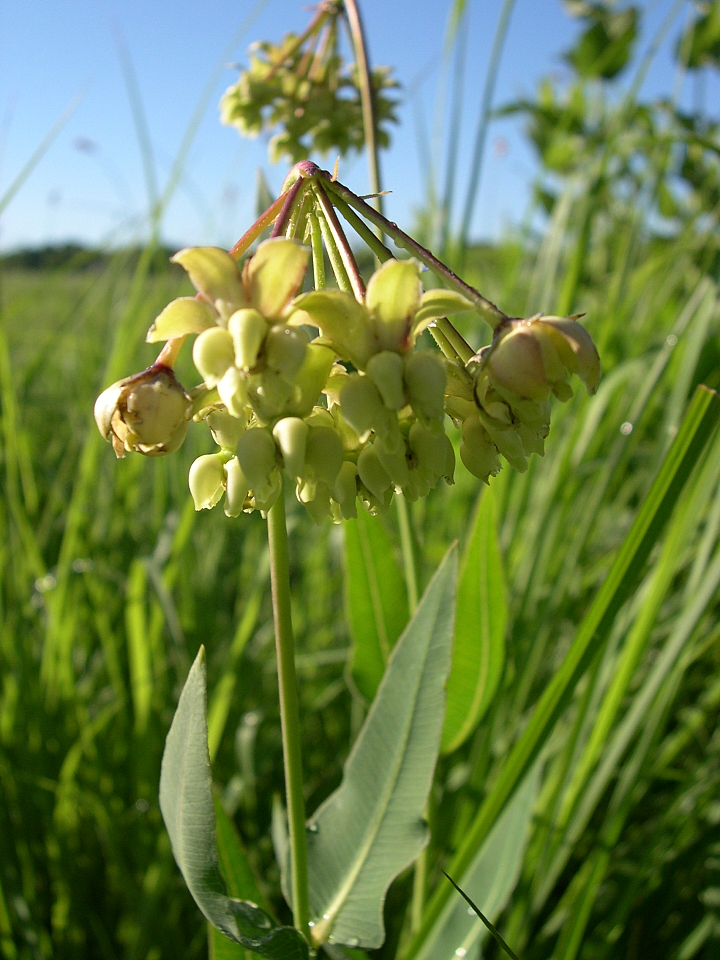
Asclepias meadii, Mead’s Milkweed, is one of the rarest milkweeds in North America and a symbol of the tallgrass prairie that once covered the Midwest. It is a short, unbranched plant, usually 8 to 16 inches tall, with a few pairs of broad, smooth, blue-green leaves and a single nodding cluster of greenish-cream flowers at the top of the stem in late spring.
Mead’s milkweed grows only in high-quality, never-plowed tallgrass prairie and in a few rocky glades, habitats that have almost entirely vanished. It was once found from eastern Kansas across Missouri, Iowa and Illinois to Indiana and Wisconsin. Today most surviving populations are in eastern Kansas and western Missouri, mainly in old prairie hay meadows, and the species is listed as threatened under the U.S. Endangered Species Act (since 1988).
This page is an identification and appreciation guide. Mead’s milkweed is not a plant for ordinary gardens: it is slow, long-lived and federally protected, and it should never be dug from the wild. Below you’ll learn how to recognize it, where it survives, why it declined, and how gardeners can help it and its prairie by planting other native milkweeds.
Identification
Mead’s milkweed is easy to overlook among prairie grasses. The key features are its short single stem, one terminal flower cluster that droops on a long stalk, and broad, smooth, clasping leaves with a whitish bloom.
Stem & Leaves
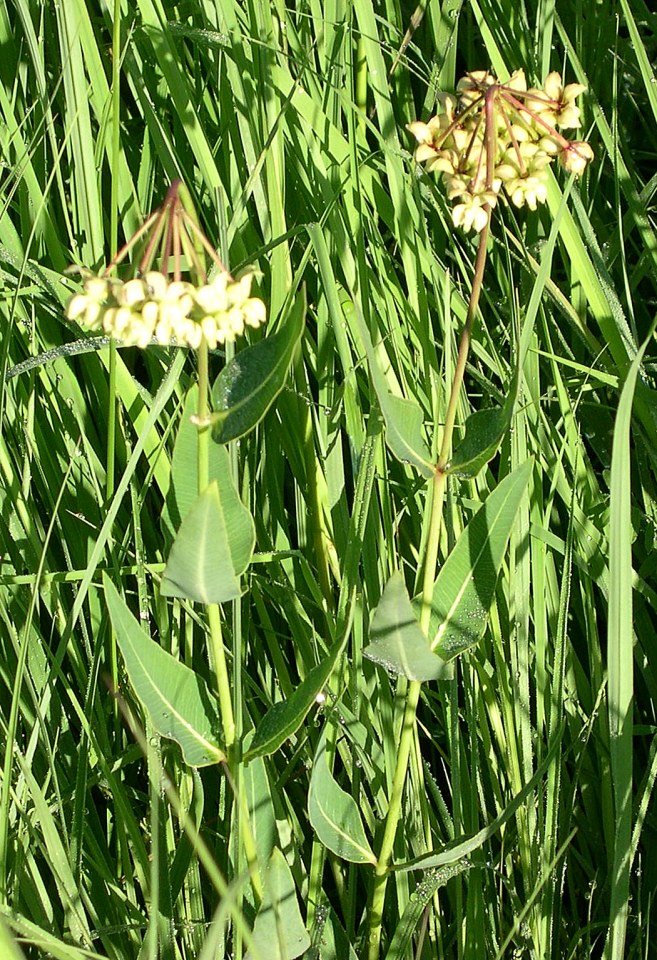
Each plant usually sends up one slender, unbranched stem from a deep, woody rootstock. The leaves are opposite, broadly egg-shaped to lance-shaped, 2 to 3 inches long, smooth, stalkless, and often clasping the stem. They are blue-green with a waxy, whitish surface and a prominent pale midvein. Like other milkweeds, the plant has milky sap.
Flowers
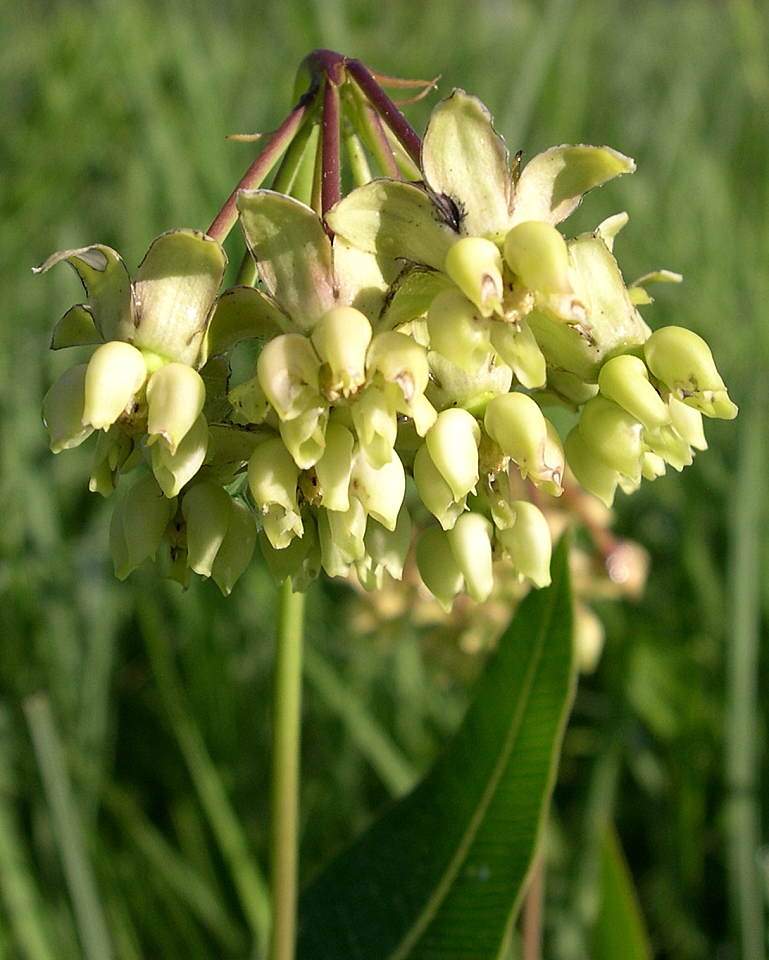
Unlike most milkweeds, which carry several flower clusters along the upper stem, Mead’s milkweed has a single umbel at the very top of the stem, on a stalk that bends so the cluster nods. Each umbel has roughly 6 to 15 flowers. They are pale greenish-cream to yellowish, sometimes with a faint purple tinge, with reflexed petals and five cupped hoods. Flowering is in late May and June.
Pods & Seeds
Pollinated flowers produce narrow, smooth seed pods 3 to 4 inches long that split in late summer to release flat brown seeds with tufts of silky hairs. Pods are uncommon, because the plant needs cross-pollination between genetically different individuals, and many small populations consist of only a few clones.
Look-alikes
Whorled Milkweed has narrow, thread-like leaves in whorls and white flowers. Clasping or sand milkweed (A. amplexicaulis) has wavy-edged clasping leaves and an upright, purplish-green flower cluster on a stouter stem. Green milkweeds (A. viridiflora, A. viridis) have green flowers in several clusters or upright heads. The single nodding umbel is the best clue to Mead’s milkweed.
Quick Facts
| Scientific Name | Asclepias meadii Torr. ex A. Gray |
| Family | Apocynaceae (dogbane family; milkweed subfamily) |
| Plant Type | Long-lived herbaceous perennial from a deep rootstock |
| Mature Height | 8–16 in |
| Mature Spread | Single stems; a few inches |
| Growth Rate | Very slow; seedlings can take several years to flower |
| Sun Exposure | Full sun |
| Water Needs | Moderate; mesic to dry-mesic prairie |
| Soil Type | Silty clay loam prairie soils; thin rocky soils on glades |
| Soil pH | About 5.5–7.5 |
| Bloom Time | Late May–June |
| Flower Color | Pale greenish-cream |
| Fall Color | Yellowing leaves; stems die back |
| Fruit | Narrow smooth pod 3–4 in, with silky-tufted seeds |
| Deer Resistant | Usually; toxic milky sap |
| USDA Hardiness Zones | 4–7 |
Native Range
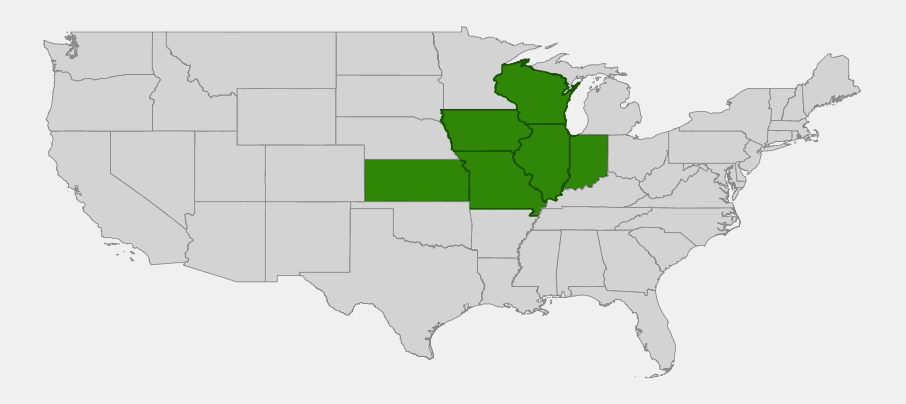
USDA PLANTS lists Mead’s milkweed as native in Kansas, Missouri, Iowa, Illinois, Indiana and Wisconsin. Its historical range covered the eastern tallgrass prairie from eastern Kansas to northwestern Indiana and southern Wisconsin. Most of that prairie was plowed for farmland in the 1800s and early 1900s, and the species disappeared with it.
Today the great majority of populations are in eastern Kansas and western Missouri, in native prairie hay meadows that have been mowed for hay instead of plowed. Small natural populations survive in southern Iowa and in the igneous glades of southern Illinois. The original Indiana and Wisconsin populations were lost; the U.S. Fish and Wildlife Service and partners have reintroduced the species to protected prairies in Illinois and Indiana as part of its recovery.
It needs open, fire- or mowing-maintained grassland. Without fire, shrubs and trees invade prairies and shade it out, and annual haying in late spring before seed is set can limit reproduction. Its slow growth and dependence on cross-pollination between different clones make small, isolated populations especially vulnerable.
📋 Regional plant lists featuring Mead’s Milkweed: Illinois, Iowa & Missouri · Nebraska, Kansas & Eastern Colorado · Ohio & Indiana · Michigan, Wisconsin & Eastern Minnesota
Can You Grow It?
Short answer: not in an ordinary garden. Mead’s milkweed is a federally threatened species, it is not sold by regular nurseries, and moving or selling it across state lines requires federal permits. Plants and seed for recovery work are propagated by botanical gardens and conservation agencies under permit. Never dig Mead’s milkweed or collect its seed from the wild. Its deep rootstock does not survive transplanting, and every wild plant matters to the species’ survival.
Safety note: like other milkweeds, Mead’s milkweed contains cardiac glycosides in its milky sap and foliage. It is toxic if eaten by people, pets or livestock, and the sap can irritate the eyes.
Light
It needs full sun in open prairie. Shade from encroaching shrubs or tall, dense vegetation is one of the main reasons populations decline.
Soil & Water
In the wild it grows in deep, silty clay loam prairie soils and in thin, rocky soils of glades, which are moist in spring and dry in late summer. It is adapted to the cycles of drought and fire typical of the tallgrass prairie.
Planting Tips
If you want to support milkweed-dependent wildlife, plant common nursery milkweeds that grow in the same region: Butterfly Weed for dry, sunny gardens, Swamp Milkweed for moist soil, and Whorled Milkweed for lean ground. Landowners with remnant prairie can help most by protecting it from plowing, herbicides and woody encroachment.
Pruning & Maintenance
In remnant prairies, managers maintain habitat with prescribed fire, typically in early spring or fall, and with haying timed after seed set. Late-spring burns and mowing during flowering can harm seed production.
Propagation
Recovery programs grow plants from hand-pollinated seed, crossing different genetic individuals because the species is self-incompatible. Seedlings grow slowly and may take many years to reach flowering size. This work is done under permit by conservation partners such as botanical gardens and state agencies.
Where to See It
- Kansas and Missouri prairie preserves: prairie hay meadows and preserves managed by conservation organizations and state agencies, in late May and June
- Southern Illinois glades: small natural populations in the Shawnee Hills region
- Reintroduction sites: protected prairies in Illinois and Indiana where the species has been restored
- Guided prairie walks: the best way to see it without trampling: many preserves offer spring wildflower walks
Wildlife & Ecological Value
Mead’s milkweed is part of a web of prairie life, and its decline mirrors the loss of the tallgrass prairie itself.
For Pollinators
The flowers are visited by bumble bees and other large bees, which carry the milkweed’s paired pollen sacs (pollinia) from plant to plant. Successful pollination requires pollen from a genetically different plant, which is hard in small populations of a few clones.
For Birds
The prairies where it survives are home to grassland birds such as dickcissels, Henslow’s sparrows, eastern meadowlarks and greater prairie-chickens in Kansas and Missouri.
For Mammals
The toxic sap discourages browsing, but the plant is sometimes damaged by grazing, mowing and trampling. Deer generally avoid milkweeds.
Ecosystem Role
As a milkweed it is a potential host plant for monarch butterfly caterpillars, though it is far too rare to matter much for monarchs. Its value is as an indicator of high-quality, never-plowed prairie: where Mead’s milkweed survives, a rich community of other prairie plants usually survives too.
Cultural & Historical Uses
The species was named for Samuel Barnum Mead, a 19th-century physician and botanist in Augusta, Illinois, who collected it in western Illinois in the mid-1800s. John Torrey named it in his honor, and Asa Gray published the description.
It was listed as threatened under the Endangered Species Act in 1988, and the U.S. Fish and Wildlife Service published a recovery plan in 2003. Recovery work has included surveys of prairie hay meadows, hand pollination, seed banking, and reintroductions in Illinois and Indiana.
Mead’s milkweed has become a flagship species for tallgrass prairie conservation. Many of its best remaining populations are on privately owned hay meadows, so cooperation with farmers and ranchers who keep their prairies unplowed is central to its survival.
Frequently Asked Questions
Is Mead’s milkweed endangered?
It is listed as threatened under the U.S. Endangered Species Act (since 1988). It has lost most of its historical range, and most remaining populations are in eastern Kansas and western Missouri.
Can I buy Mead’s milkweed for my garden?
Generally no. It is not available from regular nurseries, and propagation and interstate movement are done under federal permit for recovery projects. Plant common native milkweeds such as butterfly weed, swamp milkweed or whorled milkweed instead.
Is Mead’s milkweed a host plant for monarchs?
Like other milkweeds, it can host monarch caterpillars, but it is far too rare to be important to monarchs. Planting common milkweeds does much more to support them.
How do I identify Mead’s milkweed?
Look for a short single stem with a few pairs of broad, smooth, blue-green, clasping leaves and one nodding cluster of greenish-cream flowers at the very top, blooming in late May and June in unplowed prairie.
Is Mead’s milkweed poisonous?
Yes. Like other milkweeds, its milky sap and leaves contain cardiac glycosides that are toxic if eaten by people, pets or livestock, and the sap can irritate the eyes.

Looking for a nursery that carries Mead’s Milkweed?
Browse our native plant nursery directory: Illinois, Indiana, Iowa & Kansas · Missouri · Wisconsin

