
Miner’s Candle (Cryptantha virgata)
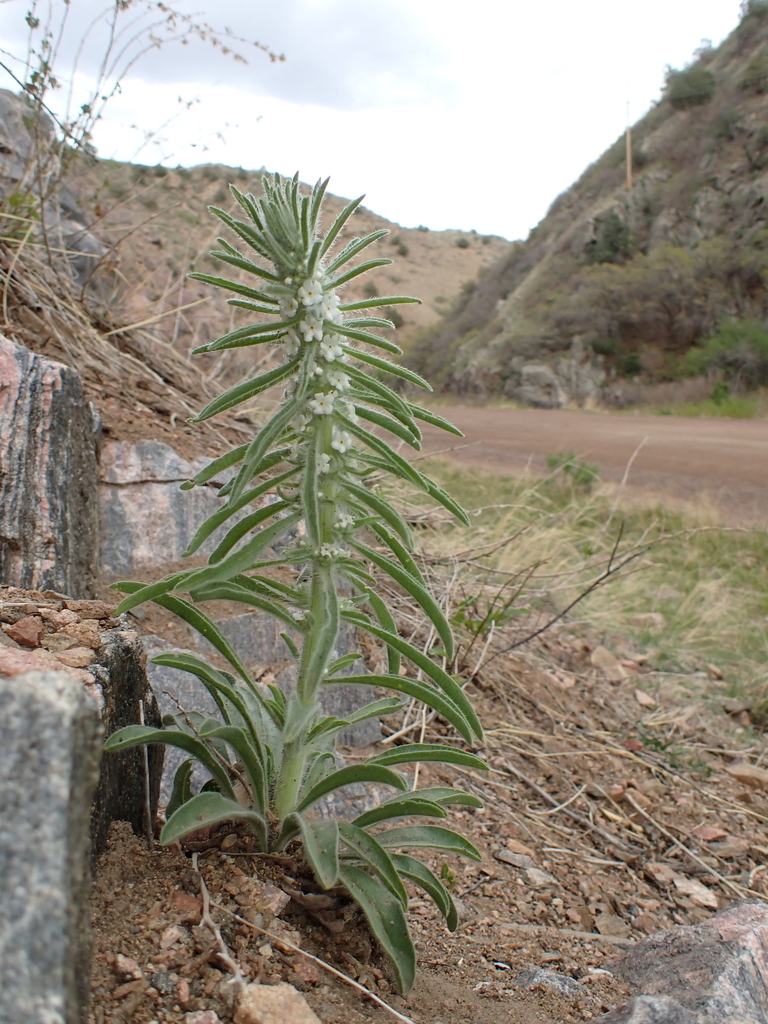
Cryptantha virgata, known as Miner’s Candle, is a striking native wildflower of the foothills and lower mountains of the Colorado Front Range and southeastern Wyoming. It sends up a single, stiff, upright spike, usually 8 to 20 inches tall, densely set with small white flowers and long, narrow, bristly leafy bracts. The whole plant looks like a pale, fuzzy candle standing in the rocks, which is how it got its common name.
It belongs to the borage family (Boraginaceae) and is one of the white-flowered “cat’s-eyes” or “hiddenflowers,” a large western group often placed in the genus Oreocarya; many current references list it as Oreocarya virgata. It is a regional specialty: almost all of its range lies along the eastern edge of the Rockies in Colorado and the Laramie Range of Wyoming.
Miner’s candle is usually a biennial or short-lived perennial. It spends one or more years as a low rosette of bristly leaves, then blooms once from late spring to midsummer, sets seed and dies. Its stiff hairs can irritate the skin, so handle it with care. Bees and other small insects visit the flowers, and the tall white spikes are a familiar sight on dry, gravelly slopes in foothill parks around Denver, Boulder, Colorado Springs and Fort Collins.
Identification
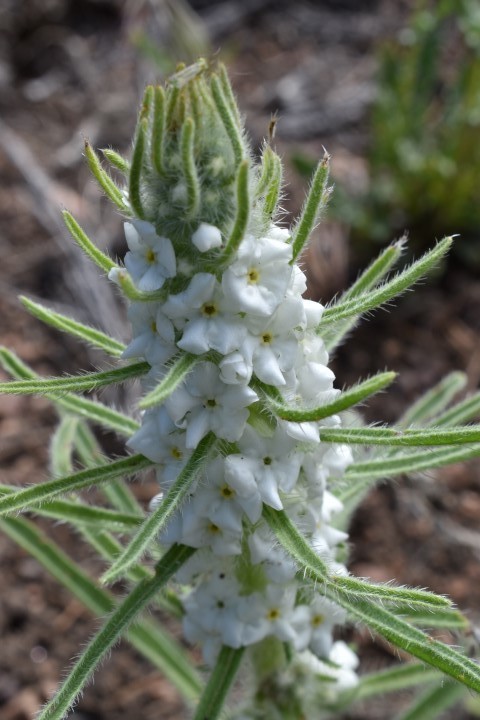
Look for a single, upright, candle-like spike of small white flowers mixed with long, narrow, bristly leafy bracts, rising from a rosette of hairy, strap-shaped leaves on dry, gravelly foothill slopes in Colorado and southeastern Wyoming.
Leaves
The basal leaves form a rosette and are narrow, strap-shaped to spoon-shaped, about 1½ to 4 inches long, and covered with stiff, bristly hairs that often have swollen, blister-like bases. The stem leaves are narrow and linear, becoming bract-like and very long within the flower spike, where they stick out well beyond the flowers.
Stems
Usually a single stout stem rises from the rosette, unbranched or with short side branches in the flower spike. It is about 8 to 20 inches tall, sometimes taller, and densely covered with long, spreading, bristly hairs.
Flowers
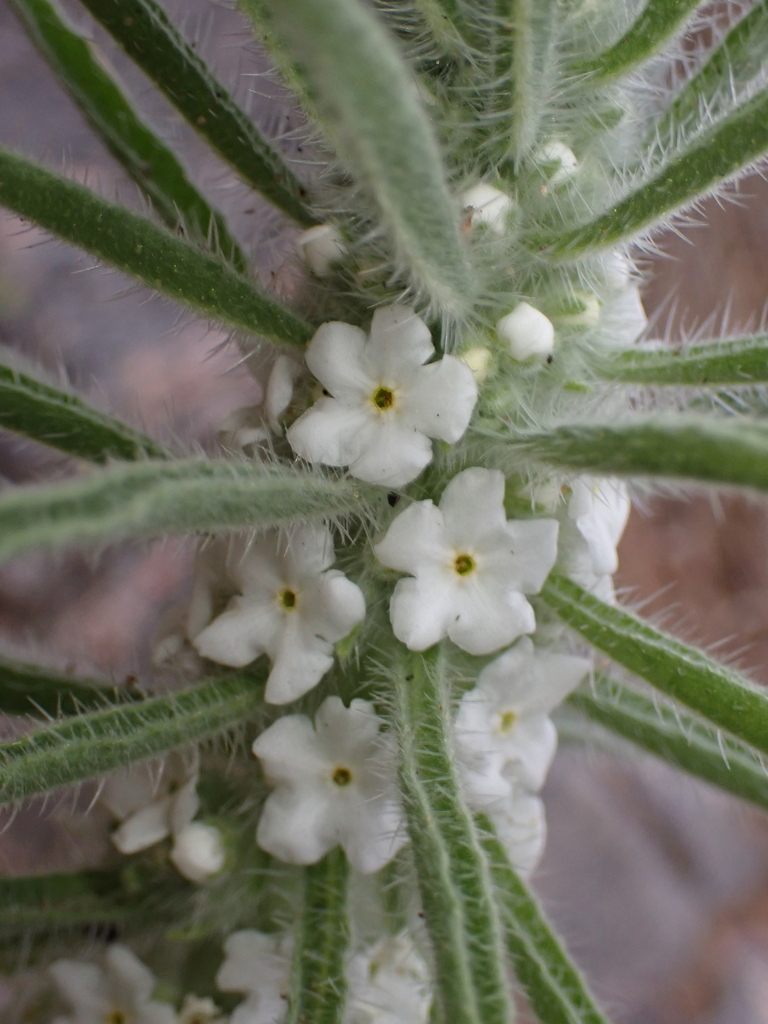
The flowers are crowded in short, coiled clusters along most of the length of the stem, forming a narrow, cylindrical spike. Each flower is about 1/3 inch across, with five rounded, white petal lobes and small, yellow, crest-like folds (fornices) at the throat that form a yellow eye. The hairy sepals enclose the flower base. Bloom is mainly from May to July.
Fruit & Seeds
Each flower forms up to four small, hard nutlets, roughened on the back, held within the persistent bristly calyx. After seeds ripen, the whole plant dies, and the dry, brown stalk may stand into winter.
Look-alikes
Other white-flowered cryptanthas, such as the widespread perennial James’s cat’s-eye (Cryptantha or Oreocarya cinerea), are lower plants with several stems and rounded flower clusters, without the long, protruding bracts. Northern cryptantha (Oreocarya celosioides) has a stout, thick spike but shorter bracts and grows mostly to the north and west. Panamint Cryptantha is a small desert annual. Miner’s candle is told by its single, tall, narrow spike with long, bristly, leafy bracts sticking out among the flowers.
Quick Facts
| Scientific Name | Cryptantha virgata (syn. Oreocarya virgata) |
| Family | Boraginaceae (borage family) |
| Plant Type | Biennial or short-lived perennial herb |
| Mature Height | 8–20 in |
| Mature Spread | 6–10 in |
| Growth Rate | Slow; rosette first, then a single bloom |
| Sun Exposure | Full sun |
| Water Needs | Low |
| Soil Type | Dry, well-drained gravelly, sandy or decomposed granite soil |
| Soil pH | About 6.0–8.0 |
| Bloom Time | May–July |
| Flower Color | White with a yellow eye |
| Fall Color | None |
| Fruit | Four small roughened nutlets |
| Deer Resistant | Yes; bristly and rarely browsed |
| USDA Hardiness Zones | 4–7 |
Native Range
Miner’s candle has a small range. USDA PLANTS lists it as native only in Colorado and Wyoming. It is centered on the foothills of the Colorado Front Range and extends north into the Laramie Range and nearby uplands of southeastern Wyoming.
In Colorado it grows along the eastern edge of the mountains from the Wyoming border south through Larimer, Boulder, Jefferson and Douglas counties to the Pikes Peak region, and into some higher parks and valleys west of the foothills. It is common in many foothill open-space parks along the Front Range urban corridor.
It grows in dry, open, sunny places: foothill grasslands and shrublands, openings in ponderosa pine and Douglas-fir woodland, rocky and gravelly slopes, and road cuts. It is especially common on coarse, decomposed granite and other well-drained soils.
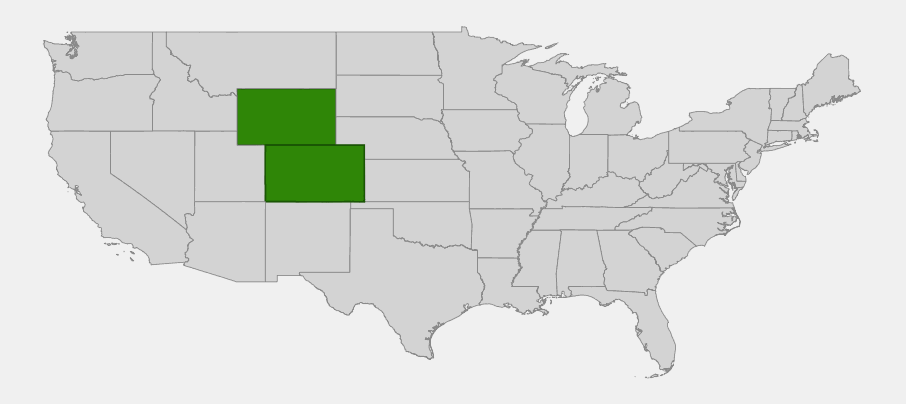
📋 Regional plant lists featuring Miner’s Candle: Montana & Wyoming
Growing & Care Guide
Miner’s candle is seldom sold in nurseries, but it can be grown from seed in dry, sunny gardens along the Front Range and in similar climates. Treat it as a biennial that reseeds in open, gravelly ground.
Light
Full sun. It grows naturally on open, exposed slopes and does poorly in shade.
Soil & Water
Plant in lean, fast-draining gravelly, sandy or decomposed granite soil. It needs little water once established; overwatering and rich soil shorten its life and cause rot. In most Front Range gardens, natural precipitation is enough after the first season.
Planting Tips
Sow seed directly in fall in a rock garden, gravel garden or dry meadow, where seedlings will not be crowded by vigorous plants. Because each plant dies after blooming, sow seed in two or more years so you have plants at different stages.
Pruning & Maintenance
Wear gloves; the stiff bristles can irritate the skin. Leave the flowering stalk until the seeds have dropped, then remove it. Keep the area around rosettes open and weed-free so that new seedlings can establish.
Propagation
Grow only from seed, collected in midsummer when the nutlets are ripe and sown outdoors in fall for natural winter stratification. Seedlings form rosettes the first year and usually bloom in the second or a later year. Do not dig plants from the wild; the taproot does not transplant well.
Landscape Uses
- Rock gardens: dramatic vertical accent for dry, gravelly sites
- Xeric gardens: needs no irrigation once established on the Front Range
- Pollinator gardens: flowers visited by small native bees and flies
- Foothill restoration: native biennial for gravelly slopes and road cuts
- Wildflower viewing: common in Front Range foothill parks in late spring
Wildlife & Ecological Value
Miner’s candle is a small but characteristic part of the Front Range foothill flora.
For Pollinators
Small native bees, such as sweat bees and small mason bees, and bee flies and other flies visit the flowers for nectar and pollen. The yellow eye at the throat guides insects to the nectar.
For Birds
Insects on the flowers feed foraging songbirds, and some ground-feeding birds may eat fallen nutlets.
For Mammals
The dense, stiff bristles discourage most browsers, so deer and livestock usually leave it alone. Small rodents may harvest the nutlets.
Ecosystem Role
As a biennial that colonizes open, gravelly ground, it helps cover disturbed soil on slopes and road cuts and adds flowers for pollinators in the dry foothill grasslands.
Cultural & Historical Uses
The genus name Cryptantha means “hidden flower,” from Greek, because some species have tiny flowers that do not open. The species name virgata means “wand-like,” for the long, straight flowering stem. Thomas Conrad Porter first described the plant, and Edwin Blake Payson later placed it in Cryptantha. Many botanists now separate the perennial and biennial western cat’s-eyes into the genus Oreocarya, so it is also listed as Oreocarya virgata.
The name miner’s candle reflects the plant’s candle-like shape and its home in the Colorado foothills, the setting of the 1859 Pikes Peak gold rush and the mining towns that followed. The artist Mary Vaux Walcott painted the plant in 1937 for her series of North American wildflower watercolors.
On this site, related plants include Panamint Cryptantha and other members of the borage family, such as Prairie Bluebells, which grows in the same foothills.
Frequently Asked Questions
Where does miner’s candle grow?
Only in Colorado and southeastern Wyoming, mainly along the foothills of the Colorado Front Range and in the Laramie Range, on dry, gravelly slopes, grasslands and open pine woods.
Why is it called miner’s candle?
Its single, upright, pale, fuzzy flower spike looks like a candle, and it grows in the Colorado foothills where mining towns sprang up after the 1859 gold rush.
Is miner’s candle a perennial?
It is usually a biennial or short-lived perennial. It grows as a rosette for one or more years, blooms once, sets seed and dies.
Can I touch miner’s candle?
Handle it carefully. Its stiff, bristly hairs can irritate the skin, so wear gloves when working with it.
When does miner’s candle bloom?
Mainly from May to July, depending on elevation and spring moisture.


