
Rayless Greenthread (Thelesperma megapotamicum)
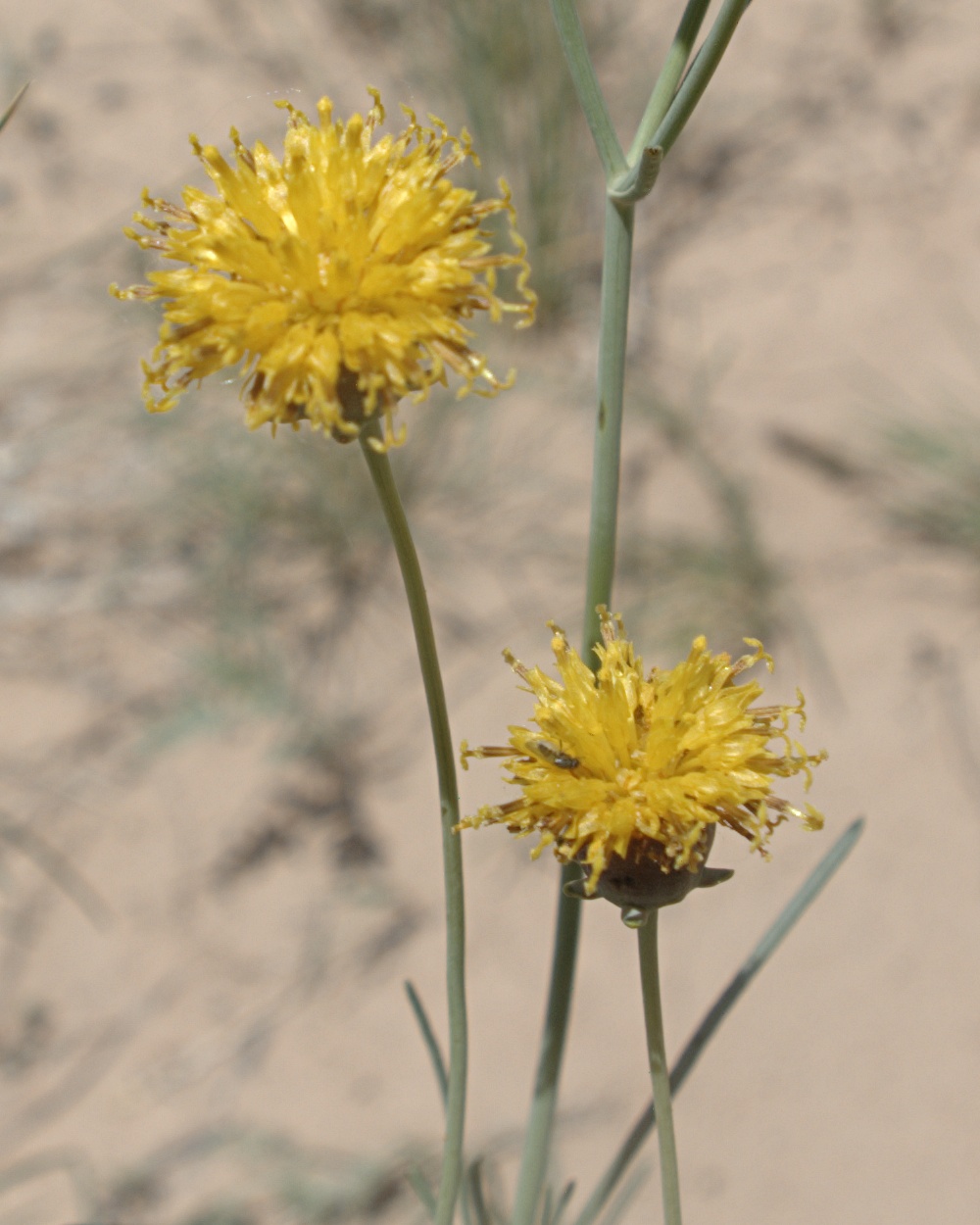
Thelesperma megapotamicum, known as Rayless Greenthread, Hopi tea greenthread (the USDA PLANTS name), Navajo tea or cota, is a slender perennial of the sunflower family (Asteraceae) native to the Great Plains and the American Southwest. From spring into fall it carries small, button-like yellow flower heads on tall, wiry, nearly leafless stems above a sparse clump of thread-like leaves.
Its flower heads usually lack ray flowers, which separates it from its showier relative, the annual greenthread (Thelesperma filifolium), a different species with bright yellow rays. Rayless greenthread is a modest, airy plant, but it is tough, drought tolerant and long-lived, and it spreads slowly by underground stems to form loose colonies.
It is best known as a traditional tea plant. Across the Southwest, Hopi, Navajo and other Native peoples, and Hispanic communities in New Mexico and southern Colorado, have long gathered the stems and leaves, often bundled and dried, to brew a mild herbal tea. This guide covers how to identify rayless greenthread, where it grows, how to grow it, and its value to wildlife and people.
Identification
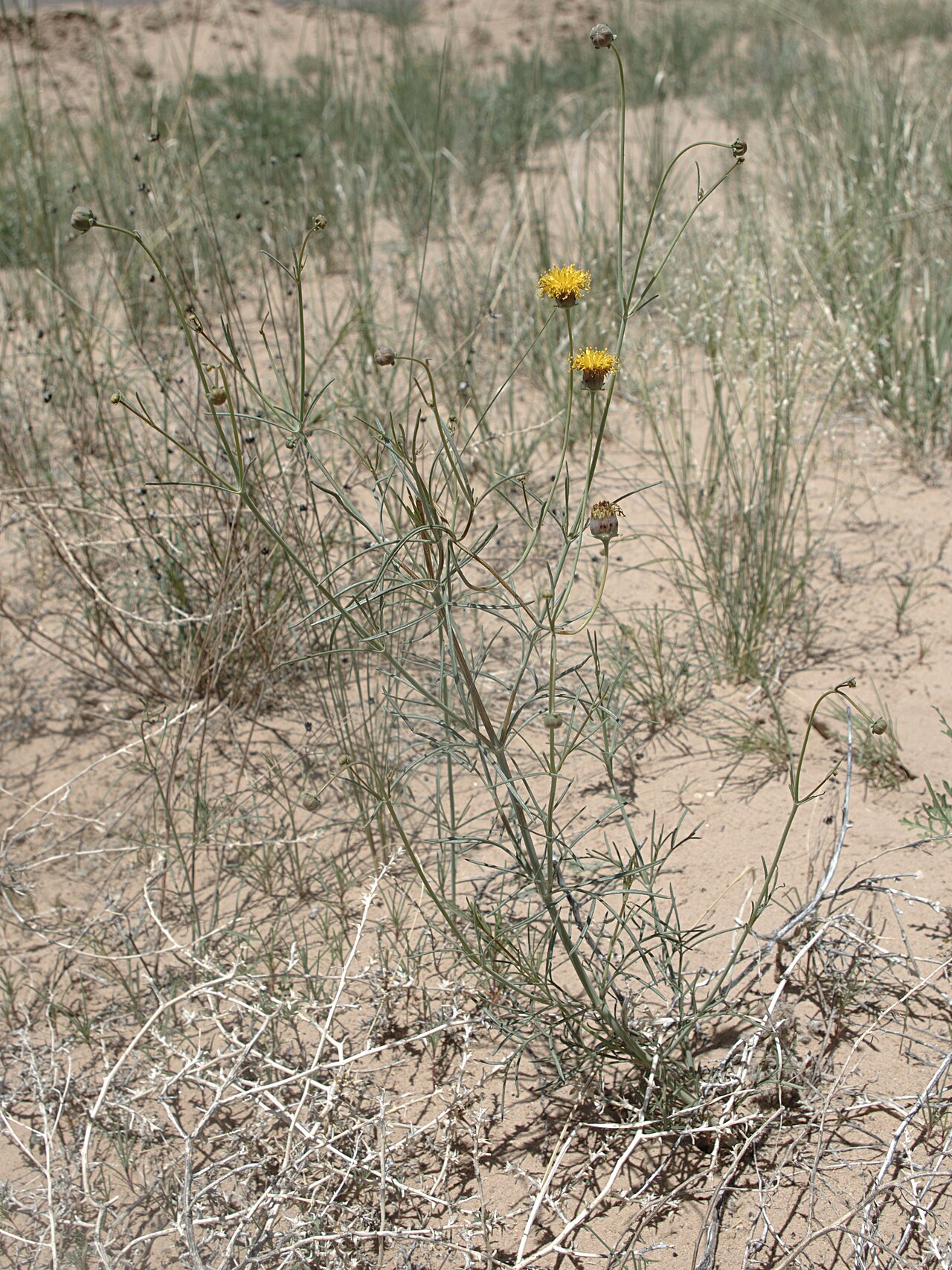
Rayless greenthread is easy to overlook among grasses. Look for slender, blue-green, wiry stems with a few thread-like leaves, topped in summer by small yellow heads that look like buttons, without the petal-like rays of most sunflower-family plants.
Stems & Growth Habit
The plant grows from a perennial root system with spreading underground stems, sending up several to many smooth, slender, upright stems usually 8 to 30 inches tall. The stems branch in the upper part and are mostly bare of leaves near the top. The whole plant is hairless and blue-green, and it often forms loose colonies.
Leaves
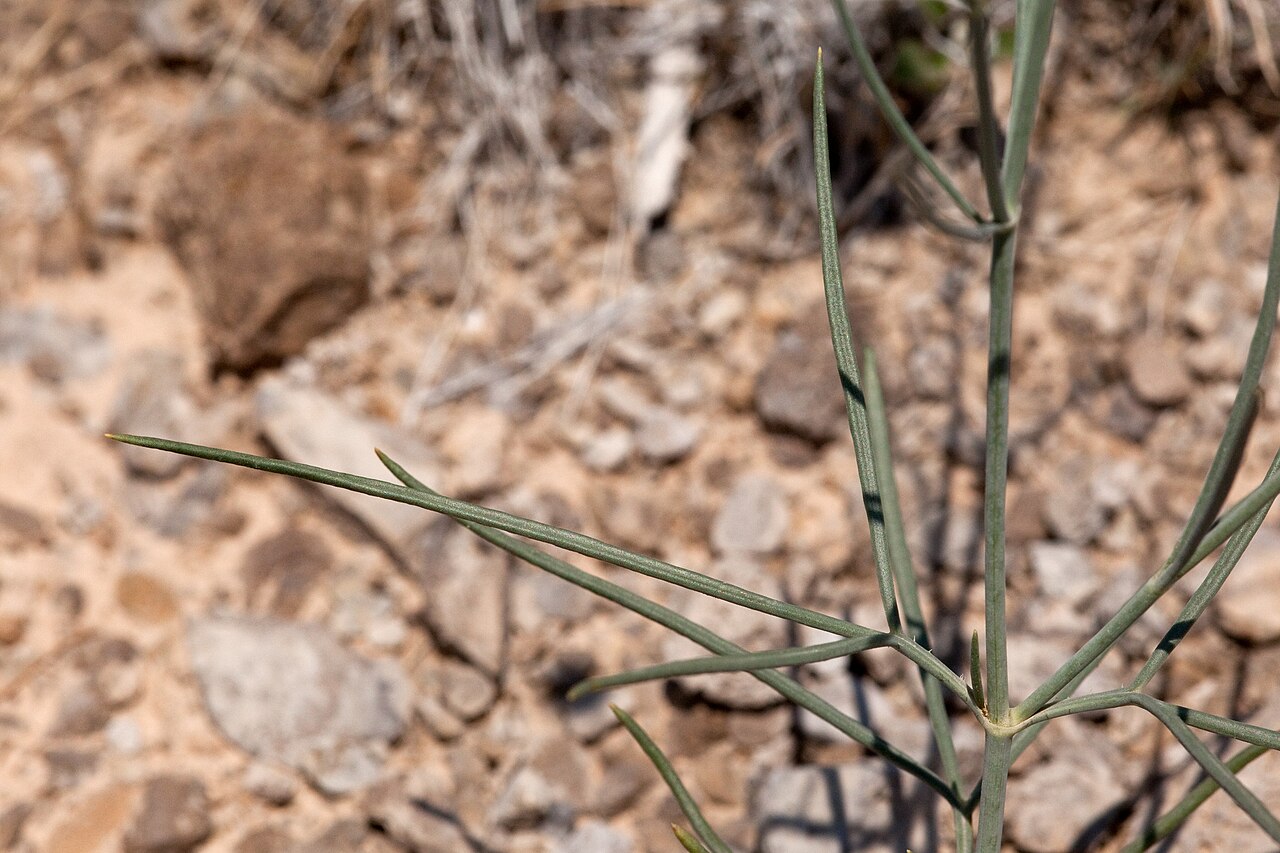
Most leaves are near the base and lower stems. They are opposite and divided into a few long, very narrow, thread-like segments, each about 1 to 1 1/2 inches long. The leaves are sparse, so the plant has an airy, see-through look, similar to a tuft of grass with a few branches.
Flowers
The flower heads are borne singly at the ends of long, slender stalks. Each head is about 1/2 inch across and made up of many small, tubular, yellow to orange-yellow disk flowers. Ray flowers are usually absent, though a few heads may carry small yellow rays. Beneath the head is a distinctive two-layered set of bracts: a few short, narrow outer bracts and an inner cup of bracts fused together for about half their length, with purplish tips and pale, papery edges. Flowering runs from about April to October, with most bloom in summer.
Fruit & Seeds
The seeds (achenes) are small, narrow and dark, often curved and roughened, and each is tipped with two short, barbed awns that can catch on fur and clothing. They ripen in late summer and fall.
Look-alikes
Greenthread (Thelesperma filifolium) is an annual or short-lived perennial with conspicuous yellow rays and is common in Texas and the southern plains. Stiff greenthread (Thelesperma subnudum) has larger heads that may have rays and is mainly a plant of the Colorado Plateau and Rocky Mountain region. Without flowers, rayless greenthread could be mistaken for a grass, but its opposite, divided leaves give it away.
Quick Facts
| Scientific Name | Thelesperma megapotamicum (Spreng.) Kuntze |
| Family | Asteraceae (aster or sunflower family) |
| Plant Type | Herbaceous perennial, spreading by rhizomes |
| Mature Height | 8–30 in |
| Mature Spread | 6–18 in; forms loose colonies |
| Growth Rate | Moderate |
| Sun Exposure | Full sun |
| Water Needs | Low; drought tolerant |
| Soil Type | Well-drained sandy, gravelly, rocky or clay-loam soils |
| Soil pH | Neutral to alkaline (about 6.5–8.5) |
| Bloom Time | April–October |
| Flower Color | Yellow to orange-yellow; usually without rays |
| Fall Color | Stems dry tan to brown |
| Fruit | Small achenes with two barbed awns |
| Deer Resistant | Not well documented |
| USDA Hardiness Zones | 4–9 |
Native Range
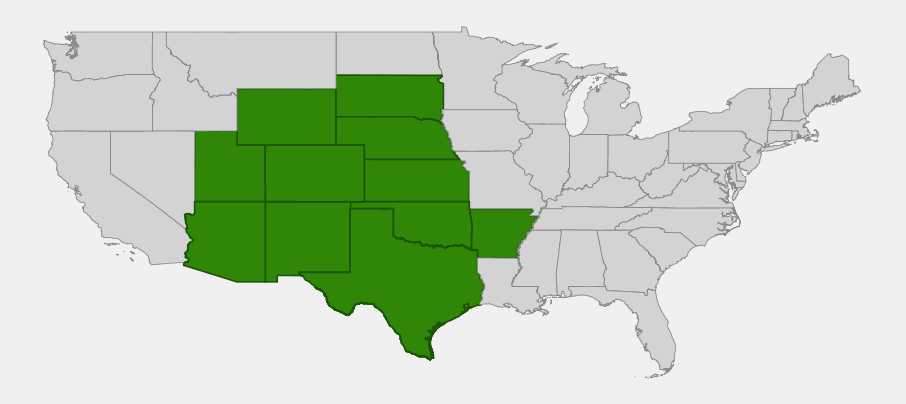
Rayless greenthread is native to the Great Plains and the Southwest, from South Dakota and Wyoming south through Nebraska, Colorado, Kansas, Utah, Oklahoma, New Mexico, Arizona and Texas, with scattered occurrences in Arkansas. It continues south into northern Mexico, and the same species also grows in parts of South America, an unusual split range shared by a few other plants of dry grasslands.
It is most common in the southern Rocky Mountain foothills, the high plains of eastern Colorado and New Mexico, and the plains of western Kansas, Oklahoma and Texas. It is rare at the edges of its range: NatureServe ranks it vulnerable in South Dakota and critically imperiled in Utah. USDA PLANTS also shows records from California, Oregon, Montana, Minnesota, Michigan, Illinois, Indiana and Missouri, but these are considered introduced populations, often along railroads and roadsides, and are not shown on the native range map.
It grows in dry grasslands and prairies, on sandy or rocky slopes, mesas and roadsides, in open pinyon-juniper and oak woodlands, desert scrub and open ponderosa pine forest, from about 1,000 feet to around 9,500 feet in elevation. It often turns up in disturbed openings, where its rhizomes allow it to spread.
📋 Regional plant lists featuring Rayless Greenthread: Montana & Wyoming · Nebraska, Kansas & Eastern Colorado · Utah & Western Colorado · Arizona & New Mexico · Arkansas, Louisiana, Eastern Oklahoma & Eastern Texas · South & West Texas · North Dakota, South Dakota & Western Minnesota
Growing & Care Guide
Rayless greenthread is an easy, low-maintenance plant for dry, sunny gardens in the Great Plains and Southwest. It is sold by some regional native plant nurseries and seed companies, often as Hopi tea or Navajo tea, and it works well in prairie and xeric plantings, herb gardens and among native grasses.
Light
Plant it in full sun. In shade the stems flop and flowering is sparse.
Soil & Water
It needs well-drained soil and thrives in sandy, gravelly or rocky ground, though it tolerates clay loam if it is not waterlogged. Water new plants during their first growing season. Once established, it survives on natural rainfall in most of its range, and occasional deep watering during long droughts keeps it blooming. Avoid rich, wet soils.
Planting Tips
Plant it in spring or fall, in groups or drifts, since single plants are slender and easy to lose. Its airy stems combine well with blue grama, sideoats grama and other short grasses and with low wildflowers such as blackfoot daisy and prairie zinnia. In smaller gardens, keep in mind that it spreads slowly by rhizomes.
Pruning & Maintenance
No pruning is needed. Cut the dry stems down in late winter or early spring before new growth starts. If you harvest stems for tea, cut them during summer bloom and leave enough of each clump to keep the plant vigorous.
Propagation
Grow it from seed sown in spring or fall, barely covered, in a sunny spot. A period of cold, moist stratification may improve germination. Established colonies can also be divided in early spring by lifting sections of rhizome with stems attached.
Landscape Uses
- Xeric and prairie gardens: an airy, drought-tolerant perennial among native grasses
- Herb and ethnobotanical gardens: a traditional Southwestern tea plant
- Pollinator plantings: long summer bloom for small native bees and other insects
- Grassland restoration: a native forb of dry plains and foothills
- Roadside and slope plantings: tolerates poor, dry, disturbed soils
Wildlife & Ecological Value
Rayless greenthread is a small part of the forb community in western grasslands, but it blooms over a long season and is used by many insects.
For Pollinators
The small disk flowers provide nectar and pollen for native bees, especially small bees, along with flies, beetles and small butterflies. Because it blooms from late spring into fall, it is a dependable food source through the hottest months.
For Birds
Seed-eating birds such as sparrows and finches may eat the small seeds in fall. Grassland birds also forage for insects among the stems.
For Mammals
Deer, pronghorn and livestock occasionally graze the stems, but it is not a major forage plant. Small mammals eat the seeds.
Ecosystem Role
As a deep-rooted, rhizomatous perennial, rayless greenthread helps hold soil on dry slopes and disturbed ground, and it adds flowering diversity to grass-dominated plains and woodlands. Its ability to colonize openings makes it one of the native plants that helps revegetate disturbed sites in its range.
Cultural & Historical Uses
The genus name Thelesperma comes from the Greek thele, nipple, and sperma, seed, referring to the small bumps on the seeds of some species. The species name megapotamicum means “of the great river.” The plant was first described by Curt Sprengel in 1826 as Bidens megapotamica and was moved to Thelesperma by Otto Kuntze in 1898. It was also long known as Thelesperma gracile.
Rayless greenthread is one of the best-known traditional tea plants of the Southwest. Hopi and Navajo people, other Native nations of the region, and Hispanic families in New Mexico and southern Colorado, who call it cota, have gathered the summer stems, often folded and tied into small bundles, dried them and brewed them into a mild, slightly earthy tea. The plant has also been used as a dye plant for yellow and orange tones.
Today cota and Navajo tea are still gathered and sold at local markets in the Southwest and are grown in herb gardens. If you want to try it, grow your own or buy from a reputable source, harvest only from plants you can identify with certainty and where gathering is allowed, and take only a portion of each plant.
Frequently Asked Questions
Is rayless greenthread the same as greenthread?
No. Greenthread (Thelesperma filifolium) is a related species with bright yellow rays. Rayless greenthread (Thelesperma megapotamicum) usually has button-like heads without rays. Both have thread-like leaves.
Why is it called Hopi tea or Navajo tea?
Hopi, Navajo and other peoples of the Southwest have traditionally brewed a tea from its dried stems and leaves. In New Mexico it is widely known as cota.
Where does rayless greenthread grow?
It is native to the Great Plains and Southwest, from South Dakota and Wyoming to Arizona, New Mexico and Texas, and into northern Mexico. It also grows in parts of South America. Populations farther east and west in the United States are considered introduced.
Is it easy to grow?
Yes, in a sunny spot with well-drained soil. It is drought tolerant, needs no fertilizer and spreads slowly by rhizomes into loose colonies.
Does rayless greenthread attract pollinators?
Yes. Small native bees and other insects visit its small yellow flower heads from late spring into fall.

Looking for a nursery that carries Rayless Greenthread?
Browse our native plant nursery directory: Arizona & Arkansas · Colorado · Kansas · Nebraska, New Mexico & Oklahoma · South Dakota, Texas & Utah · Wyoming

