
Narrowleaf Gentian (Gentiana linearis)
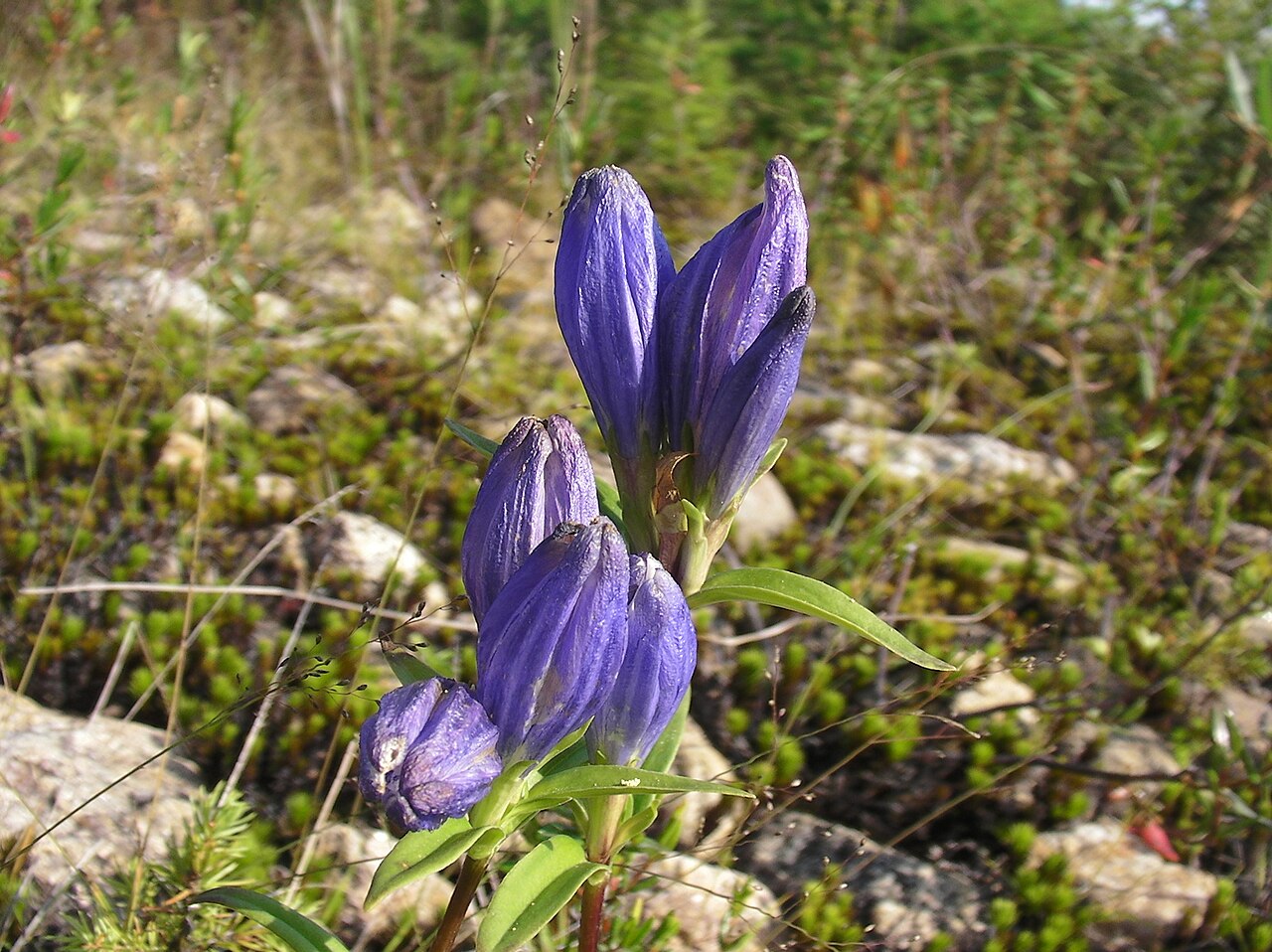
Gentiana linearis, known as Narrowleaf Gentian, is a native perennial wildflower of bogs, wet meadows, seeps and cool, moist mountain openings in northeastern North America. A member of the gentian family (Gentianaceae), it is a close relative of the bottle gentians. Like them, it bears deep blue to violet, tubular flowers that stay closed or only barely open, but its leaves are distinctly narrow and grass-like, as its name says.
Plants usually grow 1 to 2 feet tall on unbranched stems, with a tight cluster of one to several flowers at the top and sometimes a few more in the upper leaf axils. It blooms from late July into September, a little earlier than most other blue gentians in its range. Its range runs from Manitoba and the Great Lakes to Newfoundland and New England, with outlying populations along the Appalachian Mountains south to Virginia, West Virginia and Tennessee.
Narrowleaf gentian is uncommon in much of its range and is tracked as a rare plant in several states, especially toward the southern edge of its range. It is seldom offered by nurseries. If you want to grow it, use nursery-propagated plants or seed from a reputable native plant source, and never dig plants from the wild.
Identification
Look for slender, unbranched stems with pairs of very narrow, linear to narrowly lance-shaped leaves, topped by a small cluster of upright, nearly closed blue-violet flowers in late summer.
Growth Habit
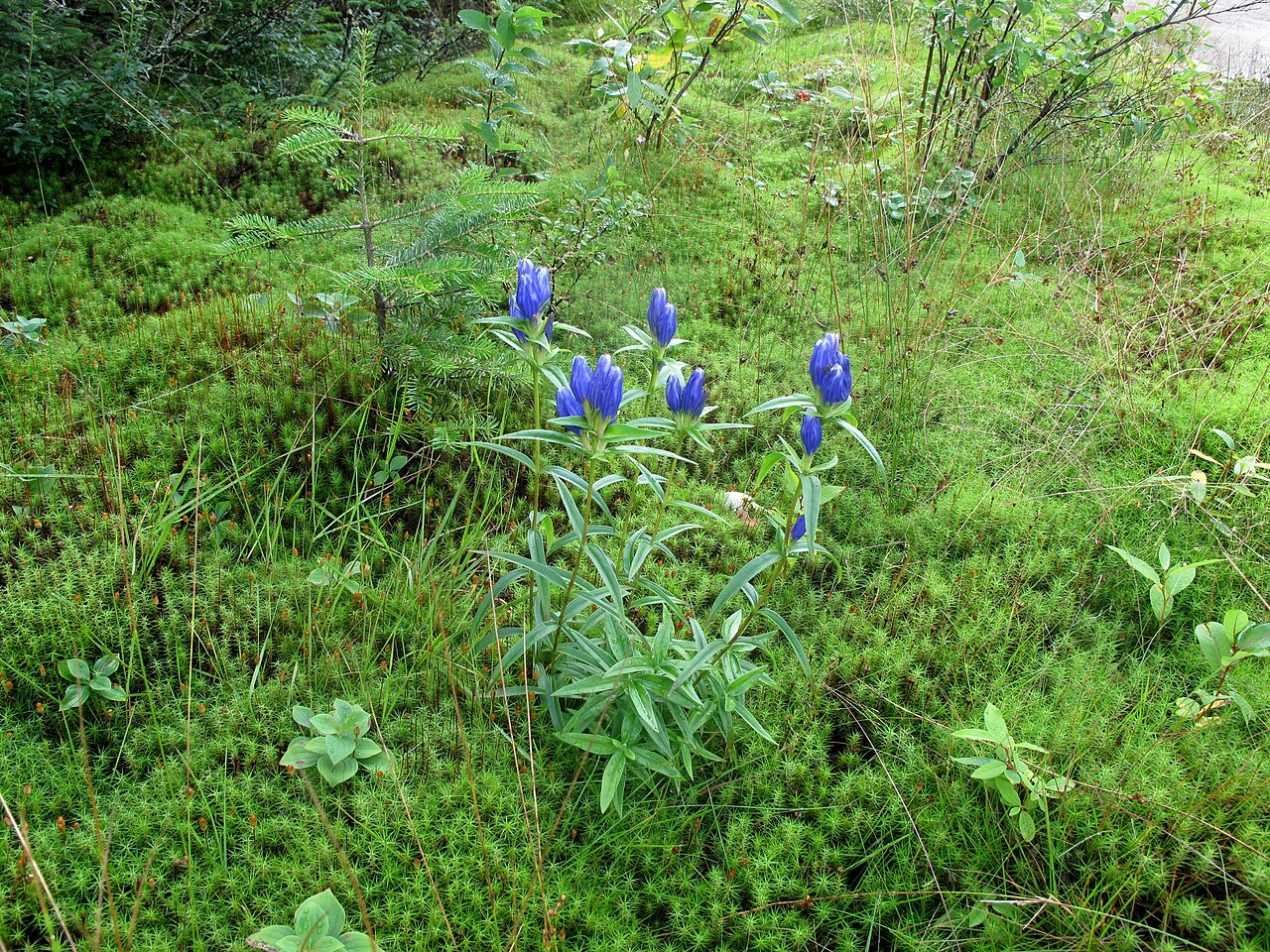
An erect, clump-forming perennial from a short rootstock, usually 1 to 2 feet tall (8 to 30 inches). Stems are smooth and usually unbranched, often several from one crown.
Leaves
The leaves are opposite, stalkless and smooth, narrowly linear to narrowly lance-shaped, about 2 to 4 inches long and usually less than 1/2 inch wide, much narrower than those of bottle gentian. They are firm and pointed.
Flowers
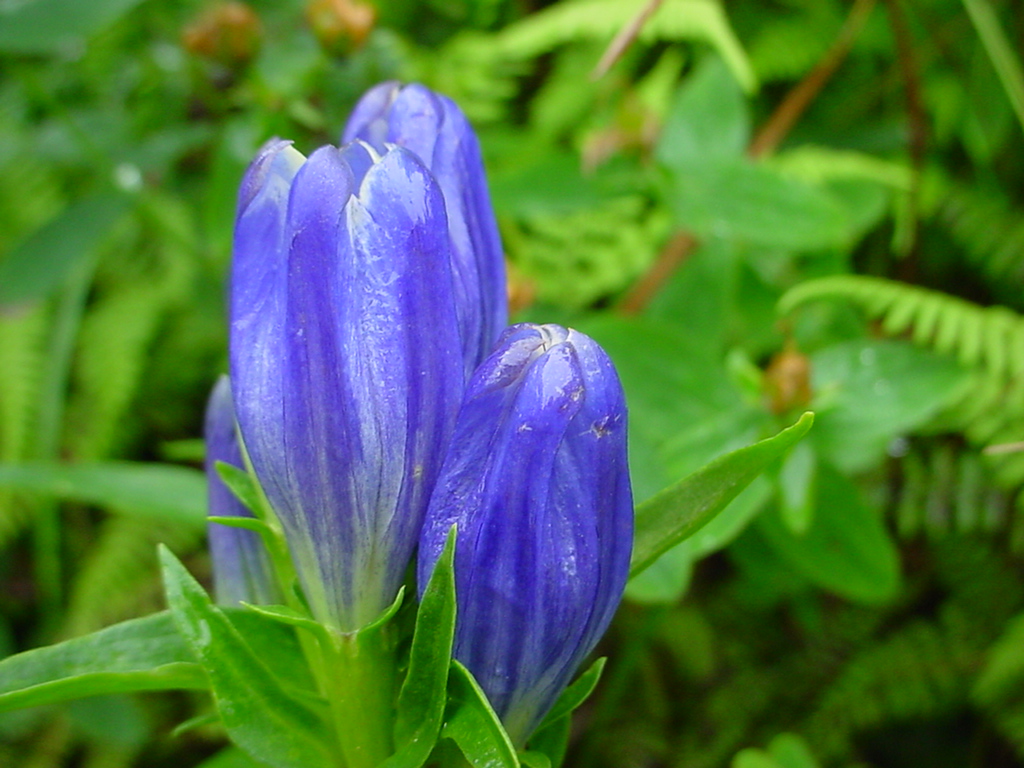
Flowers are 1 to 1 1/2 inches long, deep blue to violet (rarely white), upright and narrowly bell- or club-shaped, in a terminal cluster of one to five, with a few more sometimes in the upper leaf axils. The five short corolla lobes meet or open only slightly at the tip, and small pleats between them hold the flower nearly closed. A green calyx with short, narrow lobes sits at the base. Bloom time is late July to September.
Fruit & Seeds
The fruit is a narrow capsule that develops within the persistent, withered corolla and splits in fall to release many small seeds.
Look-alikes
Bottle gentian (Gentiana andrewsii) and closed gentian (G. clausa) have wider, lance-shaped to oval leaves and fully closed flowers. Soapwort gentian (G. saponaria) has broader leaves and grows farther south. Narrowleaf gentian is distinguished by its very narrow leaves and slightly open flower tips. In some areas it hybridizes with other gentians, producing plants with intermediate leaves.
Quick Facts
| Scientific Name | Gentiana linearis |
| Family | Gentianaceae (gentian family) |
| Plant Type | Herbaceous perennial wildflower |
| Mature Height | 1–2 ft |
| Mature Spread | 6–12 in |
| Growth Rate | Slow |
| Sun Exposure | Full sun to part shade |
| Water Needs | High; moist to wet soil |
| Soil Type | Moist to wet, acidic, peaty or sandy soil |
| Soil pH | Acidic (about 4.5–6.5) |
| Bloom Time | Late July–September |
| Flower Color | Deep blue to violet |
| Fall Color | Leaves may turn purplish |
| Fruit | Capsule with many small seeds |
| Deer Resistant | Moderate |
| USDA Hardiness Zones | 3–6 |
Native Range
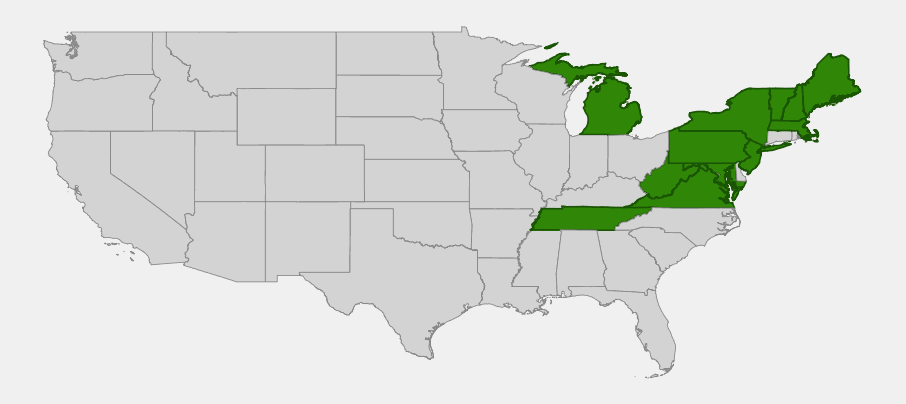
Narrowleaf gentian is native to northeastern North America. USDA PLANTS records it as native in Maine, New Hampshire, Vermont, Massachusetts, New York, New Jersey, Pennsylvania, Maryland, West Virginia, Virginia, Tennessee and Michigan. In Canada it grows from Manitoba and Ontario east through Quebec to New Brunswick and Newfoundland.
It is most frequent in northern New England, the Adirondacks, northern Michigan and southern Canada. Farther south it is rare and grows mainly at higher elevations in the Appalachians, including mountain bogs and high meadows in West Virginia, Virginia and the Great Smoky Mountains of Tennessee. Records in New Jersey and Maryland are few and scattered.
Typical habitats are bogs, fens, wet meadows, seepage areas, wet thickets, open stream and lake shores, and moist, open mountain slopes and balds. In northern New England it also grows in subalpine meadows. It favors cool, acidic, moist soils in full sun or light shade.
📋 Regional plant lists featuring Narrowleaf Gentian: New York, Pennsylvania & Northern New Jersey · Michigan, Wisconsin & Eastern Minnesota · Kentucky & Tennessee · Connecticut, Massachusetts & Rhode Island · New Hampshire, Maine & Vermont · Maryland, Virginia & West Virginia · Delaware, Southern New Jersey & Long Island
Growing & Care Guide
Narrowleaf gentian is a choice plant for a bog garden or a constantly moist, sunny spot in cooler climates. It is slow to establish and dislikes hot, dry summers, but once settled it is long-lived. Start with nursery-propagated plants or seed from a reputable source.
Light
Full sun to part shade. In cool northern and mountain gardens it does well in full sun if the soil stays moist; in warmer areas give it light afternoon shade.
Soil & Water
It needs consistently moist to wet, acidic soil rich in organic matter, such as a mix of peat or leaf mold and sand. Never let it dry out. A bog garden, pond margin or low, wet spot that stays damp all summer is ideal.
Planting Tips
Plant in spring with the crown at soil level. Space plants about 12 inches apart and group several together for a better display. Keep taller, aggressive neighbors away, because it competes poorly in dense vegetation.
Pruning & Maintenance
Little care is needed. Leave the stems standing until the capsules have released their seed, then cut them back in late fall or spring. Avoid disturbing the crowns, which resent being moved once established.
Propagation
Grow it from seed sown on the surface of moist, acidic mix in fall or after a period of cold, moist stratification; the small seeds need light to germinate. Seedlings grow slowly and may take two to three years to flower. Established clumps can be carefully divided in early spring.
Landscape Uses
- Bog gardens: late-summer blue for wet, acidic bog plantings
- Pond and stream edges: for cool, constantly moist margins
- Wet meadows: a long-lived accent among sedges and wet-meadow wildflowers
- Pollinator gardens: late-season flowers for bumblebees
- Mountain and northern gardens: suited to cool summers and acidic soils
Wildlife & Ecological Value
Like other closed and nearly closed gentians, narrowleaf gentian is closely tied to bumblebees, the only common insects strong enough to open its flowers.
For Pollinators
Bumblebees push their way between the nearly closed corolla lobes to reach the nectar at the base of the flower, carrying pollen from plant to plant. Smaller bees cannot get in, although some insects may rob nectar by biting through the side of the flower.
For Birds
The small seeds have little value for birds, but the bogs and wet meadows where it grows support many nesting songbirds.
For Mammals
Deer and other herbivores sometimes browse the stems. Like other gentians, it has bitter compounds that make it less palatable than many wetland plants.
Ecosystem Role
It is part of the plant community of open bogs, fens and wet mountain meadows, and in the south it is a relict of cooler times, surviving in high-elevation wetlands. It declines when these sites are drained, overgrown by shrubs or trampled.
Cultural & Historical Uses
The genus name Gentiana honors Gentius, a king of ancient Illyria who, according to tradition, discovered the medicinal value of gentian roots. The species name linearis refers to the narrow, linear leaves that separate it from the bottle gentians.
Gentian roots are famously bitter, and European species have long been used to make bitter tonics and digestive liqueurs. Narrowleaf gentian shares those bitter compounds, but it is uncommon and should not be collected; it is valued today as a wildflower rather than as a medicine.
In the southern Appalachians, narrowleaf gentian is one of several northern plants that survive in high mountain bogs and meadows, a reminder of colder climates during the last ice age. These small populations are of special interest to botanists and conservationists.
Frequently Asked Questions
Do narrowleaf gentian flowers ever open?
Only slightly. The tips of the corolla lobes part a little, but the flowers never open wide. Bumblebees force their way in to pollinate them.
How is narrowleaf gentian different from bottle gentian?
Narrowleaf gentian has much narrower, linear leaves and flowers that open slightly at the tip. Bottle gentian has wider leaves and flowers that stay fully closed.
Where does narrowleaf gentian grow?
In bogs, fens, wet meadows, seeps and moist mountain openings from Manitoba and the Great Lakes to Newfoundland and New England, and south in the Appalachians to Tennessee.
Can I grow narrowleaf gentian in my garden?
Yes, in a cool, constantly moist, acidic spot such as a bog garden. Use nursery-propagated plants or seed and never dig wild plants.
When does narrowleaf gentian bloom?
From late July into September, depending on latitude and elevation.

Looking for a nursery that carries Narrowleaf Gentian?
Browse our native plant nursery directory: Maine, Maryland, Massachusetts & Michigan · New Hampshire, New Jersey & New York · Pennsylvania, Tennessee, Vermont & Virginia · West Virginia

