
Marsh Grass-of-Parnassus (Parnassia palustris)
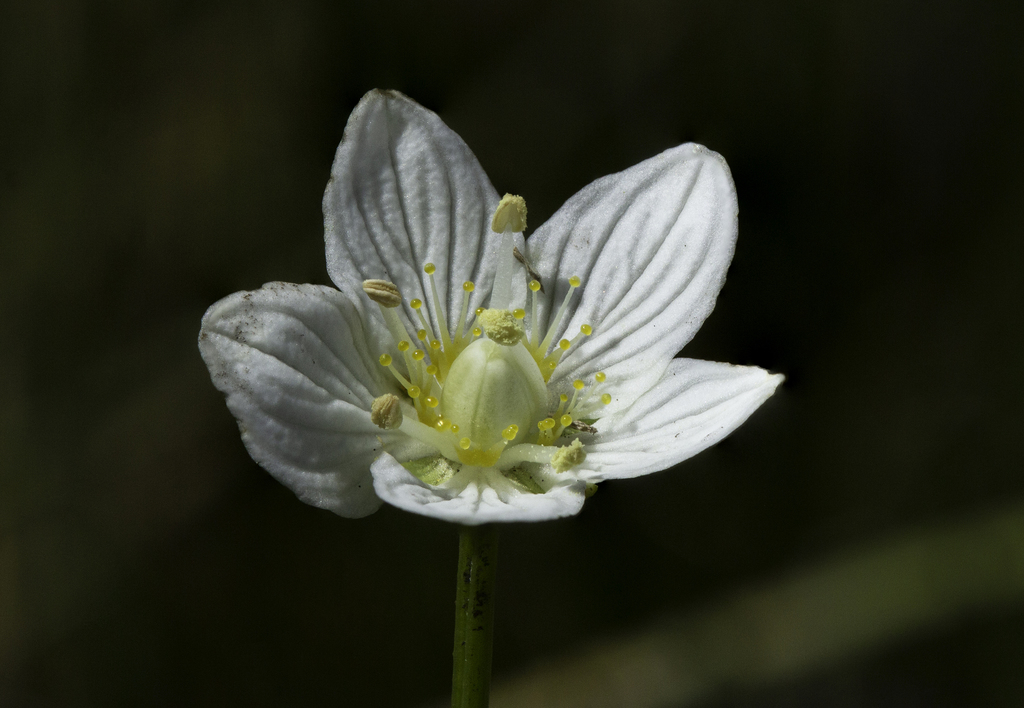
Parnassia palustris, known as Marsh Grass-of-Parnassus or northern grass-of-Parnassus, is a low perennial wildflower of wet meadows, fens, seeps and stream banks across the cooler parts of the Northern Hemisphere. Despite its name, it is not a grass. In mid to late summer it raises slender stems, usually 4 to 20 inches tall, each with a single, five-petaled white flower about 3/4 to 1-1/4 inches across, finely veined in green or gray.
The flower has one of the most intriguing structures of any wildflower. Between its five true stamens are five sterile, fringed structures called staminodes, each divided into a fan of slender filaments tipped with shiny, yellow-green knobs that look like drops of nectar. They help attract flies and other small pollinators. The family placement of Parnassia has long puzzled botanists; it is now usually placed in the staff-tree family (Celastraceae).
In the United States it grows from Alaska and the Pacific states east through the Rocky Mountains and Great Basin to the northern Great Plains and the upper Great Lakes. In the garden, it is a choice plant for a bog garden, fen or streamside with cool, constantly moist, often limy soil. This guide covers how to identify it, where it grows, how to grow it, and its value to pollinators.
Identification
Marsh grass-of-Parnassus is easy to recognize by its single white flowers with veined petals and fringed staminodes, but there are several similar species of Parnassia in North America.
Growth Habit
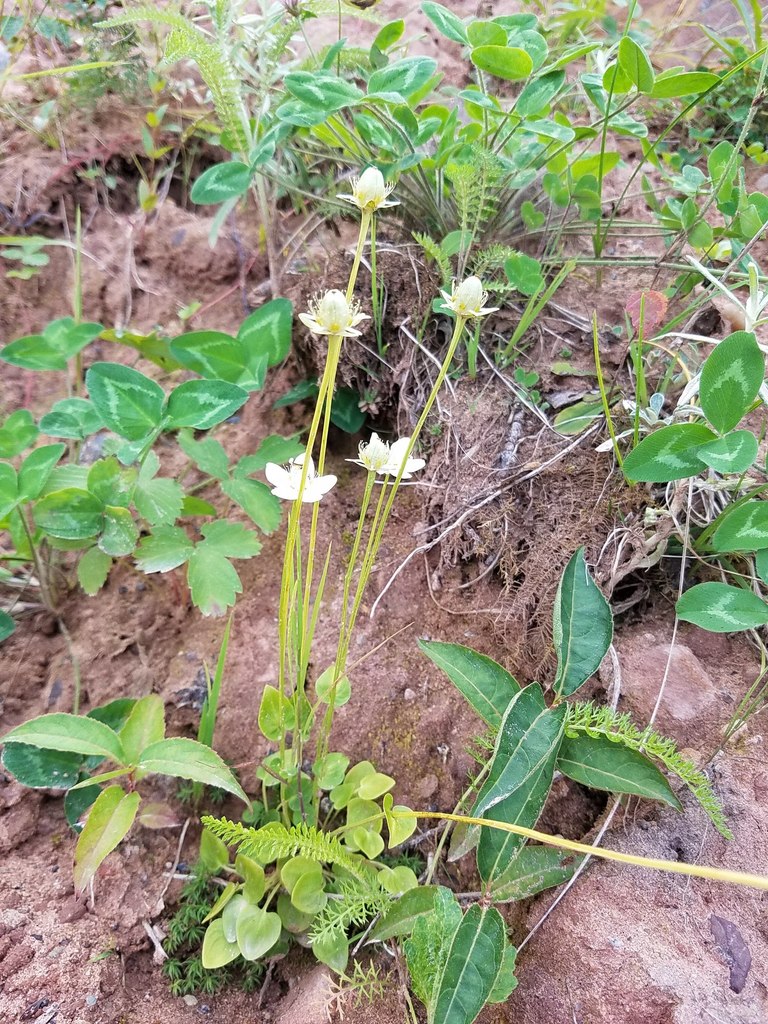
It grows as a small clump of basal leaves from a short, thick rhizome. In summer it sends up one to several slender, upright, unbranched flowering stems, usually 4 to 20 inches tall depending on the site, each ending in a single flower. The whole plant is hairless.
Leaves
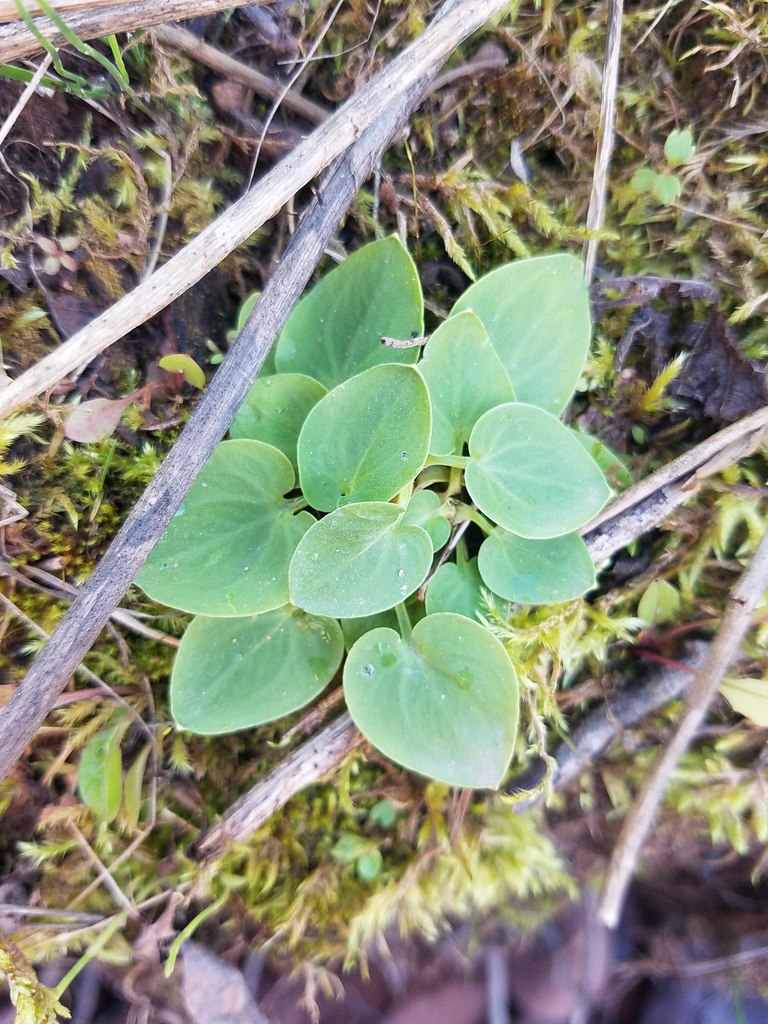
The basal leaves are smooth, somewhat fleshy and rounded to heart-shaped, usually 1/2 to 2 inches long, on long stalks. Each flowering stem carries a single stalkless leaf that clasps the stem, usually below the middle. This clasping stem leaf is a useful field mark.
Flowers
Each flower has five white, oval petals, about 1/2 inch long, marked with fine, darker green to gray veins. Five fertile stamens alternate with five staminodes, each divided into a fringe of several to many slender filaments ending in round, shiny, yellowish-green glands. The flowers bloom from about July to September, later at higher elevations.
Fruit & Seeds
The fruit is an egg-shaped capsule, about 1/2 inch long, that splits into four parts to release many tiny, winged seeds, which are spread by wind and water.
Look-alikes
Other North American species include small-flowered grass-of-Parnassus (P. parviflora), with smaller petals and staminodes divided into fewer (about 5 to 7) segments; Kotzebue’s grass-of-Parnassus (P. kotzebuei) of Alaska and the high mountains, which has short petals and usually no stem leaf; fringed grass-of-Parnassus (P. fimbriata) of the western mountains, with fringed petal edges; and Carolina grass-of-Parnassus (P. glauca) of the East, which has broader leaves and three-pronged staminodes. Some floras treat western plants as P. palustris var. montanensis.
Quick Facts
| Scientific Name | Parnassia palustris L. |
| Family | Celastraceae (staff-tree family); formerly placed in Saxifragaceae or Parnassiaceae |
| Plant Type | Herbaceous perennial |
| Mature Height | 4–20 in in flower |
| Mature Spread | 4–8 in |
| Growth Rate | Slow to moderate |
| Sun Exposure | Full sun to part shade |
| Water Needs | High; constantly moist to wet soil |
| Soil Type | Wet, often calcareous soils of fens, seeps, wet meadows and stream banks |
| Soil pH | About 6.5–8.0; tolerates limy soil |
| Bloom Time | July–September |
| Flower Color | White with green or gray veins |
| Fall Color | None |
| Fruit | Egg-shaped, four-parted capsule with tiny seeds |
| Deer Resistant | Not well documented |
| USDA Hardiness Zones | 2–7 |
Native Range
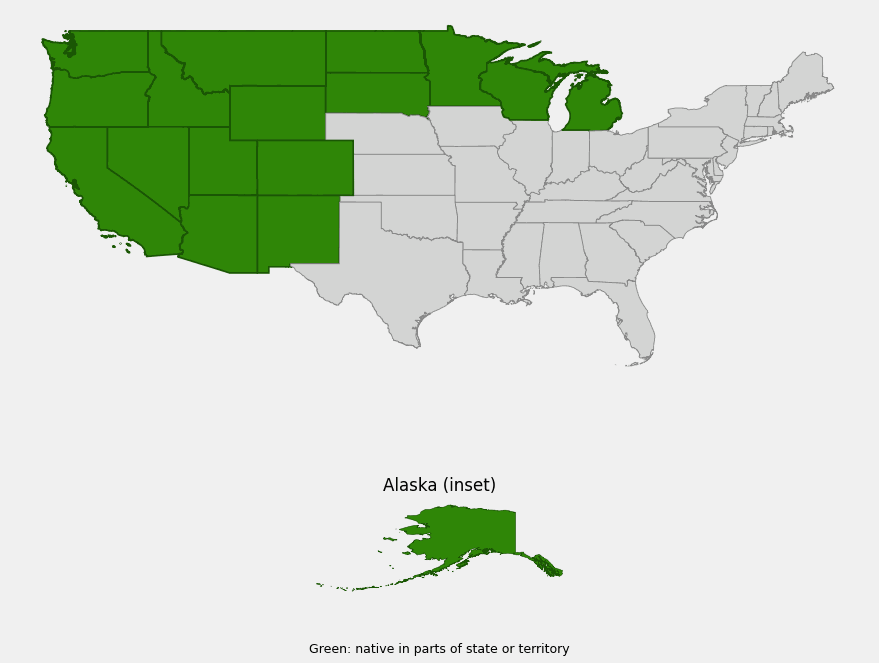
Marsh grass-of-Parnassus is circumboreal: it grows across northern Europe and Asia as well as North America. In North America it ranges across Canada from Newfoundland and Labrador to Yukon and Nunavut. In the United States, USDA PLANTS lists it as native to Alaska, the Pacific states (Washington, Oregon, California), the Rocky Mountain and Great Basin states (Idaho, Montana, Wyoming, Colorado, Utah, Nevada, Arizona and New Mexico), the Dakotas, and the upper Great Lakes states of Minnesota, Wisconsin and Michigan.
It is most common in Alaska, the mountains of California, northern Minnesota and the Rocky Mountains. In the Southwest it is restricted to scattered springs, seeps and mountain meadows; Arizona has only a few known sites, which are best treated as outlying populations. In the Dakotas it grows in fens, wet meadows and seeps in the north and in the Black Hills. In the Great Lakes states it is found mainly in the north, in fens, wet sand flats and along the shores of Lake Superior.
Throughout its range it grows in open, wet places: fens and calcareous wet meadows, seeps and springs, stream banks, lake shores, wet sand and gravel flats, and moist tundra, from near sea level in the north to subalpine elevations in the western mountains. It often grows in alkaline, mineral-rich soils.
📋 Regional plant lists featuring Marsh Grass-of-Parnassus: Idaho, Eastern Oregon & Eastern Washington · Montana & Wyoming · Michigan, Wisconsin & Eastern Minnesota · Utah & Western Colorado · Arizona & New Mexico · Alaska · North Dakota, South Dakota & Western Minnesota · Western Oregon & Western Washington · California & Nevada
Growing & Care Guide
Marsh grass-of-Parnassus is not a common garden plant, but it can be grown in a bog garden, an artificial fen, or along a cool stream or pond edge. It is occasionally offered by specialist nurseries and seed suppliers. Its needs are simple but strict: constant moisture, cool roots and an open, sunny site.
Light
Grow it in full sun in cool climates, or with afternoon shade where summers are hot. In the wild it grows in open fens and meadows, often among low sedges and grasses.
Soil & Water
The soil must stay moist to wet all season. A mineral soil or a mix of sand and peat-free compost works well, and it tolerates and often prefers limy, alkaline conditions. Never let the soil dry out. It does best where water seeps or flows slowly, as at a pond margin or in a constantly fed bog bed.
Planting Tips
Plant small pots in spring in a damp spot where taller plants won’t crowd it. It looks best in groups among small sedges, sundews and other low wetland plants, where its white flowers stand out in late summer.
Pruning & Maintenance
Little care is needed. Remove dead stems in fall or spring. Keep competing grasses and weeds in check, since this small plant is easily overtopped. In hot, dry spells, check that the soil stays wet.
Propagation
Grow it from fresh seed sown on the surface of moist, sandy compost in fall and left outdoors over winter; the seeds benefit from cold stratification and need light to germinate. Established clumps can be divided carefully in spring. Never dig plants from the wild.
Landscape Uses
- Bog gardens and artificial fens: a late-summer bloom among sundews and sedges
- Pond and stream margins: thrives in constantly wet, cool soil
- Rock gardens with seepage: suits wet, gravelly, limy soil
- Pollinator gardens: attracts flies, small bees and other small insects
- Wetland restoration: a native of fens, wet meadows and seeps in the North and West
Wildlife & Ecological Value
Marsh grass-of-Parnassus has an unusual pollination system that has fascinated naturalists for more than two centuries.
For Pollinators
The flowers are visited mainly by flies, including hover flies, and also by small bees, wasps and beetles. The shiny, knob-tipped staminodes look like droplets of nectar and are thought to act as lures, while real nectar is produced at the base of the staminodes. The stamens ripen one at a time over several days, before the stigma is ready, which favors cross-pollination by visiting insects.
For Birds
It has little direct value for birds, but the fens and wet meadows where it grows support many birds, from sandhill cranes to sparrows and wrens.
For Mammals
It is a small plant that may be grazed along with other wet-meadow vegetation by deer, elk, moose and livestock. In some parts of its range, heavy grazing and trampling of wet meadows has reduced populations.
Ecosystem Role
Marsh grass-of-Parnassus is a good indicator of fens, seeps and calcareous wet meadows, habitats that depend on a steady supply of mineral-rich groundwater. These habitats are easily damaged by drainage, groundwater pumping, grazing and road building, and the plant is considered rare in some states at the edges of its range.
Cultural & Historical Uses
The name goes back to the ancient Greek physician Dioscorides, who described a “grass of Parnassus,” a plant that grazing cattle enjoyed on the slopes of Mount Parnassus in Greece. Linnaeus kept the name for the genus in 1753. The species name palustris means “of marshes.”
Grass-of-Parnassus has a long place in European folk culture and gardens, and it is a familiar late-summer wildflower in northern Britain and Scandinavia. Botanists have argued for over a century about where Parnassia belongs, placing it in the saxifrage family, in its own family, and today in the staff-tree family with bittersweet and euonymus.
Its staminodes have made it a classic example in the study of flower pollination. Their glistening, nectar-like knobs have been discussed by naturalists since the late 18th century as an example of how flowers might deceive or guide insects.
Frequently Asked Questions
Is grass-of-Parnassus a grass?
No. It is a broad-leaved wildflower with white, five-petaled flowers. The name comes from an ancient Greek description of a plant grazed on Mount Parnassus.
What are the fringed structures in the flower?
They are staminodes, sterile stamens divided into slender filaments tipped with shiny glands. They are thought to attract insects, and nectar is produced at their bases.
Where does marsh grass-of-Parnassus grow?
It grows in fens, wet meadows, seeps, stream banks and tundra across the northern parts of North America, Europe and Asia. In the U.S. it is found from Alaska to California, the Rockies, the Dakotas and the upper Great Lakes.
Can I grow it in my garden?
Yes, in a bog garden or along a cool, constantly wet stream or pond edge with sun or light shade. It does not tolerate dry soil or hot, dry summers.
When does it bloom?
From about July to September, with peak bloom in late summer.

Looking for a nursery that carries Marsh Grass-of-Parnassus?
Browse our native plant nursery directory: Alaska & Arizona · California · Colorado · Idaho · Michigan, Minnesota & Montana · Nevada, New Mexico & North Dakota · Oregon · South Dakota & Utah · Washington · Wisconsin & Wyoming

