
Parish’s Bluecurls (Trichostema parishii)
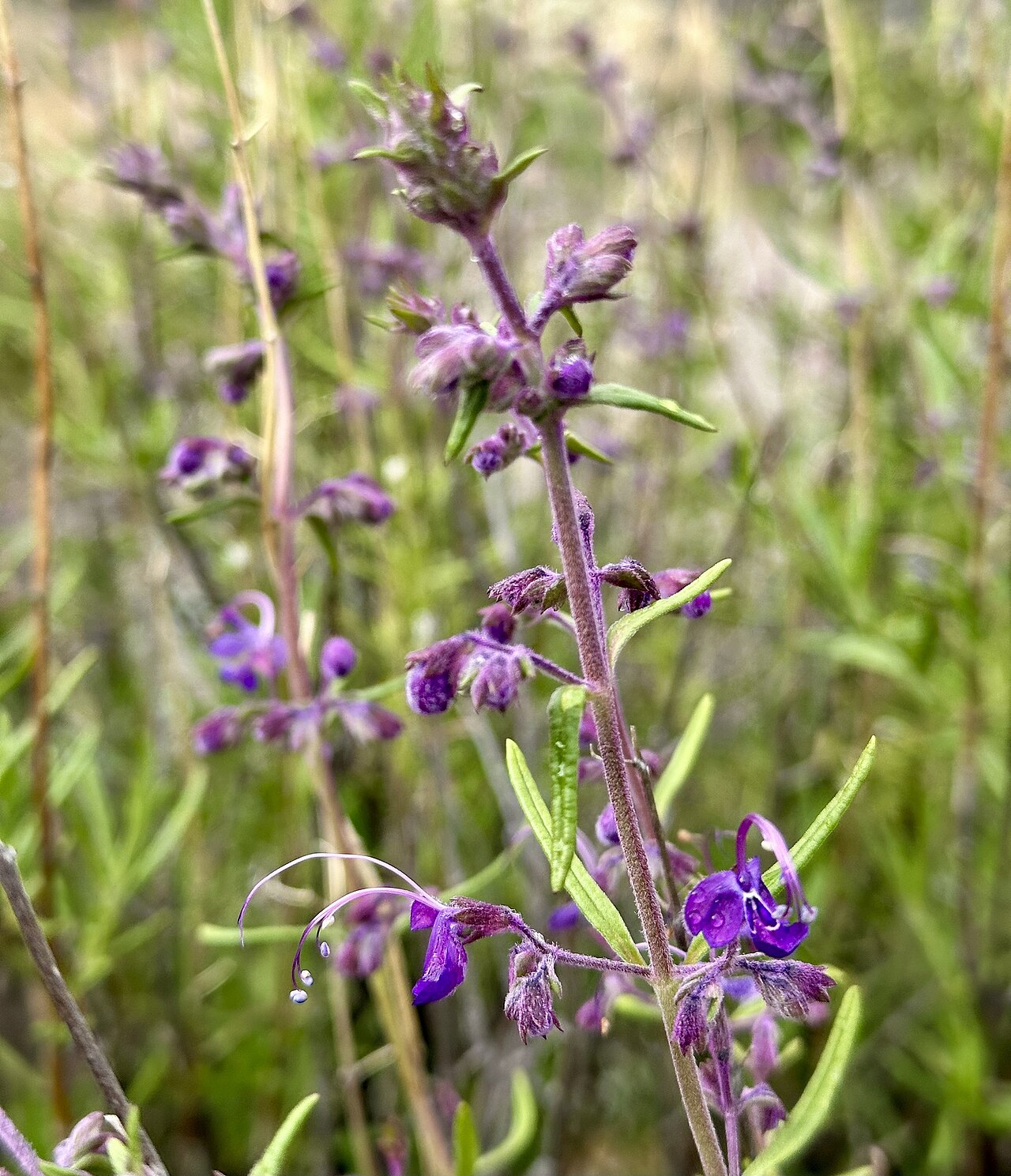
Trichostema parishii, known as Parish’s Bluecurls or mountain bluecurls, is an aromatic shrub of the chaparral and sage scrub of southern California and northern Baja California. In spring its stems are lined with clusters of violet-purple flowers wrapped in soft, colored wool, and each flower sends out four long, arching stamens that curl up and over like the strands of a fountain.
It is a close relative of the better-known woolly blue curls (Trichostema lanatum) and has the same strong, sweet-resinous scent when the leaves are brushed. Plants are usually 2 to 4 feet tall, with narrow, dark green leaves that roll under at the edges, and they grow on dry, rocky and sandy slopes in the foothills and mountains, where hummingbirds and bees work the flowers through spring.
The species honors Samuel Bonsall Parish, who with his brother William botanized extensively around San Bernardino in the late nineteenth century. This guide covers how to identify Parish’s bluecurls, where it grows, how to grow it in a dry southern California garden, and its value to pollinators.
Identification
In bloom, Parish’s bluecurls is unmistakable: an upright, aromatic shrub with narrow leaves and spikes of purple, woolly-hairy flower clusters with long, curved blue stamens. Out of flower, the rolled-under linear leaves and the strong resinous smell are the best clues.
Growth Habit
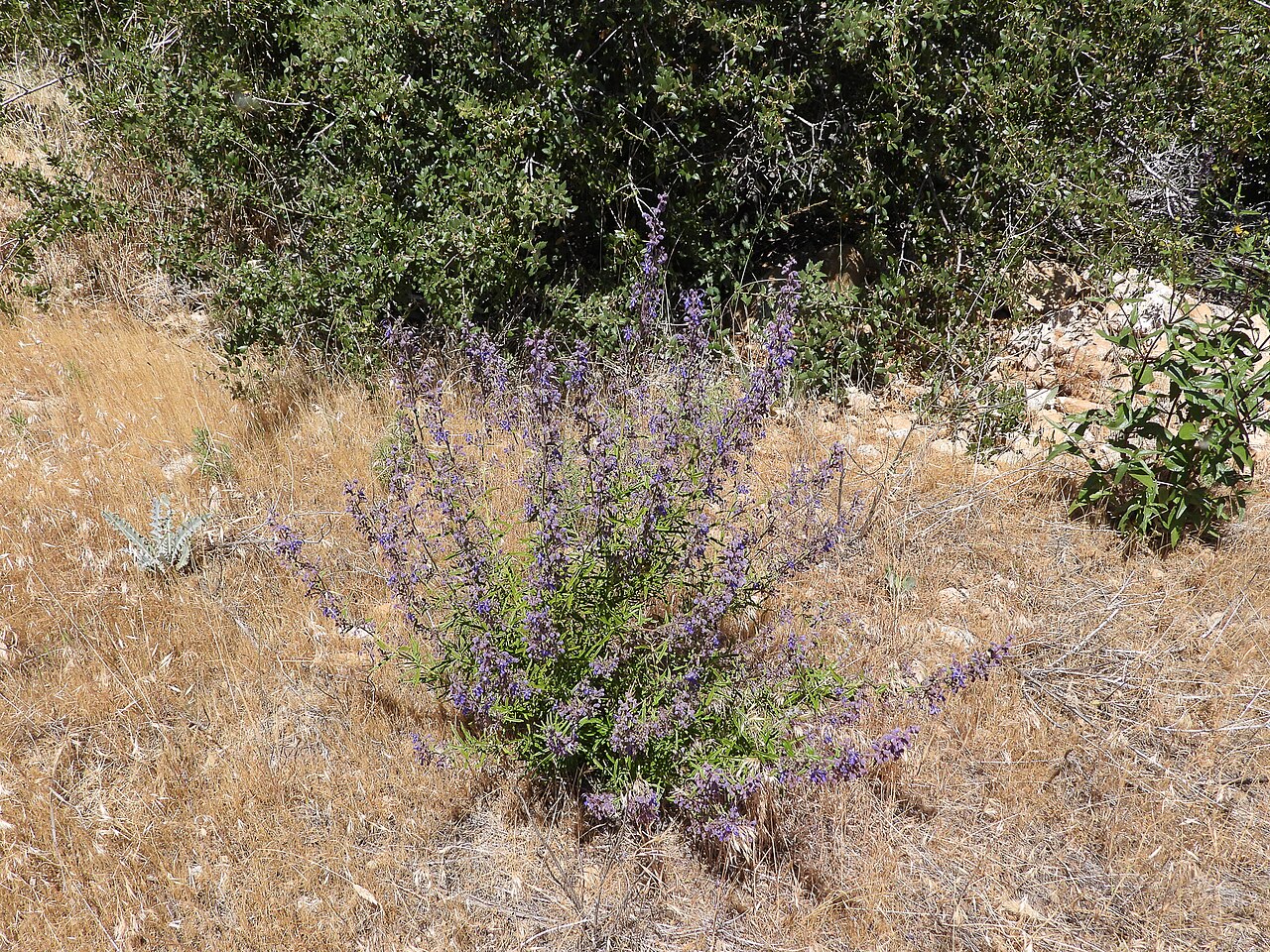
It is an upright, much-branched shrub, usually 2 to 4 feet tall (rarely to about 4 1/2 feet) and about as wide, with stiff, leafy stems from a woody base. Small clusters of short leaves often grow in the angle above each main leaf, giving the stems a bushy look.
Leaves
The leaves are opposite, narrow and linear, up to about 2 1/2 inches long, dark green above and hairier below, with edges that roll under. The foliage is covered with short glandular and nonglandular hairs and smells strongly aromatic when crushed.
Flowers
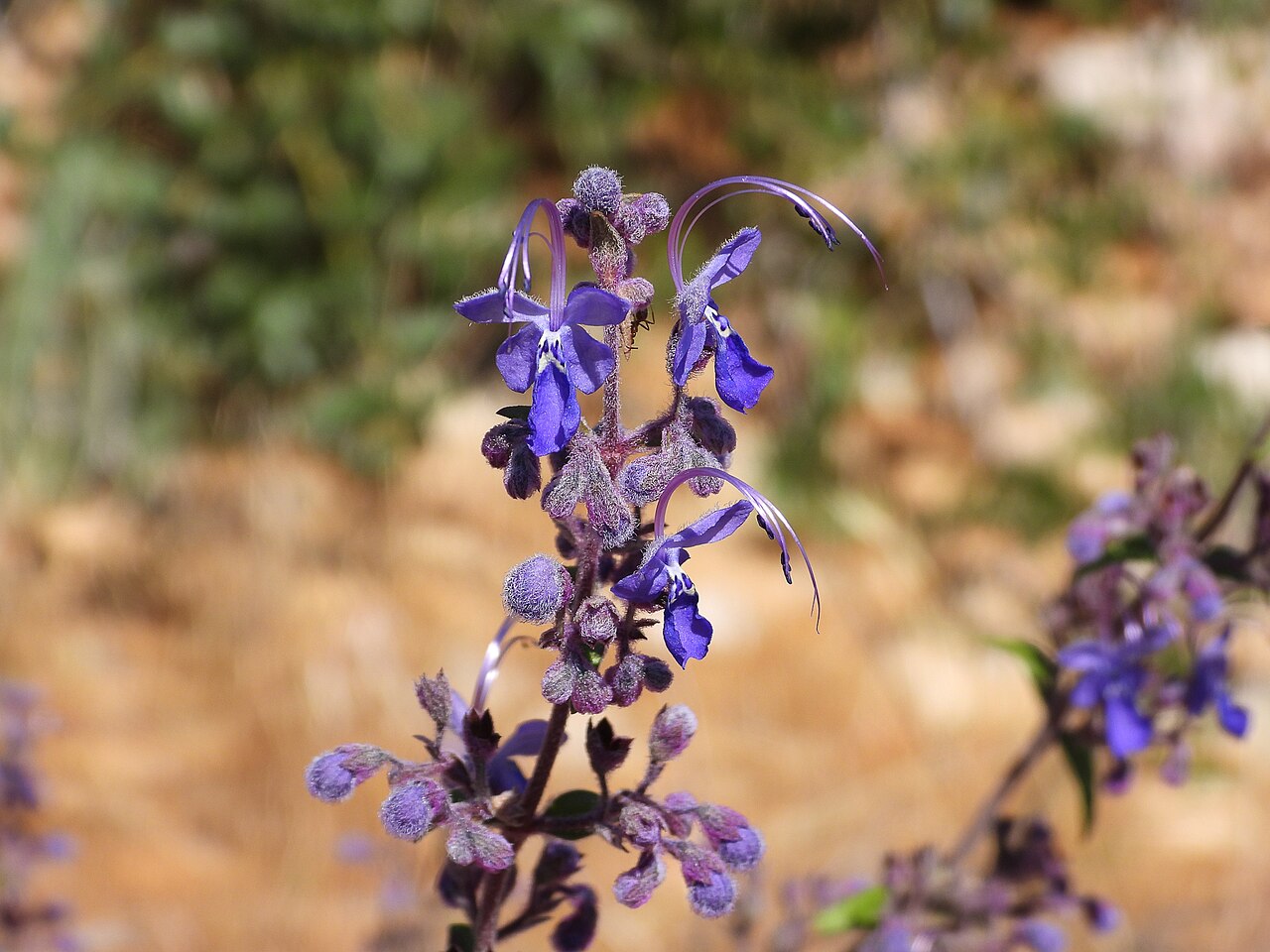
Flowers are borne in clusters along the upper part of the stems, forming long, leafy spikes. The flower clusters and calyces are covered in fluffy, woolly hairs in shades of blue, pink and purple. Each flower has a tubular, two-lipped purple corolla with a lower lip up to about 3/8 inch long, and four long, curved stamens up to about 1 inch long that arch over the flower. Bloom is mainly March through May, continuing into June at higher elevations.
Fruit & Seeds
After flowering, each calyx holds four small, rough nutlets typical of the mint family, which drop near the plant in summer.
Look-alikes
Woolly blue curls (Trichostema lanatum) is very similar, but its flower clusters are covered in denser, longer wool and its flowers are generally larger; it is more widespread in the coastal mountains of central and southern California. Annual bluecurls such as vinegar weed (Trichostema lanceolatum) are summer-blooming annuals with broader leaves and a sharp vinegar smell, not shrubs.
Quick Facts
| Scientific Name | Trichostema parishii Vasey |
| Family | Lamiaceae (mint family) |
| Plant Type | Evergreen aromatic shrub |
| Mature Height | 2–4 ft |
| Mature Spread | 2–4 ft |
| Growth Rate | Moderate to fast |
| Sun Exposure | Full sun to light shade |
| Water Needs | Very low; summer-dry once established |
| Soil Type | Rocky, gravelly or sandy, very well-drained soils |
| Soil pH | About 6.0–8.0 |
| Bloom Time | March–June |
| Flower Color | Violet-purple with blue to pink woolly hairs |
| Fall Color | None; may drop some leaves in late summer drought |
| Fruit | Four small nutlets inside the persistent calyx |
| Deer Resistant | Generally avoided because of its strong aromatic oils |
| USDA Hardiness Zones | 8–10 |
Native Range
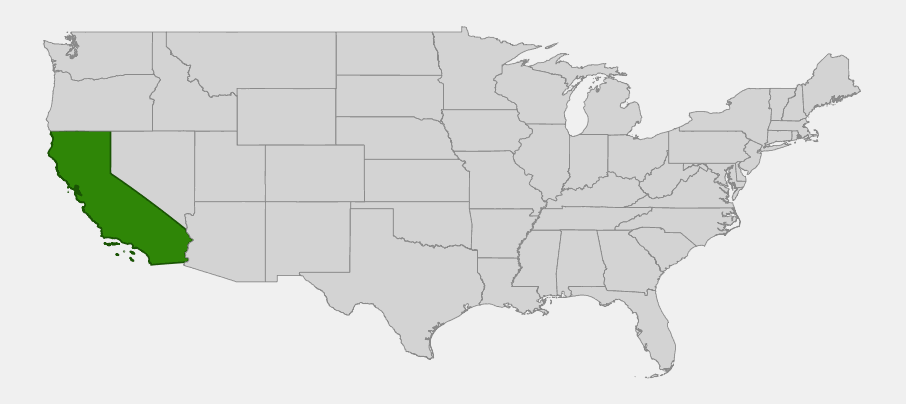
Parish’s bluecurls is native to southern California and northern Baja California, Mexico. USDA PLANTS lists it in California only, where it is confined to the southern part of the state.
It grows in the Transverse Ranges, including the San Gabriel and San Bernardino Mountains, and in the Peninsular Ranges, from the San Jacinto and Santa Rosa Mountains south through the mountains of San Diego County, such as the Cuyamaca and Laguna Mountains, into Baja California. Most populations are on the inland, foothill and mountain slopes rather than right on the coast.
It grows in chaparral and coastal sage scrub, often on dry, rocky, sandy or decomposed-granite slopes and in openings between larger shrubs, from about 2,000 to 6,500 feet in elevation. NatureServe ranks it as globally vulnerable (G3) because of its limited range. Like other chaparral shrubs, it is adapted to periodic wildfire and often appears abundantly on slopes in the years after a burn.
📋 Regional plant lists featuring Parish’s Bluecurls: California & Nevada
Growing & Care Guide
Parish’s bluecurls is a showy, fragrant shrub for dry gardens in southern California and similar Mediterranean climates. Like its cousin woolly blue curls, it is touchy about water and drainage, but on a sunny, fast-draining slope it rewards with months of purple flowers and hummingbird visits. It is occasionally offered by southern California native plant nurseries and seed suppliers.
Light
Plant it in full sun, or light afternoon shade in hot inland valleys. Too much shade makes it sparse and reduces flowering.
Soil & Water
It needs fast-draining soil: decomposed granite, gravel, sand or a rocky slope. Heavy or poorly drained soil, especially when combined with summer water, quickly leads to root rot. Water a new plant every week or two through its first spring, then taper off; established plants should be left essentially dry in summer, with at most an occasional deep soak in very hot inland gardens.
Planting Tips
Plant small container plants in late fall or winter so rain can establish them. Set them on a mound or slope, keep mulch and drip emitters away from the crown, and avoid planting near lawns or irrigated beds. It looks natural with sages, buckwheats, ceanothus, manzanitas and penstemons.
Pruning & Maintenance
Lightly tip-prune after flowering to keep the plant compact. Avoid heavy cutting into bare wood. It is naturally fairly short-lived in gardens, often a few years to about a decade, so let a few seedlings grow or replant from time to time.
Propagation
It can be grown from seed, which benefits from smoke treatment or a cold-moist period to improve germination, mimicking post-fire conditions. Softwood cuttings taken in spring can also root, but they rot easily if kept too wet. Collect seed only in small amounts and only where permitted, and never dig plants from the wild.
Landscape Uses
- Dry, waterwise gardens: thrives with no summer water once established
- Hummingbird gardens: a reliable spring nectar source for hummingbirds
- Pollinator gardens: its flowers are visited by many native bees
- Fragrance gardens: aromatic foliage releases a sweet, resinous scent when brushed
- Chaparral and slope restoration: suited to rocky, sunny hillsides and post-fire revegetation
Wildlife & Ecological Value
The flowers of Parish’s bluecurls are designed for pollinators: the long stamens arch down to brush pollen onto visiting bees and hummingbirds.
For Pollinators
Bumble bees, carpenter bees and many smaller native bees visit the flowers for nectar, and the arching stamens dust their backs with pollen as they feed. Butterflies also take nectar from the flowers.
For Birds
Hummingbirds, including Anna’s and Costa’s hummingbirds, visit the purple flowers in spring. Chaparral birds such as wrentits and towhees forage among the shrubs for insects.
For Mammals
The strong aromatic oils make it unpalatable to deer and most other browsers, so it is rarely eaten.
Ecosystem Role
It is part of the diverse shrub cover of southern California chaparral and sage scrub, helping hold soil on steep slopes. Because it often flourishes in the years after wildfire, it contributes to the flush of flowers that feeds pollinators during post-fire recovery.
Cultural & Historical Uses
The species was described by George Vasey, botanist of the U.S. Department of Agriculture, and named for Samuel Bonsall Parish. Samuel and his brother William Fletcher Parish collected plants around San Bernardino from the 1880s onward, and many southern California plants carry their name.
The genus name Trichostema comes from Greek words for “hair” and “stamen”, referring to the long, thread-like stamens that give all bluecurls their common name. The woolly flower clusters and arching stamens make the southern California shrubby bluecurls some of the most distinctive wildflowers of the region.
Related shrubby bluecurls were used by Indigenous peoples of California for medicinal teas and as a fragrant wash, and gardeners today value the strong, pleasant scent. Because Parish’s bluecurls has a limited range, enjoy it in the wild and buy nursery-grown plants rather than collecting it.
Frequently Asked Questions
Where does Parish’s bluecurls grow?
It grows in chaparral and coastal sage scrub in the Transverse and Peninsular Ranges of southern California, mostly between about 2,000 and 6,500 feet, and south into Baja California.
How is Parish’s bluecurls different from woolly blue curls?
They look alike, but woolly blue curls has denser, longer wool on the flower clusters and usually larger flowers. Parish’s bluecurls is mostly a plant of the southern California mountains.
Does Parish’s bluecurls need summer water?
No. Once established it should be kept nearly dry in summer. Summer water in poorly drained soil is the most common reason it dies in gardens.
Do hummingbirds visit Parish’s bluecurls?
Yes. Hummingbirds and many native bees visit its purple spring flowers.
How tall does Parish’s bluecurls grow?
It usually grows 2 to 4 feet tall and about as wide.

Looking for a nursery that carries Parish’s Bluecurls?
Browse our native plant nursery directory: California

