
Red Stopper (Eugenia rhombea)
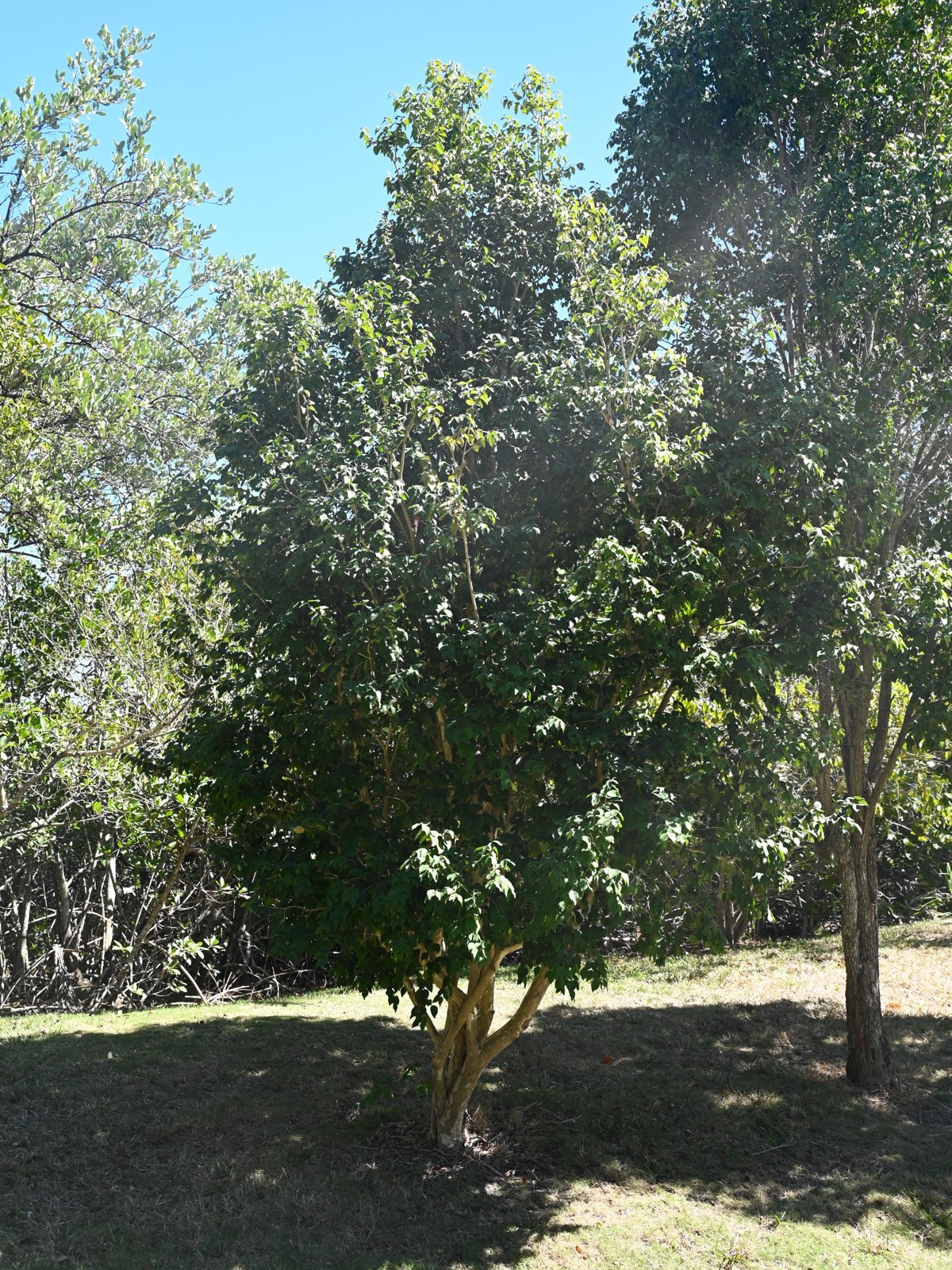
Eugenia rhombea, the Red Stopper, is a small, slow-growing hammock tree found in the United States only in Miami-Dade County and the Florida Keys. A member of the myrtle family, it shares the glossy, gland-dotted foliage and fragrant white flowers typical of its relatives, but it has become genuinely rare in the wild — rare enough that the State of Florida lists it as an endangered species. Where tropical hardwood hammock still survives in South Florida, red stopper persists as an understory-to-midstory tree, more often encountered today in botanical gardens and native plant nurseries than in its original habitat.
Red stopper typically grows 15 to 25 feet tall as a single- or multi-trunked small tree, occasionally reaching larger size in sheltered hammock settings. Its diamond-shaped (“rhombic,” the source of its species name) leaves are glossy, leathery and aromatic when crushed, and its small white flowers give way to round berries that ripen through red to nearly black — a reliable food source for hammock birds. Because it is slow-growing, salt-tolerant, and naturally compact, red stopper has become a popular choice for South Florida native landscaping even as its wild populations remain critically limited.
Identification
Red stopper belongs to the “stopper” group of Florida Myrtaceae (which also includes Spanish stopper, white stopper, and simpson stopper), all of which share translucent oil glands in the leaves, smooth multicolored bark, and small white four-petaled flowers. Red stopper is distinguished from its relatives chiefly by its diamond-shaped leaf outline and its typically smaller, denser stature.
Bark & Stems
The bark is smooth and thin, mottled gray, tan and reddish-brown, often peeling in small flakes to reveal lighter inner bark beneath — a trait shared with several other Florida stoppers. Young twigs are slender and reddish, becoming gray-brown with age.
Leaves
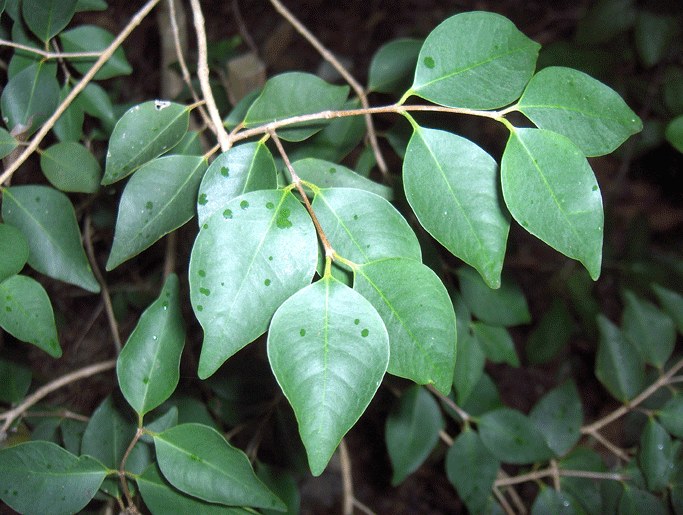
Leaves are opposite, simple, 1 to 3 inches long, with a distinctive rhombic (diamond) to elliptic outline that narrows to a point at both the base and tip. The upper surface is glossy dark green; held up to the light, the leaf blade shows the tiny translucent oil glands characteristic of the myrtle family, and crushed foliage releases a spicy, aromatic scent.
Flowers
Small white flowers with four petals and a prominent tuft of stamens appear singly or in small clusters in the leaf axils, mainly in spring and summer. They are modest in size but can be numerous enough to scent the surrounding hammock air.
Fruit & Seeds
The fruit is a small, round berry roughly 1/4 to 1/2 inch across that ripens from green to red and finally to dark purplish-black. Each berry typically holds one or two seeds and is an important food source for hammock songbirds, which in turn disperse the seeds to new sites.
Quick Facts
| Scientific Name | Eugenia rhombea |
| Family | Myrtaceae (Myrtle) |
| Plant Type | Evergreen shrub or small tree |
| Mature Height | 15–25 ft |
| Mature Spread | 10–15 ft |
| Growth Rate | Slow |
| Sun Exposure | Full Sun to Partial Shade |
| Water Needs | Low to moderate once established |
| Soil Type | Well-drained limestone/sandy hammock soils |
| Soil pH | Neutral to alkaline |
| Bloom Time | Spring–summer |
| Flower Color | White |
| Fall Color | Evergreen; no notable fall color |
| Fruit | Small red-to-black bird-dispersed berries |
| Deer Resistant | Generally yes |
| USDA Hardiness Zones | 10b – 11 |
Native Range
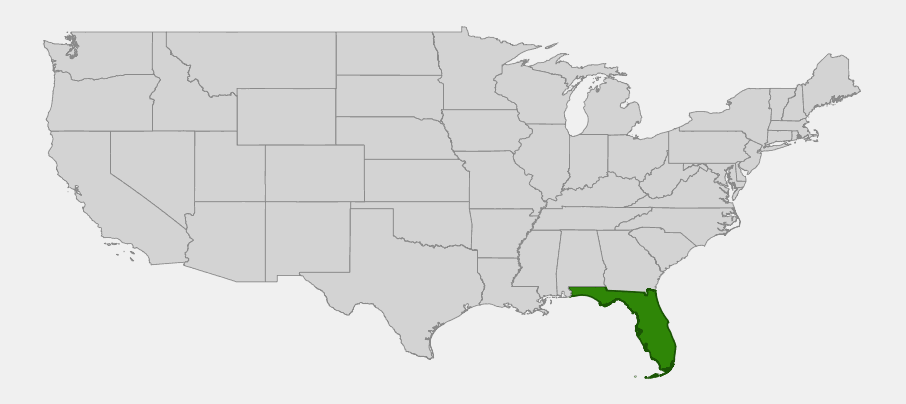
In the continental United States, red stopper is native only to Miami-Dade County and the Florida Keys (Monroe County), where it grows in tropical hardwood hammocks and coastal rock hammocks at the extreme southern tip of the peninsula. It is one of the rarest native trees in Florida; habitat loss from development across South Florida’s hammock lands has made wild populations small and scattered, and the species is formally listed as endangered by the State of Florida.
Within its limited Florida range, red stopper grows as an understory to midstory tree beneath taller hammock canopy species, favoring the well-drained limestone or sandy soils typical of rockland and tropical hammocks. It tolerates salt spray and occasional brackish exposure near the coast, reflecting its broader Caribbean distribution.
Beyond Florida, red stopper occurs more widely through the Caribbean, including Puerto Rico, the U.S. Virgin Islands, Cuba, Hispaniola, and other West Indian islands, where it remains a characteristic component of tropical dry and hardwood forests.
📋 Regional plant lists featuring Red Stopper: none yet — no plantnative.org regional list currently covers South Florida’s tropical hammock species; see our full native plant directory for other Florida-native trees.
Growing & Care Guide
Red stopper is well suited to South Florida gardens that mimic its native hammock conditions — well-drained soil, warm temperatures, and at least partial sun — and it is increasingly available from nurseries specializing in Florida native plants, offering gardeners a way to support a genuinely rare species.
Light
Red stopper grows in full sun to partial shade. In the wild it often establishes in the dappled light of a hammock understory, then tolerates more open conditions as it matures, so young plants may benefit from some shade protection.
Soil & Water
It prefers well-drained, neutral to alkaline soils, consistent with the limestone-based substrates of South Florida hammocks, but adapts reasonably well to typical sandy garden soils provided drainage is good. Once established, red stopper has low to moderate water needs and tolerates South Florida’s dry season without supplemental irrigation in most settings; it also shows good tolerance of salt spray near the coast.
Planting Tips
Plant red stopper in a location with good drainage and protection from the harshest reflected heat while it is young, since it is naturally an understory-to-midstory species. Its slow growth rate and compact habit make it a good choice for smaller yards or foundation plantings where a large canopy tree would be impractical.
Pruning & Maintenance
Red stopper needs minimal pruning; its naturally dense, rounded form rarely requires shaping beyond removing dead or damaged wood. Because it grows slowly, major pruning can set the plant back considerably, so light, infrequent maintenance is best.
Landscape Uses
Thanks to its compact size, dense foliage, and fragrant flowers, red stopper fits a range of residential and restoration uses:
- Hedges and screens in frost-free South Florida landscapes
- Specimen or accent tree for smaller yards
- Hammock restoration plantings that reintroduce a genuinely rare native species
- Wildlife gardens aimed at supporting fruit-eating songbirds
If you’re building out a broader South Florida native tree palette, our guide to shade trees for South Florida covers larger canopy species that pair well with an understory tree like red stopper.
Wildlife & Ecological Value
As a fruiting hammock tree, red stopper plays a meaningful role in supporting South Florida’s native bird community, and its flowers add further value for pollinating insects.
For Birds
The small red-to-black berries attract a variety of fruit-eating hammock songbirds, including mockingbirds, thrashers, and migratory thrushes passing through South Florida, which rely on hammock fruit sources like red stopper during migration. For more on choosing native plants that support resident and migratory birds, see our guide to attracting songbirds with native plants.
For Pollinators
The small white flowers, though modest individually, attract native bees and other pollinating insects, particularly when a plant is in full bloom and scenting the surrounding hammock air.
Ecosystem Role
As an increasingly rare hammock tree, red stopper contributes to the structural diversity of the shrinking tropical hardwood hammock community in Miami-Dade and the Keys, providing food and cover in an ecosystem type that has lost most of its historical extent to development. Because fruiting trees like red stopper draw dispersing birds, planting it in restoration or garden settings can help support broader hammock wildlife connectivity even outside protected natural areas.
Cultural & Historical Uses
Red stopper does not carry a well-documented history of medicinal or culinary use in Florida comparable to some other hammock species; its chief historical significance lies in its role as a characteristic, now-rare component of South Florida’s tropical hardwood hammocks, ecosystems that supported indigenous communities and early settlers with timber, game, and other hammock resources long before large-scale development reduced them to scattered remnants.
In recent decades, red stopper has gained renewed attention through conservation and native-plant horticulture programs, including botanical garden collections such as Fairchild Tropical Botanic Garden in Miami, which propagate and display the species as part of broader efforts to document and preserve Florida’s rarest native hammock trees.
Frequently Asked Questions
Is red stopper endangered?
Yes. Red stopper is listed as an endangered species by the State of Florida, where it survives only in scattered tropical hardwood hammock sites in Miami-Dade County and the Florida Keys.
How can I tell red stopper from other Florida stoppers?
Look at the leaf shape: red stopper’s leaves have a distinctly diamond-shaped (rhombic) outline that narrows to a point at both ends, while related species like white stopper and Spanish stopper tend toward more rounded or elliptical leaves. All stoppers share translucent leaf glands and smooth, mottled bark.
How big does red stopper get?
Most cultivated and wild specimens in Florida reach 15 to 25 feet tall, growing slowly into a dense, rounded small tree or large shrub rather than a towering canopy tree.
Is red stopper fruit edible for people?
The berries are eaten by hammock birds, but red stopper is grown in home landscapes primarily as an ornamental and wildlife plant rather than as a food crop, and no reliable culinary use is documented for the species in Florida.
Can I buy red stopper for my garden?
Yes — it is increasingly offered by nurseries specializing in South Florida native plants, making it possible for home gardeners to grow and help conserve a genuinely rare native tree.

Looking for a nursery that carries Red Stopper?
Browse our native plant nursery directory: Florida
For other South Florida hammock trees, see our pages on Gumbo Limbo and West Indian Mahogany. To learn more about why native trees matter for local ecosystems, see the benefits of planting native trees.

