
Sensitive Plant (Mimosa pudica)
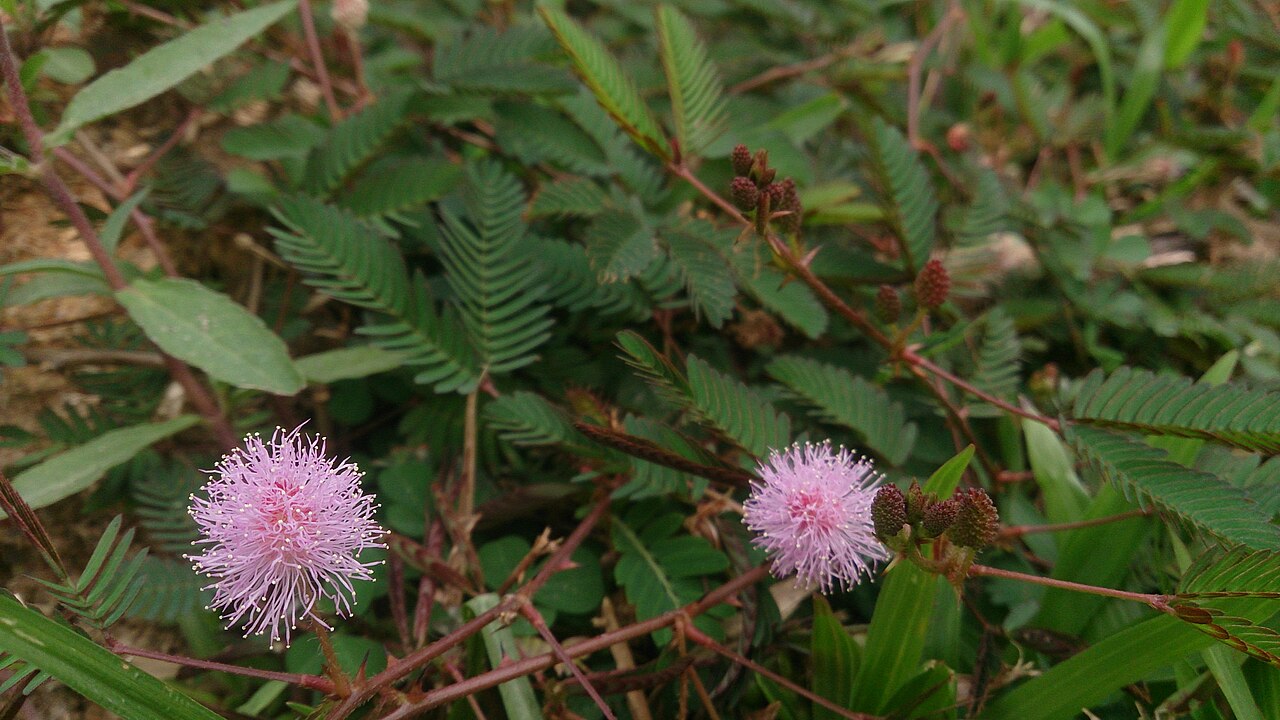
Mimosa pudica, the Sensitive Plant, is the famous “touch-me-not” whose leaves fold up the moment you brush them. It is a low, sprawling member of the pea family (Fabaceae) with feathery leaves, prickly stems and fluffy pink flower heads the size of a marble. In Puerto Rico it is known as moriviví (“I died, I lived”), a name that describes exactly what the plant does: it collapses when touched and, a few minutes later, opens again as if nothing had happened. Other Spanish names include dormidera and vergonzosa, and in English it is also called shameplant, shy plant and humble plant.
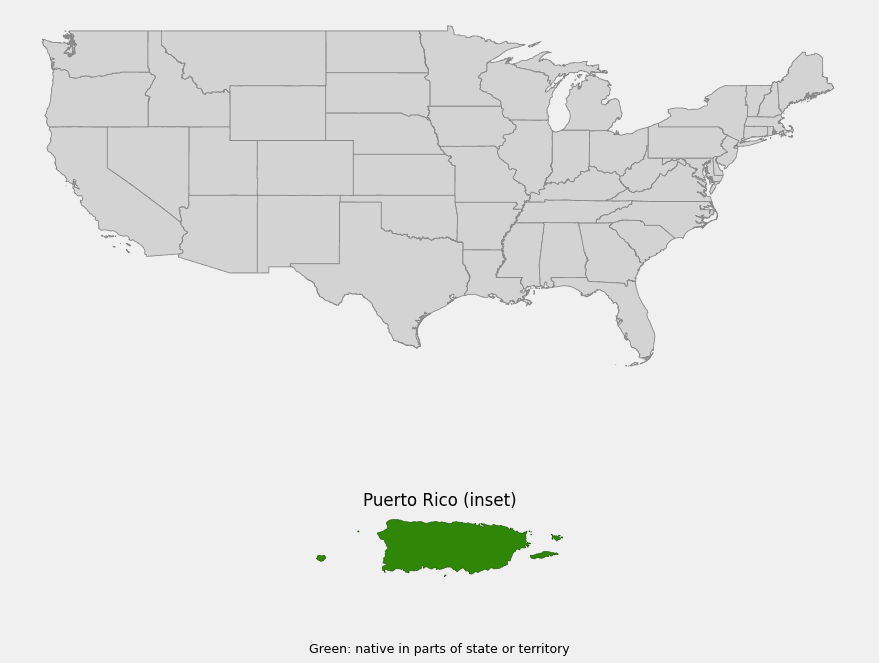
Within the United States, USDA PLANTS lists sensitive plant as native only to Puerto Rico and the U.S. Virgin Islands. Its natural range covers the American tropics, from Mexico through Central America and the Caribbean to South America. Elsewhere it has been carried around the world as a curiosity and has become a pantropical weed. It is naturalized but not native in Hawaii and Florida, where it should not be planted outdoors.
Most people meet sensitive plant as a houseplant or a kit of seeds for children, and it is one of the best plants for showing that plants can move. This guide explains how to identify it, where it grows wild in Puerto Rico, how the leaf movement works, and how to grow it safely indoors or in a frost-free garden, including the precautions its prickles and its invasive habit call for.
Identification
Sensitive plant is easy to recognize: no other common plant folds its leaves so quickly and so completely when touched. Several related Mimosa species also respond to touch, though, including native sensitive briars of the southern U.S. such as catclaw briar and littleleaf sensitive briar, and the Caribbean relative Mimosa casta. The leaf pattern and flower color help separate them.
Stems & Growth Habit
Sensitive plant is a short-lived perennial or subshrub that is often grown as an annual. It forms a low, branching mound or sprawls across the ground, usually 6 to 20 inches tall, with stems that can creep or scramble 2 to 3 feet or more. The stems are woody at the base on older plants, often reddish, hairy, and armed with small, hooked prickles, so handle it with some care.
Leaves
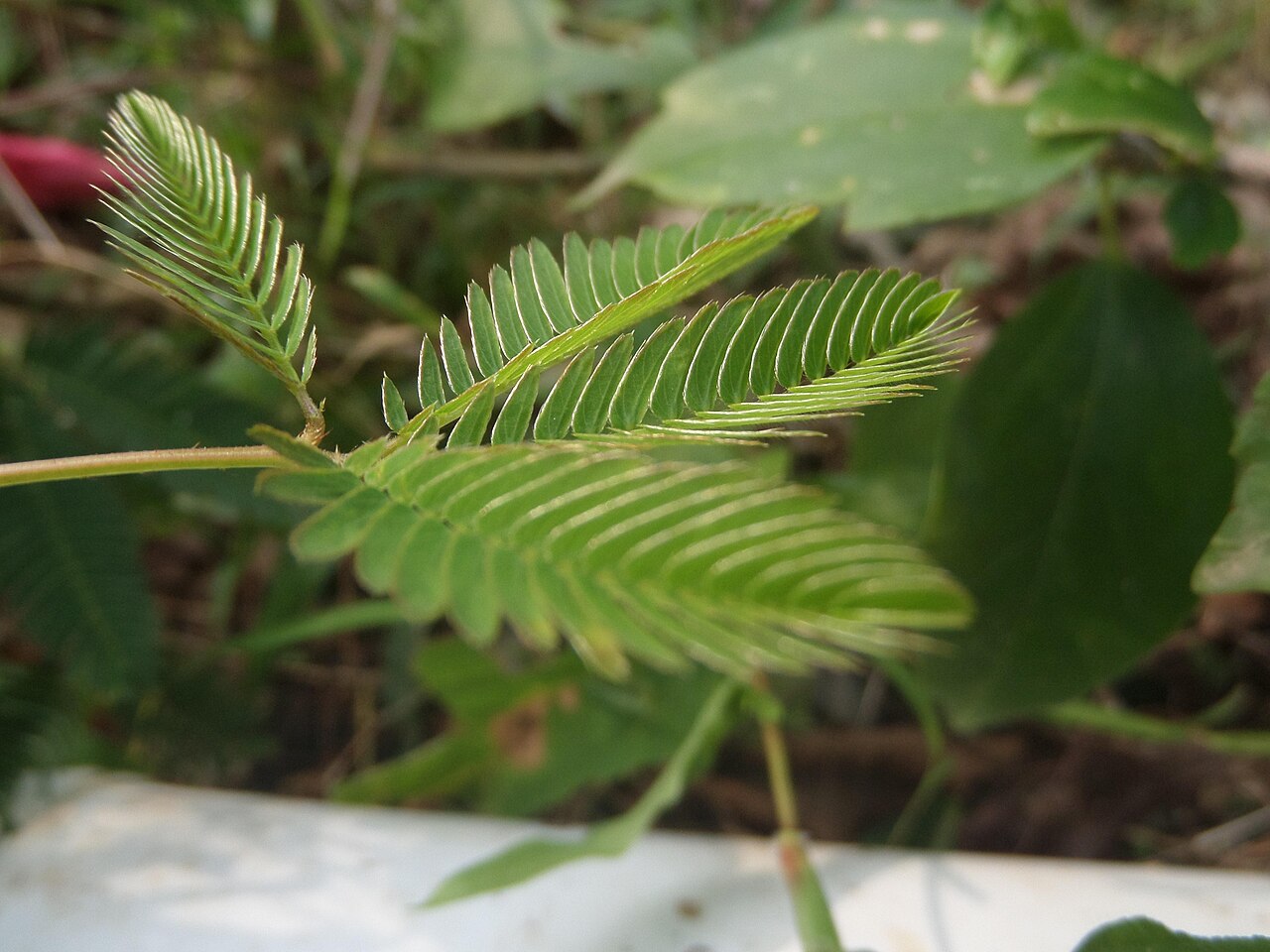
The leaves are bipinnate, like those of a fern or a small acacia. Each leaf has a slender stalk ending in usually two pairs of feather-like segments (pinnae) held close together like the fingers of a hand. Each segment carries 10 to about 25 pairs of narrow leaflets, each about a quarter to half an inch long. The leaves are bright green, sometimes with a few bristly hairs.
When a leaf is touched, shaken, heated or cut, the leaflets fold together in pairs from the point of contact, the segments draw together, and the whole leaf stalk drops downward. A strong touch spreads the response to neighboring leaves. The leaves also fold every evening and reopen in the morning.
Flowers
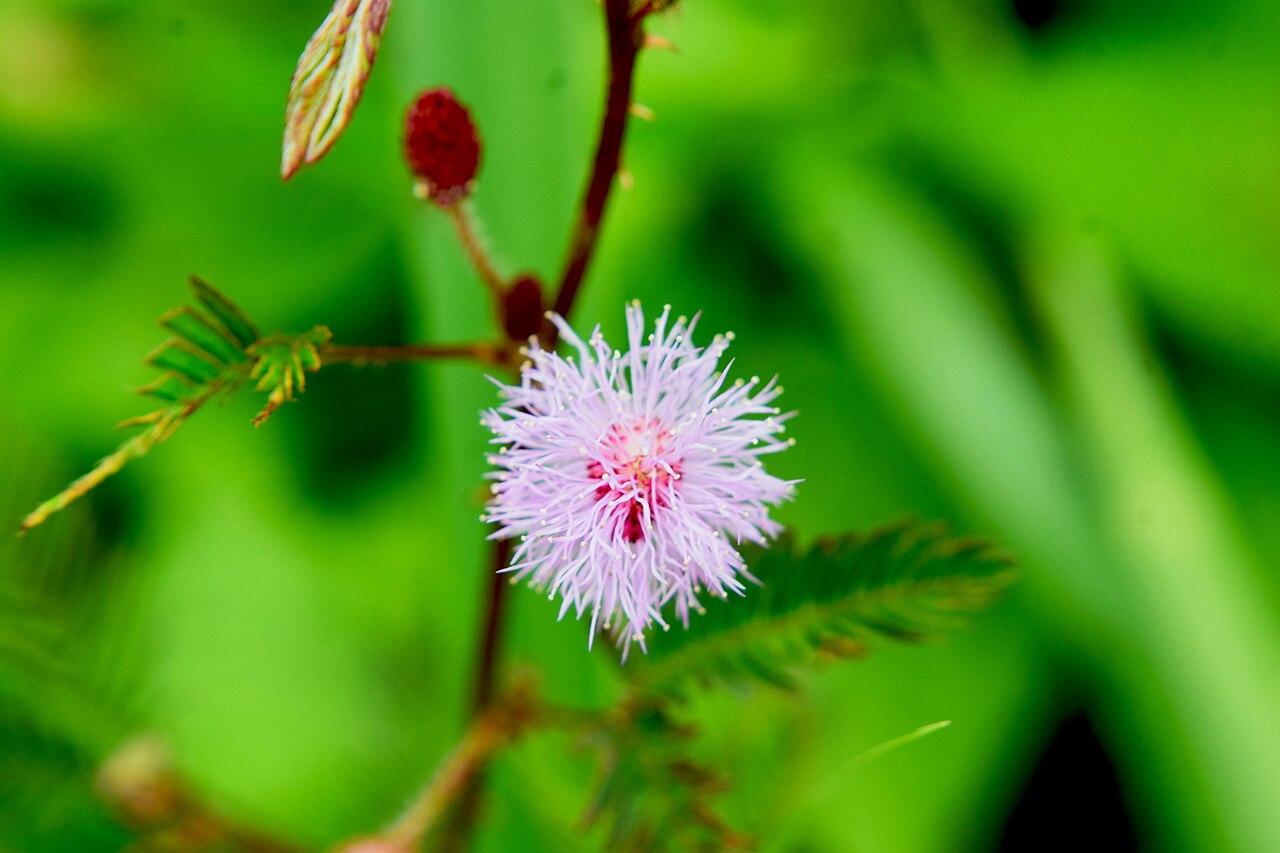
Flowers are packed into round heads about half an inch to three quarters of an inch across, held on stalks from the leaf joints. Each head contains dozens of tiny flowers, but what you see are their long stamens, pale pink to lilac, which make the head look like a pom-pom or a powder puff. The buds are often dark red or purplish. In Puerto Rico it can bloom at almost any time of year, with most flowers in the warm, rainy months.
Fruit & Seeds
The flowers are followed by clusters of small, flat pods about half an inch long, with bristly edges. When ripe, each pod breaks crosswise into one-seeded segments, and the bristly segments cling to fur and clothing. The seeds are small, flat and brown with a very hard coat. They can lie dormant in the soil for years, which is one reason the plant is so hard to remove once it is established.
Quick Facts
| Scientific Name | Mimosa pudica L. |
| Family | Fabaceae (pea or legume family) |
| Plant Type | Short-lived perennial or subshrub, often grown as an annual or houseplant |
| Mature Height | 6–20 in (rarely to about 3 ft) |
| Mature Spread | 1–3 ft; stems sprawl or creep |
| Growth Rate | Fast |
| Sun Exposure | Full sun to part shade (bright light indoors) |
| Water Needs | Moderate; evenly moist but well-drained soil |
| Soil Type | Sandy, loamy or disturbed soils; tolerates poor soil |
| Soil pH | About 5.0–7.0 (acidic to neutral) |
| Bloom Time | Much of the year in Puerto Rico; summer indoors and in mild climates |
| Flower Color | Pink to lilac (pom-pom heads) |
| Fall Color | None; evergreen in frost-free climates |
| Fruit | Clusters of small bristly pods that break into one-seeded segments |
| Deer Resistant | Partly; prickly stems discourage browsing, but livestock may eat it |
| USDA Hardiness Zones | 10–13 as a perennial (killed by frost; grown as an annual or houseplant elsewhere) |
Native Range
In U.S. jurisdictions, USDA PLANTS lists Mimosa pudica as native to Puerto Rico and the U.S. Virgin Islands. Its native range is the American tropics: Mexico, Central America, the Caribbean islands and much of tropical South America. In Puerto Rico it is one of the most familiar wild plants, found from the coast into the mountains wherever the ground is open and sunny.
USDA also records it from Florida, Hawaii, Maryland and Virginia, but only as an introduced plant. In Hawaii and the Pacific islands it has been naturalized for well over a century and is a common weed of pastures, lawns and roadsides. In Florida it occurs as an escape in the southern part of the state. The mainland records farther north are waifs that do not survive winter. Around the tropics of Africa, Asia and Australia it is regarded as a weed of crops and pastures.
Because the native range map for the United States shows only Puerto Rico, gardeners elsewhere should grow it indoors or as a summer annual in containers. Where winters are frost-free outside Puerto Rico and the Virgin Islands, especially in Hawaii and south Florida, keep it in pots and remove the seed pods so it cannot spread.
📋 Regional plant lists featuring Sensitive Plant: Puerto Rico
Growing & Care Guide
Sensitive plant is easy to grow from seed and does well on a sunny windowsill, which is why it turns up in so many classrooms. In Puerto Rico it hardly needs a gardener at all. A few precautions matter: its stems are prickly, it is not a plant for pets or toddlers to chew on (see the safety note in the FAQ), and in frost-free places outside its native range it can become a weed.
Light
Give it as much light as possible. Outdoors it grows best in full sun, and it tolerates light shade. Indoors, a south- or west-facing window or a grow light 12 to 16 hours a day keeps plants compact and flowering. In low light the stems stretch, the leaves stay partly closed, and plants rarely bloom.
Soil & Water
Use a light, well-drained potting mix, such as ordinary potting soil with some perlite or sand. Water when the top half inch of soil starts to dry, and do not let the pot sit in water. Like other legumes it forms root nodules with nitrogen-fixing bacteria, so it needs little or no fertilizer; a dilute feed once a month in summer is plenty for potted plants. Sensitive plant likes warmth and humidity and sulks below about 60°F (16°C).
Planting Tips
Grow it from seed. The hard seed coat needs to be broken first: soak seeds in hot (not boiling) water overnight, or nick them gently with a nail file, then sow them about an eighth of an inch deep. Kept warm, about 75–85°F (24–29°C), and moist, they usually germinate in one to three weeks. Seedlings start responding to touch when they have only a few true leaves. Transplant carefully, because the plants dislike root disturbance. Outdoors, plant after all danger of frost, in a sunny spot.
Pruning & Maintenance
Pinch the tips of young plants to keep them bushy, and trim straggly stems at any time. Wear gloves for larger plants because of the prickles. Avoid touching the leaves constantly. Each folding uses energy, and a leaf needs time with its leaflets open to make food, so a plant that is handled all day grows poorly. Indoor plants often decline after a year or two; it is easy to start new ones from seed.
Propagation
Seed is the standard method, and a single plant produces plenty of it. Stem cuttings 3 to 4 inches long also root in moist, warm potting mix or water, though less reliably. Outside Puerto Rico and the Virgin Islands, especially in Hawaii, Florida and other frost-free areas, pick off seed pods before they ripen and do not toss plants or soil where seed could sprout.
Landscape Uses
- Houseplant and windowsill plant: one of the best plants for showing children, and adults, how plants respond to touch
- Science classrooms: easy experiments on touch, light, darkness and recovery time
- Container plant: a summer annual on a sunny patio, kept in a pot so it cannot spread
- Puerto Rican gardens: a low groundcover for sunny, informal or wild corners, where it is a familiar native
- Pollinator patches in Puerto Rico: its pink flower heads attract small bees
Wildlife & Ecological Value
In Puerto Rico, sensitive plant is part of the community of low plants that quickly cover open, disturbed ground. Its touch response is thought to help protect it: a folded, drooping leaf looks wilted and exposes its prickles, and the sudden movement may startle small grazing animals and insects.
For Pollinators
The flower heads produce abundant pollen and attract bees, including honey bees and small native bees. In Puerto Rico, bees are a common sight on the flower heads along lawns and roadsides.
For Birds
Seed-eating ground birds such as doves and grassquits may pick up the small seeds, and the low tangles give cover to insects that birds feed on. The plant is not an important bird food.
For Mammals
Goats and cattle will graze it despite the prickles. The bristly pod segments cling to fur, which helps spread the seeds. The foliage contains mimosine, an amino acid that is toxic to livestock in large amounts, so pastures heavily overgrown with it are of poor value.
Ecosystem Role
Sensitive plant is a pioneer of bare and disturbed soils. Its root nodules host nitrogen-fixing bacteria, which add nitrogen to poor soils, and its mat of stems helps protect the soil from rain and erosion. Its long-lived seed bank lets it return quickly after plowing, grazing or clearing. Outside its native range the same traits make it a weed.
Cultural & Historical Uses
Sensitive plant has fascinated scientists for centuries. In 1729 the French astronomer Jean-Jacques d’Ortous de Mairan kept a potted Mimosa in a dark cupboard and noticed that its leaves still opened and closed on a daily schedule. That simple observation is considered one of the first demonstrations of a biological clock. The quick folding works differently: when a leaf is disturbed, an electrical signal travels along the stalk to swellings at the base of each leaflet and leaf (the pulvini), and cells there quickly lose water and turgor, so the leaf collapses. In recent decades researchers have used the plant in experiments on how plants sense and “remember” repeated, harmless disturbance.
Linnaeus named the species in 1753. Pudica is Latin for shy or bashful, the same idea as the English “shameplant” and the Spanish vergonzosa. The Puerto Rican name moriviví has a life beyond botany: it is used as a word for resilience, for something or someone that falls and gets back up, and it appears in Puerto Rican songs, poetry, art and the names of community groups.
Sensitive plant also has a long history in folk medicine across the tropics, where the roots and leaves have been used in home remedies. Those uses have not been shown to be safe or effective, and the plant contains mimosine and other active compounds, so it should not be eaten or used as a remedy without medical advice.
Frequently Asked Questions
Why do sensitive plant leaves close when touched?
At the base of each leaflet and leaf stalk is a small swelling called a pulvinus. A touch triggers an electrical signal, and cells in the pulvini quickly move potassium and other ions, lose water, and go limp, so the leaflets fold and the leaf droops. The leaves reopen after several minutes, usually within about 10 to 20, as the cells refill. The response probably helps protect the plant from grazing animals and insects.
Is sensitive plant toxic to people, cats or dogs?
Treat it as mildly toxic. Its leaves and seeds contain mimosine, which is harmful to livestock in large amounts, and the stems have sharp prickles. Keep it out of reach of pets and small children, do not eat any part of it, and wear gloves when handling large plants. If a pet chews a lot of it or seems unwell, call your veterinarian.
Is Mimosa pudica native to the United States?
Only in Puerto Rico and the U.S. Virgin Islands, according to USDA PLANTS. It is introduced, and often weedy, in Hawaii and Florida. On the mainland it is grown as a houseplant or summer annual.
Can I grow sensitive plant indoors?
Yes. Grow it in a bright, sunny window or under a grow light, in well-drained potting mix kept lightly moist, at normal room temperatures above about 60°F. Start new plants from seed every year or two, because older indoor plants tend to get leggy.
Is sensitive plant invasive?
It is a weed in many tropical and subtropical regions outside its native range, including Hawaii. Its prickly mats and long-lived seeds are hard to remove. Outside Puerto Rico and the Virgin Islands, grow it in pots, remove the seed pods, and never plant it out in frost-free areas.

Looking for a nursery that carries Sensitive Plant?
Our nursery directory does not yet include Puerto Rico. Browse the native plant nursery directory by state: Alabama–Arkansas · California · Colorado–Hawaii · Idaho–Kansas · Kentucky–Montana · Nebraska–Oklahoma · Oregon · Pennsylvania–Virginia · Washington · West Virginia–Wyoming

