
Catclaw Briar (Mimosa nuttallii)
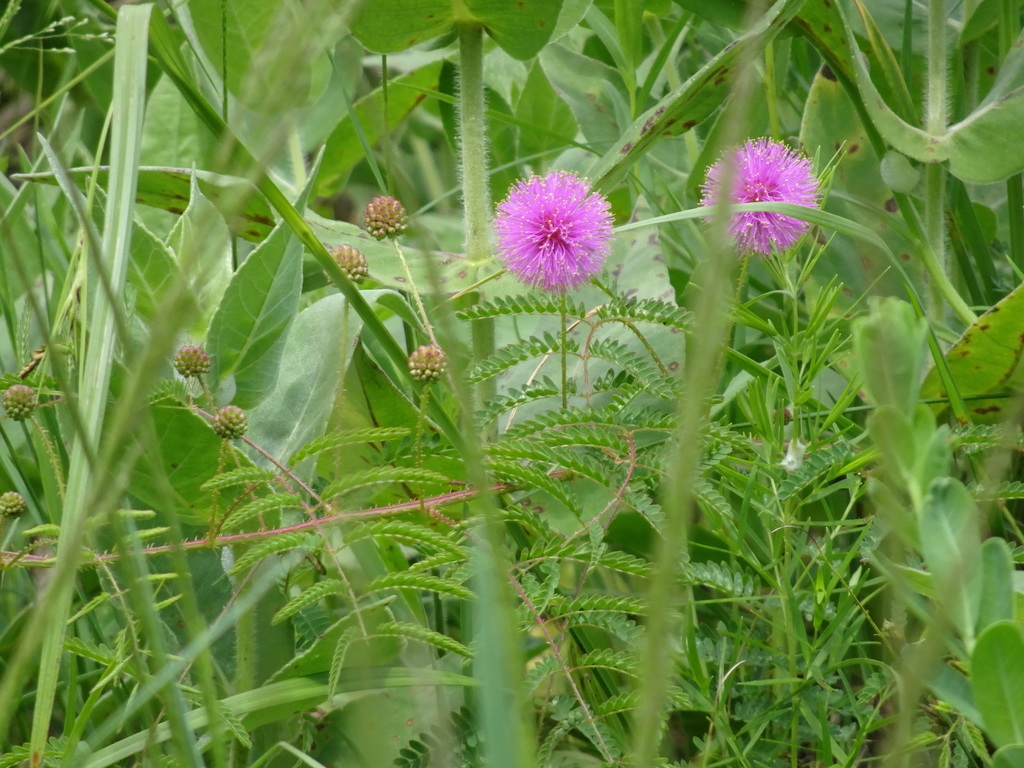
Mimosa nuttallii, known as Catclaw Briar (USDA: Nuttall’s sensitive-briar), is a sprawling, prickly perennial legume of prairies and open woodlands in the central United States. It was long known as Schrankia nuttallii, and some botanists treat it as Mimosa quadrivalvis var. nuttallii. Other names include sensitive briar and shame-boy, both references to its leaves, which fold up when touched.
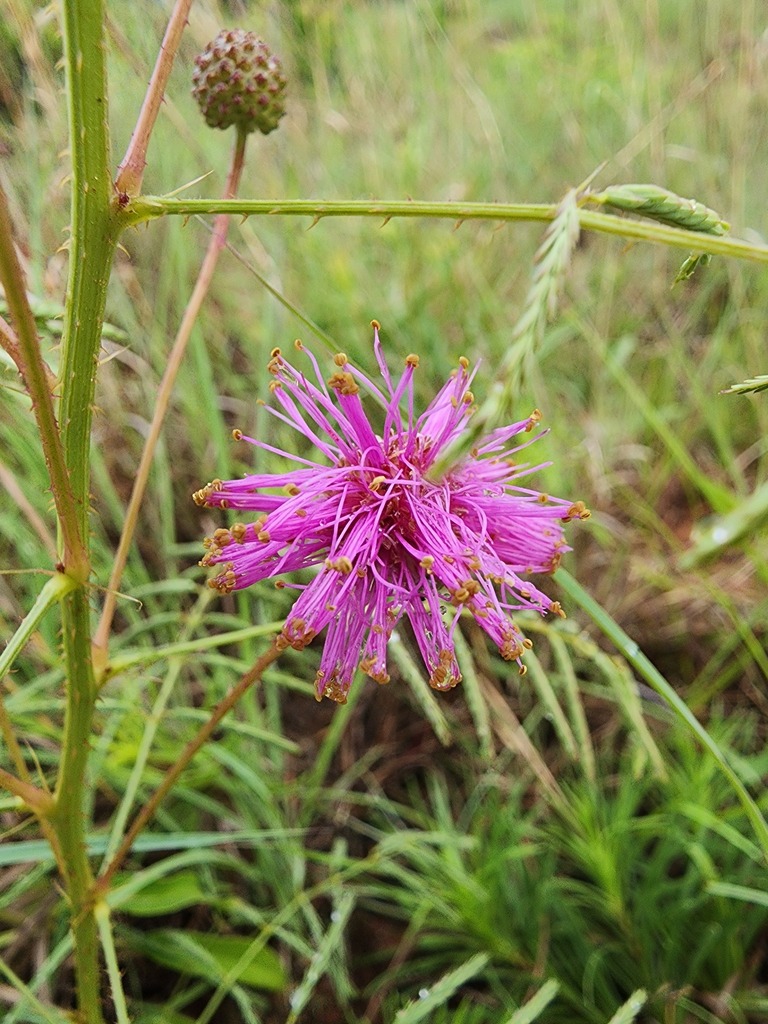
From late spring through summer, catclaw briar produces round, bright pink flower heads about 3/4 inch across, like tiny pompoms, on slender stalks. Each head is a ball of tiny flowers whose long pink stamens are tipped with yellow pollen. The ribbed stems trail along the ground for 2 to 4 feet, lined with small, hooked prickles that catch on skin and clothing, which gives the plant its common name.
Catclaw briar is a tough, drought-tolerant plant for prairie restorations, meadows and dry, sunny slopes. It fixes nitrogen, feeds bees, and is a nutritious forage plant for wildlife and livestock. Its prickles make it a poor choice next to paths, but it adds color and interest to natural plantings. Children (and adults) love to touch its leaves and watch them close.
Identification
Look for prickly, sprawling stems in prairies with finely divided, fern-like leaves that fold up when touched, and round pink pompom flower heads in summer.
Growth Habit
Catclaw briar grows from a thick, woody taproot and sends out several ribbed, trailing or arching stems 2 to 4 feet long, rarely standing more than 1 to 2 feet tall. The stems are lined with small, recurved (hooked) prickles. It dies back to the ground in winter and resprouts in spring.
Leaves
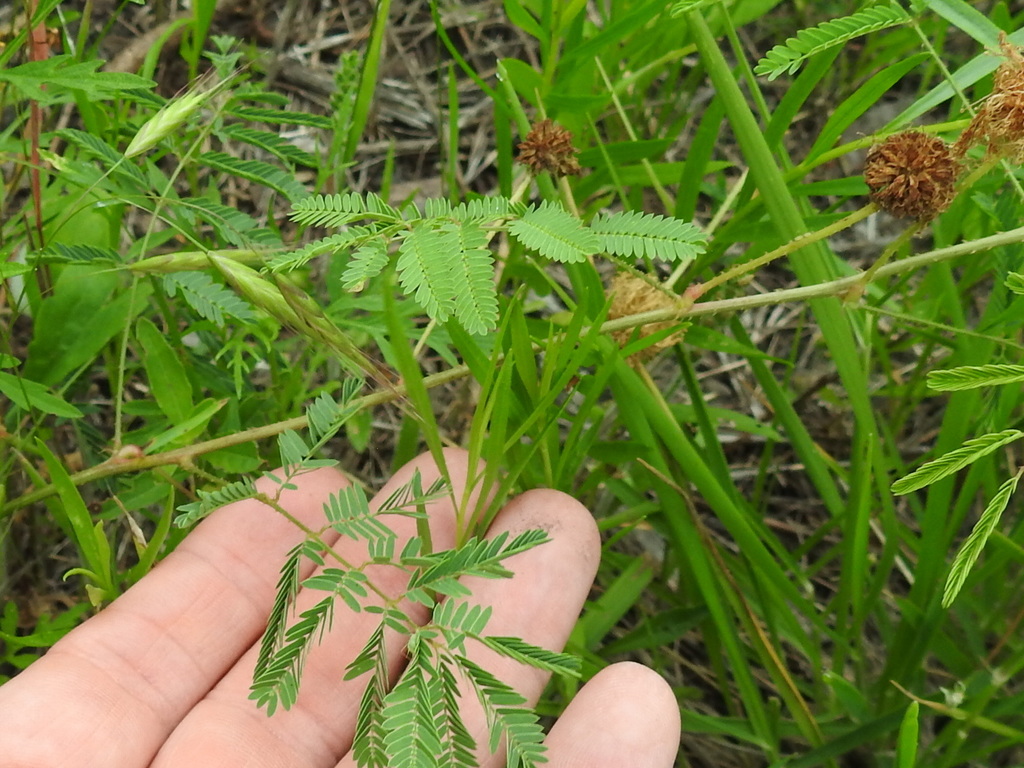
The leaves are alternate and twice compound (bipinnate), with 4 to 9 pairs of side branches (pinnae), each with 8 to 15 pairs of tiny, elliptic leaflets. The leaf stalks are prickly. The leaflets fold together quickly when touched, shaken or at night, a movement called seismonasty, similar to the well-known sensitive plant (Mimosa pudica).
Flowers
Flower heads appear from May to September on leafless stalks from the leaf axils. Each head is a ball about 1/2 to 3/4 inch across made up of many tiny flowers, each with five small petals and 8 to 10 long, pink to rose-purple stamens with yellow anthers. Before they open, the buds look like small green blackberries. The flowers are lightly fragrant.
Fruit
The fruit is a slender, round, four-sided pod 1 to 3 inches long, densely covered with small prickles. It splits lengthwise when ripe to release several hard, brown seeds.
Look-alikes
Littleleaf sensitive-briar (Mimosa microphylla) is very similar; it grows mainly in the Southeast, east of catclaw briar, and is told apart by technical features of the leaflets and pods. Powderpuff (Mimosa strigillosa) has no prickles. Illinois bundleflower has similar leaves but white flower heads and no prickles. The tree called mimosa (Albizia julibrissin) is an unrelated, non-native ornamental.
Quick Facts
| Scientific Name | Mimosa nuttallii (syn. Schrankia nuttallii, Mimosa quadrivalvis var. nuttallii) |
| Family | Fabaceae (pea family) |
| Plant Type | Sprawling, prickly herbaceous perennial |
| Mature Height | 1–2 ft (stems trail 2–4 ft) |
| Mature Spread | 2–4 ft |
| Growth Rate | Moderate |
| Sun Exposure | Full sun to light shade |
| Water Needs | Low; drought tolerant |
| Soil Type | Sandy, rocky, loamy or silty prairie soils |
| Soil pH | Slightly acidic to alkaline (about 6.0–8.0) |
| Bloom Time | May–September |
| Flower Color | Pink to rose-purple with yellow anthers |
| Fall Color | None notable |
| Fruit | Prickly, slender pod, 1–3 in |
| Deer Resistant | No; browsed by deer and livestock |
| USDA Hardiness Zones | 5–9 |
Native Range
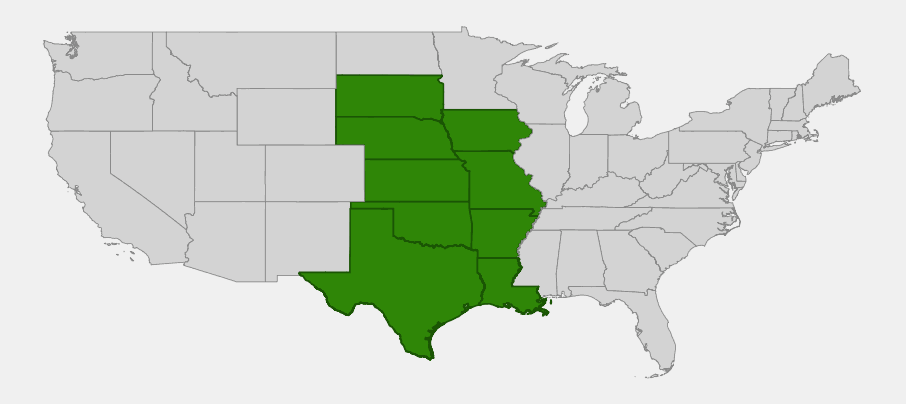
Catclaw briar is a plant of the central and southern Great Plains and the Ozarks. USDA PLANTS lists it as native in nine states: South Dakota, Nebraska, Iowa, Kansas, Missouri, Oklahoma, Arkansas, Louisiana and Texas. It does not grow in Canada.
It is most common in the prairies of Kansas and Oklahoma, the Ozarks of Missouri and Arkansas, and north-central and East Texas. In South Dakota it is near its northern limit and grows mainly in the southern part of the state. In Texas it extends from the Red River and the Pineywoods west to the Rolling Plains and the eastern Panhandle, and south to the Hill Country edge around San Antonio.
It grows in upland prairies, savannas, glades, open oak woodlands, pastures, roadsides and the edges of woods, usually on sandy, rocky or well-drained soils. It is often an indicator of well-managed rangeland because grazing animals eat it eagerly and it disappears under overgrazing.
📋 Regional plant lists featuring Catclaw Briar: Nebraska, Kansas & Eastern Colorado · Illinois, Iowa & Missouri · Arkansas, Louisiana, Eastern Oklahoma & Eastern Texas · South & West Texas · North Dakota, South Dakota & Western Minnesota
Growing & Care Guide
Catclaw briar is easy to grow in sunny, well-drained sites and needs almost no care once established. Plant it where its prickly stems will not be brushed by people or pets.
Light
Full sun is best. It tolerates light shade at woodland edges but flowers less there.
Soil & Water
It thrives in sandy, rocky or loamy soils with good drainage, and tolerates poor, dry soil. Its deep taproot makes it very drought tolerant. Water only to establish young plants; avoid soggy soil.
Planting Tips
Plant in spring from container-grown plants or sow seed in a meadow or prairie planting. Because of its deep taproot, place it where it can stay; large plants do not transplant well. Let it sprawl among grasses such as little bluestem, which help support the stems. Wear gloves when handling it.
Pruning & Maintenance
No pruning is needed. Cut or mow old stems to the ground in late winter, or burn prairie plantings on a regular schedule; it resprouts well after fire.
Propagation
Grow from seed. The hard seed coat must be nicked or sanded (scarified), or soaked in hot water, before sowing. Sow in spring after the soil warms.
Landscape Uses
- Prairie restoration: a native legume that fixes nitrogen and feeds wildlife
- Meadow gardens: bright pink pompoms through summer
- Dry slopes: deep-rooted and drought tolerant
- Pollinator gardens: pollen source for native bees
- Educational gardens: touch-sensitive leaves fascinate children
Wildlife & Ecological Value
Catclaw briar is a valuable prairie legume, providing pollen for bees, seeds for birds and nutritious forage for grazing animals.
For Pollinators
The flower heads produce abundant pollen and attract many native bees, including bumble bees, leafcutter bees and small sweat bees, as well as butterflies.
For Birds
Bobwhite quail and other ground birds eat the seeds, and the prickly tangles provide cover.
For Mammals
Deer and livestock graze the leaves, which are high in protein. Ranchers note that its presence indicates good range condition.
Ecosystem Role
As a legume, it hosts nitrogen-fixing bacteria in its roots, enriching prairie soils. Its deep taproot helps it survive drought and fire, and it resprouts quickly after prairie burns.
Cultural & Historical Uses
The species name honors Thomas Nuttall (1786–1859), an English botanist who traveled the American frontier, including Arkansas Territory and what is now Oklahoma, in 1818–1820, collecting many plants new to science.
The leaves fold when touched as a defense: the sudden movement may startle grazing insects and makes the plant look wilted and less appetizing. The roots are reported to give off a garlic-like smell when disturbed.
The genus Schrankia, in which this plant was long placed, honored the German botanist Franz von Paula Schrank. In 1991 the botanist Rupert Barneby merged Schrankia into Mimosa, and most floras now follow that treatment.
Frequently Asked Questions
Why do catclaw briar leaves close when touched?
The leaflets fold up quickly when touched or shaken, a movement called seismonasty. It is thought to deter grazing insects and animals. The leaves reopen after a few minutes.
Is catclaw briar the same as mimosa tree?
No. The mimosa tree (Albizia julibrissin) is an unrelated, non-native ornamental tree. Catclaw briar is a low, prickly native perennial.
Is catclaw briar invasive?
No. It is a native prairie plant. It can spread by seed in open, disturbed sites but is not aggressive in established prairies.
Are the prickles dangerous?
The small, hooked prickles can scratch skin and catch on clothing, but they are not poisonous. Wear gloves when handling the plant.
Is catclaw briar good for wildlife?
Yes. It feeds native bees, its seeds are eaten by quail, and its leaves are high-protein forage for deer and livestock.

Looking for a nursery that carries Catclaw Briar?
Browse our native plant nursery directory: Arkansas · Iowa & Kansas · Louisiana & Missouri · Nebraska & Oklahoma · South Dakota & Texas

