
Phantom Orchid (Cephalanthera austiniae)
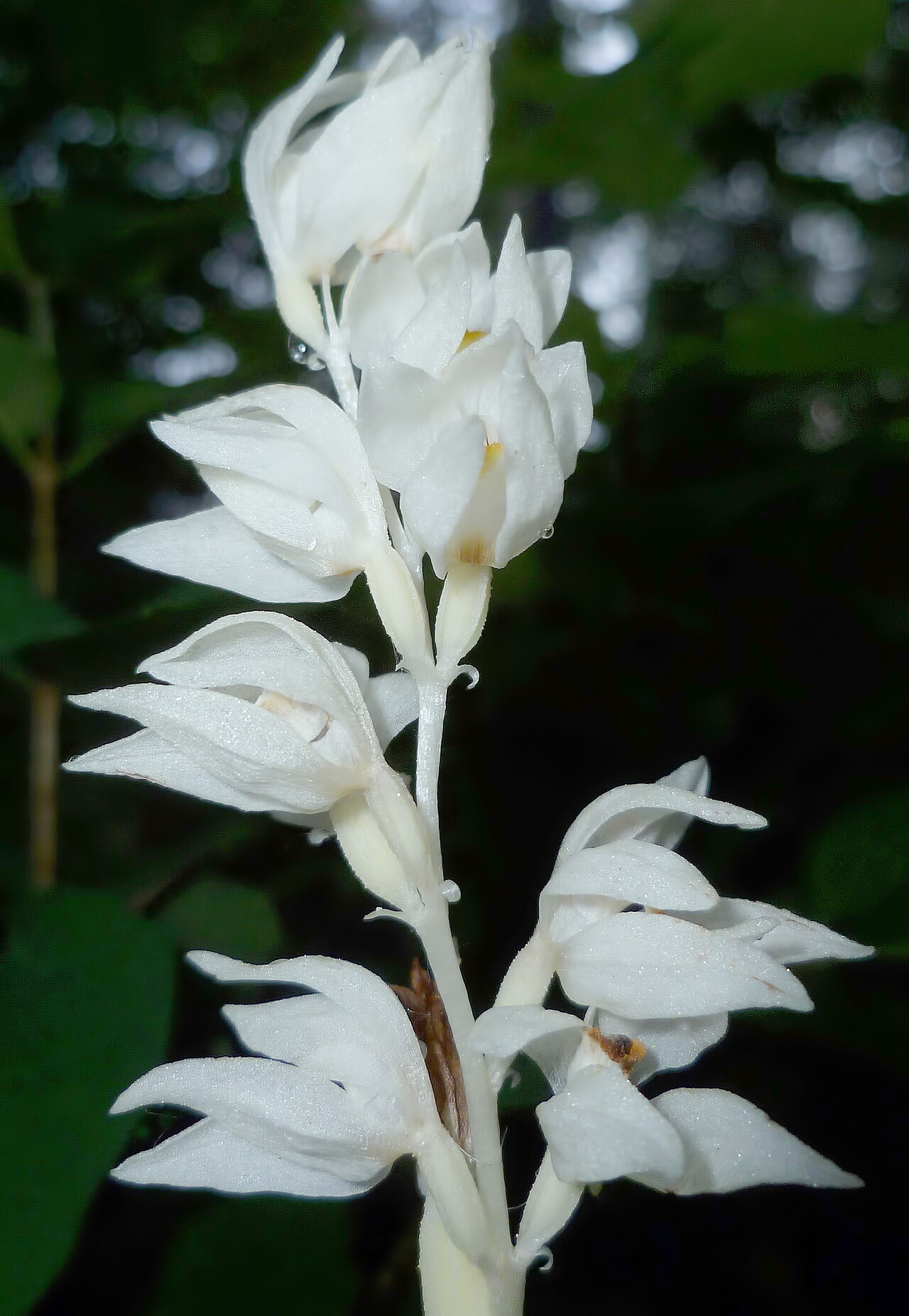
Cephalanthera austiniae, the Phantom Orchid or snow orchid, is one of the most striking wildflowers of western forests: an orchid that is entirely white, from its stem and scale-like leaves to its waxy flowers. It grows in the deep shade of conifer and mixed forests from British Columbia south through Washington, Oregon and Idaho to California, and it is the only member of the genus Cephalanthera native to North America. It was formerly known as Eburophyton austiniae.
Phantom orchid has no chlorophyll and cannot make its own food from sunlight. It is fully mycoheterotrophic: it gets all of its sugars and nutrients from soil fungi that are also connected, through mycorrhizae, to the roots of nearby trees. In effect, the orchid draws on the forest’s own underground network. It spends most of its life as an underground rhizome and sends up a ghostly flowering stem, usually 8 to 20 inches tall, in late spring or summer, and it may not appear every year.
Because of that complete dependence on its fungal partners, phantom orchid cannot be grown in gardens or transplanted, and it must never be dug from the wild. This page is a guide to identifying it, understanding how it lives, and knowing where and when to look for it.
Identification
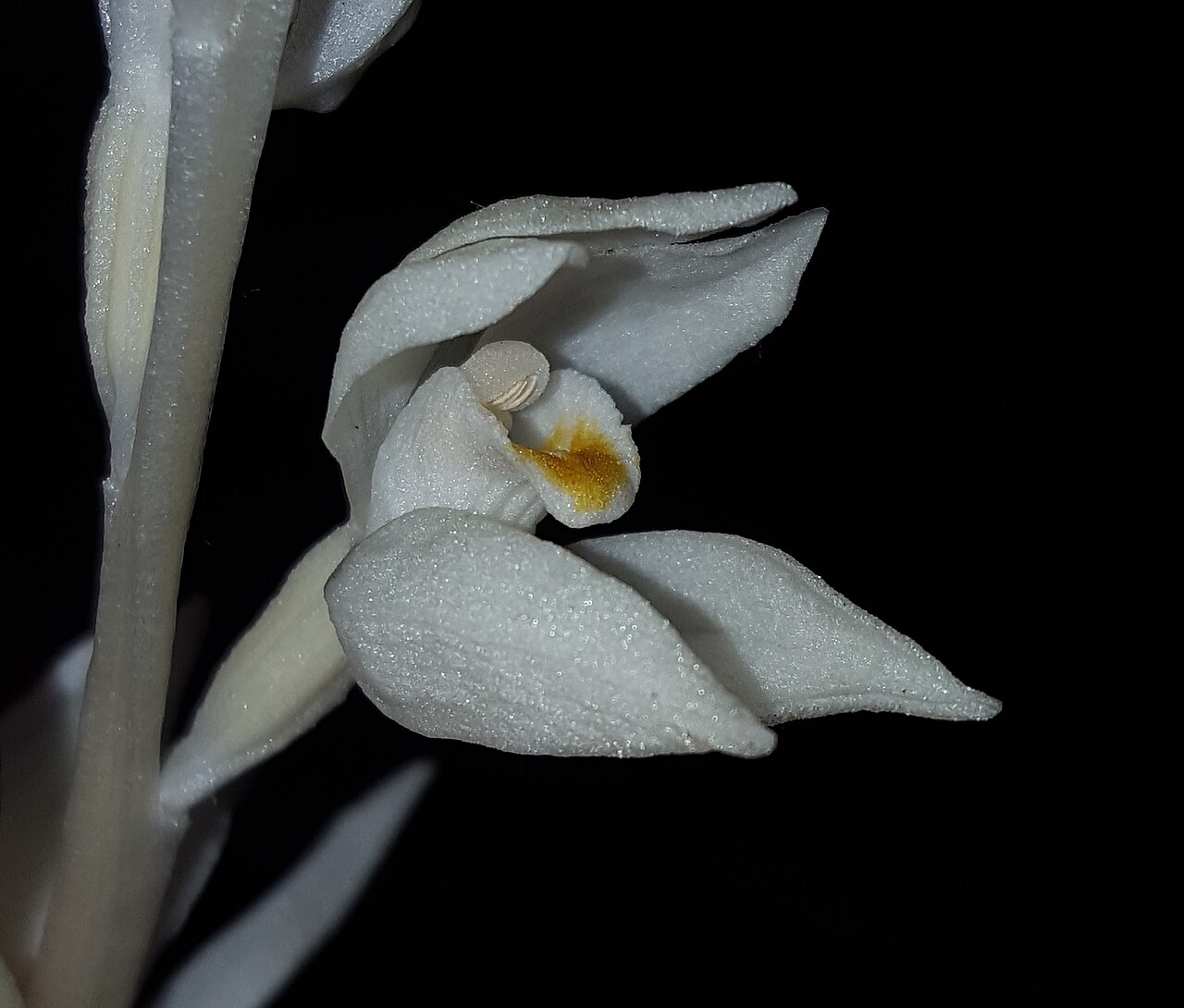
Few plants are as easy to recognize as phantom orchid once you see one. The combination of an all-white stem and clearly orchid-shaped white flowers with a yellow-marked lip is unique in western forests.
Growth Habit
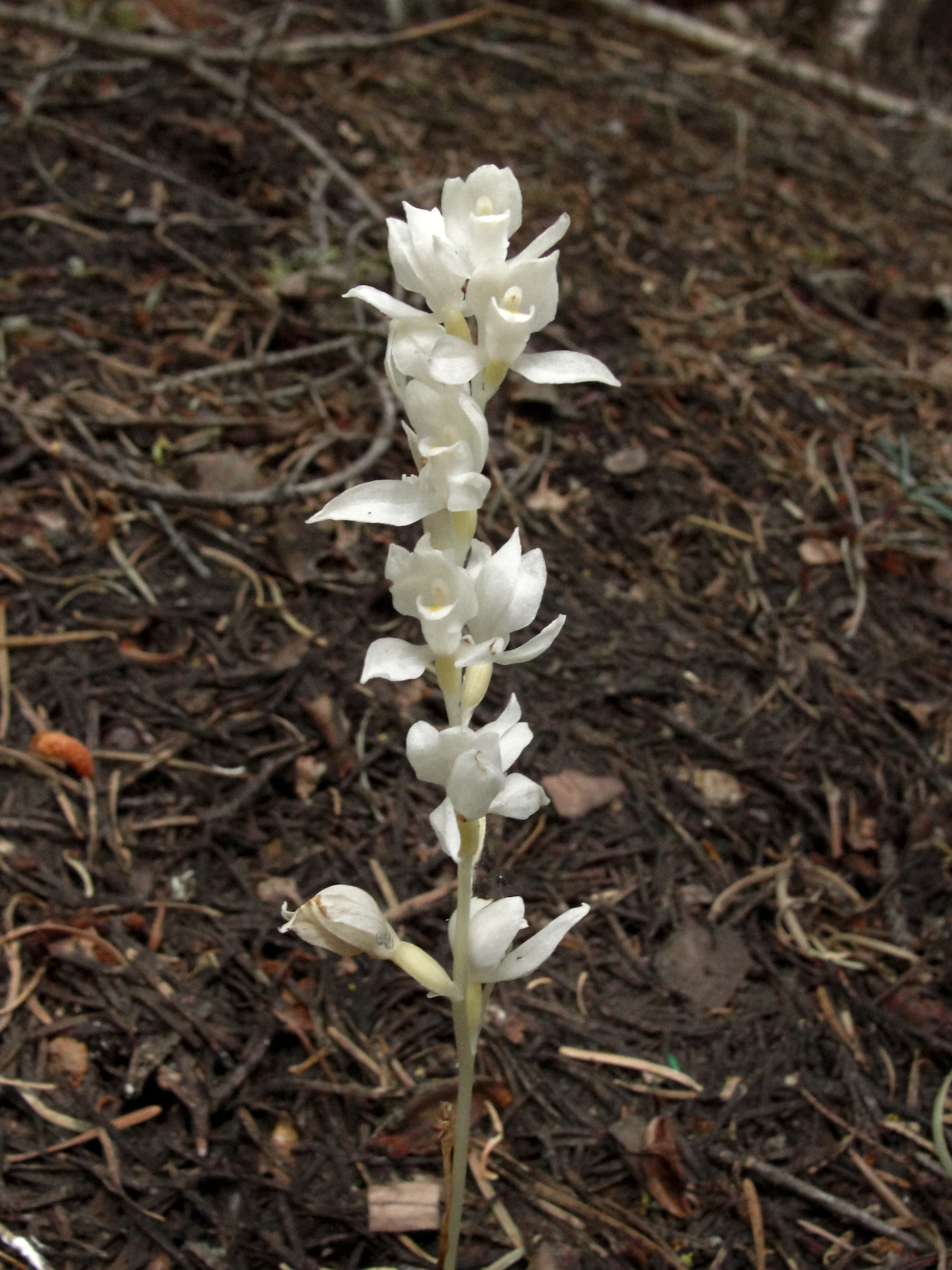
Each plant is a single erect, unbranched stem, usually 8 to 20 inches tall, rising from a creeping underground rhizome. Several stems sometimes come up together in a small cluster. The whole plant is white or ivory, and it turns brown as it ages after flowering.
Leaves
The leaves are reduced to a few pale, sheathing scales that wrap the lower stem and grade into small bracts beneath the flowers. They have no chlorophyll and play no role in feeding the plant.
Flowers
The upper part of the stem carries a loose spike of about 5 to 20 white flowers, each roughly 3/4 inch long. The sepals and side petals are waxy and white, and the lip has a bright yellow to golden patch inside, the only color on the plant. The flowers are often described as sweetly fragrant, with a vanilla-like scent. Bloom time is mainly May to August, earlier at low elevations in California and later in the mountains and farther north.
Fruit & Seeds
Pollinated flowers develop into upright, ribbed capsules that release enormous numbers of dust-like seeds. Like other orchid seeds, they have almost no stored food, and a seed can only develop if it is colonized by a suitable fungus.
Look-alikes
Other leafless, non-green plants of western forests are easy to tell apart. Ghost pipe (Monotropa uniflora) is also white but has a single nodding, bell-shaped flower. Snow plant is bright red, pinedrops is tall, sticky and reddish-brown, and coralroots are orchids with brown, purplish or yellowish stems. Rarely, an individual of another orchid lacks pigment, but such plants are extremely unusual.
Quick Facts
| Scientific Name | Cephalanthera austiniae (A. Gray) A. Heller (syn. Eburophyton austiniae) |
| Family | Orchidaceae (orchid family) |
| Plant Type | Mycoheterotrophic perennial herb; no chlorophyll |
| Mature Height | 8–20 in |
| Mature Spread | A single stem, sometimes in small clusters |
| Growth Rate | Not applicable; flowering stems appear irregularly |
| Sun Exposure | Deep to partial shade of mature forest |
| Water Needs | Not cultivated; grows in forest soils that stay moist below the litter |
| Soil Type | Deep humus and conifer needle litter over forest soils |
| Soil pH | Acidic to near neutral forest soils |
| Bloom Time | May–August |
| Flower Color | White, with a yellow patch on the lip |
| Fall Color | None; stems turn brown after flowering |
| Fruit | Upright capsules with dust-like seeds |
| Deer Resistant | Not applicable; not a garden plant |
| USDA Hardiness Zones | Not cultivated (native forests roughly zones 5–9) |
Native Range
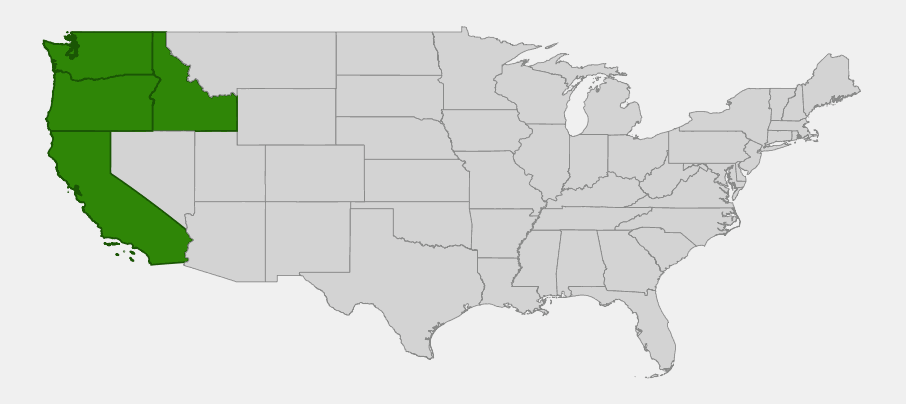
Phantom orchid is native to the Pacific Northwest and California. USDA PLANTS lists it in California, Idaho, Oregon and Washington, and in Canada it reaches southern British Columbia, mainly on southern Vancouver Island and in the southwestern mainland.
It is most often seen in California, in the Coast Ranges, Klamath Mountains, Cascades and Sierra Nevada, and in western Oregon and Washington, including the Cascades, Coast Range and Puget Sound lowlands. It also grows on the east slope of the Cascades, as in Chelan County, Washington, in the Blue Mountains of northeastern Oregon, and in the forests of northern Idaho. It is uncommon to rare toward the edges of its range, and in many places it is known from only a few sites.
Typical habitats are shady, mature forests with a deep layer of humus and needle litter: Douglas-fir and mixed conifer forests, redwood and mixed evergreen forests in California, and conifer-hardwood forests elsewhere, from near sea level into the mountains. It favors undisturbed sites where the soil fungi and trees it relies on are well established.
📋 Regional plant lists featuring Phantom Orchid: Western Oregon & Western Washington · California & Nevada
Can You Grow It?
The honest answer is no. Phantom orchid cannot be grown in a garden, bought from a nursery or moved from the wild, because it depends completely on specific soil fungi that are in turn linked to living forest trees.
Light
It grows in the deep or dappled shade of mature forest, but light is not what limits it. Phantom orchid has no chlorophyll and takes all of its food from mycorrhizal fungi in the forest soil. Research on the species has found that it associates with fungi that also form mycorrhizae with the roots of surrounding trees, so the orchid is ultimately supported by the trees through this fungal link. Without the right fungi and their host trees, the plant cannot survive.
Soil & Water
It needs deep, undisturbed forest humus and needle litter that stay moist below the surface, with its fungal partners and their host trees in place. A garden bed cannot provide that. Digging up a phantom orchid destroys it. Its rhizome and fungal connections cannot be carried to a new site, and the plant will die. Many populations are small, so removing even a few stems can harm them. Never dig, pick or collect it.
Planting Tips
Do not try. There is no legitimate source of phantom orchid plants or seed for gardeners. Any offer of wild-collected plants should be avoided. Its dust-like seeds cannot develop without the right fungus, so scattering seed is not a way to grow it.
Pruning & Maintenance
If you are lucky enough to have phantom orchids on forested land you manage, the best thing you can do is protect the forest around them. Keep the mature trees, avoid disturbing the soil and litter, and keep trails, logging equipment and heavy foot traffic away from the plants. Plants may not appear above ground every year, so a missing stem does not mean the orchid is gone.
Propagation
It reproduces from dust-like seed that must be colonized by the right fungus, and by slow spread of its rhizome, neither of which can be managed in cultivation. Enjoy it in place. Stay on trails or step carefully, avoid trampling the surrounding litter, and do not clear needles or plants around it for a better photo. Consider sharing locations of sensitive populations only with land managers or botanical groups.
Where to See It
- Northern California forests: Coast Ranges, Klamath Mountains and the Sierra Nevada, often in mixed conifer and redwood forests in late spring and early summer
- Western Oregon and Washington: shady Douglas-fir forests of the Cascades, Coast Range and Puget Sound region from late spring into summer
- East of the Cascades and Idaho: scattered sites in Chelan County, Washington, the Blue Mountains of Oregon and the forests of northern Idaho
- Southern British Columbia: rare in forests on southern Vancouver Island and the southwestern mainland
- Guided wildflower walks: native plant society field trips are a good, responsible way to see it without disturbing it
Wildlife & Ecological Value
Phantom orchid is a quiet but revealing part of the forest ecosystem, showing how closely trees, fungi and understory plants are linked.
For Pollinators
The fragrant white flowers are visited by small bees and other insects, which are drawn to the scent and the yellow lip. Pollination appears to be infrequent, and the plant also spreads slowly by its underground rhizome.
For Birds
It has no direct value as food for birds, but it grows in the mature forests that support many forest birds.
For Mammals
Deer and small mammals occasionally nibble the stems, and slugs may feed on them in moist forests. It is not an important food plant for any animal.
Ecosystem Role
Phantom orchid is an indicator of healthy, mature forest soils with a well-developed fungal network. Because it relies on fungi that link it to the surrounding trees, it is part of the shared underground network that connects many forest plants.
Cultural & Historical Uses
The species is named for Rebecca Merritt Austin (1832–1919), a self-taught botanist who collected plants in the northern Sierra Nevada and Plumas County, California, in the 1870s and sent specimens to Harvard botanist Asa Gray. Gray first described the plant from her collections, and it was later moved to Cephalanthera.
The genus name Cephalanthera comes from the Greek for “head” and “anther”, describing the shape of the anther. The rest of the genus grows in Europe and Asia; phantom orchid is the only North American species. For a time it was given its own genus, Eburophyton, meaning “ivory plant”.
Its common names, phantom orchid and snow orchid, capture the startling sight of a pure white orchid glowing in the dim light of an old forest. For many hikers in the Pacific Northwest and California, finding one is a highlight of the season.
Frequently Asked Questions
Why is phantom orchid white?
It has no chlorophyll, the green pigment plants use to make food from sunlight. Instead it gets all of its food from soil fungi that are connected to nearby trees.
Can I grow phantom orchid in my garden?
No. It depends entirely on specific soil fungi linked to living forest trees, so it cannot be grown from nursery stock, seed or transplants. Never dig it from the wild.
Where does phantom orchid grow?
In shady, mature conifer and mixed forests of California, Oregon, Washington, Idaho and southern British Columbia.
When does phantom orchid bloom?
Mainly from May to August, depending on elevation and latitude.
Is phantom orchid rare?
It is uncommon in most of its range and rare in some areas, especially toward the edges of its range. It may not appear every year at a site, so always leave it undisturbed.

Looking for a nursery that carries Phantom Orchid?
Browse our native plant nursery directory: California · Idaho · Oregon · Washington

