Slim Tridens (Tridens muticus)
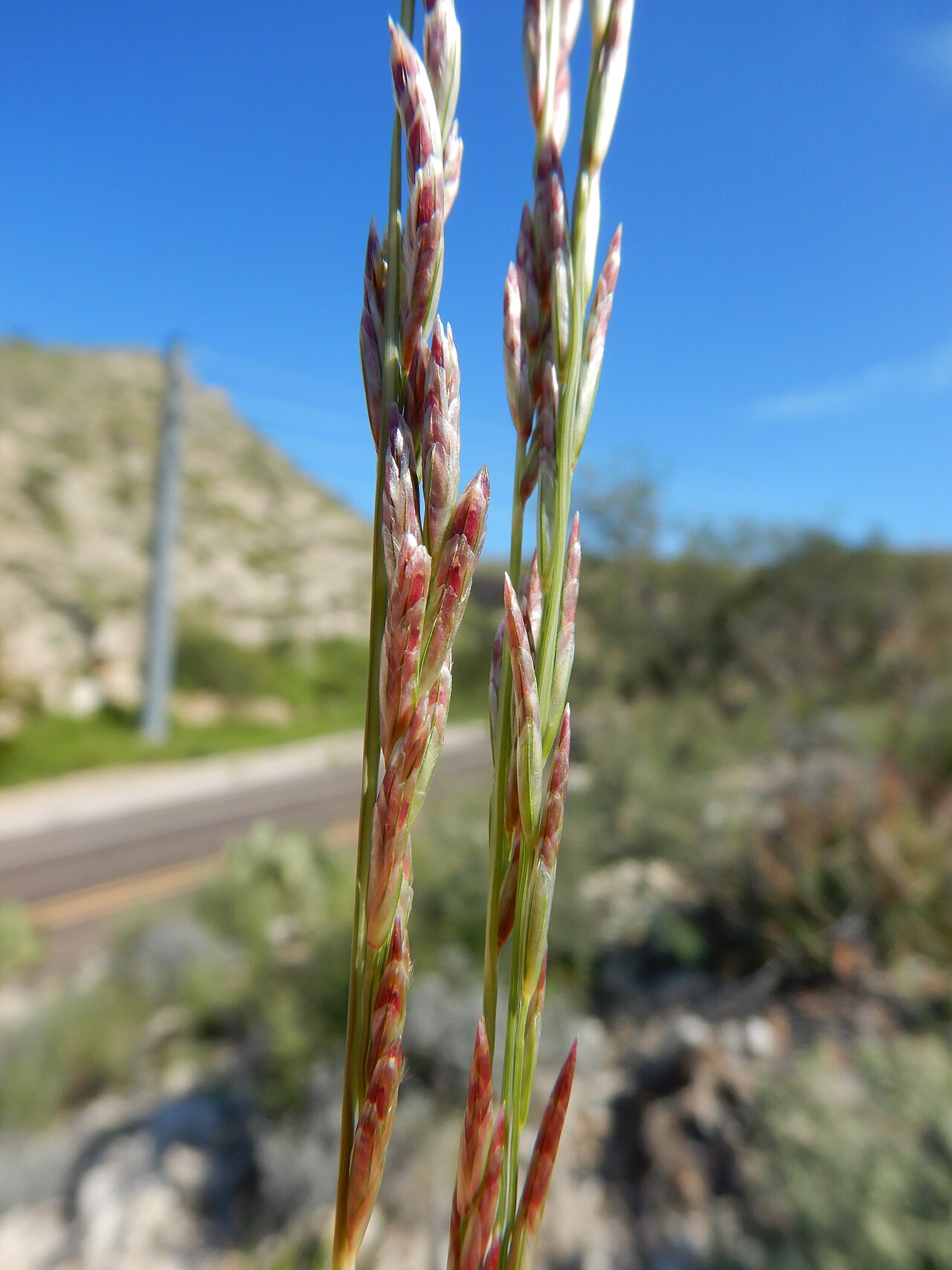
Tridens muticus, commonly known as Slim Tridens, is a wiry, densely tufted native perennial bunchgrass found across much of the warm, dry western and southern United States. The species name muticus means “awnless” or “blunt,” referring to the lemma tips, which lack the bristly awns seen in many related grasses — a useful identification detail once you know to check for it. Slim Tridens is one of the more wide-ranging members of its genus, turning up from California desert washes to Ozark glades in Missouri, though it is most abundant across the Chihuahuan and Sonoran Desert grasslands and the southern Rocky Mountain foothills.
True to its name, Slim Tridens has a slender, delicate look: narrow, scabrous (rough-textured) leaves and a slim, interrupted flower spike that gives the whole plant an airy, almost see-through quality compared to coarser desert grasses. Mature clumps reach 1 to 2.5 feet tall and are densely tufted, with no spreading rhizomes, so they stay put as a tidy, long-lived bunchgrass rather than filling in like a turf grass.
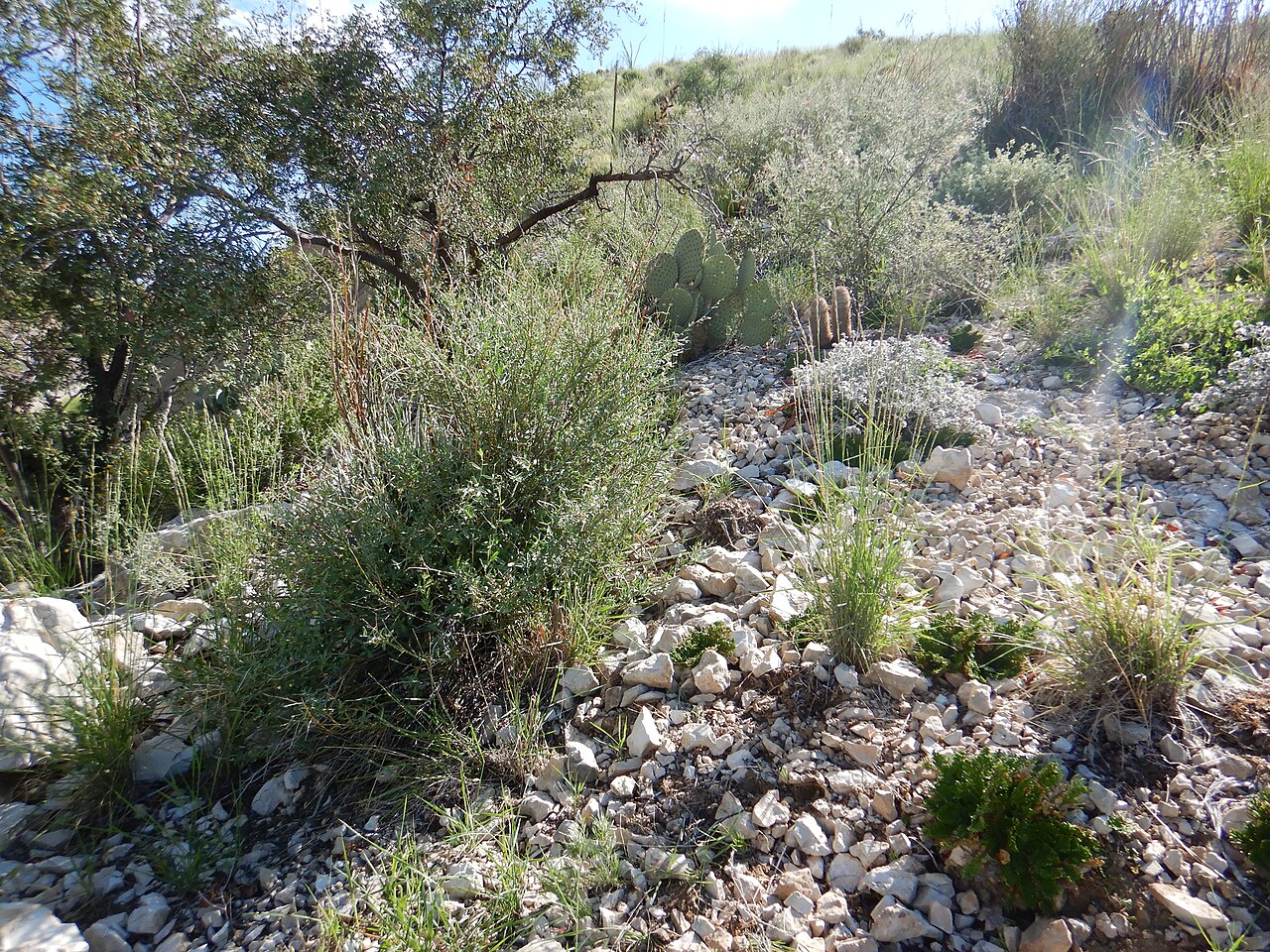
In the wild, Slim Tridens grows on rocky slopes, limestone and caliche outcrops, desert grassland, and dry open woodland edges, often rooting directly into gravelly or stony ground that holds little organic matter. It is valued by desert and xeriscape gardeners for exactly the conditions that make it difficult for less-adapted grasses: poor rocky soil, intense heat, and long dry spells.
Identification
Slim Tridens is a cespitose (densely tufted) perennial that forms tight clumps from a knotty, shortly rhizomatous base — the clump thickens over the years but does not spread outward the way a true rhizomatous grass would. Culms are slender, 8 to 32 inches (20–80 cm) tall, with nodes that often bear short, soft hairs.
Leaves & Growth Habit
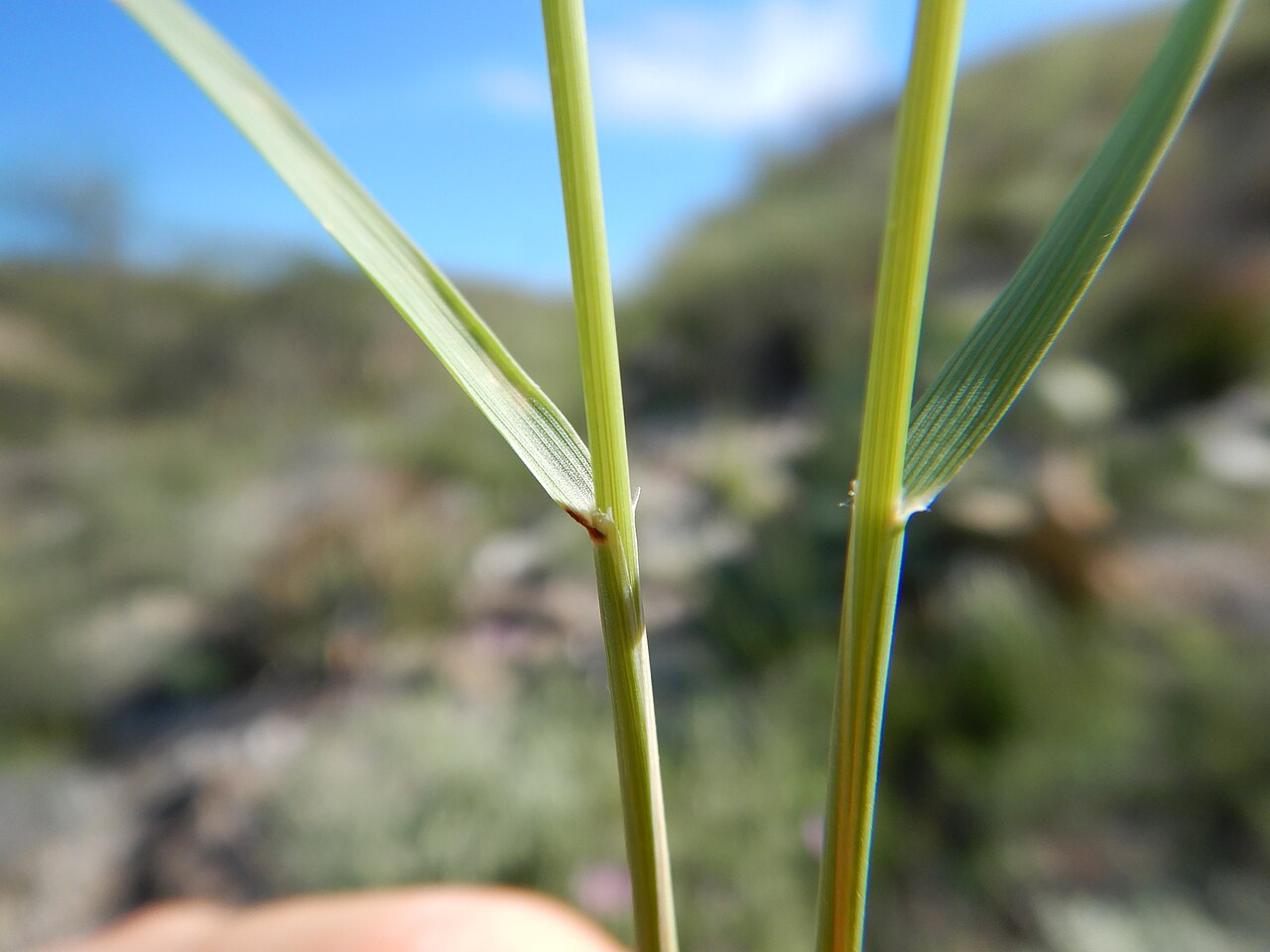
Leaf blades are narrow, just 1 to 4 mm wide, usually involute (rolled inward) or loosely folded, giving the foliage a wiry, thread-like appearance. Sheaths are rounded, with the lower sheaths often strigose or pilose (bearing short, stiff or soft hairs) while upper sheaths are smoother; the ligule is a short, membranous fringe, 0.5 to 1 mm long and ciliate (fringed with fine hairs) — visible with a hand lens where the leaf blade meets the stem.
Flowers & Seed Heads
The inflorescence is a narrow, elongated panicle, often interrupted (with visible gaps between clusters of spikelets rather than one continuous dense spike) and typically tinged reddish-purple when fresh, fading to a buff or pinkish-tan as it matures and dries. Glumes are short — usually 5 mm or less — and do not fully cover the florets they subtend, another distinguishing detail from similar tridens species with longer, more enclosing glumes. As the species name indicates, the lemmas are essentially awnless or very shortly pointed, lacking the long bristles found on many Southwest native grasses.
Fruit & Seeds
Seed is small and produced in modest quantity along the narrow panicle branches, dispersing locally as the dried inflorescence breaks apart over winter. Two recognized varieties occur in the U.S. — the typical, more western Tridens muticus var. muticus, and the more easterly Tridens muticus var. elongatus, which tends toward slightly longer panicles and ranges further east into Missouri and Louisiana.
Quick Facts
| Scientific Name | Tridens muticus (syn. Tridentopsis mutica, Triodia mutica) |
| Family | Poaceae (Grass) |
| Plant Type | Warm-Season Perennial Bunchgrass |
| Mature Height | 1–2.5 ft (8–32 in culms) |
| Mature Spread | 1 ft dense tuft |
| Growth Rate | Slow to moderate |
| Sun Exposure | Full Sun |
| Water Needs | Low |
| Soil Type | Rocky, gravelly, limestone or caliche; well-drained |
| Soil pH | 6.5–8.5 (neutral to alkaline) |
| Bloom Time | Summer – Fall |
| Flower Color | Reddish-purple fading to buff-tan |
| Fall Color | Tan, wiry foliage persists through winter |
| Fruit | Small, essentially awnless grass seed (caryopsis) |
| Deer Resistant | Moderate (light forage value) |
| USDA Hardiness Zones | 6–10 |
Native Range
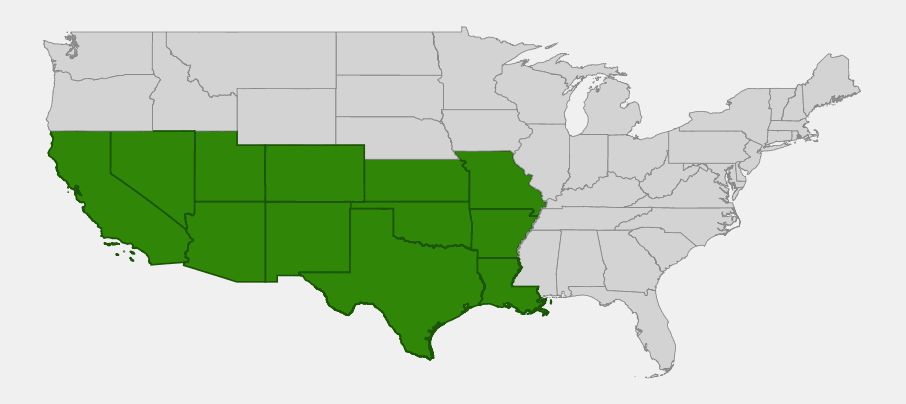
Slim Tridens has one of the broadest ranges of any Tridens species in North America, native from California east through Nevada, Utah, Colorado, Arizona, New Mexico, and the southern Great Plains into Kansas, Oklahoma, Texas, Arkansas, Missouri, and Louisiana, and south into central Mexico. Despite this wide distribution, it is nowhere a dominant grass; it occurs as a scattered, persistent component of rocky, open plant communities rather than forming extensive stands.
It favors dry, rocky ground: limestone hills, caliche flats, gravelly desert slopes, canyon walls, and the thin soils of open woodland and glade edges. In the more easterly parts of its range — the Ozark glades of Missouri and Arkansas, for instance — it is often a signature species of exposed limestone outcrops where few other grasses can establish.
Common associates shift with region: in the desert Southwest, Slim Tridens grows with creosote bush, ocotillo, and other grama grasses on rocky bajadas and canyon slopes; farther east and north, it turns up alongside little bluestem and sideoats grama on limestone prairie and glade habitat.
📋 Regional plant lists featuring Slim Tridens: Arizona & New Mexico · South and West Texas · California & Nevada · Utah & Western Colorado · Arkansas, Louisiana, Eastern Oklahoma & Eastern Texas · Nebraska, Kansas & Eastern Colorado · Illinois, Iowa & Missouri
Growing & Care Guide
Slim Tridens is an easygoing, low-maintenance choice for gardeners dealing with rocky, poor, or alkaline soil where showier grasses often fail. Its slender, see-through form also makes it a useful textural contrast plant rather than a bold focal specimen.
Light
Full sun is essential. Slim Tridens is adapted to open rocky ground across its range and does not tolerate significant shade.
Soil & Water
This is a grass for difficult, rocky, mineral soils — limestone, caliche, gravel, and thin desert or glade soils are its natural home, and it generally performs poorly in rich, amended garden soil, where it can become floppy or short-lived. Once established, it needs no supplemental irrigation beyond natural rainfall across most of its range; occasional deep watering during extreme drought helps appearance but is not required.
Planting Tips
Set out container plants in spring, choosing a site with rocky, lean, fast-draining soil rather than amended garden beds. Space plants 10 to 15 inches apart for a naturalistic drift. Because it is slow to moderate in growth and does not spread by rhizomes, give it time to fill in rather than expecting quick coverage.
Pruning & Maintenance
Cut clumps back in late winter to remove the prior year’s dried growth and keep the tuft tidy. Avoid fertilizing — Slim Tridens is adapted to nutrient-poor rocky soils, and rich feeding tends to weaken its naturally wiry, upright form.
Landscape Uses
Slim Tridens suits a range of low-water, rock-forward garden styles:
- Rock gardens and crevice plantings in gravelly or limestone soil
- Xeriscaping on hot, dry, poorly irrigated sites
- Glade and limestone prairie restoration in the eastern part of its range
- Desert grassland and bajada plantings paired with cacti and grama grasses
- Erosion control on rocky slopes and caliche cuts
Wildlife & Ecological Value
Though not a dominant grass anywhere in its range, Slim Tridens contributes meaningfully to the structure and stability of rocky, open plant communities across a wide swath of the West and South.
For Birds
Small seed-eating birds forage on the modest seed crop produced by mature panicles, and the wiry, upright tufts offer scattered low cover in otherwise open, rocky terrain where ground-level shelter is scarce.
For Mammals
Slim Tridens provides light forage value for desert and rangeland grazers, including pronghorn and deer, and for livestock on native range, though it is not considered a primary forage species given its typically sparse distribution.
For Pollinators
As a wind-pollinated grass, it provides no nectar, but like other native bunchgrasses it supports grassland insects that in turn sustain birds and other wildlife in the rocky habitats where it grows.
Ecosystem Role
Slim Tridens’ fibrous root system helps stabilize thin, rocky, and erosion-prone soils on slopes and outcrops across a remarkably broad range of climates, from Mojave Desert washes to Ozark limestone glades, making it a quietly important soil-holding species wherever it occurs.
Cultural & Historical Uses
Slim Tridens has not been a major forage or economic grass historically, owing to its scattered, non-dominant distribution across rocky terrain, but it has long been recognized by range scientists and botanists as an indicator of healthy, undisturbed rocky grassland and glade habitat across its wide range.
Its persistence on limestone glades in the Ozarks and on caliche and rocky slopes in the Southwest has made it useful in regional vegetation surveys and restoration work aimed at identifying and protecting these specialized rock-outcrop plant communities, which often harbor other uncommon or regionally rare species alongside it.
Among native-plant gardeners, Slim Tridens remains a relatively niche choice, grown mainly by those restoring authentic rocky desert-grassland, glade, or xeriscape plantings rather than for broad ornamental appeal — valued for ecological authenticity more than visual drama.
Frequently Asked Questions
How is Slim Tridens different from other Tridens species?
Its narrow, often interrupted, reddish-tinged panicle and essentially awnless lemmas (the species name muticus means “awnless”) distinguish it from relatives like White Tridens, which has a denser, paler, more continuous seed head.
Will Slim Tridens grow in regular garden soil?
It performs best in lean, rocky, fast-draining soil and tends to struggle, flopping or declining, in rich, regularly amended garden beds. It is best suited to true rock gardens, gravel beds, or unimproved native soil.
Why is Slim Tridens native to so many different states?
Its narrow habitat requirement — exposed, rocky, well-drained ground — occurs in patches across a huge geographic range, from desert bajadas in California to limestone glades in Missouri, allowing the species to persist in scattered pockets without being common anywhere in particular.
Does Slim Tridens spread aggressively in the garden?
No. It is a slow-growing, densely tufted bunchgrass with a knotty but non-spreading base; it thickens in place rather than spreading by rhizomes or runners.
Is Slim Tridens good for erosion control?
Yes, particularly on rocky slopes and limestone or caliche outcrops where its fibrous roots help stabilize thin soils that are otherwise prone to erosion, though it establishes more slowly than faster-growing erosion-control grasses.

Looking for a nursery that carries Slim Tridens?
Browse our native plant nursery directory: California · Nevada, New Mexico & Oklahoma · Utah & Texas · Arizona & Arkansas · Kansas · Louisiana & Missouri · Colorado