
Sweetberry Honeysuckle (Lonicera caerulea)
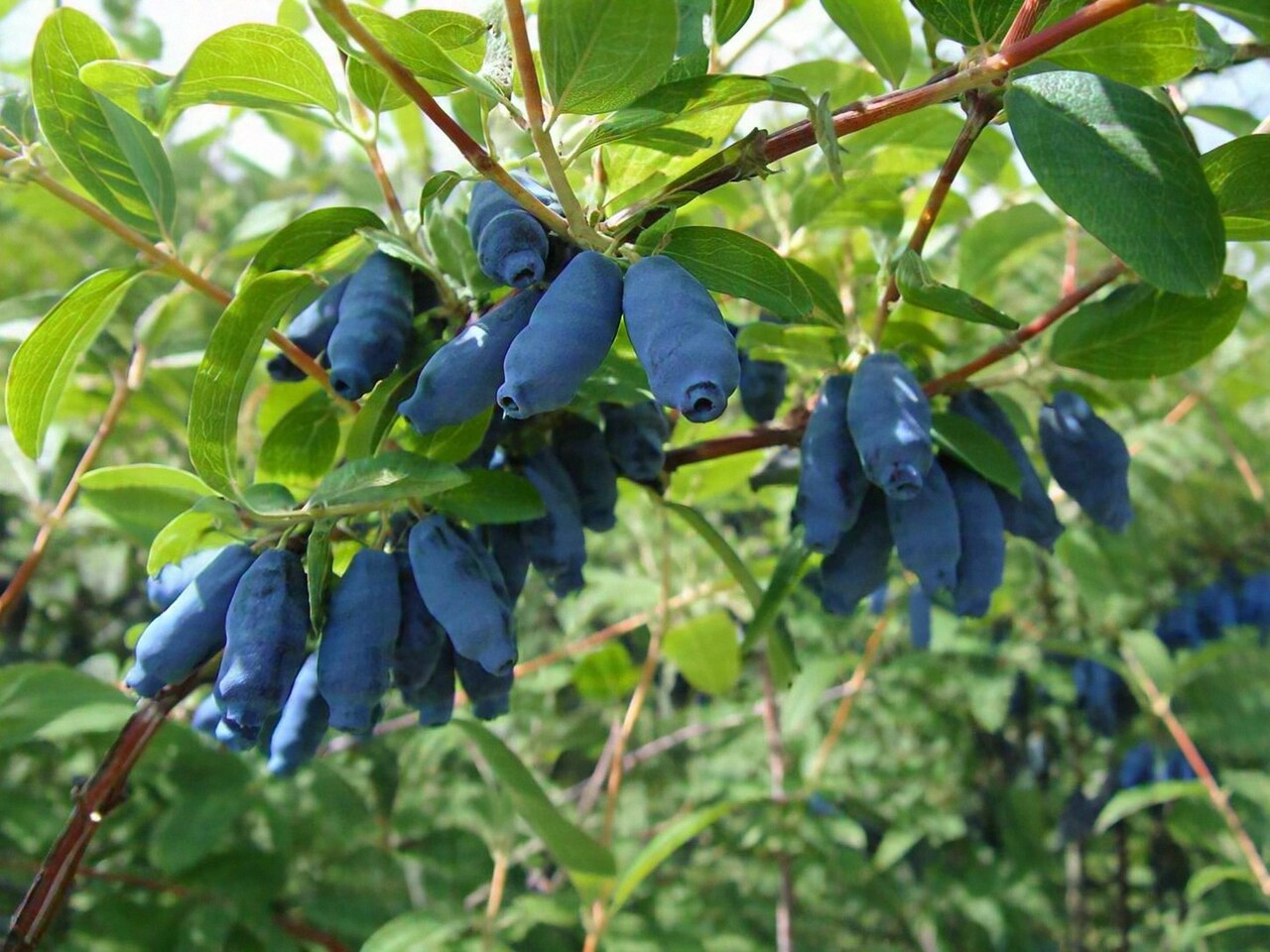
Lonicera caerulea, the Sweetberry Honeysuckle, is a cold-hardy, upright shrub honeysuckle best known today as haskap or honeyberry, the edible blue berry that has become a favorite of northern fruit growers. It is not a vine: it forms a rounded bush of opposite, gray-green leaves, opens pale yellow, paired flowers very early in the season, and then ripens oblong, powder-blue berries that taste like a cross between blueberry, raspberry and blackcurrant.
The species is circumboreal, growing wild across the cool parts of Europe, Asia and North America. In the United States, USDA PLANTS lists it as native in seven western states, where the wild form (often called var. cauriana) grows in wet mountain meadows, bogs and stream banks of the Sierra Nevada, Cascades and northern Rocky Mountains. The plants sold as haskap and honeyberry in nurseries are mostly cultivars bred from Japanese and Russian forms, but they are the same species.
This guide covers how to tell sweetberry honeysuckle from other native honeysuckles, where it grows wild in the West, how to grow haskap cultivars for fruit in cold climates, and what the shrub offers early bumblebees and berry-eating birds.
Identification
Sweetberry honeysuckle is a shrub honeysuckle with flowers in pairs, like several other native “fly honeysuckles.” The combination of a fused, oblong blue berry with a whitish bloom, pale yellow flowers, and peeling, reddish-brown bark on older stems sets it apart.
Growth Form & Bark
Wild plants in the western mountains are usually low, branching shrubs 1 to 4 feet tall, sometimes sprawling in wet meadows. Haskap cultivars grow into rounded bushes about 4 to 6 feet tall and wide. Young twigs are often hairy and reddish; older stems have tan to reddish-brown bark that peels off in long, papery strips. The shrub leafs out very early, often while there is still frost in the forecast.
Leaves
The leaves are opposite, simple and untoothed, oval to oblong, about 1 to 3 inches long, and gray-green to blue-green with a slightly waxy or hairy surface. At the base of each leaf pair there are often small leafy stipules joined across the stem, a detail that helps separate it from some other honeysuckles. Fall color is usually modest yellow, and the leaves drop early in hot summers.
Flowers
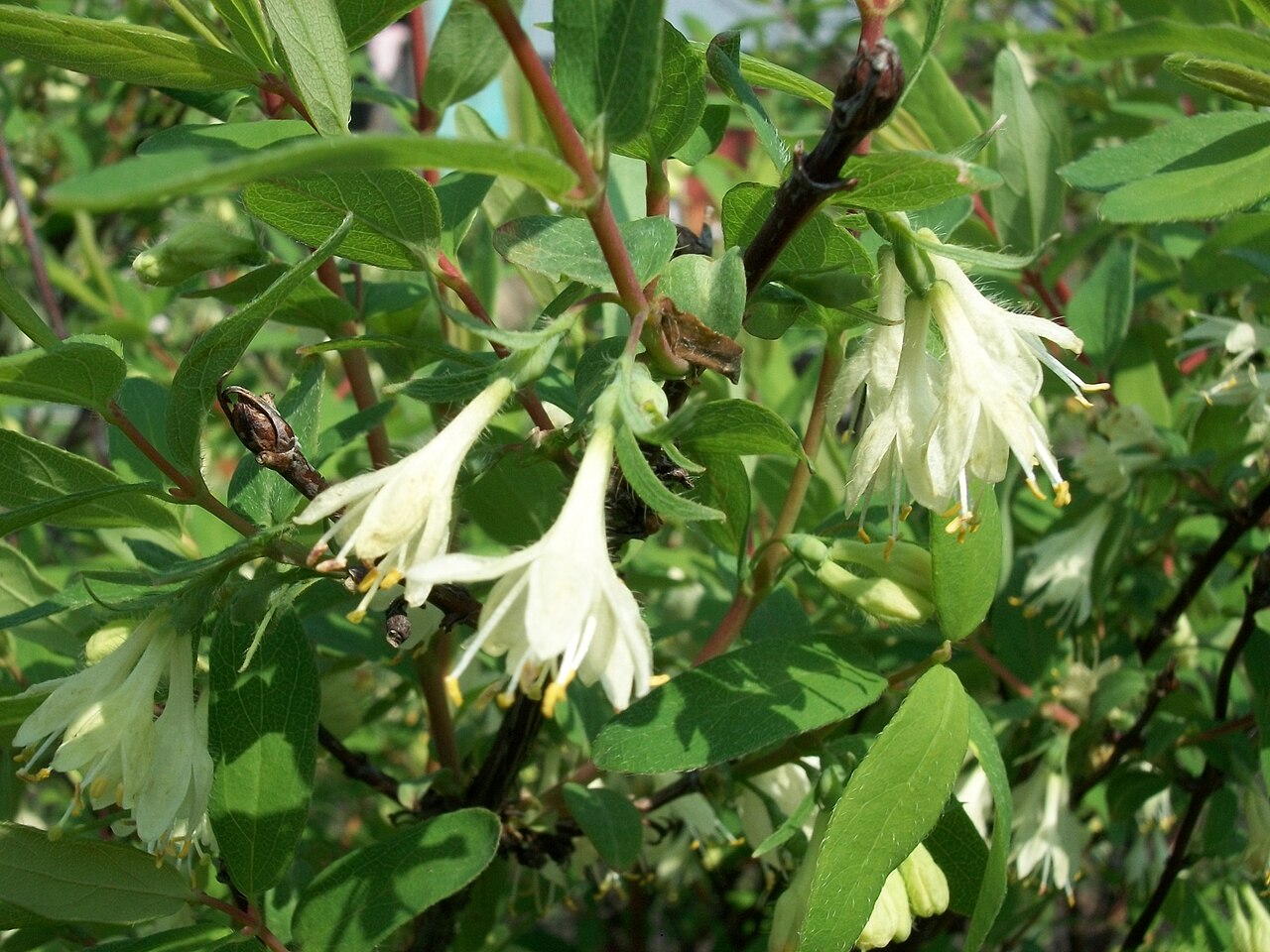
The flowers appear in pairs at the leaf axils, each about half an inch long, funnel-shaped and pale yellow to creamy white, with five nearly equal lobes and stamens that just reach past the mouth of the tube. In cultivation they open in early spring, often in March or April, and tolerate frost. In the high mountains of the West the wild plants bloom later, from about May to July, as the snow melts.
Fruit
The two ovaries of each flower pair are enclosed together in a cup of fused bracts, so each pair produces a single blue berry. The berry is oblong or barrel-shaped, about half an inch to an inch long on cultivars (smaller on wild plants), dark blue with a pale waxy bloom, and filled with dark red-purple juice and tiny seeds. Haskap cultivars ripen in early summer, often ahead of strawberries; wild western plants ripen in mid to late summer.
Many other honeysuckles have red, orange or black berries that are not edible. Twinberry, a common western neighbor, has two separate shiny black berries cradled by red or purple bracts, and American fly honeysuckle has paired red berries. Always be sure of the identification before eating wild fruit.
Quick Facts
| Scientific Name | Lonicera caerulea L. |
| Family | Caprifoliaceae (honeysuckle family) |
| Plant Type | Deciduous shrub |
| Mature Height | 1–4 ft wild; 4–6 ft for haskap cultivars |
| Mature Spread | 3–5 ft |
| Growth Rate | Moderate |
| Sun Exposure | Full sun to part shade |
| Water Needs | Moderate to high; likes evenly moist soil |
| Soil Type | Moist loam, peaty or organic soil; tolerates clay with good drainage |
| Soil PH | About 5.5–7.0 (tolerates roughly 4 to 7.7) |
| Bloom Time | March–April in gardens; May–July in western mountains |
| Flower Color | Pale yellow to creamy white |
| Fall Color | Modest yellow |
| Fruit | Edible oblong blue berry with a waxy bloom |
| Deer Resistant | No; deer and moose browse it |
| USDA Hardiness Zones | 2–7 (many cultivars to zone 1 or 2) |
Native Range
Sweetberry honeysuckle is one of the few shrubs that circles the globe in the cool north. It grows from Scandinavia and the Alps across Russia and Siberia to Kamchatka, Hokkaido and northeastern China, and across Canada from British Columbia and Alberta eastward. Botanists divide it into many varieties or subspecies, and the eastern Asian forms (var. edulis, var. kamtschatica and var. emphyllocalyx) are the ancestors of most haskap cultivars.
In the United States, USDA PLANTS maps Lonicera caerulea as native only in the West: California, Idaho, Montana, Nevada, Oregon, Washington and Wyoming. These are the wild var. cauriana plants of subalpine meadows, fens and streamsides in the Sierra Nevada, Cascades and northern Rockies. Nevada has only a few scattered records, which we treat as outlying populations.
In the Northeast and Great Lakes region there is a closely related shrub, mountain fly honeysuckle. Some botanists treat it as Lonicera caerulea var. villosa, but USDA PLANTS keeps it as a separate species, Lonicera villosa, native from Minnesota to Maine and Pennsylvania. We follow USDA here, so the map shows only the western states; if you garden in the East, mountain fly honeysuckle is your local wild relative.
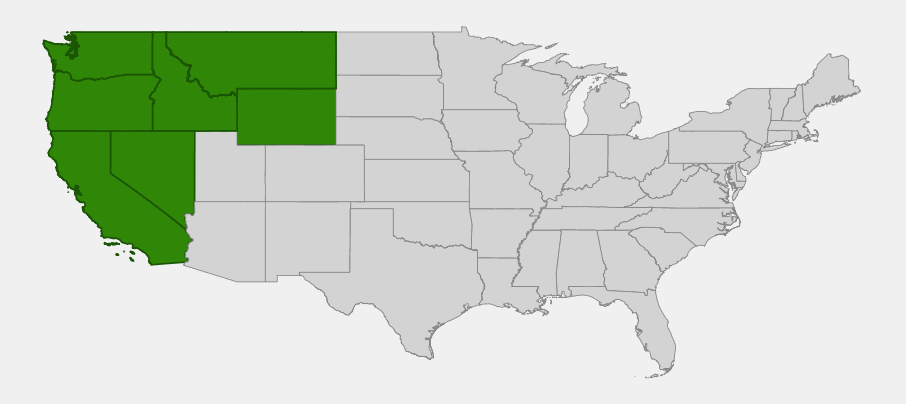
📋 Regional plant lists featuring Sweetberry Honeysuckle: Idaho, Eastern Oregon & Eastern Washington · Montana & Wyoming · Western Oregon & Western Washington · California & Nevada
Growing & Care Guide
Haskap is one of the easiest fruiting shrubs for cold climates. It shrugs off deep winter cold, flowers through spring frosts, and has few serious pests. The two things that matter most are planting at least two compatible varieties for pollination and keeping the soil evenly moist while the fruit develops.
Light
Full sun gives the best fruit crop in northern gardens. In hot summer areas (roughly zone 6 and warmer), afternoon shade helps, because the leaves scorch and drop early in strong heat. Wild sweetberry honeysuckle often grows at the edges of forests and in partly shaded wet meadows.
Soil & Water
Grow it in moist, well-drained soil rich in organic matter. It tolerates a wide pH range, from fairly acidic to slightly alkaline, and handles wetter ground than most fruit bushes, which reflects its bog and meadow origins. Water regularly in the first two years and during dry spells in spring, when the berries are swelling. A 2 to 3 inch layer of mulch keeps the shallow roots cool and moist.
Planting Tips
Haskap is not self-fruitful. Plant at least two different cultivars that bloom at the same time within about 50 feet of each other; nurseries list compatible pollination partners. Space plants about 4 to 5 feet apart in a row or 5 to 6 feet apart as specimens. Plant in early spring or fall. For the wild western form, look for native plant nurseries in the Northwest and Northern Rockies, and use it in a wet meadow, rain garden or pond edge.
Pruning & Maintenance
Little pruning is needed for the first three years. After that, in late winter, remove dead and crossing branches and take out one or two of the oldest stems each year to keep the bush open and productive. Fruit forms on the previous year’s wood, so avoid heavy cuts. Birds are the main pest: cover bushes with netting a few weeks before harvest. Pick when the berries are blue all the way through (cut one open; the inside should be dark purple, not green), because they color up on the outside before they are fully ripe and sweet.
Propagation
Softwood cuttings taken in early summer root well under mist or in a covered tray, and hardwood cuttings also work. Seed needs cleaning from the pulp and a period of cold, moist stratification, but seedlings will not match a named cultivar. Wild plants should not be dug; buy nursery plants instead.
Landscape Uses
- Edible landscape: a compact fruiting shrub that ripens the first berries of the season
- Cold-climate fruit growing: one of the hardiest fruit crops, suited to zones 2 to 5 where blueberries struggle
- Wet meadow and rain gardens: the wild western form suits moist, sunny to partly shaded native plantings
- Informal hedge: a low, dense row of mixed cultivars that also pollinate each other
- Pollinator gardens: very early flowers for queen bumblebees emerging in spring
Wildlife & Ecological Value
Because it blooms so early and fruits so early, sweetberry honeysuckle fills two gaps in the wildlife calendar: nectar for the first bees of spring and berries before most other shrubs ripen.
For Pollinators
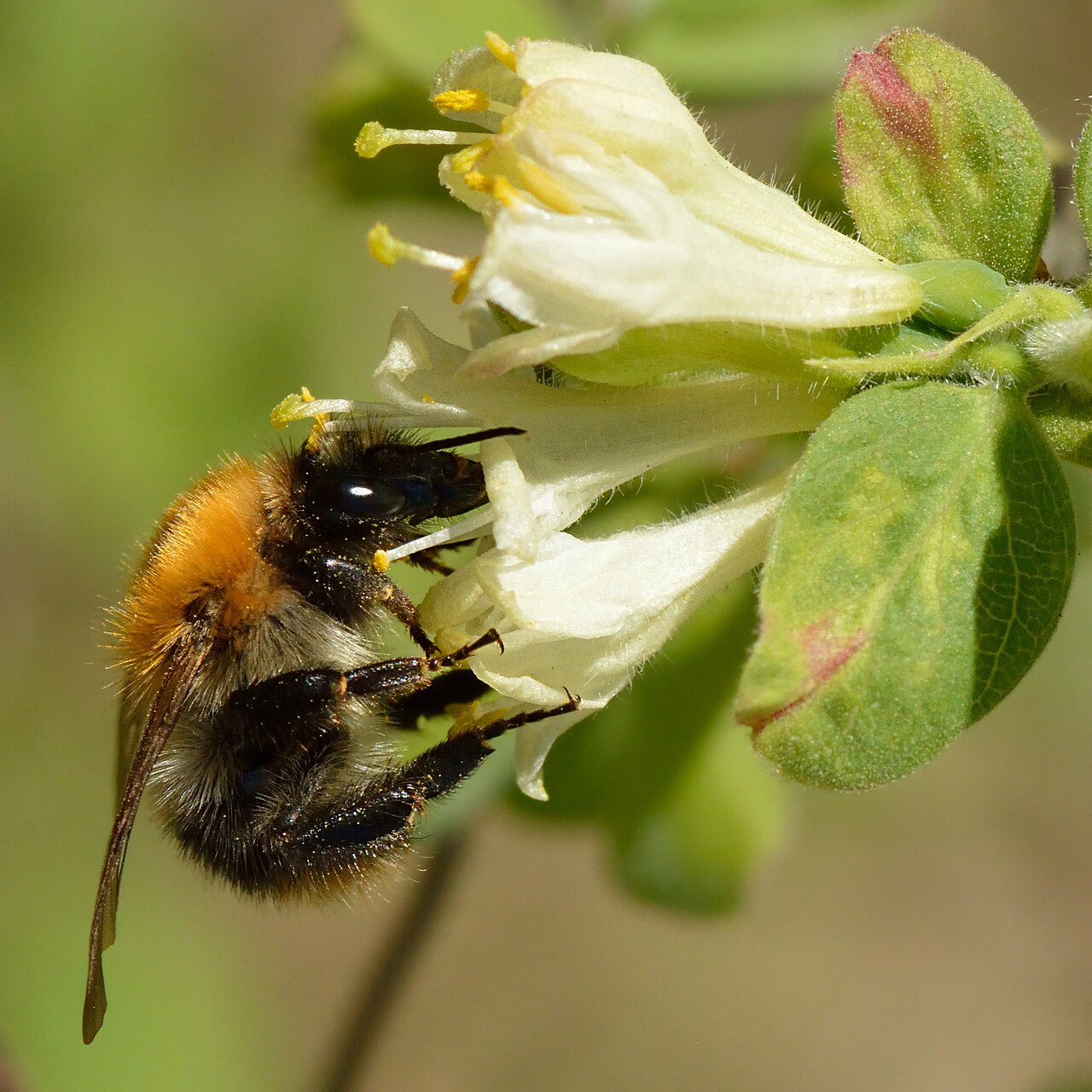
Bumblebees are the main pollinators. The flowers open in cool, cloudy weather when honeybees stay home, and queen bumblebees, which fly at low temperatures, work them heavily. Mason bees and other early native bees also visit.
For Birds
Robins, waxwings, thrushes, grouse and many other birds eat the berries, often clearing a garden bush before the owner notices it is ripe. In wild meadows the shrubs provide low cover and nesting sites.
For Mammals
Bears, chipmunks and other small mammals eat the fruit. Deer, elk and moose browse the twigs and foliage, so new garden plantings may need protection where browsing is heavy.
Ecosystem Role
In subalpine meadows, fens and streamsides, sweetberry honeysuckle is part of the shrub layer that shades the soil, holds stream banks and feeds wildlife. Its flowers are among the earliest food sources after snowmelt.
Cultural & Historical Uses
The name haskap comes from the Ainu people of Hokkaido, Japan, who gathered the wild berries for generations. Indigenous peoples of Siberia and the Russian Far East did the same, and Russian botanists began breeding the plant for fruit in the twentieth century. The North American name “honeyberry” came later, and the University of Saskatchewan has bred many of the hardy, large-fruited cultivars grown in Canada and the northern United States today.
The berries are high in vitamin C and in the dark red-purple pigments called anthocyanins. They are eaten fresh or made into jam, juice, wine, ice cream and baked goods, and haskap products are popular in Japan. The juice stains strongly, much like blueberries or blackcurrants.
The species name caerulea means “sky blue,” for the fruit. Unlike the invasive Asian bush honeysuckles that crowd eastern woodlands, sweetberry honeysuckle is a modest, slow-spreading shrub and a native member of western mountain plant communities.
Frequently Asked Questions
Is haskap the same as sweetberry honeysuckle?
Yes. Haskap, honeyberry, blue honeysuckle and sweetberry honeysuckle are all names for Lonicera caerulea. Most nursery plants are cultivars bred from Asian forms of the species, while the wild plants native to the western United States belong to var. cauriana.
Are haskap berries safe to eat?
Yes, the berries of Lonicera caerulea are edible and widely sold. Many other honeysuckle berries are not, so only eat fruit you are certain is this species. The edible berry is oblong and blue with a waxy bloom.
Do I need two haskap plants to get fruit?
Yes. Haskap needs pollen from a different, compatible cultivar that blooms at the same time. Plant at least two varieties within about 50 feet of each other.
Is Lonicera caerulea native to the eastern United States?
USDA PLANTS lists Lonicera caerulea as native only in western states. The similar mountain fly honeysuckle of the Northeast and Great Lakes is listed by USDA as a separate species, Lonicera villosa, though some botanists treat it as a variety of L. caerulea.
How cold-hardy is haskap?
Very hardy. Dormant plants survive temperatures far below 0°F, and the flowers can take spring frosts. It grows well from about zone 2 to zone 7, but struggles with long, hot summers.

Looking for a nursery that carries Sweetberry Honeysuckle?
Browse our native plant nursery directory: California · Idaho · Montana · Nevada · Oregon · Washington · Wyoming

