
American Fly Honeysuckle (Lonicera canadensis)
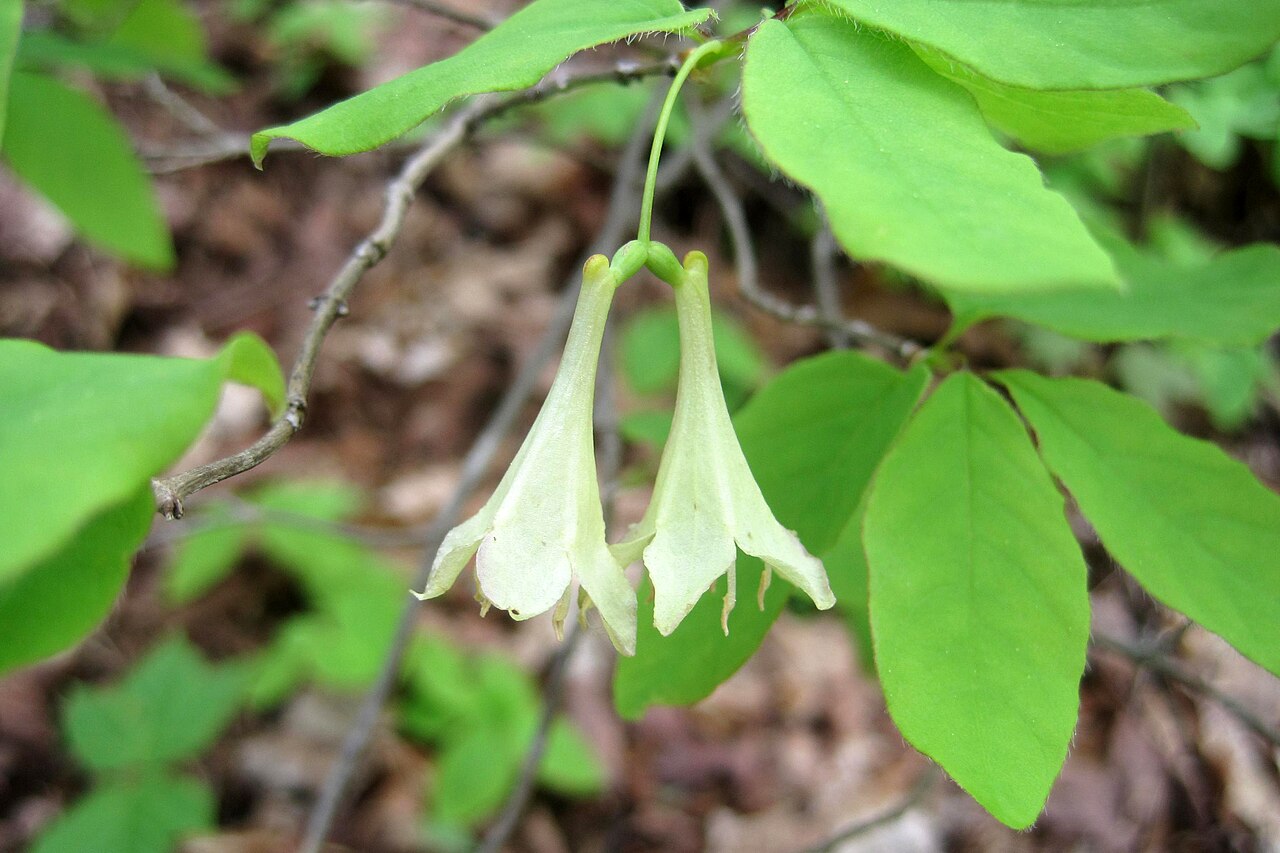
Lonicera canadensis, known as American Fly Honeysuckle, is a small, loosely branched native shrub of cool, shady northern forests. It belongs to the honeysuckle family (Caprifoliaceae). Usually 2 to 5 feet tall, it is one of the first shrubs to bloom in the northern woods, opening pairs of pale yellow, funnel-shaped flowers in April and May as its leaves unfold.
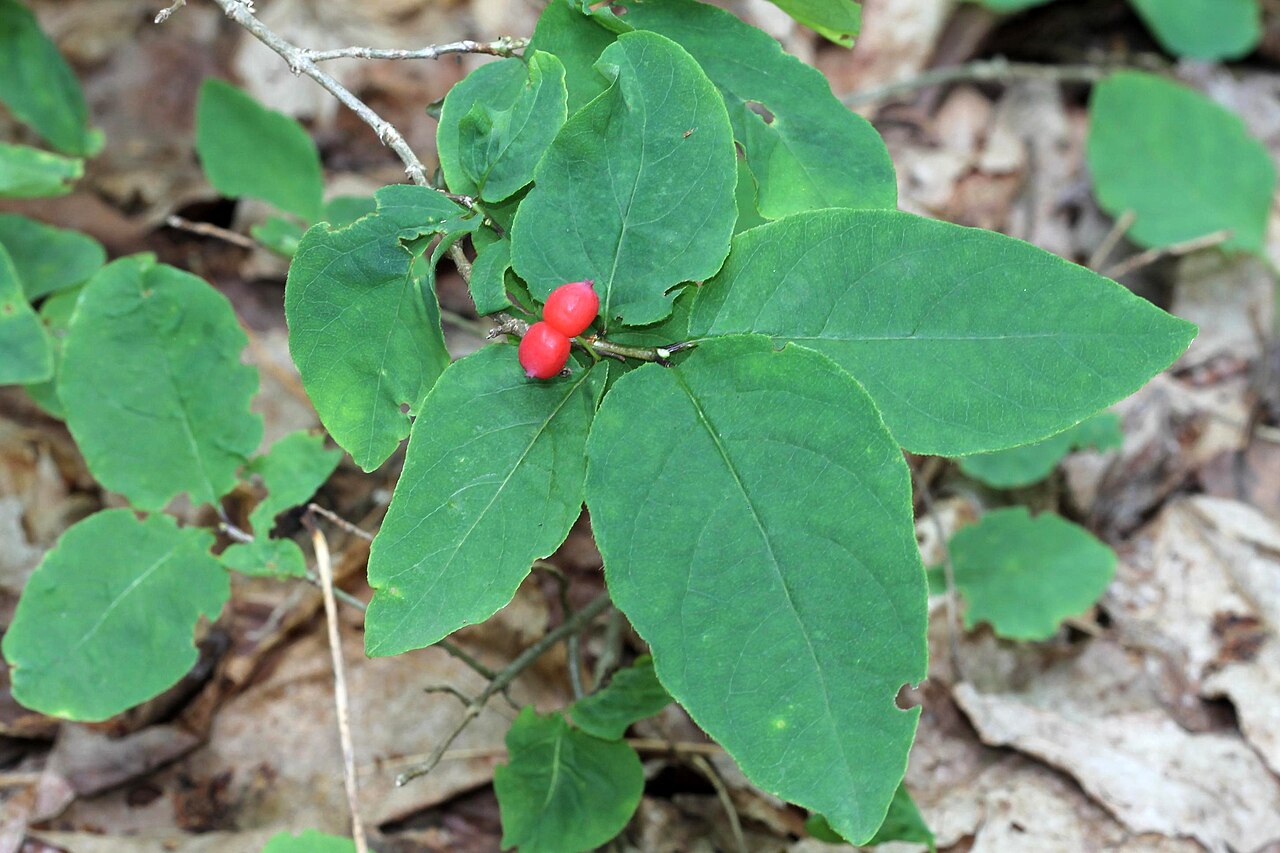
The flowers are followed in early summer by pairs of bright red berries that slightly diverge from each other, like two small drops on a common stalk. The leaves are thin, oval and soft green, with tiny hairs along their edges. It is a quiet, graceful shrub of hemlock and northern hardwood forests, often growing alongside spring wildflowers, ferns and mosses.
American fly honeysuckle is not one of the invasive bush honeysuckles. Amur, Morrow’s, Tatarian and Bell’s honeysuckle are Asian and European shrubs that crowd out native plants across much of the East. This native species is shade-loving, slow-spreading and an important early source of nectar for bumble bees. Its range runs from the Maritime provinces and Ontario through New England and the Great Lakes states to Minnesota and Iowa, and south in the Appalachians to North Carolina, Tennessee and northern Georgia.
Identification
Look for a low, open shrub in moist shady woods with opposite, oval leaves fringed with fine hairs, and, in spring, pale yellow flowers dangling in pairs beneath the leaves.
Growth Form & Stems
It is a small deciduous shrub, usually 2 to 5 feet tall, with a few slender, spreading or arching stems. Young twigs are smooth and often reddish to gray-brown; older stems have gray bark that may shred slightly. The pith inside the stems is white and solid, a useful difference from the invasive bush honeysuckles, whose older stems have a hollow, brown pith.
Leaves
The leaves are opposite, simple, oval to oblong, 1 1/2 to 4 inches long, with rounded or slightly heart-shaped bases and smooth edges fringed with fine hairs. They are thin and bright green above, paler beneath, and appear very early in spring.
Flowers
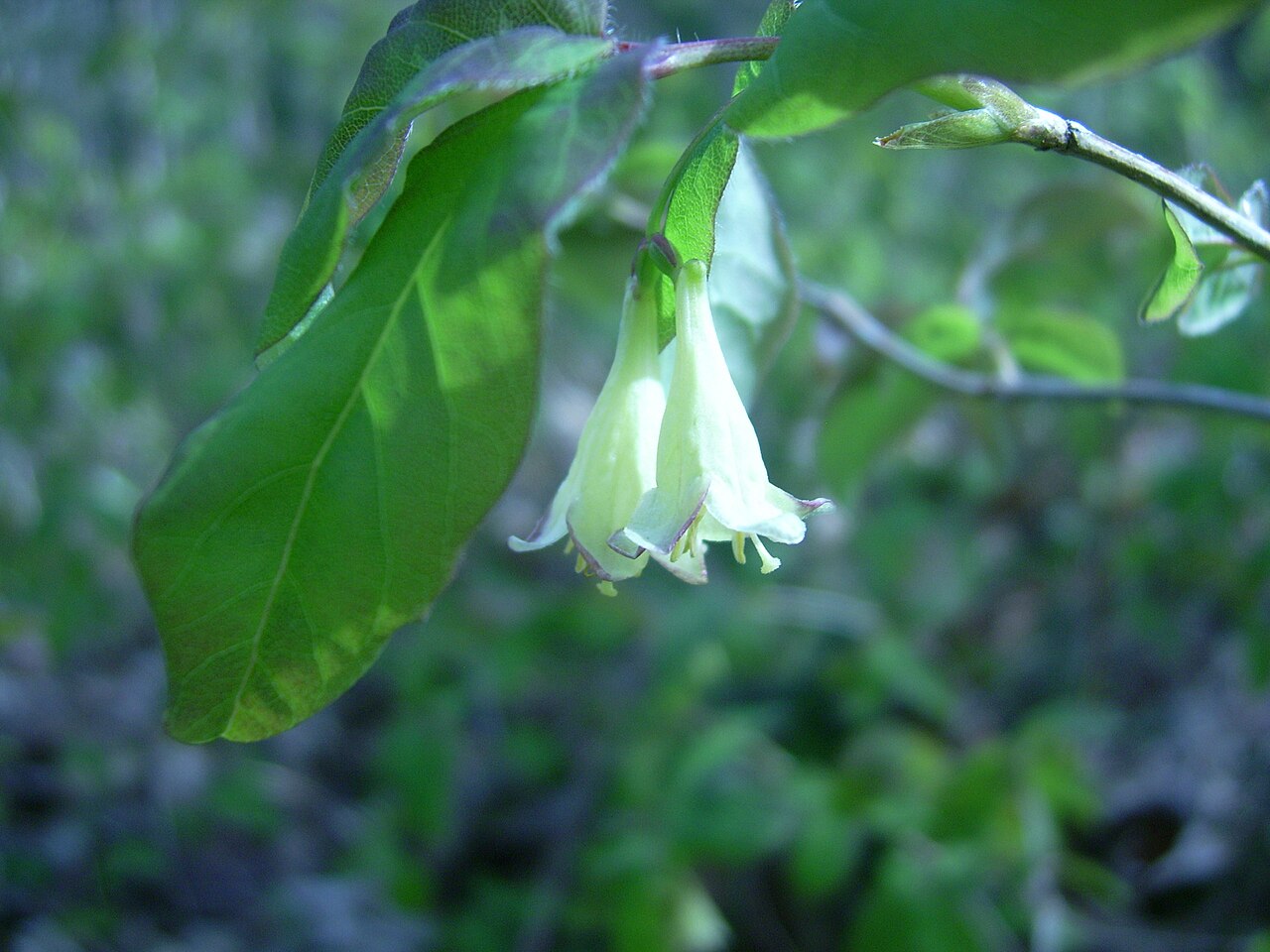
In April and May, pairs of flowers hang on slender shared stalks from the leaf axils. Each flower is a pale yellow to greenish-yellow funnel about 3/4 inch long, with five nearly equal lobes and a slight bulge at the base of the tube. The stamens barely protrude.
Fruit & Seeds
Each flower pair produces two bright red, juicy, oval berries about 1/3 inch long, usually separate and spreading apart in a V. They ripen in June and July and are quickly eaten by wildlife. Each berry contains a few small seeds. The berries are not considered edible for people.
Look-alikes
Invasive bush honeysuckles (Lonicera maackii, L. morrowii, L. tatarica and L. × bella) are taller, denser shrubs of sunnier, disturbed sites with white, pink or red flowers, hollow pith in older stems, and berries that persist into fall. Native northern bush honeysuckle (Diervilla lonicera) has toothed leaves and yellow flowers in summer, with dry capsules instead of berries. Mountain fly honeysuckle (L. villosa) of bogs has hairy leaves and blue berries.
Quick Facts
| Scientific Name | Lonicera canadensis |
| Family | Caprifoliaceae (honeysuckle family) |
| Plant Type | Small deciduous shrub |
| Mature Height | 2–5 ft (occasionally to 6 ft) |
| Mature Spread | 2–5 ft |
| Growth Rate | Slow to moderate |
| Sun Exposure | Part shade to full shade |
| Water Needs | Medium; evenly moist soil |
| Soil Type | Moist, humus-rich, well-drained loam |
| Soil pH | Acidic to near neutral (about 4.5–7.0) |
| Bloom Time | April–May |
| Flower Color | Pale yellow to greenish yellow |
| Fall Color | Yellow |
| Fruit | Paired red berries, June–July |
| Deer Resistant | No; browsed by deer |
| USDA Hardiness Zones | 3–6 |
Native Range
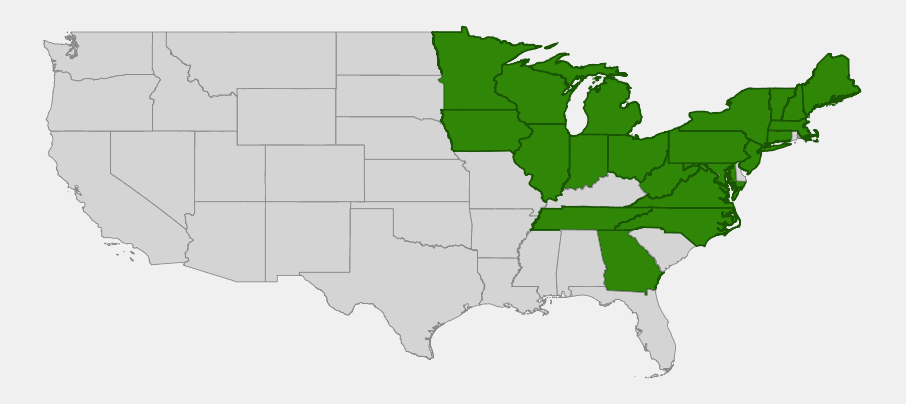
American fly honeysuckle grows across the cool northeastern quarter of North America. USDA PLANTS lists it as native in Canada and the lower 48 states, with records from 21 states. In Canada it grows in Ontario, Quebec, New Brunswick, Nova Scotia and Prince Edward Island.
In the United States it is most common in the northern forests of New England, New York, Pennsylvania, Michigan, Wisconsin and Minnesota, mainly in the northern and eastern parts of Minnesota rather than the prairie west. It extends south in scattered populations to Iowa, Illinois, Indiana, Ohio, New Jersey and Maryland, and follows the Appalachian Mountains through West Virginia and Virginia to the high mountains of North Carolina and Tennessee. Northeastern Georgia is the southern tip of its range, where it is rare and local in the Blue Ridge.
It grows in cool, moist, shady forests: hemlock and northern hardwood forests, mixed conifer woods, ravines and stream banks, and the edges of cedar swamps. In the southern Appalachians it is a plant of high elevations, where the climate resembles that of the North.
📋 Regional plant lists featuring American Fly Honeysuckle: New York, Pennsylvania & Northern New Jersey · Ohio & Indiana · Michigan, Wisconsin & Eastern Minnesota · Kentucky & Tennessee · Connecticut, Massachusetts & Rhode Island · New Hampshire, Maine & Vermont · Maryland, Virginia & West Virginia · Delaware, Southern New Jersey & Long Island · Illinois, Iowa & Missouri · Alabama, Georgia & Mississippi · North & South Carolina · North Dakota, South Dakota & Western Minnesota
Growing & Care Guide
American fly honeysuckle is an easy, low-key shrub for shady woodland gardens in the North and in the mountains. It does not climb or spread aggressively, and it fills the space under trees with soft foliage and early flowers.
Light
Part shade to full shade suits it best. It tolerates morning sun in cool climates but suffers in hot, sunny, dry sites.
Soil & Water
Plant it in moist, well-drained soil rich in organic matter, such as woodland loam with leaf mold. It prefers acidic to near-neutral soil. Keep it watered during dry spells, especially in the first two summers.
Planting Tips
Plant container-grown shrubs in spring or early fall, 3 to 4 feet apart. Use it in groups beneath tall trees, along a shady woodland path or with ferns and spring wildflowers. It is a good choice for replacing invasive bush honeysuckles in shady sites once they have been removed.
Pruning & Maintenance
Little pruning is needed. Remove dead or crossing stems after flowering. Mulch with leaves to keep the roots cool and moist. Protect young plants from deer browsing.
Propagation
Sow cleaned seed from ripe berries outdoors in fall, or give it about two to three months of cold, moist stratification before spring sowing. Softwood cuttings taken in early summer root fairly readily under mist or a humidity dome.
Landscape Uses
- Woodland gardens: an early-blooming shrub for moist shade under trees
- Pollinator gardens: an early nectar source for queen bumble bees
- Bird gardens: red summer berries eaten by songbirds
- Invasive honeysuckle replacement: a native alternative for shady sites
- Forest restoration: restores the shrub layer of northern hardwood and hemlock forests
Wildlife & Ecological Value
Blooming early and fruiting in early summer, American fly honeysuckle supports insects and birds at times of year when few other shrubs do.
For Pollinators
The pale yellow, tubular flowers open in April and May, when queen bumble bees are emerging and searching for food. Bumble bees are among its main pollinators, and other early bees and flies also visit. Native honeysuckles are also larval host plants for the snowberry clearwing, a hummingbird-like day-flying moth.
For Birds
The red berries ripen in early summer and are eaten by songbirds such as thrushes, catbirds and other fruit-eating birds of the forest, which spread the seeds. The shrub provides low cover in the forest understory.
For Mammals
White-tailed deer browse the twigs and leaves, and small mammals such as chipmunks may eat fallen fruit.
Ecosystem Role
As part of the shrub layer of northern hardwood and hemlock forests, it provides cover, early nectar and summer fruit. Where invasive bush honeysuckles have taken over the forest understory, restoring native shrubs such as this one helps rebuild the native food web.
Cultural & Historical Uses
The genus Lonicera honors Adam Lonicer, a 16th-century German botanist and physician. The species name canadensis means “of Canada,” where it is widespread. The common name fly honeysuckle refers to the group of shrubby honeysuckles with paired flowers, sometimes called fly honeysuckles to distinguish them from climbing honeysuckle vines.
In much of the eastern United States, the word “honeysuckle” now brings to mind invasive shrubs and vines from Asia and Europe. Native shrubby honeysuckles such as American fly honeysuckle are easily overlooked by comparison, but they are part of the original flora of northern forests and support native insects and birds.
Gardeners and land managers who remove invasive bush honeysuckles are encouraged to learn to recognize this native species first, so that it is not cut down by mistake. Its solid white pith, hairy-edged leaves, early pale yellow flowers and early summer red berries make it easy to tell apart.
Frequently Asked Questions
Is American fly honeysuckle invasive?
No. It is a native shrub of northern forests that grows slowly and stays small. The invasive honeysuckles are Asian and European species such as Amur, Morrow’s and Tatarian honeysuckle.
How can I tell it from invasive bush honeysuckle?
American fly honeysuckle is a small shade shrub with hairy-edged leaves, pale yellow flowers in April and May, early summer red berries and solid white pith. Invasive bush honeysuckles are taller, with white to pink flowers, hollow older stems and berries that last into fall.
Are the berries edible?
No. They are not considered edible for people and should not be eaten, but birds eat them readily.
Will it grow in full sun?
It prefers part to full shade and cool, moist soil. In hot, sunny, dry sites it struggles.
Does it attract pollinators?
Yes. Its early spring flowers are an important food source for queen bumble bees and other early-season insects.

Looking for a nursery that carries American Fly Honeysuckle?
Browse our native plant nursery directory: Connecticut & Georgia · Illinois, Indiana & Iowa · Maine, Maryland, Massachusetts, Michigan & Minnesota · New Hampshire, New Jersey, New York, North Carolina & Ohio · Pennsylvania, Tennessee, Vermont & Virginia · West Virginia & Wisconsin