
Red Trillium (Trillium erectum)
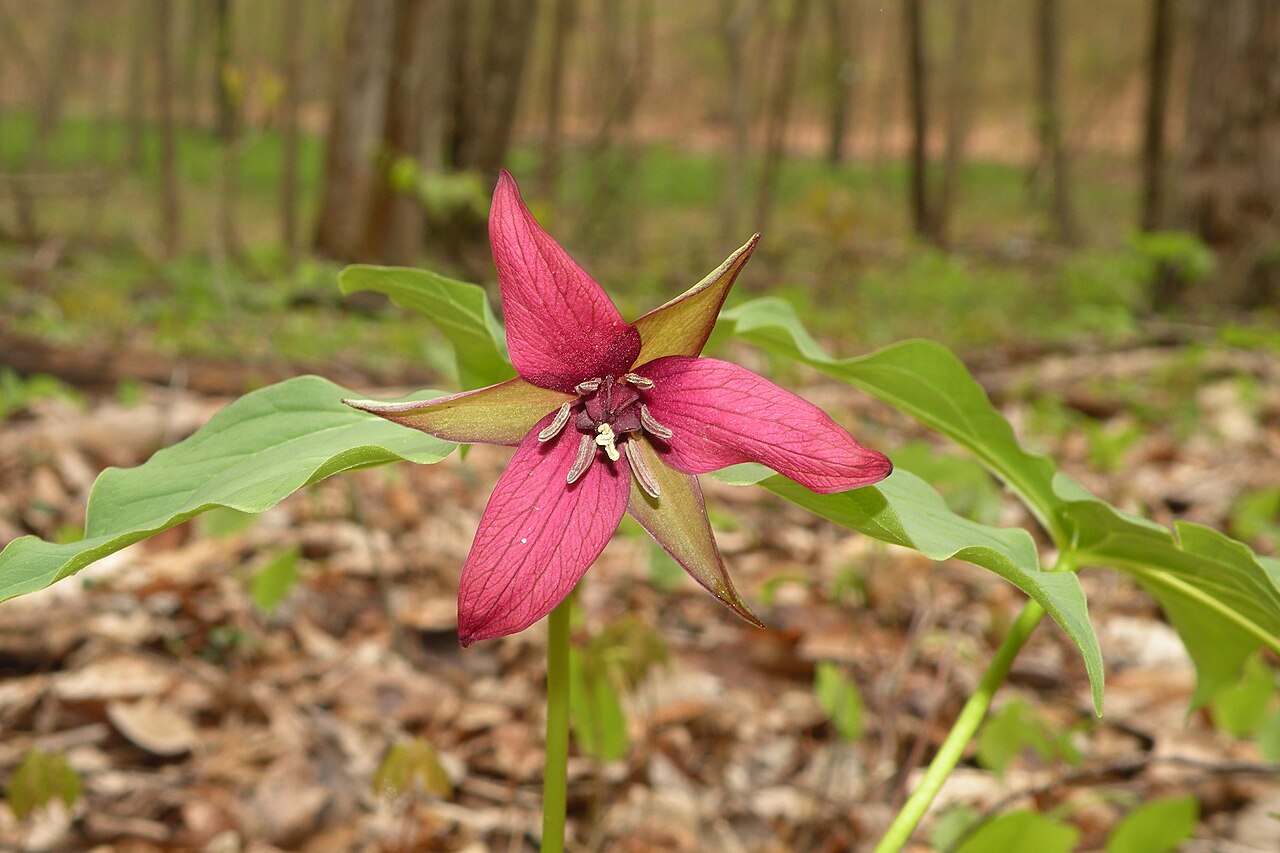
Trillium erectum, known as Red Trillium, wake robin, purple trillium, birthroot or stinking Benjamin, is one of the signature spring wildflowers of the northeastern forests and the Appalachian Mountains. Each plant sends up a single stem with a whorl of three broad leaves and a single flower with three pointed, maroon-red petals. It blooms in April and May, around the time the first robins return north, which explains the old name wake robin.
Red trillium is a long-lived perennial that grows from a thick underground rhizome. Older references place it in the lily family (Liliaceae), as USDA PLANTS still does, but botanists now include trilliums in the bunchflower family (Melanthiaceae). Its flowers are pollinated mainly by flies and beetles rather than bees, and they smell faintly of wet dog or spoiled meat, the source of names such as stinking Benjamin and stinking Willie.
It is a plant of rich, moist, shady hardwood and mixed forests, and it grows slowly. A seedling can take five to ten years to reach flowering size, and an established clump may be decades old. This guide describes how to identify red trillium and its color forms, where it grows, and how gardeners can grow it responsibly from nursery-propagated plants without taking anything from the wild.
Identification
Trilliums are easy to recognize as a group because almost everything about them comes in threes: three leaves, three sepals, three petals, and a three-parted stigma. Telling the species apart takes a closer look at the flower stalk, petal shape and ovary.
Stem & Rhizome
Each plant has a single, unbranched, smooth stem, usually 8 to 16 inches tall and sometimes taller, growing from a short, thick, horizontal rhizome. Older plants may produce several stems from branches of the rhizome, forming small clumps. The plant is a spring ephemeral in the broad sense: it emerges in early spring, flowers before the tree canopy closes, and the leaves turn yellow and die back by mid to late summer.
Leaves
The three leaves are arranged in a whorl at the top of the stem. They are stalkless, broadly diamond-shaped to nearly round, 2 to 8 inches long and about as wide, with pointed tips and a few prominent, arching veins. They are plain green, without the silver mottling of the toadshade trilliums of the South and Midwest.
Flowers
A single flower sits on a stalk (pedicel) 1 to 4 inches long, which rises straight or leans to one side above the leaves. It usually faces outward or slightly downward. The three petals are lance-shaped to oval, 1 to 2 inches long, and spread to form a flat to slightly cupped flower. In the typical form they are deep maroon or brownish red, but white, cream, yellowish, greenish and pink forms are all known, and in parts of the southern Appalachians white forms are common. In the center is a dark maroon to purplish-black ovary with three stigmas and six stamens with dark anthers.
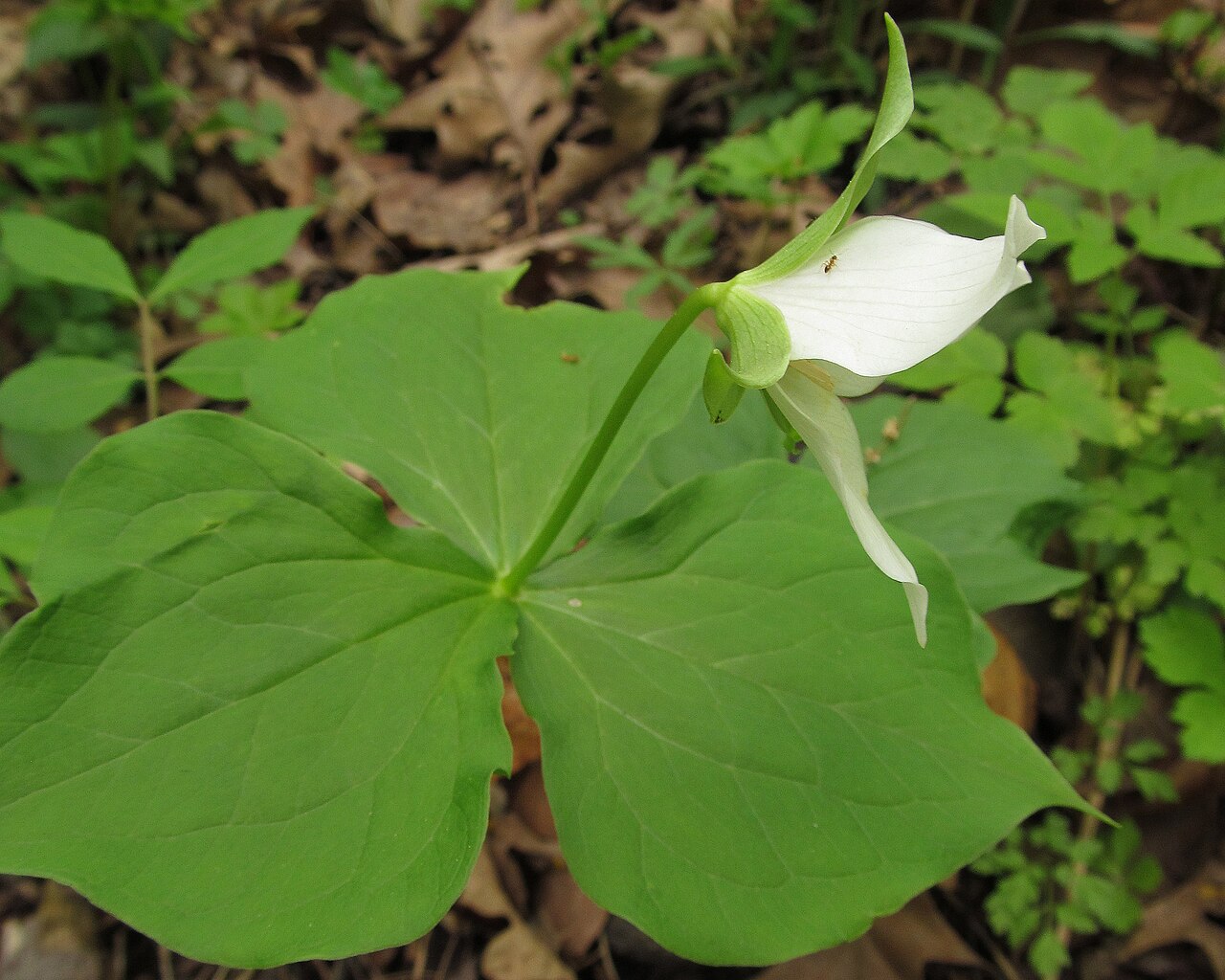
Red trillium is most often confused with large-flowered (white) trillium (Trillium grandiflorum), whose flowers are larger and pure white, aging pink, with a pale ovary and petals that overlap at the base to form a funnel. Nodding trillium (T. cernuum) hides its small white flowers below the leaves. Sweet Beth (T. vaseyi) of the southern Appalachians has larger, fragrant, dark red flowers on long, drooping stalks.
Fruit & Seeds
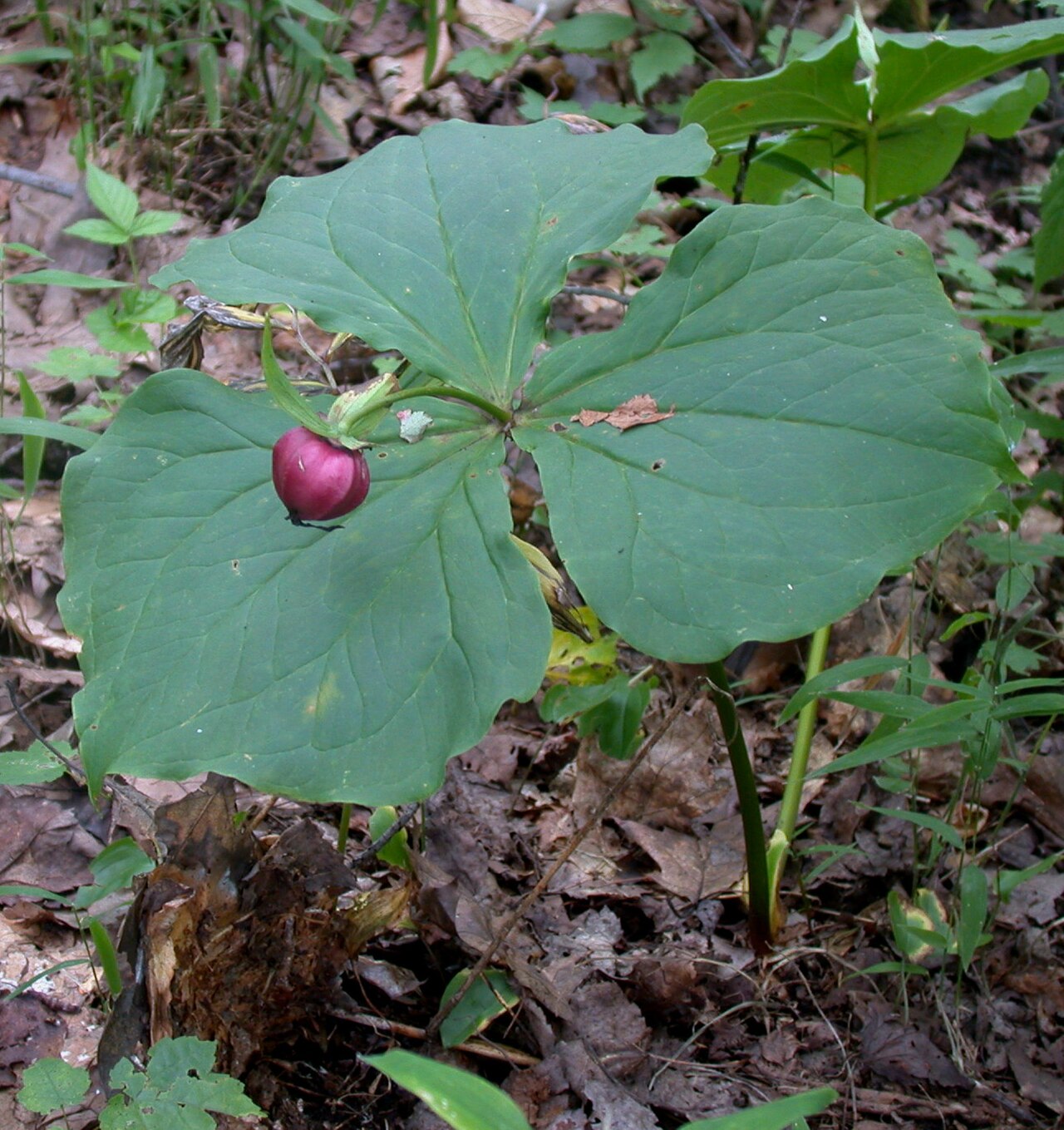
The ovary ripens by midsummer into a fleshy, six-angled, dark reddish-purple berry about three-quarters of an inch long. It holds many seeds, each with a white, oily appendage (elaiosome). Ants carry the seeds to their nests, eat the elaiosomes, and discard the seeds underground, where some germinate. Seeds need two winters before a seedling appears, and young plants produce only a single leaf for several years.
Quick Facts
| Scientific Name | Trillium erectum L. |
| Family | Melanthiaceae (bunchflower family); Liliaceae in USDA PLANTS |
| Plant Type | Herbaceous perennial from a rhizome; spring woodland wildflower |
| Mature Height | 8–16 in (occasionally to 20 in) |
| Mature Spread | 6–12 in; older plants form small clumps |
| Growth Rate | Very slow |
| Sun Exposure | Part shade to full shade |
| Water Needs | Medium; evenly moist soil in spring |
| Soil Type | Rich, humusy, well-drained loam with leaf litter |
| Soil pH | About 5.0–7.0 |
| Bloom Time | April–May (into June in the North and at high elevations) |
| Flower Color | Maroon-red; also white, cream, yellowish or pink forms |
| Fall Color | None; foliage dies back in summer |
| Fruit | Dark reddish-purple, six-angled berry; seeds spread by ants |
| Deer Resistant | No; deer browse trilliums heavily |
| USDA Hardiness Zones | 3–7 |
Native Range
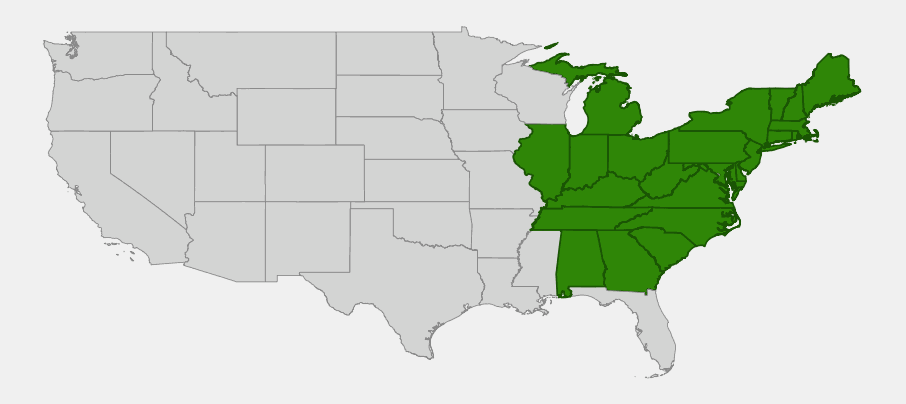
Red trillium grows across the Northeast, the Great Lakes region and the Appalachian Mountains. USDA PLANTS records it from 23 states, from Maine, New Hampshire and Vermont south through New England, New York and Pennsylvania, west to Michigan, Ohio, Indiana and Illinois, and south along the Appalachians to the Carolinas, Tennessee, northern Georgia and Alabama. In Canada it grows in Ontario, Quebec, New Brunswick and Nova Scotia.
It is common in the mountains and northern forests, especially in the cove forests, northern hardwoods and hemlock forests of the Appalachians, the Adirondacks and New England. It becomes scattered toward the Coastal Plain and the western edge of its range. In Illinois, Delaware and some other edge states it is known from only a few sites and is considered rare.
In the southern Appalachians red trillium meets several close relatives and forms intermediate plants with some of them, especially with Trillium flexipes and T. sulcatum. Many color forms occur, and at some sites white-flowered plants outnumber red ones. These forms are part of the same species and grow in the same habitats.
📋 Regional plant lists featuring Red Trillium: New York, Pennsylvania & Northern New Jersey · Ohio & Indiana · Michigan, Wisconsin & Eastern Minnesota · Kentucky & Tennessee · Connecticut, Massachusetts & Rhode Island · New Hampshire, Maine & Vermont · Maryland, Virginia & West Virginia · Delaware, Southern New Jersey & Long Island · Illinois, Iowa & Missouri · Alabama, Georgia & Mississippi
Growing & Care Guide
Red trillium is a rewarding plant for a shady woodland garden, but it should only come from nurseries that propagate their own plants. Wild trilliums are still dug and sold, often labeled vaguely as “nursery grown,” and slow-growing woodland populations recover poorly from collecting. Ask the seller whether plants were grown from seed or division, and expect propagated trilliums to cost more than collected ones. Picking the flower and leaves also harms the plant, because it loses its food supply for the year, and in some states picking or digging trilliums is restricted.
Light
Plant red trillium in light to full shade under deciduous trees, where it gets spring sun before the canopy fills in and shade in summer. It does poorly in hot, sunny sites and under dense evergreens that shade it in spring.
Soil & Water
It needs rich, loose, humusy soil that stays evenly moist in spring and early summer, but not waterlogged. Work generous amounts of leaf mold or compost into the planting area, and keep a layer of shredded leaves on the surface. The plant is dormant by late summer and tolerates drier soil then. It does not need fertilizer.
Planting Tips
Plant dormant rhizomes in late summer or early fall, 2 to 3 inches deep with the bud pointing up. Potted plants can be planted in spring. Space them about 8 to 12 inches apart, in groups, among other spring wildflowers and ferns that will fill the space when the trillium goes dormant. Mark their locations so you don’t dig into them later.
Pruning & Maintenance
Leave the foliage to die back on its own; cutting it early weakens the rhizome. Let fallen leaves stay on the bed each fall as natural mulch. Protect plants from deer, which can eat them down to the ground in spring, using fencing or repellents. Slugs sometimes damage emerging shoots.
Propagation
Established clumps can be divided carefully in late summer when the plants are dormant, keeping a bud and roots with each piece. Seed is slow: sow fresh seed in fall, outdoors in a shaded pot or bed, and wait two years for germination and five or more years for flowers. Seed should come only from your own garden plants or reputable sources, never from wild populations.
Landscape Uses
- Woodland gardens: an early-spring highlight under deciduous trees, with ferns and other ephemerals
- Shade gardens: combine with wild ginger, foamflower and ferns to cover the space after it goes dormant
- Native plant collections: grow the red, white and yellow color forms together for interest
- Forest restoration: in rich hardwood forests within its native range, using propagated stock
Wildlife & Ecological Value
Red trillium has some of the most interesting partnerships of any spring wildflower, with flies for pollination and ants for seed dispersal.
For Pollinators
The dark red color and faint scent of rotting meat attract carrion flies, blow flies and flesh flies, along with some beetles, which crawl over the flower looking for food and carry pollen between plants. The flowers produce little or no nectar. Bees visit only occasionally. The plants can also set seed by self-pollination when pollinators are scarce.
For Birds
The berries are not an important bird food, though ruffed grouse and other ground-feeding birds may eat them occasionally. Red trillium is mainly part of the rich forest-floor community that provides insects for ground-foraging songbirds like ovenbirds and thrushes.
For Mammals
White-tailed deer eat trilliums readily, and in many forests with high deer populations red trillium has become much smaller and rarer. Ecologists sometimes use trillium height and flowering as an indicator of deer browsing pressure. Small mammals may eat the berries and seeds.
Ecosystem Role
Red trillium is one of many spring wildflowers that rely on ants to spread their seeds, a relationship called myrmecochory. Because ants carry seeds only short distances, trilliums spread very slowly, and populations in forests that were once cleared may take centuries to recover. Its presence and abundance are often used as signs of an old, undisturbed forest floor.
Cultural & Historical Uses
Linnaeus described Trillium erectum in 1753. The genus name comes from the Latin tri, three, a reference to the plant’s three-part structure. The common name birthroot refers to the traditional use of the rhizome by several Native American peoples, including the Cherokee and Iroquois, and later by herbalists, to ease childbirth and to treat bleeding and other complaints.
Red trillium is part of the spring wildflower tradition of eastern North America. For many naturalists in New England and the Appalachians, its maroon flowers in the bare spring woods are one of the first signs of the season, and trillium walks are a popular event in parks and preserves in April and May.
Safety and conservation: trillium rhizomes and berries are not considered food. Some sources report that they can cause nausea if eaten, so keep them away from children and pets, and never use them as a home remedy. Many trilliums are collected from the wild for sale, which, together with deer browsing and habitat loss, has reduced populations. Gardeners can help by buying only propagated plants and by leaving wild trilliums unpicked.
Frequently Asked Questions
Why does red trillium smell bad?
The flower gives off a faint odor of wet dog or decaying meat that attracts carrion flies and beetles, its main pollinators. The smell is usually only noticeable if you put your nose close to the flower.
Can I dig red trillium from the woods?
No. Wild plants are slow to replace and often fail after transplanting, and in some states it is illegal to dig or pick trilliums without permission. Buy plants that were propagated by the nursery.
Why is my red trillium white?
Red trillium has several color forms, including white, cream, yellow and pink. White plants are common in parts of the southern Appalachians. They can be distinguished from large-flowered trillium by their dark ovary, flatter flower and shorter petals.
Does picking a trillium flower kill the plant?
Picking the flower usually removes the leaves too, because they sit just below it on the same stem. The plant loses its only source of food for the year and may take several years to recover, or it may die.
How long does red trillium take to bloom from seed?
Usually five to seven years or more. Seeds take two winters to sprout, and seedlings produce a single small leaf for several years before reaching flowering size.

Looking for a nursery that carries Red Trillium?
Browse our native plant nursery directory: Alabama · Connecticut, Delaware & Georgia · Illinois & Indiana · Kentucky, Maine, Maryland, Massachusetts & Michigan · New Hampshire, New Jersey, New York, North Carolina & Ohio · Pennsylvania, Rhode Island, South Carolina, Tennessee, Vermont & Virginia · West Virginia