
Pineweed (Hypericum gentianoides)
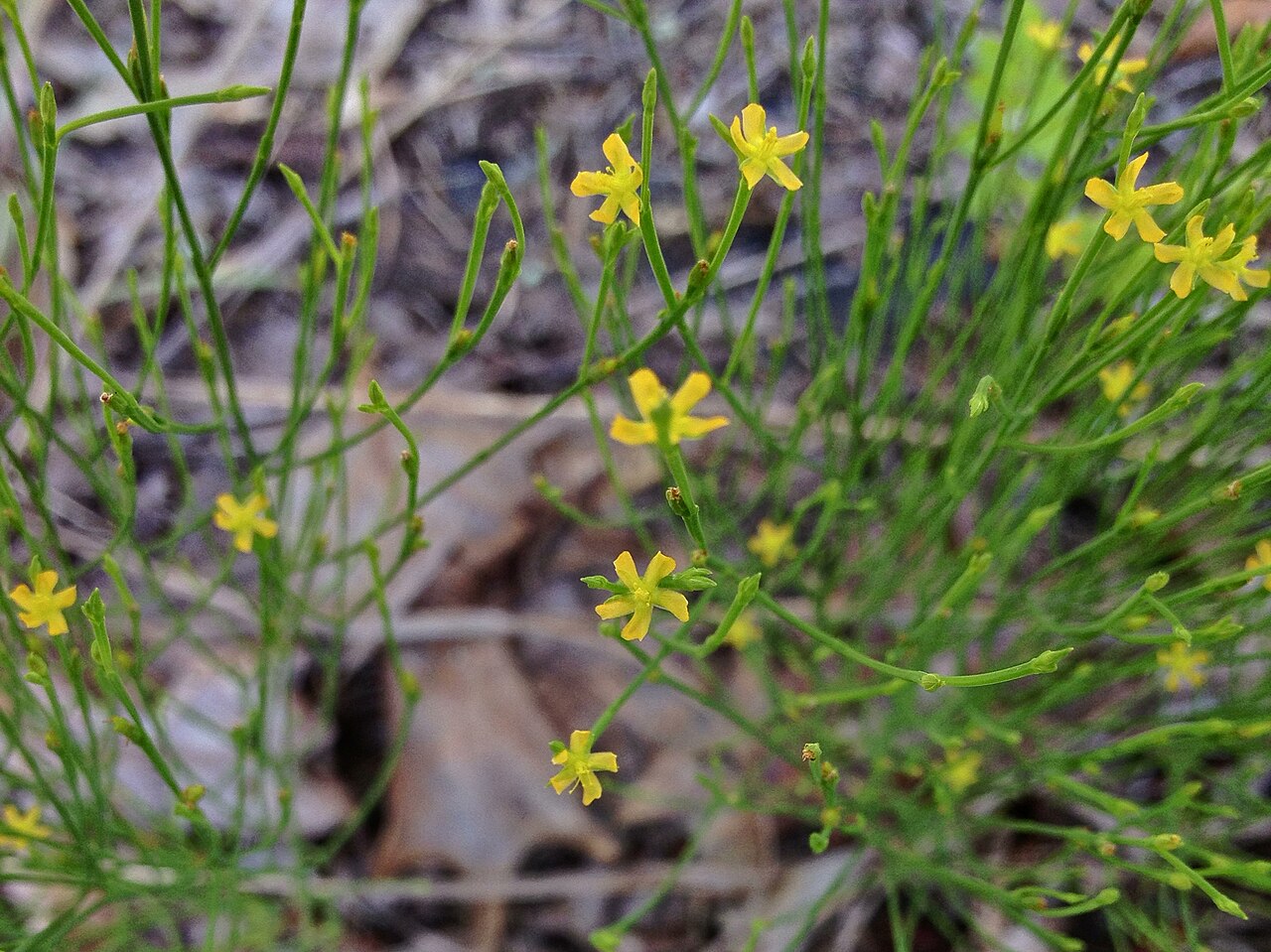
Hypericum gentianoides, known as Pineweed or orangegrass (the name used by USDA), is a small native annual in the St. John’s-wort family (Hypericaceae). It forms a bushy little tuft, usually 4 to 16 inches tall, of wiry, needle-like green branches that look a bit like a tiny pine seedling or a clump of grass. In late summer and fall it is dotted with tiny, bright yellow flowers that open only in sunshine, followed by reddish, cone-shaped seed capsules.
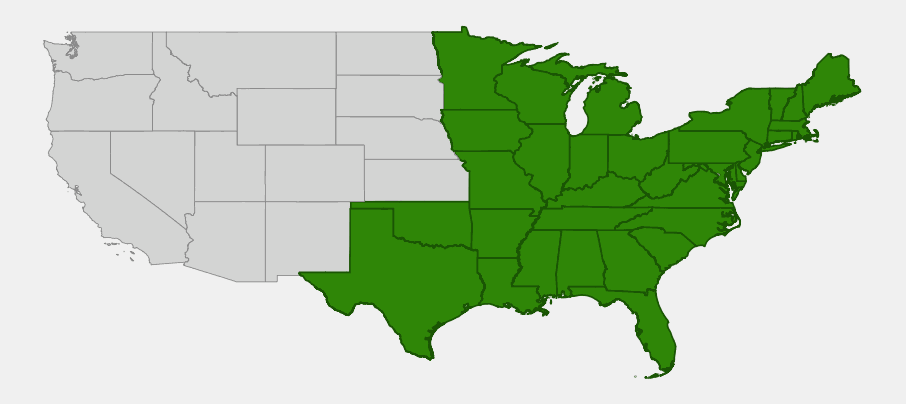
It is native across most of the eastern and central United States, from Maine and Ontario south to Florida and west to Minnesota, Missouri, Oklahoma and Texas, and also grows in Nova Scotia. It is a pioneer of bare, dry, sandy or rocky ground: rock outcrops, sand barrens, pine and oak openings, old fields and road cuts.
Pineweed is easy to overlook, but it has charms: crush a sprig and it releases a pleasant citrus scent, which is the source of the name orangegrass. In the garden it is a self-sowing filler for sunny, poor, sandy soils, rock gardens and meadow edges, where few other plants thrive.
Identification
Look for a small, broom-like tuft of wiry green stems with scale-like leaves and tiny yellow, five-petaled flowers in dry, sandy or rocky open ground from midsummer to fall.
Growth Habit
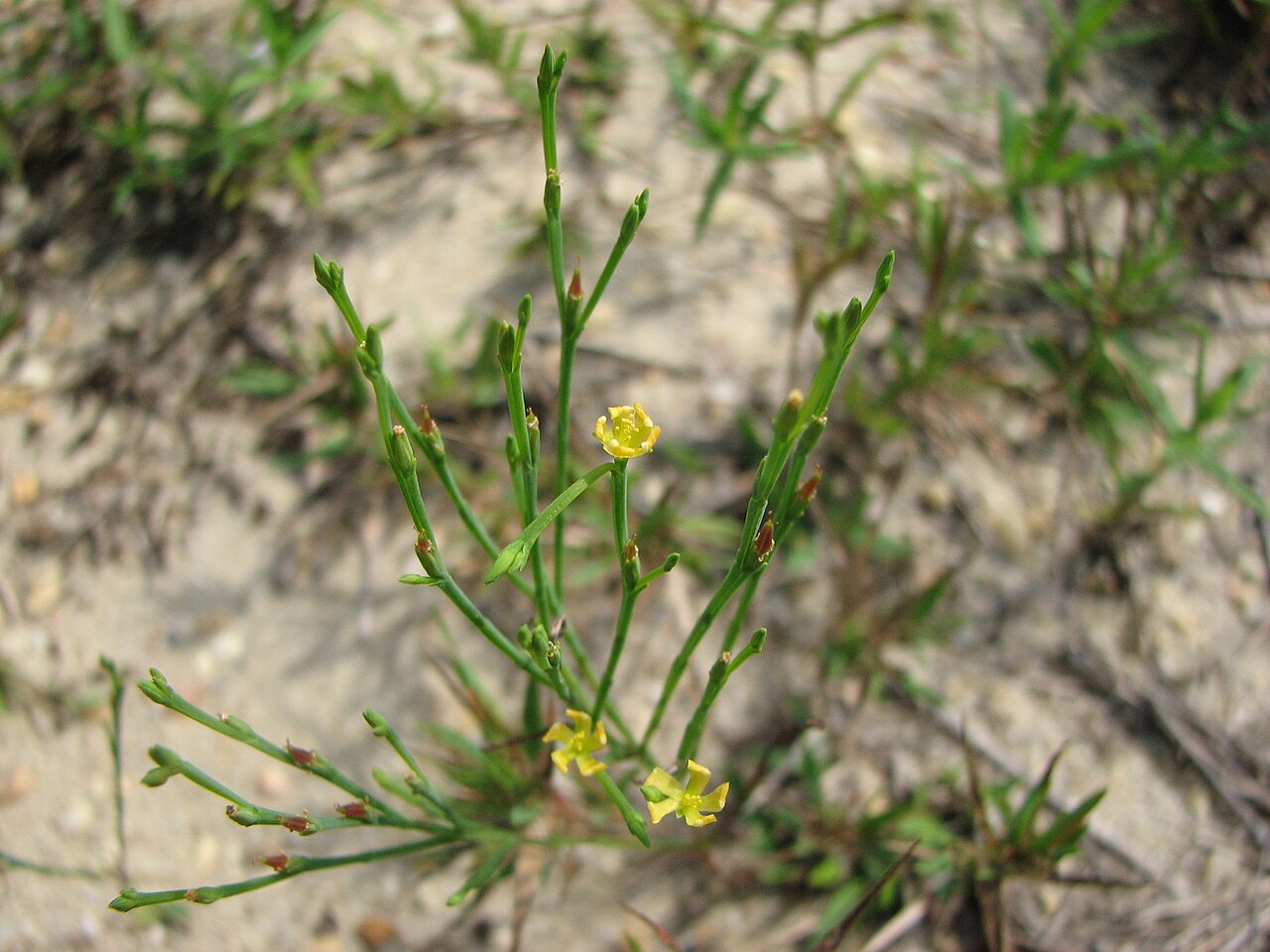
An erect annual, usually 4 to 16 inches tall, with many slender, stiff, green branches that rise from the base and fork repeatedly, giving it a bushy, broom-like shape. The stems are four-angled near the top. In fall the whole plant often turns reddish or purplish.
Leaves
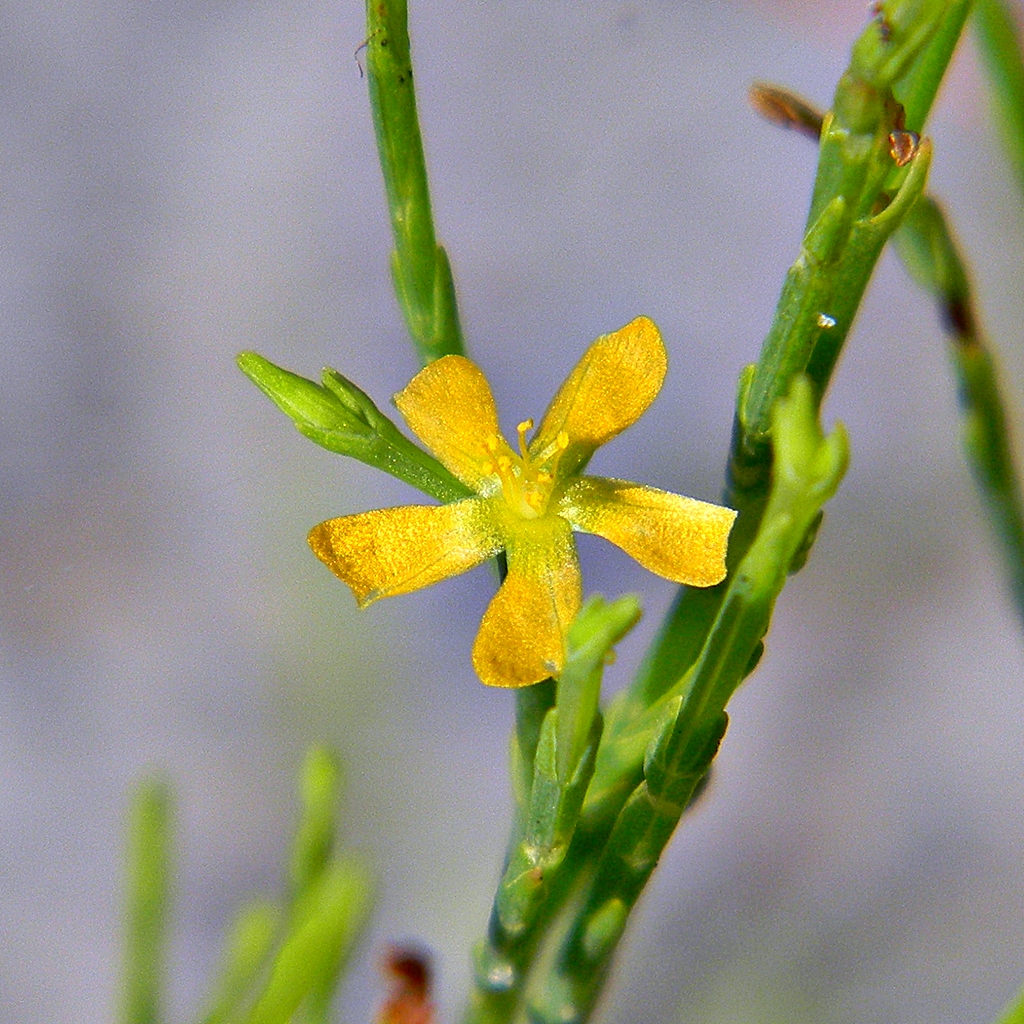
The leaves are reduced to tiny scales, only about 1/16 to 1/8 inch long, pressed flat against the stems, so the plant looks nearly leafless. The green stems do most of the photosynthesis.
Flowers
The flowers are about 1/4 inch across, with five narrow, bright yellow petals and 5 to 10 stamens. They are borne singly and nearly stalkless along the upper branches. Each flower opens only in bright sun, usually around midday, and lasts a single day. Flowering is from July to October.
Fruit
The fruit is a narrow, cone-shaped capsule about 1/4 inch long that turns red to purple as it ripens. It splits to release many tiny seeds.
Look-alikes
Other St. John’s-worts, such as shrubby St. John’s-wort (Hypericum prolificum), have normal, flat leaves. Pinweeds (Lechea) have similar wiry stems in the same habitats but have narrow green leaves and minute reddish flowers. Ground-pine clubmosses look superficially similar but never flower.
Quick Facts
| Scientific Name | Hypericum gentianoides |
| Family | Hypericaceae (St. John’s-wort family) |
| Plant Type | Annual wildflower |
| Mature Height | 4–16 in |
| Mature Spread | 3–8 in |
| Growth Rate | Fast (one season) |
| Sun Exposure | Full sun |
| Water Needs | Low; dry soil |
| Soil Type | Sandy, gravelly or rocky, low-fertility soil |
| Soil pH | Acidic to neutral (about 4.5–7.0) |
| Bloom Time | Midsummer to fall (July–October) |
| Flower Color | Bright yellow |
| Fall Color | Stems and capsules turn reddish to purple |
| Fruit | Small, cone-shaped red capsule |
| Deer Resistant | Yes; rarely browsed |
| USDA Hardiness Zones | Annual; grows wild in zones 4–9 |
Native Range
Pineweed is native to eastern and central North America. USDA PLANTS records it from 33 states, from Maine and Vermont south to Florida and west to Minnesota, Iowa, Missouri, Oklahoma and Texas, and from Ontario and Nova Scotia in Canada. It is also reported in the District of Columbia.
It is most common on the Atlantic and Gulf coastal plains and in the Piedmont and Appalachian foothills, and becomes more scattered westward, where it is mostly found in sandy areas and on rock outcrops in the Ozarks, the upper Midwest sand plains and eastern Oklahoma and Texas.
It grows in dry, open, often disturbed places with little competition: sand barrens, granite and sandstone outcrops, glades, dry pine and oak woodlands and their openings, old fields, sandy roadsides, quarries and eroded ground, usually at low to moderate elevations.
📋 Regional plant lists featuring Pineweed: New York, Pennsylvania & Northern New Jersey · Ohio & Indiana · Michigan, Wisconsin & Eastern Minnesota · Kentucky & Tennessee · Connecticut, Massachusetts & Rhode Island · New Hampshire, Maine & Vermont · Maryland, Virginia & West Virginia · Delaware, Southern New Jersey & Long Island · Illinois, Iowa & Missouri · Alabama, Georgia & Mississippi · North & South Florida · North & South Carolina · Arkansas, Louisiana, Eastern Oklahoma & Eastern Texas
Growing & Care Guide
Pineweed is an annual that thrives where most plants fail: hot, dry, sunny, nutrient-poor ground. It is grown from seed and keeps itself going by self-sowing.
Light
Full sun. It flowers only in direct sunshine and disappears when taller plants shade it.
Soil & Water
Plant in lean, sandy, gravelly or rocky soil with good drainage. It needs no fertilizer or regular watering, and rich soil just invites competing weeds. Water only in a severe drought while seedlings are tiny.
Planting Tips
Scatter seed on bare, open soil in fall or early spring and press it in lightly; the seeds are tiny and need light. It works well between stepping stones, in gravel or rock gardens, along sandy paths and in sparse meadow or green-roof plantings where it will not be crowded.
Pruning & Maintenance
No pruning is needed. Leave the dry plants standing until spring so they can drop seed. Keep some bare ground open around them, since seedlings need light and little competition to come back each year.
Propagation
It grows only from seed. Collect the red capsules in fall when they begin to split, and sow the fine seed on the soil surface in fall for spring germination.
Landscape Uses
- Rock and gravel gardens: fine-textured filler for dry, sunny pockets
- Sandy meadows and barrens: part of the natural plant mix on poor soils
- Green roofs and paths: tolerates thin, dry, hot soil
- Restoration: pioneer for eroded and bare sandy ground
- Children’s gardens: fun to crush and smell its citrus scent
Wildlife & Ecological Value
Pineweed is a small but common part of the open, dry plant communities of eastern North America.
For Pollinators
The tiny flowers offer pollen, not nectar, and are visited by small bees and flies, especially sweat bees. They also self-pollinate readily.
For Birds
Seed-eating birds may pick at the tiny seeds, but it is not a major bird food.
For Mammals
Mammals rarely eat it. Some St. John’s-worts contain compounds that can make grazing livestock sensitive to sunlight, so it is not a forage plant.
Ecosystem Role
As a pioneer annual, it colonizes bare sand, rock and eroded soil, helping to begin plant cover on harsh sites. It is characteristic of rare habitats such as sand barrens, glades and rock outcrops, which support many specialized plants and insects.
Cultural & Historical Uses
The common name orangegrass comes from the plant’s citrus-like scent when crushed. The name pineweed refers to its resemblance to a tiny pine seedling with its needle-like stems.
The species name gentianoides means “like a gentian,” a reference that early botanists made to its overall look. Linnaeus first described the plant in 1753 under the genus Sarothra, meaning “broom,” for its broom-like branching.
Like other St. John’s-worts, it contains glandular dots and resinous compounds. It has no significant place in herbal medicine, unlike the European common St. John’s-wort (Hypericum perforatum).
Frequently Asked Questions
Is pineweed a grass?
No. Despite the name orangegrass, it is an annual wildflower in the St. John’s-wort family. Its wiry stems just look grass-like.
Why is it called orangegrass?
Because crushing the stems releases a pleasant, citrus-like scent.
When does pineweed bloom?
From July to October. The tiny yellow flowers open only in full sun, usually around midday.
Is pineweed a weed in gardens?
It is a native pioneer of bare, dry ground and is rarely a problem; it disappears when taller plants shade it.
How do I grow pineweed?
Scatter seed on bare, sandy or gravelly soil in full sun in fall or early spring, and let it reseed.

Looking for a nursery that carries Pineweed?
Browse our native plant nursery directory: Alabama & Arkansas · Connecticut, Delaware, Florida & Georgia · Illinois, Indiana & Iowa · Kentucky, Louisiana, Maine, Maryland, Massachusetts, Michigan, Minnesota, Mississippi & Missouri · New Hampshire, New Jersey, New York, North Carolina, Ohio & Oklahoma · Pennsylvania, Rhode Island, South Carolina, Tennessee, Texas, Vermont & Virginia · West Virginia & Wisconsin