
Swollen Bladderwort (Utricularia inflata)
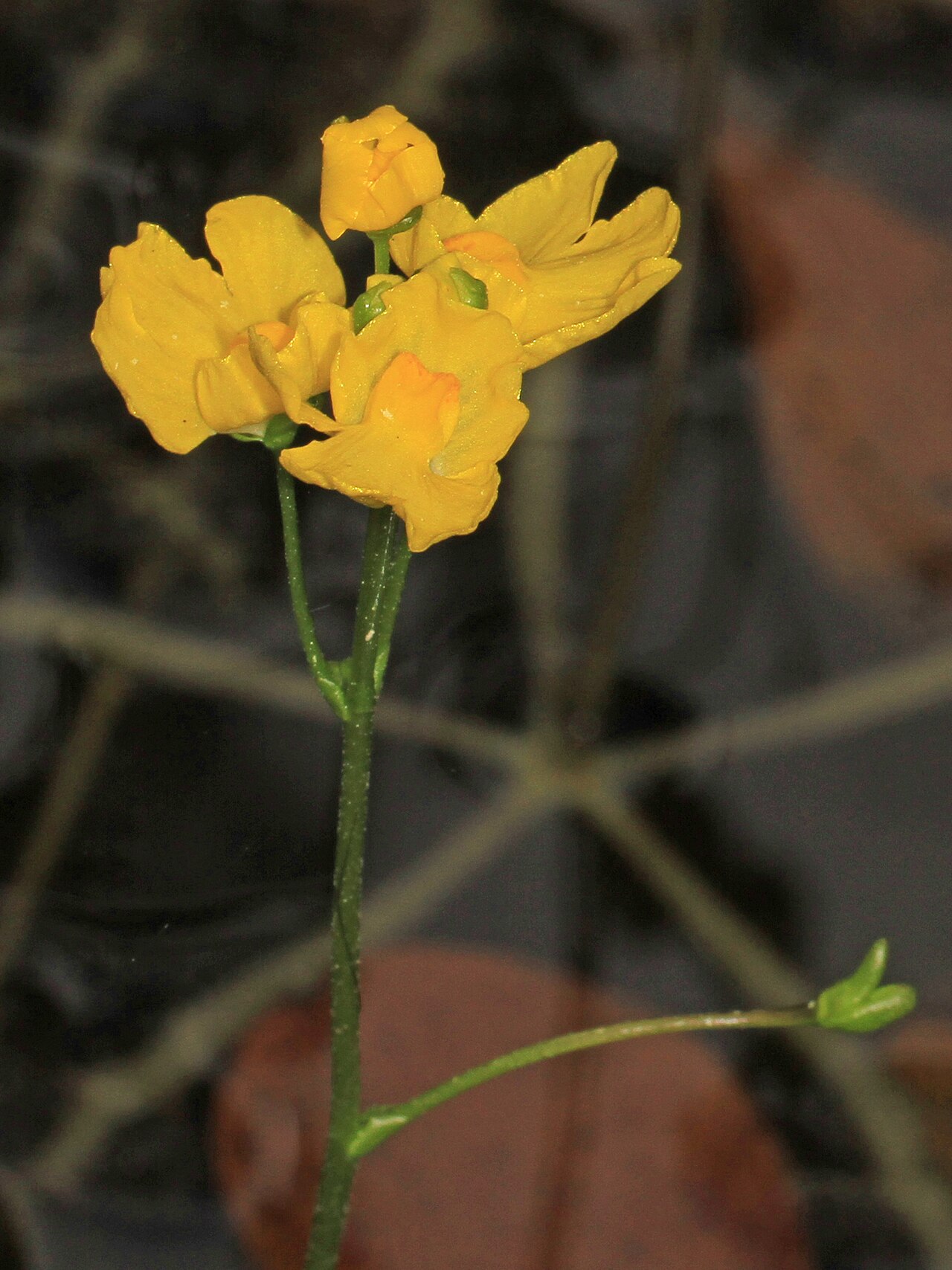
Utricularia inflata, known as Swollen Bladderwort, inflated bladderwort or floating bladderwort, is a free-floating, carnivorous aquatic plant of ponds, lakes, ditches and swamps on the Atlantic and Gulf coastal plains of the southeastern United States. It has no roots. Instead, it drifts just beneath the surface as a tangle of finely divided stems and leaves set with hundreds of tiny bladder traps that catch small aquatic animals.
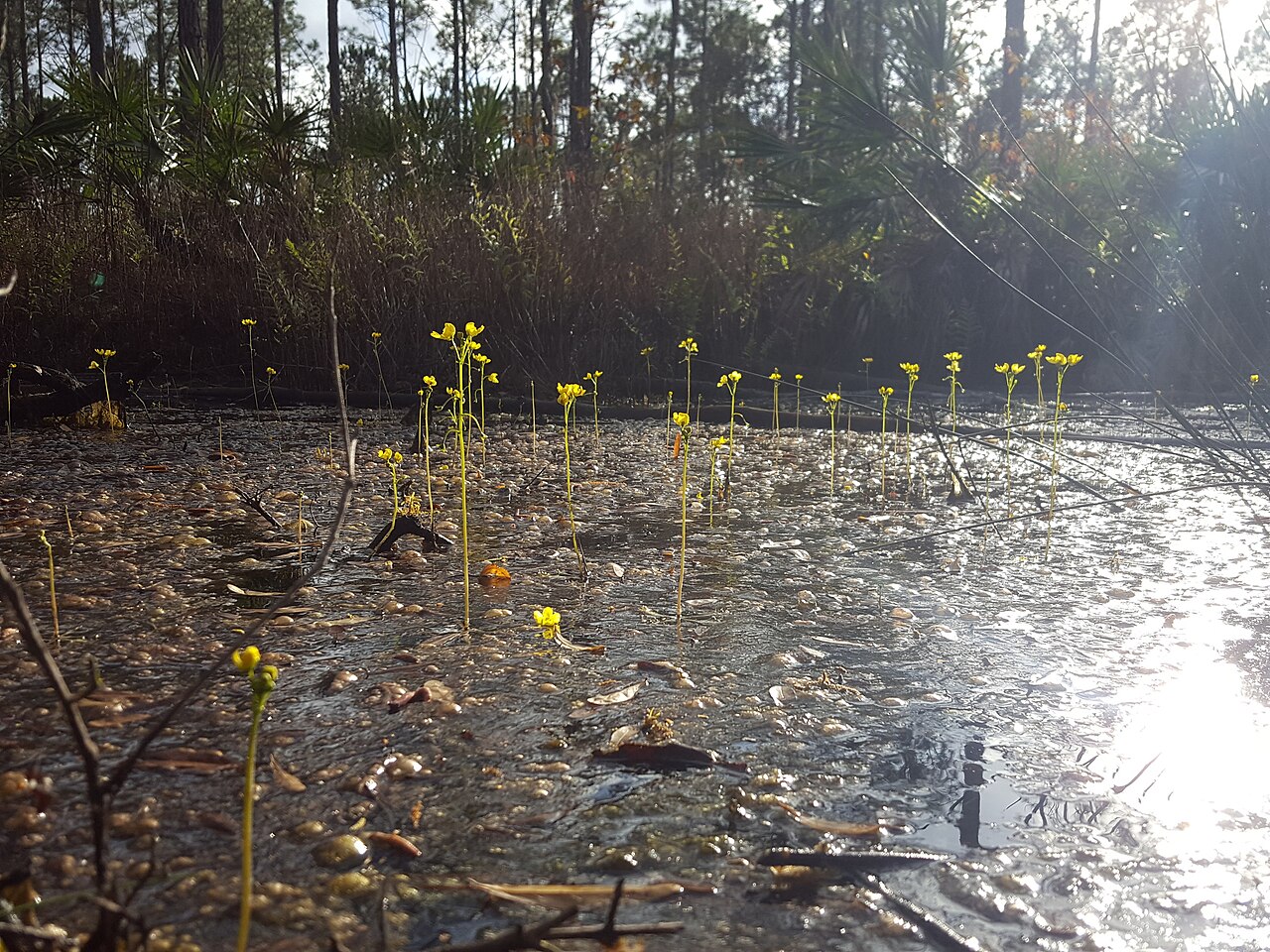
Its most remarkable feature appears when it flowers. A ring of four to ten swollen, spongy arms, like the spokes of a wheel, forms at the water surface and acts as a float, holding up a sturdy stalk with a cluster of bright yellow, snapdragon-like flowers several inches above the water. In spring and summer whole ponds can be dotted with these yellow spikes.
Swollen bladderwort is native from Texas and Oklahoma east to Florida and north along the coastal plain to New Jersey and Delaware. Outside that range it has been introduced, and in Washington State, parts of New York and Massachusetts it has become an invasive weed that crowds out native aquatic plants. This guide covers how to identify it, where it is native, how to keep it responsibly in a water garden, and its role in wetland ecosystems.
Identification
Swollen bladderwort is easiest to identify in flower, when the wheel of inflated float arms and the tall cluster of yellow flowers are visible. Out of flower, look for a floating mass of finely divided, feathery stems with tiny bladders.
Stems & Leaves
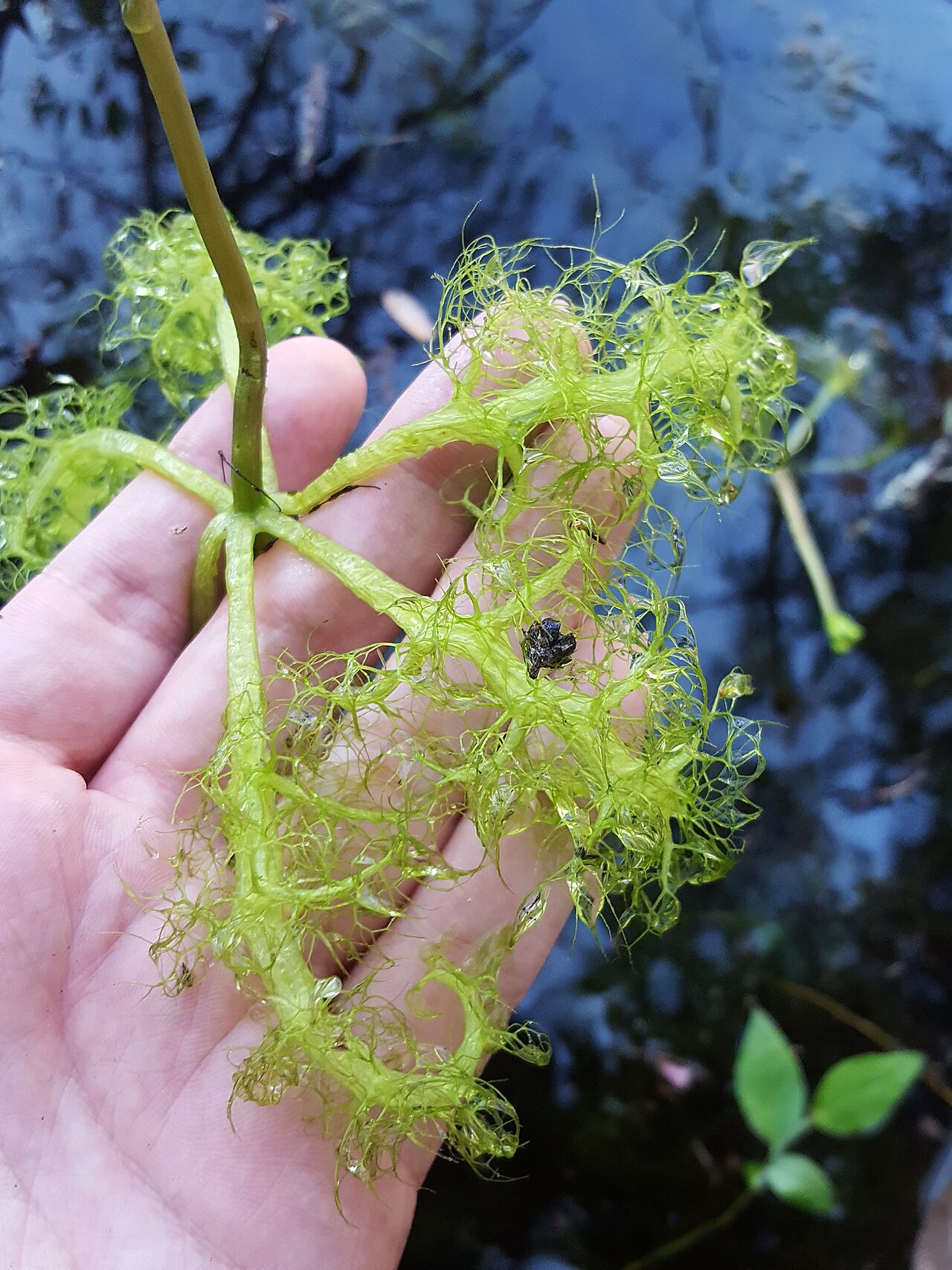
The plant is a loose, floating mass of long, branching stems, often a foot or more long, lying just under the water surface. The leaves are divided many times into very fine, thread-like segments, giving the plant a feathery look. There are no roots; the plant takes up nutrients directly from the water and from its prey.
Bladder Traps
Scattered along the leaf segments are tiny, flattened, bladder-shaped traps, each only a millimeter or two long. Each trap is kept under low pressure, with a small door surrounded by trigger hairs. When a tiny animal such as a water flea or a mosquito larva brushes the hairs, the door snaps open, water rushes in and the prey is sucked inside in a fraction of a second. The plant then digests it and absorbs the nutrients. The traps reset within minutes to hours.
Float Arms
At flowering time the plant produces a whorl of usually four to ten float arms at the base of the flower stalk. These are swollen, hollow-looking, spongy leaf stalks, several inches long, that radiate at the water surface and branch into fine, feathery tips at their ends. They give the plant its name and keep the flower stalk upright.
Flowers
The flower stalk rises several inches to about a foot above the water and carries a cluster of several to more than a dozen yellow flowers. Each flower is about 3/4 inch long, two-lipped like a snapdragon, with a broad lower lip, a raised, ridged palate and a short spur beneath. Bloom is mainly from spring to fall, and in the Deep South plants may flower nearly year round.
Look-alikes
Little floating bladderwort (Utricularia radiata) also has a whorl of float arms, but it is smaller overall, with shorter floats that branch only near the tips and fewer flowers, usually one to five. Common bladderwort (Utricularia macrorhiza) has yellow flowers but no float arms. Purple bladderwort (Utricularia purpurea) has purple flowers and leaves in whorls. Out of flower, coontail (Ceratophyllum) and water-milfoils (Myriophyllum) look similar but have no bladders.
Quick Facts
| Scientific Name | Utricularia inflata Walter |
| Family | Lentibulariaceae (bladderwort family) |
| Plant Type | Free-floating, rootless, carnivorous aquatic perennial |
| Mature Height | Flower stalks 4–12 in above the water |
| Mature Spread | Floating stems 1–3 ft or more; float whorl several inches wide |
| Growth Rate | Fast |
| Sun Exposure | Full sun to part shade |
| Water Needs | Aquatic; still, shallow, usually acidic fresh water |
| Soil Type | None needed; floats in ponds, ditches and lake margins over mucky bottoms |
| Soil pH | Acidic water preferred (about 4.5–6.5) |
| Bloom Time | Spring to fall (March–November in the Deep South) |
| Flower Color | Bright yellow |
| Fall Color | None notable |
| Fruit | Small round capsules with many tiny seeds |
| Deer Resistant | Yes; aquatic and not browsed |
| USDA Hardiness Zones | 7–10 |
Native Range
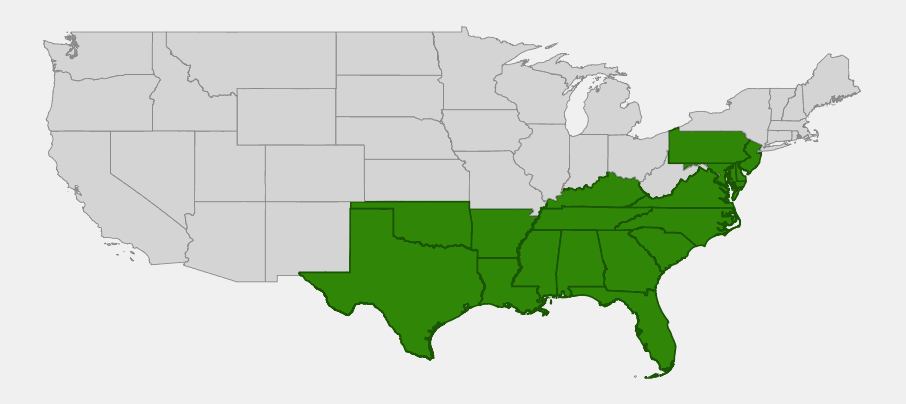
Swollen bladderwort is native to the southeastern United States, mainly on the Atlantic and Gulf coastal plains. USDA PLANTS lists it in Alabama, Arkansas, Delaware, Florida, Georgia, Louisiana, Maryland, Mississippi, New Jersey, North Carolina, Oklahoma, South Carolina, Texas and Virginia, with scattered outlying records inland in Kentucky, Tennessee and southeastern Pennsylvania. It is most abundant in Florida, southern Georgia, the Carolinas and the Gulf Coast states, and it reaches eastern Texas, southeastern Oklahoma and southern Arkansas in the west.
USDA also lists it from Massachusetts, New York and Washington, but these populations are introduced. Native Plant Trust (Go Botany) describes it as introduced in Massachusetts, New York and Washington, where it can become dominant in ponds and displace native aquatic plants. In Washington it is treated as an invasive aquatic weed in lakes of the Puget Sound region, and it has spread in some lakes in the Adirondacks of New York. These introduced states are not shown on the native range map. Plants likely spread through the aquarium and water-garden trade and on boats and trailers.
Within its native range it grows in still or slow-moving, usually acidic and nutrient-poor fresh water: cypress ponds, sinkhole ponds, Carolina bays, borrow pits, roadside ditches, swamps and the shallow edges of lakes, mostly at low elevations on the coastal plain.
📋 Regional plant lists featuring Swollen Bladderwort: New York, Pennsylvania & Northern New Jersey · Kentucky & Tennessee · Maryland, Virginia & West Virginia · Delaware, Southern New Jersey & Long Island · Alabama, Georgia & Mississippi · North & South Florida · North & South Carolina · Arkansas, Louisiana, Eastern Oklahoma & Eastern Texas
Growing & Care Guide
Swollen bladderwort can be grown in a still, sunny pond or water container, and it is a fascinating plant for a native water garden within its natural range. Because it has become invasive where it has been introduced, grow it only where it is native, buy it from a nursery that sells native aquatics, and never release it into natural waters.
Light
Give it full sun to light shade. Plants in full sun flower most heavily; in shade they grow but bloom less.
Soil & Water
It needs no soil. Keep it in still, clean, soft or rainwater-fed water, ideally somewhat acidic and low in nutrients. Hard, alkaline or fertilizer-rich water and strong algae growth weaken it. Avoid adding fertilizer to ponds where it grows; it gets its nutrients from the water and from prey.
Planting Tips
Simply float a portion of the plant in the water. In a container, a tub at least 12 inches deep with a little peat or leaf litter on the bottom works well. It combines naturally with water lilies, floatinghearts and pickerelweed. Because tiny pieces can regrow, wash boats, nets and water-garden equipment and never dump unwanted plants or pond water into streams, ponds or storm drains.
Pruning & Maintenance
Thin it if it becomes too dense by lifting out excess growth with a net; compost the removed material well away from water. In colder winters it may die back, surviving as dormant shoot tips or fragments on the bottom.
Propagation
It spreads readily from stem fragments: any piece with growing tips can form a new plant. It also produces seed in small capsules after flowering. For a water garden, a few sprigs from a native-plant source are enough to start a colony.
Landscape Uses
- Native water gardens: for still, sunny ponds within the plant’s native range
- Carnivorous plant collections: a showy aquatic bladderwort with large yellow flowers
- Wetland education: a vivid example of carnivory and floating adaptations
- Wetland restoration: a native component of coastal plain ponds
- Mosquito-prone ponds: its traps catch mosquito larvae and other tiny animals
Wildlife & Ecological Value
In its native ponds, swollen bladderwort is both a predator and a refuge, and its showy flowers feed pollinators over the water.
For Pollinators
The yellow flowers are pollinated mainly by bees, which land on the broad lower lip and push into the flower to reach nectar in the spur. Small native bees and other insects visit them.
For Birds
Wading and diving birds forage for insects, tadpoles and small fish among floating mats of bladderwort, and ducks may eat the plant material.
For Mammals
Mammals use it little, though muskrats and other aquatic mammals may feed in and among the mats.
Ecosystem Role
The bladder traps capture tiny crustaceans, insect larvae, including mosquito larvae, and other small organisms, recycling nutrients in nutrient-poor ponds. The floating mats shelter small fish, frogs, tadpoles and aquatic insects, and the plant itself supports a community of algae and microorganisms. In its native range it is one of many plants of coastal plain ponds; where introduced, however, it can form dense mats that shade out native plants and alter water chemistry.
Cultural & Historical Uses
The genus name Utricularia comes from the Latin utriculus, a small bag or bladder, referring to the traps. The species name inflata means “inflated,” describing the swollen float arms. The species was described by Thomas Walter in his Flora Caroliniana in 1788, based on plants from the Carolina coastal plain.
Bladderwort traps are among the fastest movements known in the plant kingdom: the trapdoor opens and closes in a fraction of a second. Charles Darwin studied bladderworts in his book Insectivorous Plants, and they remain a favorite subject for studies of plant carnivory.
Swollen bladderwort is also a reminder that a native plant in one region can be a problem in another. Its spread to the Pacific Northwest and the Northeast shows how aquatic plants can move through the water-garden trade and on boats. Growing it only within its native range and never releasing aquarium or pond plants into the wild protects other ecosystems.
Frequently Asked Questions
Is swollen bladderwort carnivorous?
Yes. Its underwater leaves carry tiny bladder traps that suck in and digest small aquatic animals such as water fleas and mosquito larvae.
What are the swollen arms on swollen bladderwort?
They are inflated, spongy leaf stalks that form a floating whorl at the water surface when the plant flowers, holding the flower stalk upright.
Where is swollen bladderwort native?
It is native to the Atlantic and Gulf coastal plains of the southeastern United States, from Texas and Oklahoma to Florida and north to New Jersey and Delaware, with scattered inland records.
Is swollen bladderwort invasive?
Not in its native range. It has been introduced to Washington, New York and Massachusetts, where it can spread aggressively and displace native aquatic plants. Never release it, or any pond or aquarium plant, into natural waters.
Can I grow swollen bladderwort in a pond?
Yes, if you live within its native range. Float a few sprigs in still, sunny, soft water without fertilizer, and buy plants from a source of native aquatics.

Looking for a nursery that carries Swollen Bladderwort?
Browse our native plant nursery directory: Alabama & Arkansas · Delaware, Florida & Georgia · Kentucky, Louisiana, Maryland & Mississippi · New Jersey, North Carolina & Oklahoma · Pennsylvania, South Carolina, Tennessee, Texas & Virginia

