
Purple Bladderwort (Utricularia purpurea)
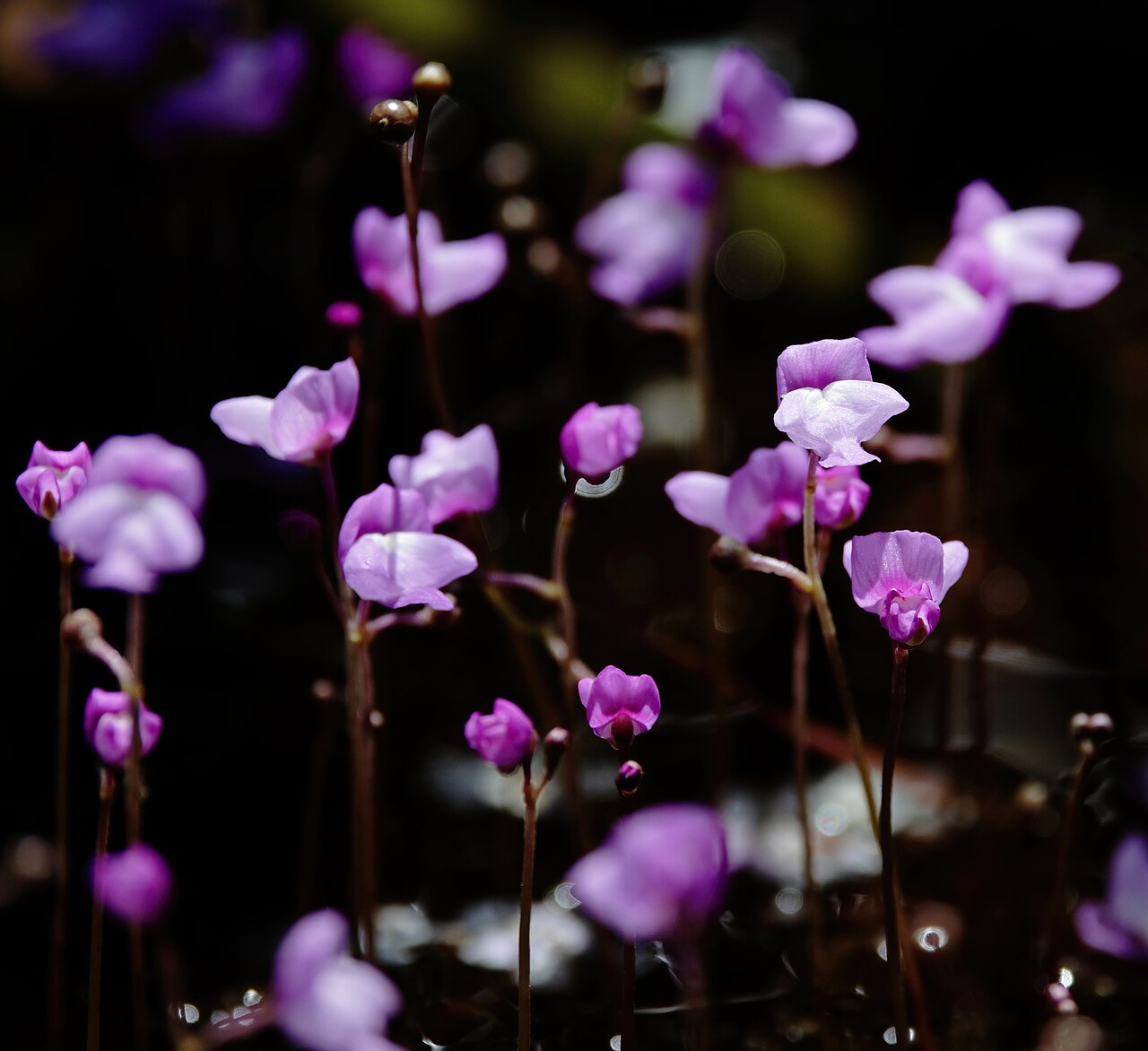
Utricularia purpurea, known as Purple Bladderwort and called eastern purple bladderwort by USDA PLANTS, is a free-floating, carnivorous aquatic plant of quiet, acidic ponds, lakes and slow streams in eastern North America. It belongs to the bladderwort family (Lentibulariaceae), together with the butterworts. It has no roots: its long, branching stems drift just below the water surface, carrying whorls of finely divided leaves and tiny bladders that trap small aquatic animals.
In summer it sends up short, slender stalks that hold one to a few small, pink to reddish-purple flowers just above the water. It is the only purple-flowered bladderwort in most of its range, and colonies in bloom can tint the surface of a pond. Its leaves are arranged in neat whorls, which makes it easy to recognize even without flowers.
Purple bladderwort is a sign of clean, soft, nutrient-poor water. It is suited to natural ponds and bog gardens with rainwater, not to garden ponds with hard tap water or fertilizer. Never collect it from wild ponds; it is rare in several states at the edges of its range.
Identification
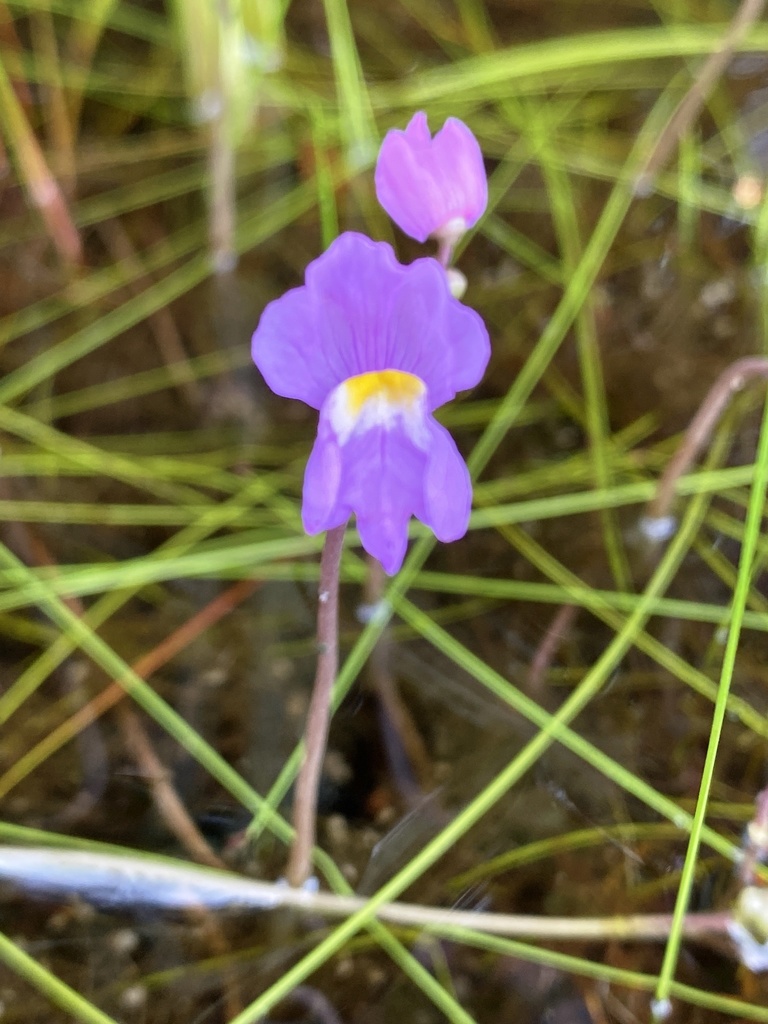
Look for small purple flowers with a yellow spot held just above still water, and below them, floating stems with whorls of fine, hair-like leaves tipped with tiny bladders.
Growth Habit
A rootless, free-floating perennial. The stems are up to about 3 feet long and lie just below the surface, often in tangled mats in water up to several feet deep. Plants have no true roots and no leaves above water.
Leaves & Bladders
The leaves grow in whorls of about five to seven at regular intervals along the stem, like the spokes of a wheel. Each leaf is divided several times into fine, thread-like segments. Tiny, round bladders, about 1/16 inch across, sit at the tips of the leaf segments. Each bladder has a trapdoor that springs open when a small animal brushes its trigger hairs, sucking in water and prey in a fraction of a second.
Flowers
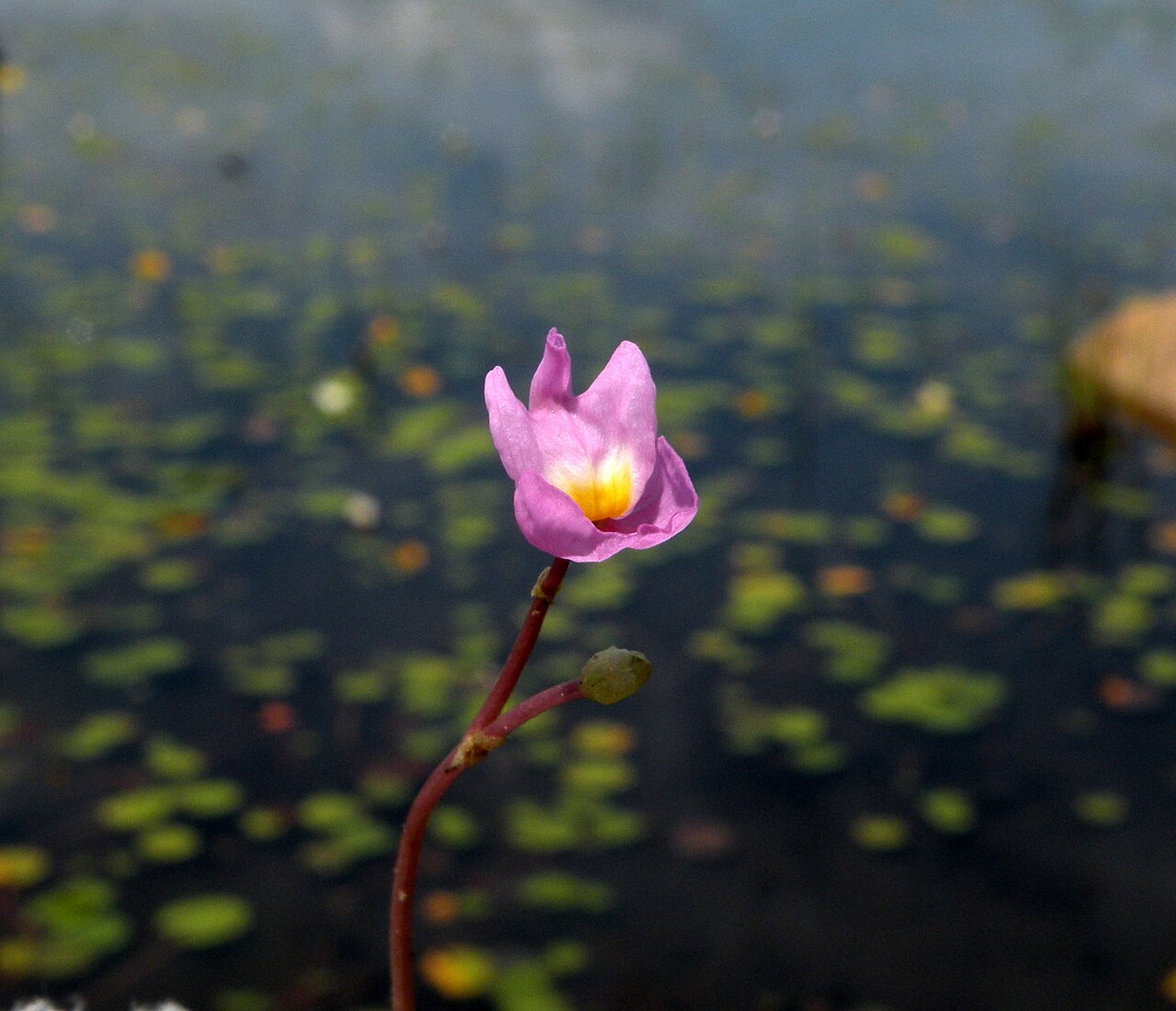
The flowering stalks rise 1 to 6 inches above the water and carry one to four flowers about 1/2 inch across. Each flower is two-lipped, pink-purple to violet, with a broad, three-lobed lower lip that has a raised yellow or whitish spot at its base, and a short spur beneath. White-flowered plants occur occasionally. Flowers appear from about June to September in the North and over a much longer season in Florida.
Fruit & Seeds
The fruit is a small, round capsule with tiny seeds. Many colonies spread mainly by stem fragments that break off and drift to new spots.
Look-alikes
Most other floating bladderworts, such as common bladderwort (Utricularia macrorhiza) and swollen bladderwort (U. inflata), have yellow flowers and leaves that are alternate rather than whorled. Zigzag bladderwort (U. subulata) has yellow flowers and grows on wet sand rather than floating. Small purple bladderwort (U. resupinata) has single, lavender flowers and grows in shallow water along shores.
Quick Facts
| Scientific Name | Utricularia purpurea |
| Family | Lentibulariaceae (bladderwort family) |
| Plant Type | Free-floating carnivorous aquatic perennial |
| Mature Height | Flower stalks 1–6 in above water; stems to 3 ft long |
| Mature Spread | Forms floating mats several feet across |
| Growth Rate | Moderate to fast |
| Sun Exposure | Full sun to part shade |
| Water Needs | Aquatic; still, soft water |
| Soil Type | None; floats in water over peaty or sandy bottoms |
| Soil pH | Acidic water (about 4.5–6.5) |
| Bloom Time | June–September (longer in Florida) |
| Flower Color | Pink-purple to violet with a yellow spot |
| Fall Color | None notable |
| Fruit | Small round capsule |
| Deer Resistant | Yes; grows in open water |
| USDA Hardiness Zones | 4–10 |
Native Range
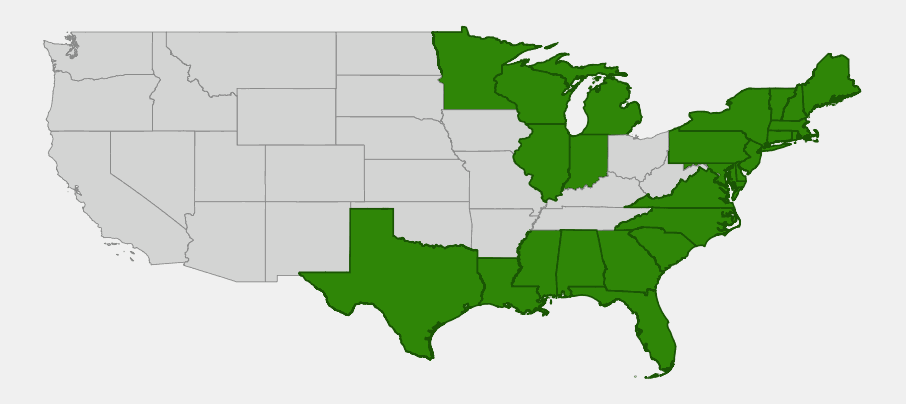
Purple bladderwort is native to eastern North America and the Caribbean region, including Cuba and Central America. USDA PLANTS lists it from Maine, Vermont and New Hampshire south along the Atlantic and Gulf Coastal Plain to Florida, and west to Louisiana and East Texas, with inland populations around the Great Lakes in New York, Pennsylvania, Michigan, Indiana, Illinois, Wisconsin and Minnesota. In Canada it grows in Nova Scotia, New Brunswick, Prince Edward Island, Newfoundland, Quebec and Ontario.
It is most common in the acidic ponds and lakes of the Atlantic Coastal Plain, such as those of Cape Cod, Long Island and the New Jersey Pine Barrens, and in the glacial lakes of New England and the upper Great Lakes. Inland and at the edges of its range it is much scarcer. In Minnesota it grows in lakes of the north-central and northeastern parts of the state, and in Texas only in the east.
It lives in quiet, clear to tea-colored, soft and nutrient-poor water of ponds, lakes, bog pools, cypress swamps and slow streams, from shallow edges to water several feet deep. In Florida it grows in marshes, cypress domes and the Everglades.
📋 Regional plant lists featuring Purple Bladderwort: New York, Pennsylvania & Northern New Jersey · Ohio & Indiana · Michigan, Wisconsin & Eastern Minnesota · Connecticut, Massachusetts & Rhode Island · New Hampshire, Maine & Vermont · Maryland, Virginia & West Virginia · Delaware, Southern New Jersey & Long Island · Illinois, Iowa & Missouri · Alabama, Georgia & Mississippi · North & South Florida · North & South Carolina · Arkansas, Louisiana, Eastern Oklahoma & Eastern Texas
Growing & Care Guide
Purple bladderwort can be grown in a natural pond, a bog garden pool or a large tub of soft water. Its needs are simple but strict: clean, acidic, nutrient-poor water and plenty of light. Buy plants from carnivorous plant growers, or get them from a friend’s established pond; never take plants from wild ponds.
Light
Full sun to part shade. It flowers best with at least several hours of direct sun.
Soil & Water
It needs no soil; it floats. Use rainwater or other soft water, ideally slightly acidic and tea-colored from peat or leaf litter. Hard tap water, fertilizer and nutrient-rich runoff encourage algae that smother it. A thin layer of peat or sand on the bottom of a container helps keep the water acidic.
Planting Tips
Simply place a few stems in the water in spring or early summer. Grow it with other soft-water plants such as waterlilies and watershield, which give some shade and shelter. Avoid ponds with fish that churn up the bottom or eat soft plants.
Pruning & Maintenance
Thin out the mats if they become too thick, and remove floating algae by hand. In cold regions, make sure the water is deep enough not to freeze solid; the stems sink to the bottom over winter and grow again in spring.
Propagation
It is easiest to propagate by stem fragments: any piece with a few whorls of leaves will grow into a new plant. It can also be grown from seed, but this is rarely done.
Landscape Uses
- Natural ponds: a delicate native flower for still, acidic water
- Bog gardens: grows in pools within a bog or carnivorous plant garden
- Container water gardens: a curiosity for tubs of rainwater in sun
- Wildlife ponds: its submerged stems shelter tiny aquatic animals
- Education: an easy way to show carnivorous plants to students
Wildlife & Ecological Value
Purple bladderwort is a small but busy part of the ecosystem of soft-water ponds and lakes, as both predator and shelter.
For Pollinators
Its flowers are visited by small bees and flies, which land on the broad lower lip, guided by the yellow spot.
For Birds
Ducks and other waterbirds may feed among the floating mats, where insects and small animals are plentiful.
For Mammals
It is of little direct value to mammals.
Ecosystem Role
The bladders catch water fleas, copepods, mosquito larvae and other tiny animals, adding nutrients that are scarce in its soft-water habitat. Its bladders are also home to a rich community of algae, bacteria and other microorganisms, and researchers have suggested the plant gains nutrients from this community as well as from prey. The floating mats shelter small fish, tadpoles and aquatic insects.
Cultural & Historical Uses
The genus name Utricularia comes from the Latin utriculus, “little bag” or “bladder,” for the traps, and purpurea means “purple,” for the flowers. The species was described in 1788 by Thomas Walter, who botanized in South Carolina.
Bladderwort traps are among the fastest known movements in the plant world. Each bladder pumps water out to create low pressure inside; when prey touches the trigger hairs, the door opens and the prey is sucked in within a few thousandths of a second.
Bladderworts were first shown to be carnivorous in the 1800s, and Charles Darwin studied their traps in his book Insectivorous Plants (1875). Purple bladderwort is listed as rare in several states at the edges of its range, where soft-water lakes are scarce or threatened by pollution and development.
Frequently Asked Questions
Is purple bladderwort carnivorous?
Yes. Tiny bladders on its leaves trap water fleas, mosquito larvae and other small animals by suddenly sucking them in.
Does purple bladderwort have roots?
No. It floats freely in the water, with no roots at all, and takes in nutrients through its leaves and bladders.
How can I tell purple bladderwort from other bladderworts?
Look for purple flowers and leaves in neat whorls. Most other floating bladderworts in its range have yellow flowers and alternate leaves.
Can I grow purple bladderwort in my garden pond?
Only if the water is soft, acidic and low in nutrients, such as rainwater. It does poorly in ponds filled with hard tap water or fed with fertilizer.
Is purple bladderwort harmful to fish?
No. Its traps are tiny and only catch microscopic animals and small larvae. The mats actually give cover to small fish and tadpoles.

Looking for a nursery that carries Purple Bladderwort?
Browse our native plant nursery directory: Alabama · Connecticut, Delaware, Florida & Georgia · Illinois & Indiana · Louisiana, Maine, Maryland, Massachusetts, Michigan, Minnesota & Mississippi · New Hampshire, New Jersey, New York & North Carolina · Pennsylvania, Rhode Island, South Carolina, Texas, Vermont & Virginia · Wisconsin

