Umbrella Magnolia (Magnolia tripetala)
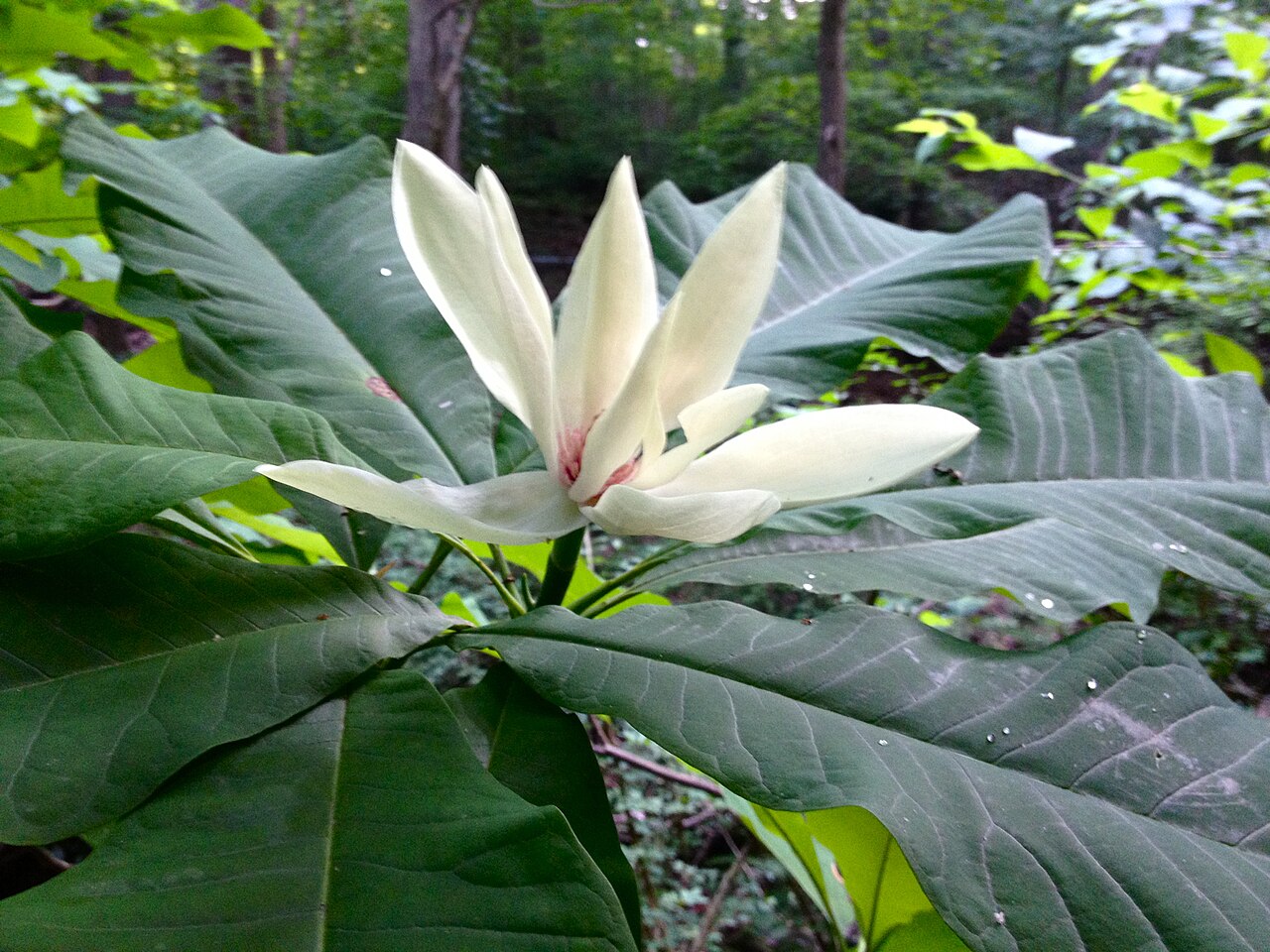
Umbrella magnolia is a small native tree with an unexpectedly bold canopy. Large leaves gather near the ends of branches, creating the umbrella-like effect that gives Magnolia tripetala its common name. Creamy flowers appear among the expanding foliage, followed by conspicuous conelike fruits. In a sheltered Carolina woodland garden, it can supply a broad-leaved texture rarely matched by other regional trees.
The usual garden size is roughly fifteen to thirty feet, although older trees can be larger. Its outline is often irregular and may include several stems rather than a single formal trunk. Give it space to express that form. This is not a narrow foundation tree or a good candidate for repeated shearing beneath a roofline.
The leaves are the main reason to plant it, and they are also the feature most affected by exposure. Strong wind can tear them, while drought and reflected heat can spoil their appearance. A moist, sheltered woodland edge is more promising than a hot parking strip. Choosing the right setting at planting is more effective than trying to correct a fundamentally exposed site later.
Identification
Leaves
Leaves are very large, commonly around ten to twenty-four inches long, and cluster near branch tips. This arrangement gives the impression of an umbrella even though the leaves are individually attached. Look at the leaf base and overall shape when separating it from other large-leaved magnolias. A single detached leaf without the branch arrangement can be misleading.
Flowers
Large creamy-white flowers appear after the leaves begin to expand. Their scent can be unpleasant rather than the sweet fragrance expected from some other magnolias. Place the tree where flowers can be seen without assuming they belong beside an open bedroom window. Flowering is seasonal, while the broad foliage dominates the summer appearance.
Fruit
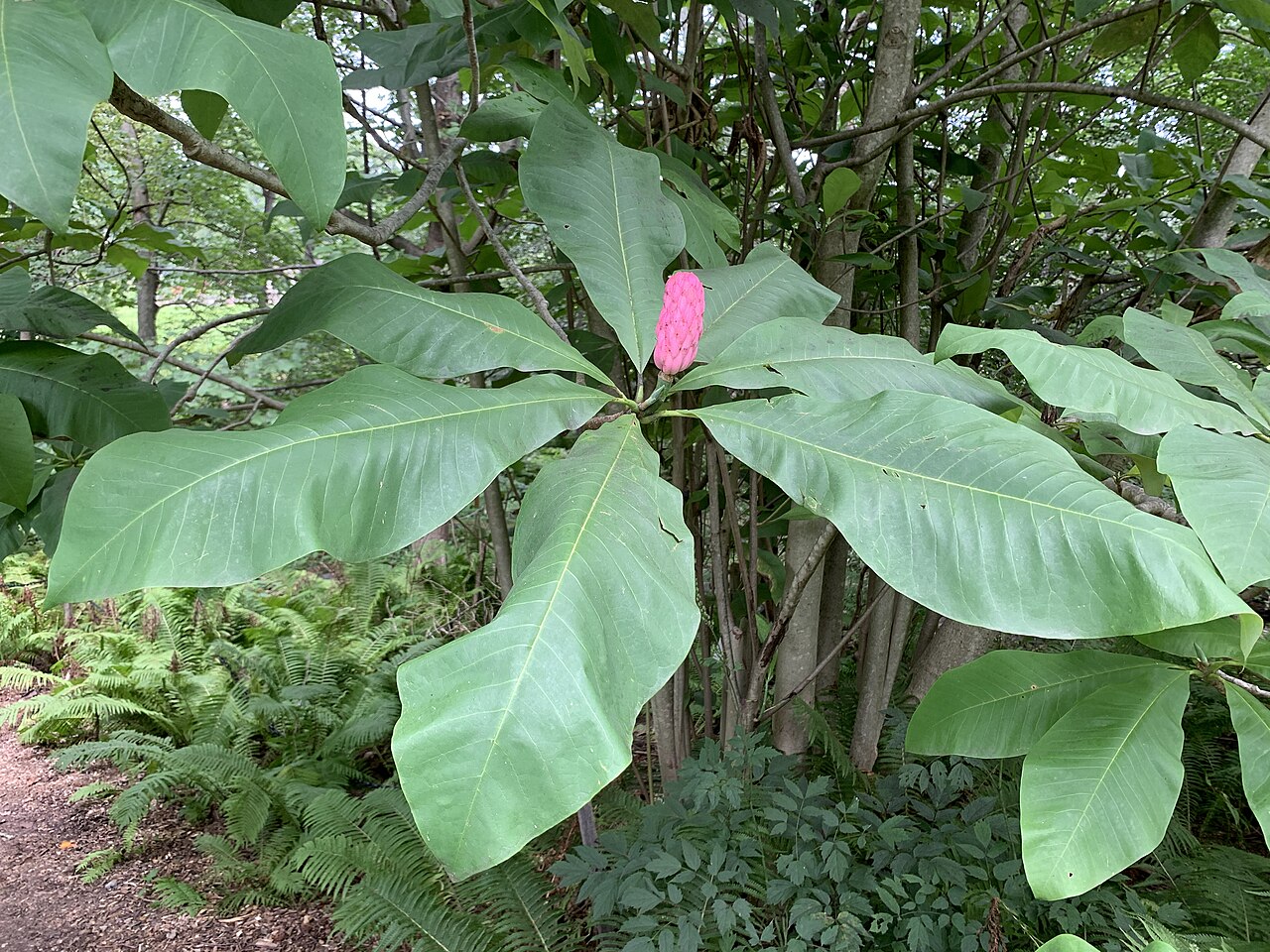
The aggregate fruit resembles a colored cone and exposes bright seeds as it matures. It is not a pine cone: the tree is a flowering plant. Fruits add a late-season feature after the brief flower display. Do not collect every fruit if wildlife and natural seasonal interest are part of the garden’s purpose.
Bark & Form
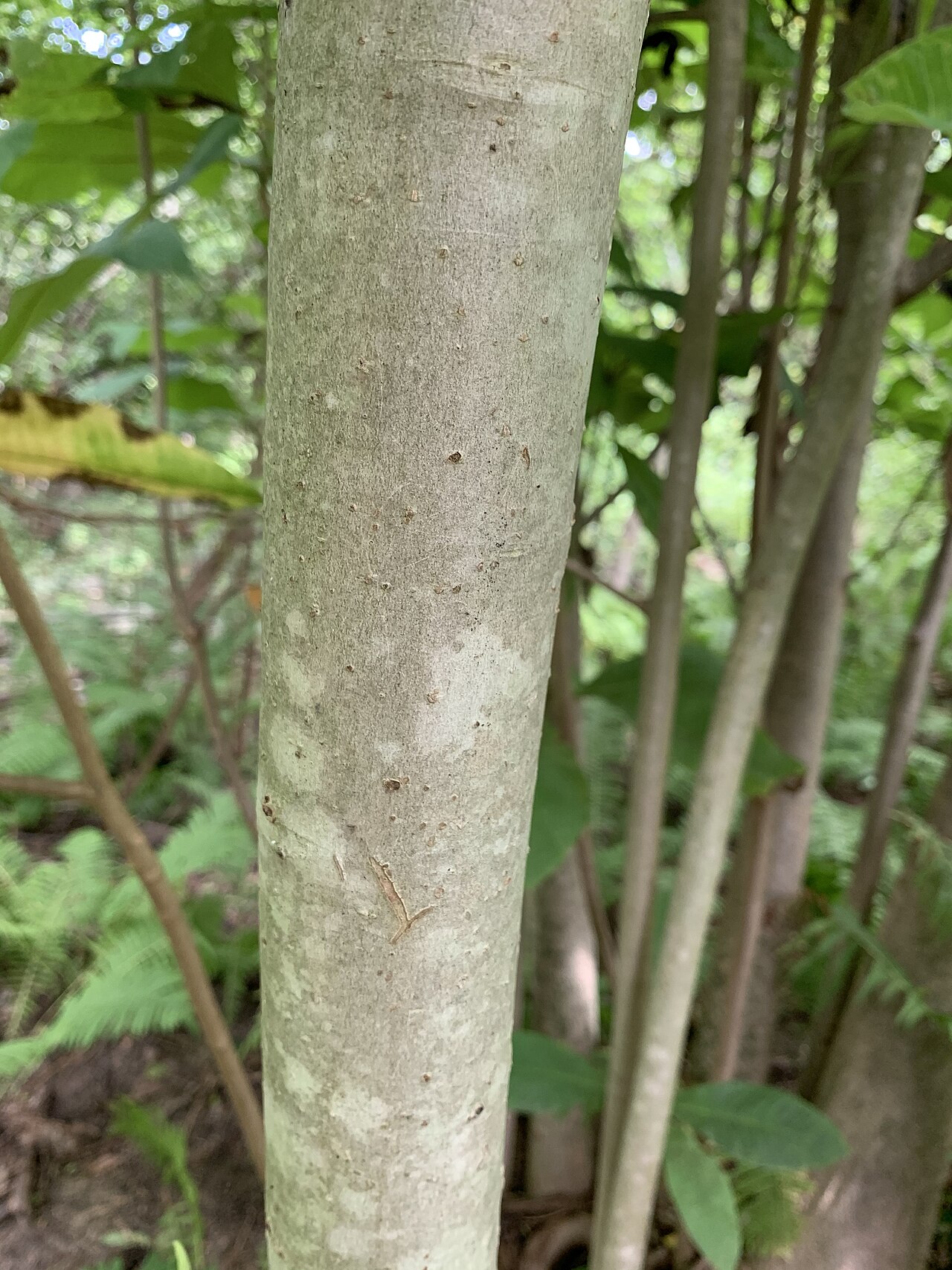
The bark is relatively smooth on younger wood, and the branches support a broad, sometimes uneven crown. Multistemmed growth is not necessarily a defect. Plan clearances around the mature spread and remove only problem branches rather than trying to impose a dense symmetrical shape through repeated cutting.
Similar Magnolias
Bigleaf magnolia and Fraser magnolia also have striking foliage. Compare leaf bases, underside characteristics, flower and fruit details using a regional guide. The legacy spelling tripetela is incorrect; the species epithet is tripetala. A nursery plant should be identified to species rather than sold only as a large-leaf magnolia.
Quick Facts
| Scientific Name | Magnolia tripetala |
| Family | Magnoliaceae |
| Plant Type | Deciduous small tree, sometimes multistemmed |
| Mature Height | Usually 15–30 feet; occasionally about 40–45 feet |
| Mature Spread | About 15–30 feet with a broad irregular crown |
| Growth Rate | Moderate |
| Sun Exposure | Partial shade to sun in a sheltered moist site |
| Water Needs | Consistent moisture with drainage; poorly suited to drought |
| Soil Type | Rich, organic woodland soil |
| Soil pH | Acidic to near neutral rich soil |
| Bloom Time | Late spring to early summer after leaves emerge |
| Flower Color | Creamy white; flowers can have an unpleasant scent |
| Fall Color | Yellow to brown; not consistently showy |
| Fruit | Conelike pink to red aggregate fruit exposing red seeds |
| Deer Resistant | Not deer-proof; protect establishing plants where browsing is heavy |
| USDA Hardiness Zones | 5–8 in common horticultural guidance |
Native Range
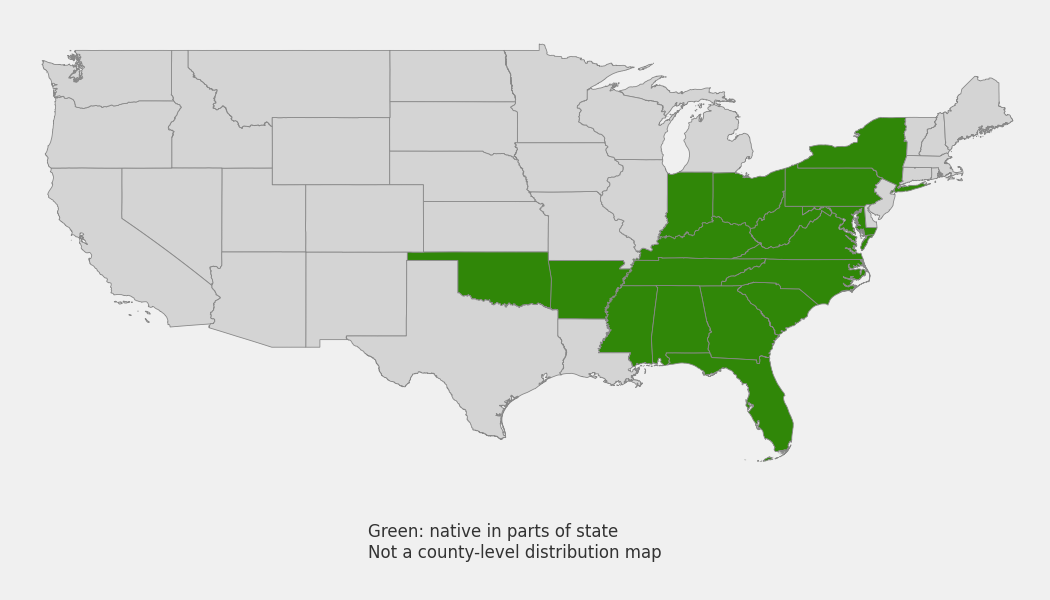
Kew places umbrella magnolia in the eastern and southeastern United States, extending westward into Arkansas and Oklahoma and northward into parts of the Midwest and Northeast. The map follows Kew’s native state treatment. Shading does not mean the tree is common statewide: natural populations are associated with particular wooded slopes, ravines and sheltered habitats.
Both North and South Carolina are within the native range. Rich woods and protected slopes provide moisture and shelter, but a regional list should not imply that every dry coastal or exposed upland site will suit it. Think in terms of habitat and local provenance as well as state boundaries.
Cultivation can extend beyond natural populations, and broad range summaries can differ at the margins. For restoration, confirm county-level status with the local flora before planting. For an ornamental native garden, use propagated stock and choose a site that resembles the species’ moist woodland setting instead of relying on a winter-hardiness number alone.
📋 Regional plant list: North & South Carolina
Growing & Care Guide
Light & Shelter
Partial shade is a useful starting point, although sun can work where moisture and shelter are adequate. Avoid the hottest reflected afternoon exposure beside pavement. The large leaves catch wind, so protection from prevailing gusts improves appearance. A woodland edge with overhead openness and lateral shelter often offers a better balance than an isolated lawn position.
Soil
Rich, organic soil with drainage is appropriate. Retain a woodland-style surface rather than repeatedly cultivating around the roots. A shallow mulch layer can help conserve moisture, but keep it away from the trunk base. Do not bury the root flare or create a mound of wet mulch against the bark.
Water
Water a newly planted tree through dry periods until roots establish beyond the original rootball. Check the soil below the surface before watering again. Established trees still perform best with dependable moisture and are not ideal drought specimens. If leaves brown during a hot spell, assess root-zone dryness and exposure rather than treating every blemish as a disease.
Planting & Space
Choose a position with room for a fifteen-to-thirty-foot spread and future branch development. Plant at the correct root-flare depth and avoid a hole that traps water. Small nursery trees are easier to establish than trying to move a large wild specimen. Keep competing turf away from the immediate root zone while the tree establishes.
Pruning
Prune sparingly for damaged wood, access or a genuine structural problem. Repeated heading cuts sacrifice the natural form and large-leaf display. Decide early which stems can remain, but do not assume that a multistemmed tree must become a single-trunk standard. Leave enough room that mature branches do not force drastic corrective pruning later.
Leaf Litter & Seasonal Care
The large leaves become conspicuous litter in autumn. In a woodland bed they can remain as part of the organic surface, though thick mats may need redistribution away from small plants. On paths, remove slippery accumulations. Consider this seasonal maintenance before placing the crown directly over a small paved sitting area.
Propagation
Seed and vegetative propagation are specialist options. Use a magnolia-specific protocol for cleaning and treating seed rather than assuming dried seed behaves like a packet of annual flowers. Nursery propagation preserves wild populations and improves traceability. Keep species and provenance labels with seedlings, particularly where several magnolia species are grown together.
Landscape Uses
- A sheltered specimen at a woodland edge
- A bold foliage layer in a rich native garden
- A small tree in a spacious moist border
- A contrast to fine-textured ferns and woodland shrubs
Wildlife & Ecological Value
Flowers & Insects
Magnolia flowers have a pollination system associated with insect visitors, including beetles. The tree adds a different flower structure to a native garden than the more familiar small tubular or daisy-like blooms. Avoid broad-spectrum spraying on flowers and recognize that an unpleasant scent to people can still be part of a flower’s biology.
Fruit & Birds
The exposed seeds are a wildlife feature, and a layered woodland garden offers both food opportunities and cover. Leave some mature fruit where practical. Wildlife use should not be interpreted as a statement that the fruit is a human food crop.
Woodland Structure
A small tree fills a middle canopy layer between tall forest trees and shrubs. Its large leaves create patches of shade and a distinct seasonal litter input. Plant compatible understory species with enough room that their crowns are not buried beneath repeated accumulations of leaves.
Habitat Stewardship
The most useful way to conserve native woodland plants is to retain functioning habitat and use propagated stock in gardens. Digging a mature wild magnolia damages roots and the surrounding community, often with poor transplant results. Support growers who can explain how their trees were produced.
Cultural & Historical Uses
The umbrella name is a visual description of leaves grouped around branch tips. It does not imply a relationship to tropical umbrella houseplants. Using Magnolia tripetala on a plant label prevents that common-name confusion and also separates it from other large-leaved native magnolias.
In modern landscape design, the species provides an almost tropical visual scale while remaining an eastern North American woodland tree. That appearance can tempt gardeners to place it in exposed sunny courtyards, yet its best performance comes from respecting the sheltered habitat behind the dramatic foliage.
Its ornamental history is best understood through the contrast between flower and leaf. The blooms are large but not necessarily pleasantly scented; the leaves offer the longer display. Selecting a site for foliage, mature structure and summer moisture leads to a more satisfying planting than choosing only from a flower photograph.
Frequently Asked Questions
Why do the leaves look torn?
Wind can damage the large blades. Shelter is an important site requirement; torn leaves do not automatically indicate an insect or disease problem.
Are the flowers sweetly fragrant?
Not reliably. Their scent can be unpleasant, so do not choose a location on the assumption that they smell like southern magnolia.
Can it grow in full sun?
Yes where moisture and shelter are adequate, but a hot dry exposed site is a poor match. Partial shade is often easier to manage.
How large should I allow it to become?
Plan for roughly fifteen to thirty feet tall and wide, with occasional larger trees. Avoid sites that will require repeated severe pruning.
Is tripetela the correct spelling?
No. The correct botanical name is Magnolia tripetala; the regional table’s legacy spelling has been corrected.
Sources & Further Reading
- NC State Extension: umbrella magnolia
- Kew: native distribution
- Oregon State: umbrella magnolia
- University of Arkansas Extension: umbrella magnolia
Find Native Plants
Ask growers about nursery propagation and regional provenance. Browse our NC native plant nurseries, SC native plant nurseries directory for suppliers. Explore the native nursery finder.