Walter’s Violet (Viola walteri)
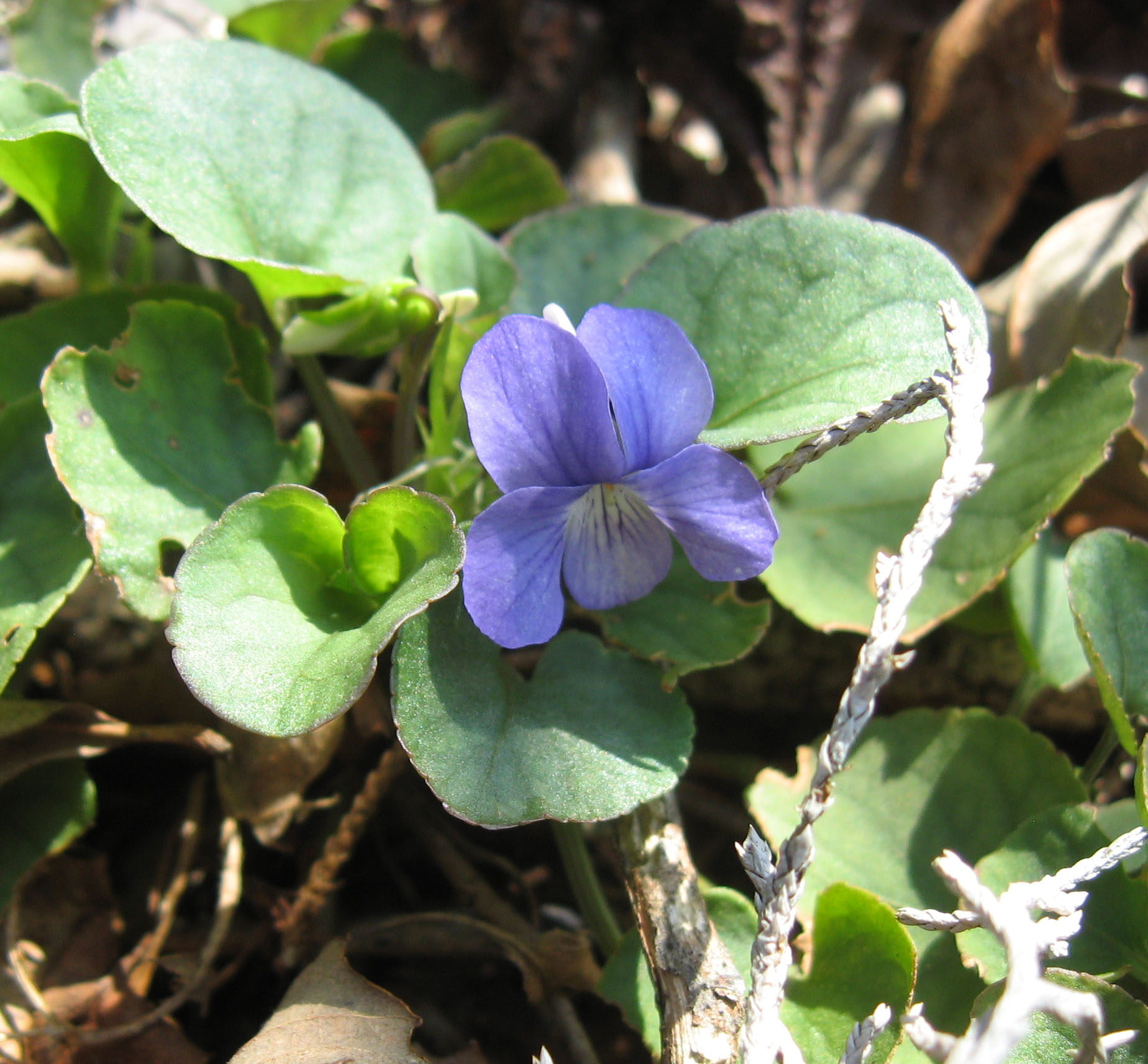
Viola walteri, commonly called Walter’s Violet or Prostrate Blue Violet, is a low, trailing woodland wildflower native to the limestone-rich forests of the southeastern and lower Appalachian United States. Unlike the familiar clump-forming violets of lawns and garden beds, this species creeps along the ground on slender, rooting stolons, forming loose mats of rounded, often silver-mottled leaves studded with small blue-violet flowers in early spring. It is named for Thomas Walter, the British-born botanist who authored the first flora of the Carolinas in the eighteenth century.
Walter’s violet is a plant of specific habitat: rich, calcareous (lime-influenced) woods, rocky ledges, and the moist, shaded banks of spring-fed streams. It is far less weedy than its common violet cousins and is uncommon to locally frequent rather than abundant across most of its range, with populations becoming scattered and fragmented toward the northern edge of its distribution. Where it does occur, it is a dependable, long-lived groundcover that asks for very little once established in the right conditions.
For a native plant garden, Walter’s violet fills a niche that few other groundcovers can match: a true evergreen-to-semi-evergreen trailing plant for dry-to-moist shade under deciduous trees, especially where soils run neutral to alkaline rather than the acidic woodland soils many eastern natives prefer. Its diminutive scale and spreading habit make it well suited to rock gardens, woodland path edges, and small-space native plantings where a sprawling, taller perennial would overwhelm the setting.
Identification
Walter’s violet is a stemless-looking perennial that spreads by thin, wiry, above-ground stolons rather than growing in a single upright clump. Individual plants form small rosettes along the stolon, so a single patch can cover a square foot or more within a couple of seasons while remaining only 2 to 4 inches tall.
Leaves
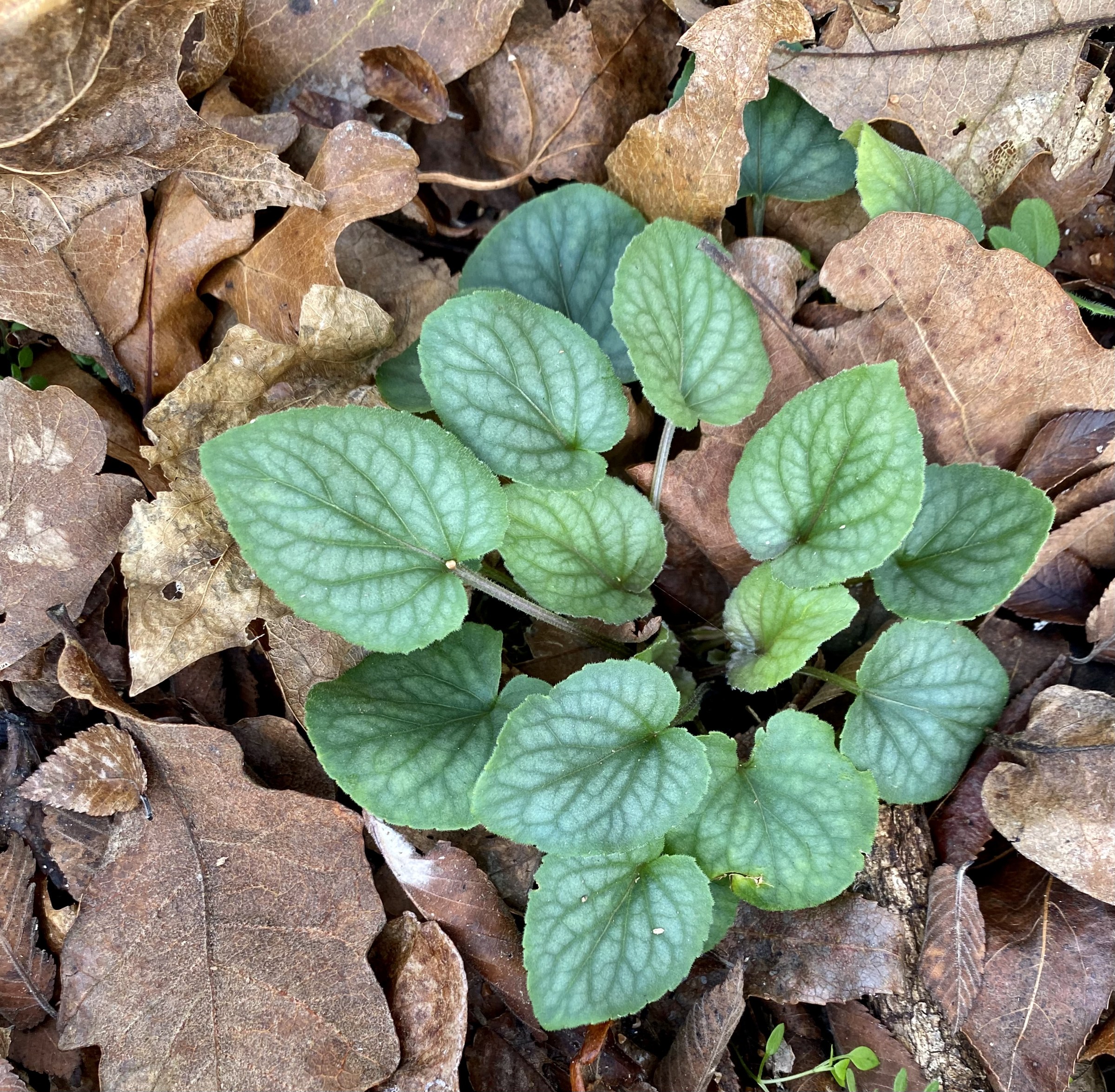
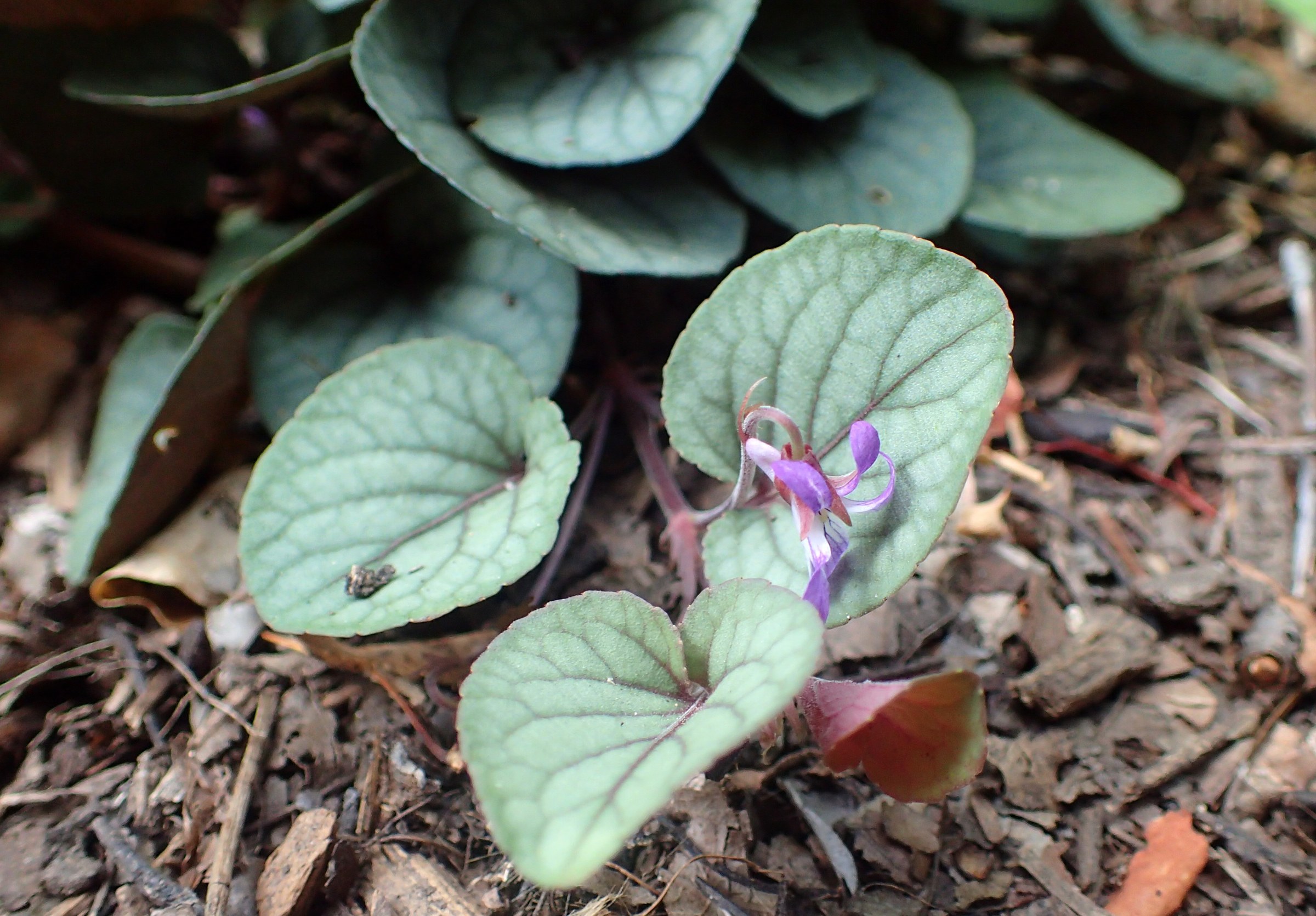
The leaves are broadly heart- to kidney-shaped, 1 to 2 inches across, with scalloped margins and a leathery texture. Many populations — and especially the horticultural selections sold as ‘Silver Gem’ — show a distinctive pewter-silver mottling along the veins and leaf surface, though wild plants can also be plain deep green. The undersides and leaf stalks are often tinged with purple, and the foliage frequently persists through winter in the milder parts of its range, turning a deeper maroon-green in cold weather.
Flowers
Flowers appear in early-to-mid spring, held on short stalks just above the leaves. Each bloom is a typical five-petaled violet flower, 1/2 to 3/4 inch across, pale lavender-blue to violet with a whitish, often darker-veined throat on the lower petal. Unlike many violets, the flowers of V. walteri are usually held close to the foliage rather than well above it, giving the plant a tidy, ground-hugging look in bloom. Like other violets, it also produces inconspicuous, non-opening (cleistogamous) flowers later in the season that self-pollinate and set seed without ever opening.
Fruit
The fruit is a small three-valved capsule that splits open and flings seeds a short distance from the parent plant when ripe. Ants are drawn to the fatty appendages (elaiosomes) on the seeds and carry them off, helping the species spread slowly to new microsites — a dispersal strategy shared with many spring woodland wildflowers.
Quick Facts
| Scientific Name | Viola walteri |
| Family | Violaceae (Violet) |
| Plant Type | Herbaceous, Trailing Perennial Groundcover |
| Mature Height | 2–4 in (5–10 cm) |
| Mature Spread | 12–24 in, slowly spreading by stolons |
| Growth Rate | Slow to moderate |
| Sun Exposure | Part Shade to Full Shade |
| Water Needs | Average to moist, tolerates brief dryness once established |
| Soil Type | Humus-rich, well-drained; loam over limestone |
| Soil pH | Neutral to alkaline (calcareous) |
| Bloom Time | March – May |
| Flower Color | Pale lavender-blue to violet |
| Fall Color | Evergreen to semi-evergreen; foliage may bronze in cold |
| Fruit | Small three-valved seed capsule |
| Deer Resistant | Somewhat (occasionally browsed) |
| USDA Hardiness Zones | 5–9 |
Native Range
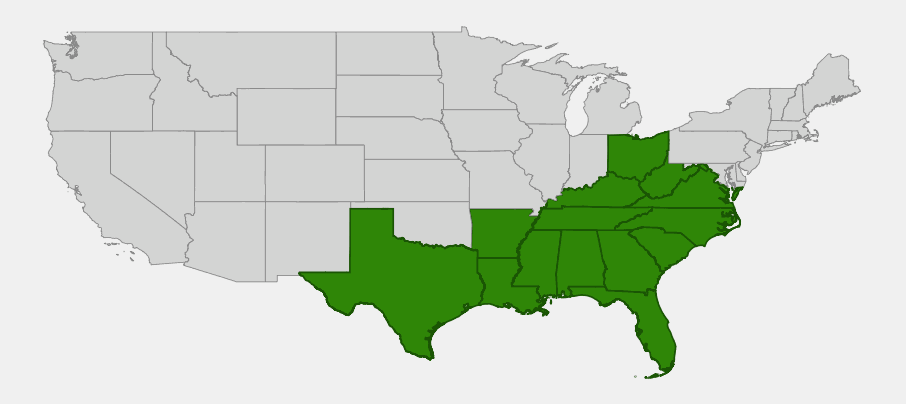
Walter’s violet is native to the southeastern United States and the lower Appalachians, with a range centered on Kentucky, Tennessee, and the Carolinas and extending south and west through the Gulf states to east Texas, and north into West Virginia, Virginia, and the southern tip of Ohio. Within this range it is patchy rather than continuous, closely tracking outcrops of limestone and other calcium-rich bedrock.
Typical habitat includes rich mesic (moderately moist) deciduous forests, calcareous rock ledges and bluffs, and the shaded banks of spring-fed creeks and gorges — the kind of site botanists call a “rich woods” community, often shared with species like wild ginger, maidenhair fern, and other calciphile (lime-loving) wildflowers. It is notably absent from the acidic sand and clay soils that cover much of the coastal plain, which is why its range reads as scattered pockets rather than a solid block on a map.
Because Walter’s violet depends on an uncommon soil chemistry, it is considered uncommon to rare through much of its range and should never be collected from the wild; several states track its populations as a species of conservation concern at the state level. Gardeners wanting to grow it should buy nursery-propagated plants, not wild-collected stock.
📋 Regional plant lists featuring Walter’s Violet: Georgia, Alabama & Mississippi · Arkansas, Louisiana, Eastern Oklahoma & Eastern Texas · Kentucky & Tennessee · North Carolina & South Carolina · Maryland, Virginia & West Virginia · Ohio & Indiana
Growing & Care Guide
Walter’s violet is an easy, trouble-free groundcover for the right spot, but it is specific about that spot: give it the shaded, humus-rich, lime-influenced soil it evolved with and it needs almost no attention afterward.
Light
Part shade to full shade suits it best, mimicking the dappled light of a deciduous forest floor. Plants tolerate a few hours of morning sun, especially in cooler climates, but hot afternoon sun will scorch the foliage and dry the shallow root system too quickly.
Soil & Water
This species wants soil on the neutral-to-alkaline side, which sets it apart from most eastern woodland natives that prefer acidic conditions. Working in a bit of crushed limestone, dolomitic lime, or simply planting near a concrete foundation or walkway (which leaches lime into the soil) can help where garden soil runs acidic. Keep the soil evenly moist but well drained; established plants handle short dry spells but will not thrive in soggy, waterlogged ground.
Planting Tips
Set out nursery-grown plants in fall or early spring, spacing them 8 to 12 inches apart if you want them to knit together into a continuous mat within a couple of seasons. A 1 to 2 inch mulch of shredded leaves helps retain moisture and keeps the shallow stolons from drying out, while also echoing the leaf litter of its native habitat.
Propagation
Established patches are easily divided in early spring or fall; simply lift a rooted section of stolon with its rosette attached and replant it. Seed can also be collected from ripe capsules, but as with many violets, germination is often better from fresh seed sown immediately rather than from stored seed.
Landscape Uses
Walter’s violet earns its place in several garden settings:
- Woodland groundcover beneath deciduous trees where turf struggles
- Rock garden and limestone outcrop plantings
- Edging for shaded paths thanks to its low, tidy habit
- Small-space native gardens where taller perennials would crowd the bed
- Container and trough plantings for a shaded patio
Wildlife & Ecological Value
Like other native violets, Walter’s violet plays an outsized ecological role relative to its small size, mostly through its relationship with butterflies and ground-dwelling insects.
For Pollinators
The spring flowers are visited by small native bees and other early-season pollinators, though — as in many violets — a large share of seed is actually produced later in the season by self-pollinating flowers that never open.
For Butterflies
Violets, including Viola walteri, are essential larval host plants for fritillary butterflies, including the great spangled fritillary and variegated fritillary. Fritillary caterpillars feed exclusively on violet foliage, making patches of native violets like this one important for completing these butterflies’ life cycle.
Ecosystem Role
The ant-dispersed seeds tie this species into the small-scale “seed-for-food” partnership common among spring woodland wildflowers, with ants carrying seeds to new ground in exchange for the fatty elaiosome attached to each one. The dense, low foliage also helps stabilize soil on the rocky slopes and streambanks where it often grows, reducing erosion on steep, shaded ground where few other plants can get a foothold.
Cultural & Historical Uses
Walter’s violet carries the name of Thomas Walter, an English-born planter and botanist who settled in South Carolina and in 1788 published Flora Caroliniana, the first flora to describe many plants of the southeastern United States using the modern Linnaean system. The species was later named in his honor by the American botanist Homer Doliver House in the early twentieth century.
Like many native violets, Viola walteri and its relatives have a history of use in folk traditions of the southeastern United States, where the leaves and flowers of various violet species were steeped for soothing teas and poultices. These uses are historical folk practice rather than established or recommended herbal medicine, and no medicinal use of Walter’s violet specifically is documented in reliable modern sources.
Today the species is known mainly to native plant gardeners and conservationists, who value it both as an attractive, well-behaved groundcover and as an indicator of the rare, high-quality calcareous woodland habitat it depends on.
Frequently Asked Questions
Is Walter’s violet the same as the common violets in my lawn?
No. The violets that colonize lawns are usually Viola sororia (common blue violet), a clump-forming species tolerant of a wide range of soils. Walter’s violet is a distinct, low-trailing species restricted to shaded, lime-rich woodland soil, and it is far less common and less weedy.
Will Walter’s violet spread aggressively in my garden?
No. It spreads slowly by short stolons and is easy to keep within bounds, nothing like the self-seeding common violets that can take over a lawn or bed.
Does Walter’s violet need lime added to the soil?
In most garden soils, yes, some adjustment helps. If your soil is naturally acidic, working in dolomitic lime or planting near concrete (which leaches alkalinity) will make conditions more to its liking.
Is Walter’s violet evergreen?
It is evergreen to semi-evergreen in much of its range, especially in milder winters, with the foliage often taking on a bronze or maroon cast in cold weather rather than dying back completely.
Can I collect Walter’s violet from the wild?
No. Because it is uncommon to rare in many areas and tied to specific, often fragile limestone habitats, wild collection is discouraged and may be restricted. Buy nursery-propagated plants instead.

Looking for a nursery that carries Walter’s Violet?
Browse our native plant nursery directory: AL, AR · FL, GA · KY, LA, MS · NC, OH · SC, TN, TX, VA · WV