
Crested Iris (Iris cristata)
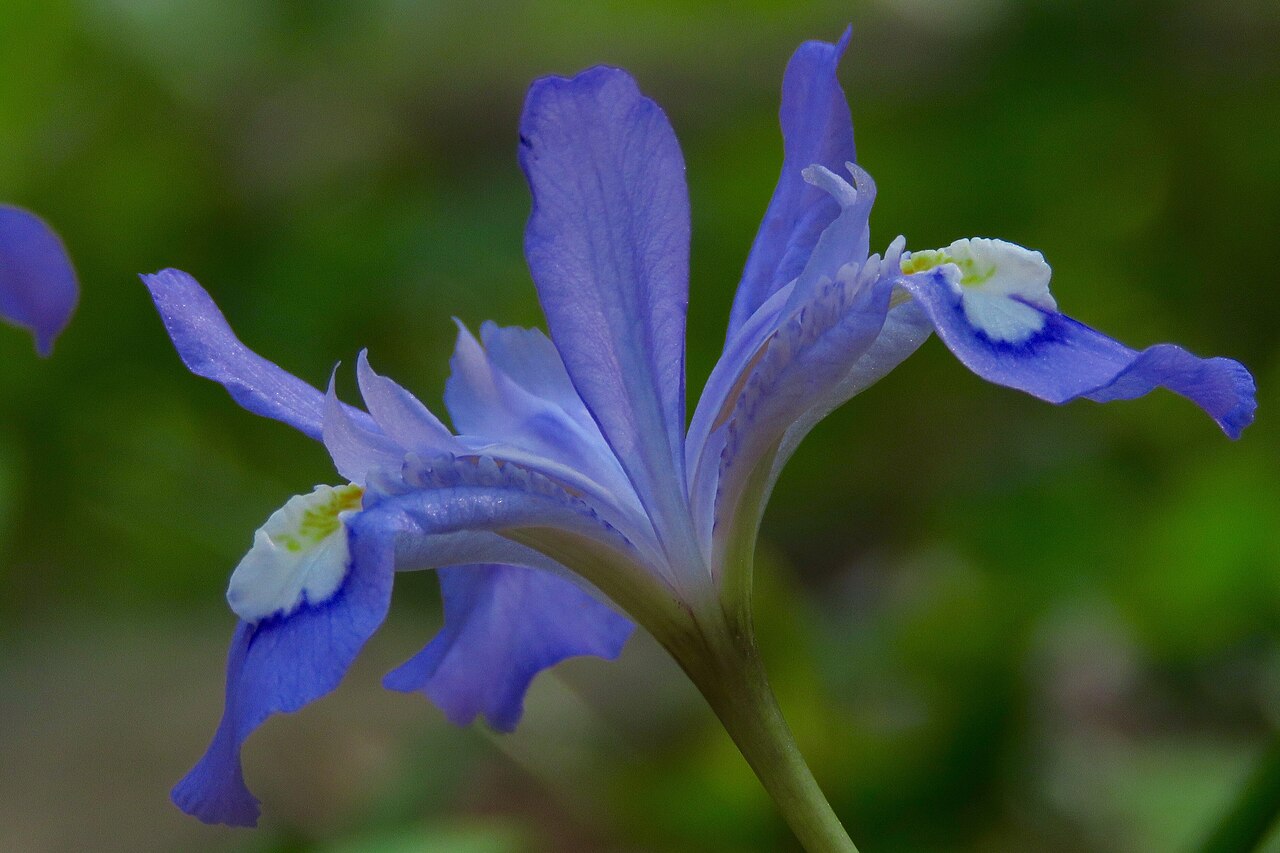
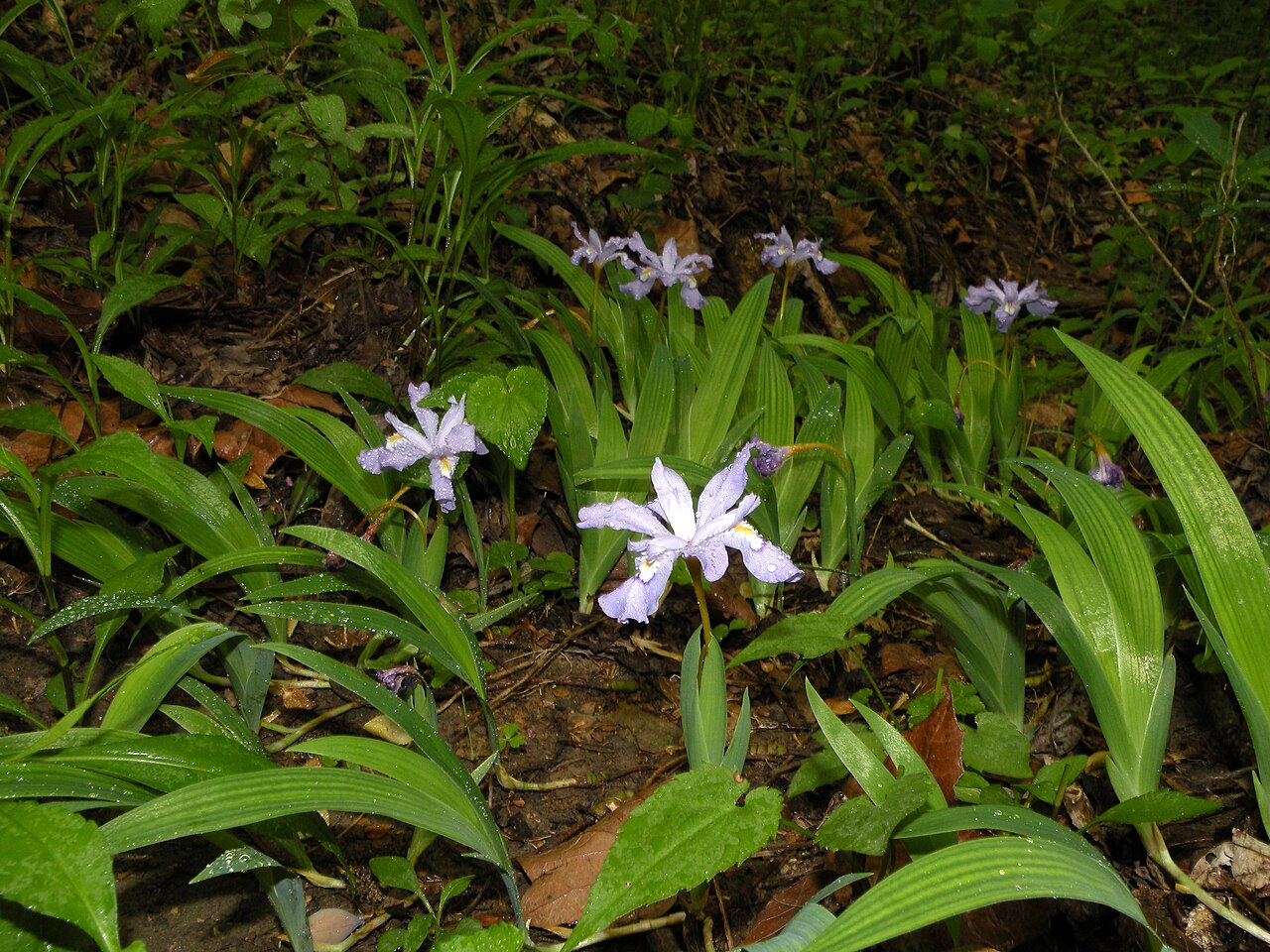
Iris cristata, commonly called Crested Iris or Dwarf Crested Iris, is a small rhizomatous perennial of the Iridaceae (iris) family and one of the most reliable spring wildflowers of the Southeastern uplands. Each plant stands only a few inches tall in bloom, yet the flowers are big for the plant: pale lavender-blue to violet, two to three inches across, with a white blaze on each of the three drooping falls and a ridged yellow-to-orange crest running down the middle of it. That crest is what gives the species its name, from the Latin crista, and it acts as a landing strip that guides bees toward the nectar tube.
In Alabama, Georgia, and Mississippi, Crested Iris grows wild on rocky wooded slopes, stream banks, and bluff bases, mostly in the northern half of each state where the Cumberland Plateau, Ridge and Valley, Blue Ridge, and Piedmont hills give it the well-drained, acidic, leaf-mold soils it prefers. It blooms from late March into May, usually just as the dogwoods and trilliums open, and then settles into a low fan-shaped carpet of sword-like leaves that lengthens through summer. Because it spreads by slender surface rhizomes, a single starter clump becomes a dense, weed-suppressing mat within a few seasons.
Gardeners prize it because it does what few flowering groundcovers manage: it thrives in dry shade under established hardwoods, takes the heat of a Southern summer, and asks for almost nothing. It is not a plant for a swampy site or a hot, baked bed, but for the woodland garden, the rocky bank, the path edge, and the shady front border it is hard to beat. This guide covers how to identify it, where it truly grows, and how to keep it flowering in Southeastern gardens.
Identification
Crested Iris is a low, spreading, herbaceous perennial. In bloom the whole plant rarely exceeds 4 to 6 inches, though the fans of leaves lengthen to 6 to 16 inches after flowering and can make the plant look taller and lankier in summer than it does in April. It is often confused with two close relatives: the Dwarf Lake Iris (Iris lacustris), a shoreline species of the Great Lakes that is smaller in every part, and Dwarf Iris (Iris verna), which has a yellow-orange blaze but no crest and narrower leaves. If the falls carry a raised, ruffled ridge, you have I. cristata.
Rhizomes & Roots
The rhizomes are slender, greenish to pale yellowish, and creep along or just under the soil surface, sending out several cord-like branches that can run 8 to 12 inches from the parent plant. Fleshy roots hang beneath them. This shallow, running habit explains everything about the plant’s behavior: it colonizes quickly on bare ground and thin leaf litter, it pulls out of the soil easily, and it rots if it is buried too deeply or kept soggy. A mature colony is really one interconnected network that can be lifted and divided like a sheet of sod.
Leaves
The leaves are basal, arranged in flat fans of six to eight, and are sword-shaped, sharply pointed, light green to yellow-green, and about an inch wide at most with a few faint veins. The innermost leaves near the crown are papery and brownish. New foliage is bright and slightly glossy in spring, and it lengthens and arches as the season progresses. In a dry summer the leaf tips can brown and the fans may die back partly, but they green up again with fall rains and the crown remains alive through winter. The foliage is evergreen only in the mildest microclimates and is otherwise cut down by hard frost.
Flowers
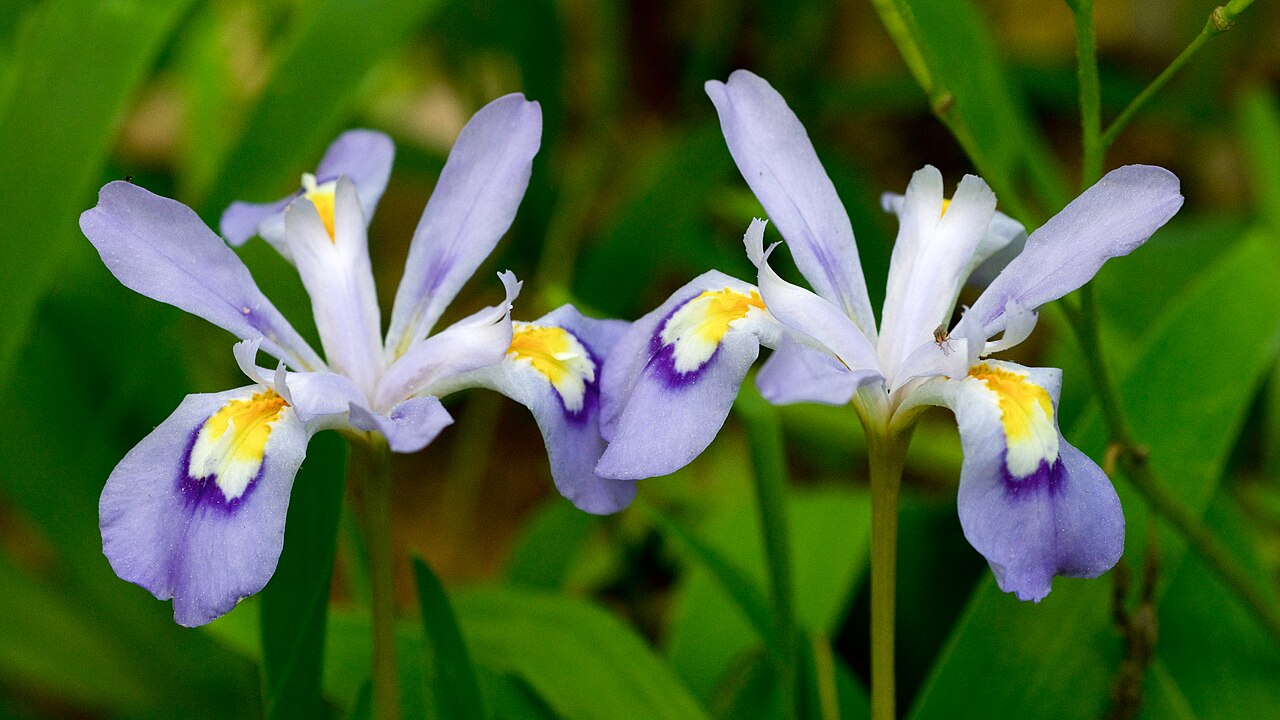
Flowers appear on very short stalks, often nearly at ground level, with one or two per spathe. Each is 1.5 to 2.5 inches across with the usual iris pattern: three broad, spreading falls, three narrower upright standards, and three petal-like style branches arching over the center. Color runs from pale lavender and lilac to clear blue and violet, with rare white and pink forms. The white signal patch on each fall is ringed with darker purple or blue and topped by three parallel yellow to orange crests. The flowers are lightly fragrant and each lasts only a few days, but a colony opens in waves over about three weeks. Bloom starts in mid to late March in the Gulf states, later at elevation.
Fruit & Seeds
Only a modest fraction of flowers set seed. The fruit is a small, three-angled, leathery capsule an inch or so long that ripens tan to brown six to eight weeks after bloom, often hidden among the lengthened leaves. It contains yellowish-brown seeds, each carrying a whitish spiral appendage. Seed is viable when fresh but stores poorly, and seedlings take two to three years to reach flowering size. This is why the species spreads mainly by rhizomes rather than by seed.
Quick Facts
| Scientific Name | Iris cristata Aiton |
| Family | Iridaceae (Iris) |
| Plant Type | Rhizomatous herbaceous perennial / groundcover |
| Mature Height | 5–10 in (13–25 cm) including bloom stalks and leaves |
| Mature Spread | 12–24 in per clump; colonies spread indefinitely by rhizomes |
| Growth Rate | Moderate; fast once established in leaf-mold soil |
| Sun Exposure | Full Sun to Part Sun (best with morning sun and afternoon shade in the Deep South) |
| Water Needs | Dry to Average; occasional watering in prolonged drought keeps foliage fresh |
| Soil Type | Well-drained, humusy or rocky loam; tolerates clay if drainage is sharp |
| Soil pH | 5.5–6.8 (acidic to slightly acidic) |
| Bloom Time | Late March – May |
| Flower Color | Pale lavender-blue to violet with white and yellow crest (rarely white) |
| Fall Color | None to slight yellowing of leaf tips |
| Fruit | Small tan three-angled capsule, often hidden by foliage |
| Deer Resistant | Mostly (rhizomes and leaves are toxic; occasional nibbling reported) |
| USDA Hardiness Zones | 3–9 |
Native Range
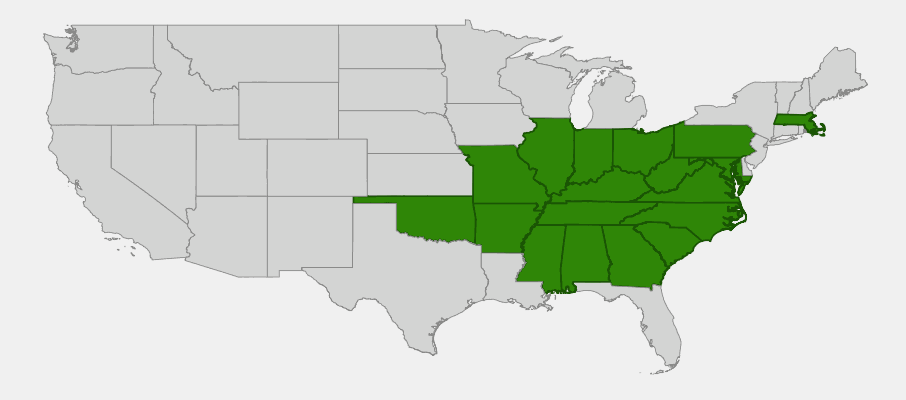
Crested Iris is native to the eastern and central United States, with a range centered on the Appalachian and interior highlands. It occurs from Pennsylvania and Maryland south through the Carolinas and Georgia to Alabama and Mississippi, and west through Kentucky, Tennessee, Missouri, and Arkansas to eastern Oklahoma, with northern outliers in Ohio, Indiana, and Illinois. Its range lies almost entirely south of the limit of the last glaciation, which helps explain why it holds so much genetic diversity compared with its threatened cousin, the Dwarf Lake Iris of the Great Lakes shorelines.
In Alabama, Georgia, and Mississippi the plant is a species of the upland forests. In Alabama it turns up on the Cumberland Plateau, in the Ridge and Valley, and in the Piedmont hills; in Georgia it is a plant of the Blue Ridge, Ridge and Valley, and Piedmont, thinning out southward toward the fall line; in Mississippi it is a scattered plant of the northern hill country. You typically find it on rich, rocky, wooded slopes, at the base of sandstone and limestone bluffs, and along sandy creek banks, often where thin soil over rock keeps larger competitors at bay.
Crested Iris is globally secure and widespread, but it is far from uniform on the ground. Colonies are patchy, tied to particular slopes and ledges, and vulnerable to development, trail clearing, and invasive groundcovers such as English ivy and Japanese honeysuckle. It is state-listed as rare along the northern edge of its range in places like Maryland and Pennsylvania. Buying nursery-propagated plants and moving them by division, instead of digging wild colonies, protects the populations that remain.
📋 Regional plant lists featuring Crested Iris: Alabama, Georgia & Mississippi · Maryland, Virginia & West Virginia · Iowa, Illinois & Missouri
Growing & Care Guide
Crested Iris is one of the easiest native woodland perennials to keep, provided you match its three basic needs: sharp drainage, acidic humus-rich soil, and protection from the hottest afternoon sun. Get those right and it will settle in and expand slowly for years without fertilizer, spraying, or staking.
Light
The species is happiest in filtered light or morning sun with afternoon shade. Regional planting lists rate it for full to part sun, and in cool, moist sites at higher elevation it will bloom well in sun. Farther south, in the Georgia Piedmont and north Alabama and Mississippi, plan on part shade: the dappled light under deciduous trees gives you spring sun before the canopy leafs out and cooling shade through the summer. Deep, all-day shade reduces flowering but the plants persist. Full afternoon sun on dry ground scorches leaf tips by midsummer and the colony thins.
Soil & Water
Give it well-drained, acidic to slightly acidic soil, about pH 5.5 to 6.8, with plenty of leaf mold. Rich, moist woodland loam is fine, but soils that are too fertile can push rank leafy growth at the expense of flowers, so do not overfeed. Sandy loam and rocky soil suit it well. In red clay, which much of Alabama and Georgia has, mix in coarse grit and shredded leaves, and plant on a slight slope or raised mound so water never stands around the rhizomes. Established plants tolerate dry spells and Southern heat, but they will look better with a deep soak every two weeks during rainless stretches. Chronic wetness is the fastest way to lose a planting to rhizome rot.
Planting Tips
The best planting window is early fall, September to November, so roots establish before the mild winter; early spring works too. Space divisions 8 to 12 inches apart for a mat in two or three seasons. Set the rhizome flat at the soil surface, covered by no more than an inch of soil or mulch, with the fan of leaves upright; deep planting suppresses flowering and invites rot. Water thoroughly at planting and keep moist for the first month. A light mulch of shredded leaves or pine straw helps hold moisture, but keep it from smothering the crowns.
Pruning & Maintenance
Very little is required. Trim brown or ragged leaf tips in late summer if they bother you, or leave them in place to feed the plant. Pull invading grasses and weed seedlings by hand while the colony is young. Because the shallow rhizomes push up out of the ground, a fresh dressing of leaf mold every fall replaces what erodes. Slugs and snails are the main pest, chewing leaves and flower buds in wet springs; a shallow dish of beer or hand picking after rain keeps them down. Iris borer and leaf spot are occasional but rarely serious, and fungal rot is essentially a drainage problem. Every three to four years, clumps that have become crowded and flower poorly should be divided.
Propagation
Division is by far the easiest and most reliable method. In early fall, when leaves begin to yellow, lift a clump with a garden fork, tease the rhizomes apart into hand-sized pieces with roots and at least one fan of leaves, and replant right away at the same depth. Keep divisions moist until established. Seed can be collected from brown capsules six to eight weeks after flowering and sown promptly in acidic, well-drained soil, since stored seed loses viability. Expect two to three years before seedlings bloom, and expect seedling colors to vary from pale blue to violet.
Landscape Uses
Crested Iris fits a surprising number of Southern garden situations:
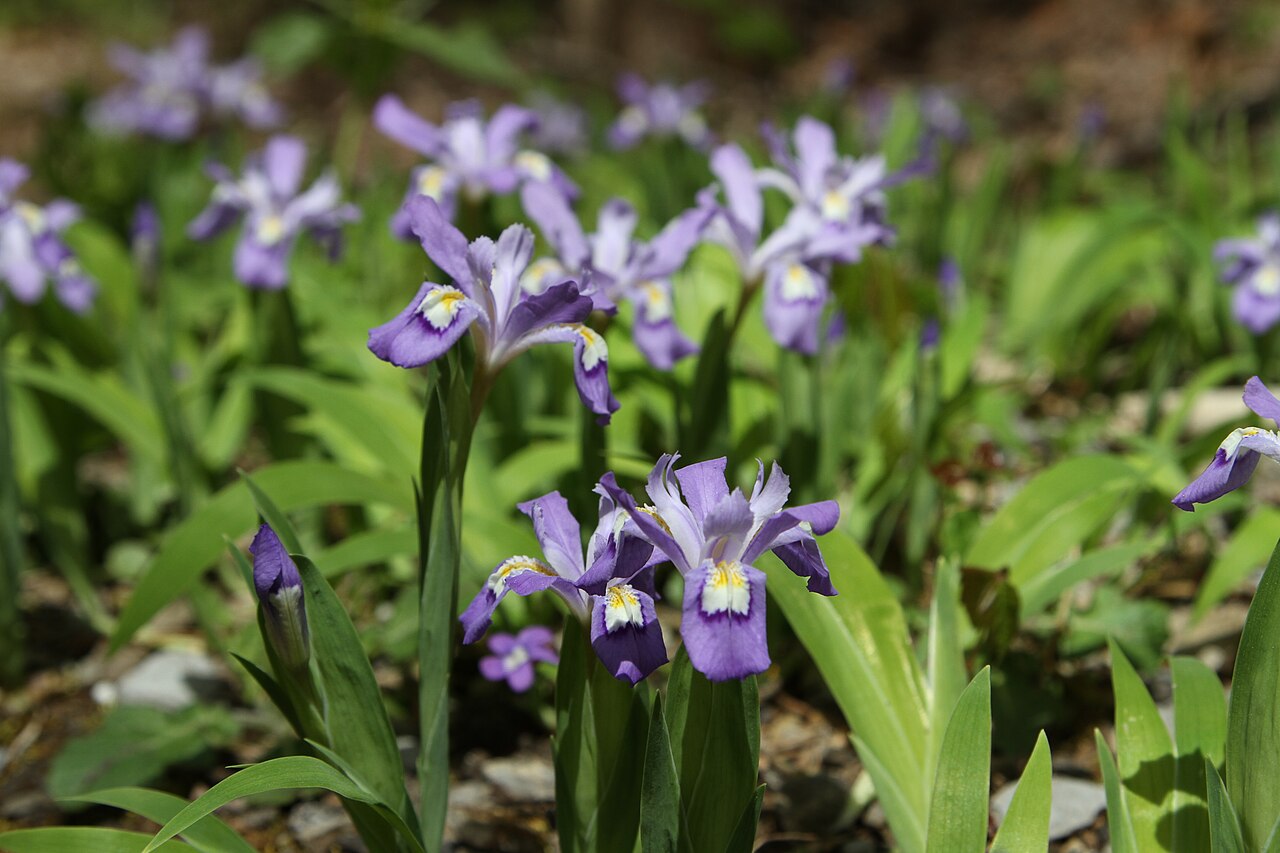
- Woodland groundcover under oaks, hickories, and dogwoods where turf will not grow
- Rock gardens and stone walls where its rhizomes weave through crevices
- Path and border edging for a tidy spring ribbon of blue
- Slope stabilization on shady banks where the rhizome mat holds thin soil
- Pollinator and hummingbird gardens as an early nectar source
- Companion planting with foamflower, wild ginger, trilliums, ferns, and Virginia bluebells
- Naturalized drifts for a low-maintenance woodland garden
For a taller iris for wetter ground, pair it with Virginia Blue Flag Iris or Larger Blue Flag Iris in the low spot of the same garden.
Wildlife & Ecological Value
Crested Iris is a small plant with an outsized role in the earliest weeks of the spring forest, when little else is blooming at ground level.
For Pollinators
The crest and the white signal patch on each fall serve as a landing guide and nectar guide, directing visiting bees down the flower’s narrow throat. Queen bumble bees, mason bees, and other early native bees are the likely visitors, and they are active in the cool weather when this iris flowers. Bloom overlaps with the emergence of bumble bee queens, whose colonies depend on early nectar and pollen in March and April. Only a fraction of flowers set seed, so pollination matters mostly for genetic mixing; the colony itself persists by rhizome.
For Birds
Ruby-throated Hummingbirds arrive in the Southeast in late March and April, and the plant is listed as a nectar source that attracts them. The dense mat of leaves also shelters small invertebrates that ground-foraging birds such as Ovenbirds, Wood Thrushes, Carolina Wrens, and towhees hunt in the leaf litter, so the plant contributes indirectly to the woodland food web.
For Mammals
Iris rhizomes and leaves contain irritating compounds and are toxic when eaten, which is why deer usually leave Crested Iris alone. Occasional nibbling on flowers and leaves has been reported, and plants generally recover. It offers cover rather than food for small mammals and amphibians that live in leaf litter.
Ecosystem Role
On rocky slopes and stream banks the rhizome mat holds thin soil against washout and slows runoff, and the low canopy of leaves keeps the soil surface cool and damp for salamanders, litter-dwelling insects, and fungi. As one of the few native groundcovers that tolerates dry shade, it fills a niche that invasive Japanese pachysandra, English ivy, and periwinkle often occupy in disturbed woodland. Replacing those with Crested Iris and its native companions rebuilds a habitat layer that supports native insects.
Cultural & Historical Uses
Crested Iris entered the gardening record early. The Quaker botanist John Bartram of Philadelphia sent plants to his English correspondent Peter Collinson in the 1750s, and the species has been grown in European gardens since about 1766. William Aiton formally described it in his Hortus Kewensis in 1789, and it was illustrated in Curtis’s Botanical Magazine in 1798. Old gardening references also list it under the name Lady’s Calamus.
Southern Appalachian peoples used it medicinally. Records of Cherokee use describe a decoction of the pulverized root applied as a salve to ulcers and sores, and an infusion of the root taken for liver complaints. In the nineteenth century, Virginia hunters reportedly chewed the root to relieve thirst, noting that it tastes sweetish at first and then becomes pungently acrid. Like most irises, the plant is toxic if eaten, and handling the rhizome can irritate skin, so none of these uses should be tried today.
In gardens the species became a staple of the cottage and woodland garden and a favorite of rock-garden growers. Today it is sold in many native plant nurseries, and named cultivars widen the palette: white forms such as ‘Alba’ and ‘Tennessee White’, deep blues such as ‘Caerulea’ and ‘Summer Sky’, and vigorous selections like ‘Powder Blue Giant’ and ‘Shenandoah Sky’. Straight species plants from a regional native nursery are the better choice when the goal is a habitat garden, since they retain the natural variation that pollinators are adapted to.
Frequently Asked Questions
When does Crested Iris bloom in Alabama, Georgia, and Mississippi?
Expect flowers from late March through April in the southern part of its range, and into early May at higher elevations in north Georgia and the Cumberland Plateau. Each flower lasts a few days, but a colony blooms for about three weeks, and cool weather extends the show.
Does Crested Iris need full shade?
No. It grows best in part shade, with morning sun and afternoon shade, and blooms most heavily with a few hours of direct light in spring. In the Deep South, afternoon shade is important in summer to prevent scorched leaf tips. Deep, all-day shade reduces flowering, though plants persist.
How do I keep it from rotting?
Drainage is the answer. Plant on a slight slope or raised bed, use gritty, humus-rich soil, and set the rhizome at the surface with no more than an inch of cover. Avoid heavy mulch over the crowns and do not water on a fixed schedule in wet weather.
How fast does it spread, and can it become invasive?
It spreads by shallow rhizomes at a moderate pace, typically doubling the width of a clump in two to three years. It is a well-behaved native colonizer that will not take over a border, and unwanted pieces are simple to lift and give away. Dividing every three to four years keeps colonies vigorous.
Is Crested Iris poisonous to pets or deer?
The rhizomes and leaves contain compounds that cause stomach upset and can irritate skin, so plant it where dogs are unlikely to dig or chew. The same toxicity makes it largely deer-resistant, though occasional nibbling has been reported.

Looking for a nursery that carries Crested Iris?
Browse our native plant nursery directory: Alabama · Georgia · Mississippi