
Allegheny Spurge (Pachysandra procumbens)
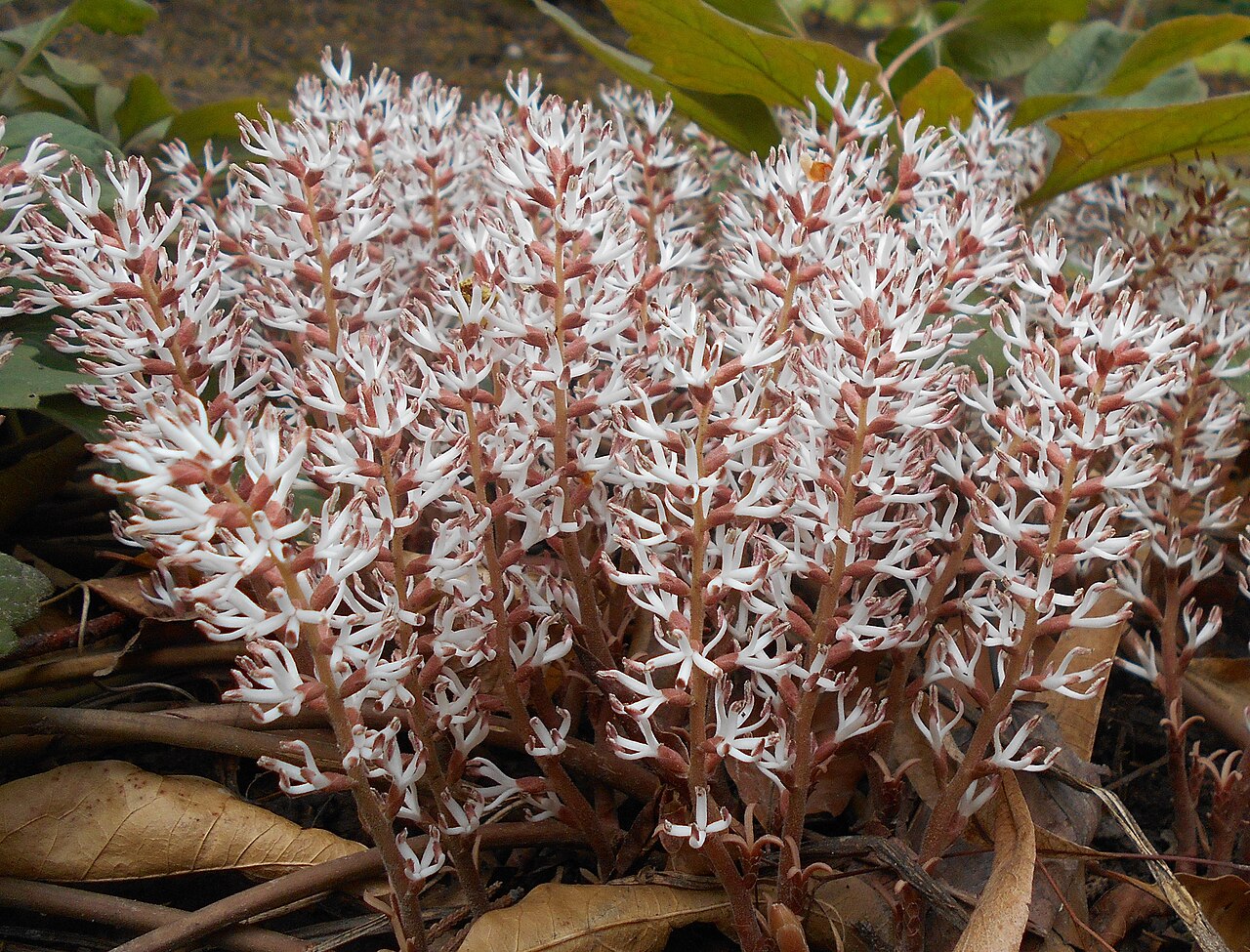
Pachysandra procumbens, commonly known as Allegheny Spurge, Mountain Spurge, or Allegheny Pachysandra, is a low, slow-spreading woodland groundcover of the southeastern United States and one of the few native plants that can stand in for the overused Japanese pachysandra. It belongs to the Buxaceae, the boxwood family, and it is a true native of the rich, limestone-influenced woods that run from the Cumberland Plateau and Tennessee Valley of northern Alabama down to the loess bluffs and hills of Mississippi.
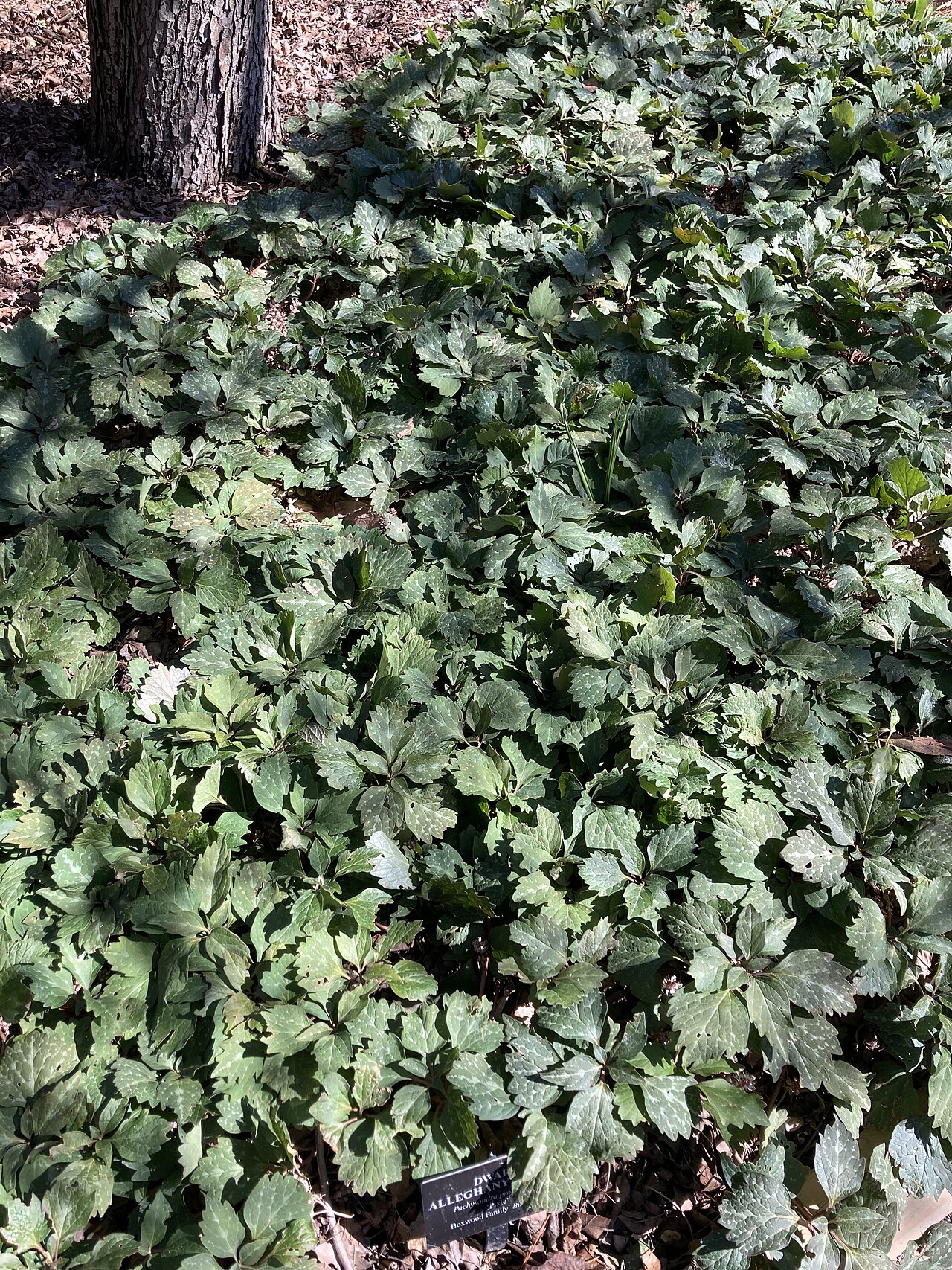
The plant is easy to identify once you see it in March. Before the new leaves have unfolded, stout spikes of fragrant white flowers, tinged pink to rusty red by their bracts, push up from the base of last year’s stems. The leaves that follow are broad, matte blue-green, coarsely toothed near the tip, and marbled with silver, purple, and olive, a pattern that intensifies in cool weather. Plants stay a foot tall or less and knit together through underground rhizomes, forming a tidy, patterned carpet under trees and shrubs.
For gardeners in Alabama, Georgia, and Mississippi, Allegheny Spurge answers a very specific problem: dry-ish to average shade under hardwoods where lawn will not grow, where mulch keeps washing off a slope, and where you want something better than English ivy or Asian pachysandra. It is not a fast fix. Expect it to fill in over several seasons, but once established it is long-lived, deer resistant, and undemanding, and it belongs to the native spring wildflower community rather than displacing it.
Identification
Allegheny Spurge is a semi-evergreen perennial subshrub, 6 to 12 inches tall in leaf and typically a little taller when the flower spikes are up. Each shoot is a short, fleshy, upright stem topped with a cluster of leaves; the stem bases are woody-ish and creep just below the soil surface on slender rhizomes. Together the shoots make a mat that is denser and softer in outline than the glossy, whorled look of the Japanese species.
Stems & Growth Habit
The upright stems are short, thick, and slightly fleshy, green to reddish, and they arise from slender rhizomes creeping just below the soil surface. New shoots appear each spring, and last year’s leafy stems slowly fade as the new growth matures. That is why a colony looks slightly ragged by late winter and freshly renewed by May.
Leaves
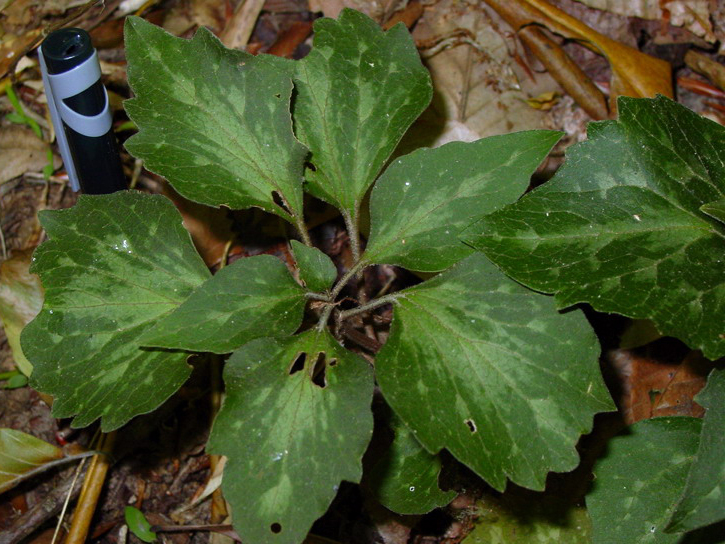
Leaves are simple, ovate to nearly round, usually 2 to 4 inches long (occasionally a bit more), and carried mostly toward the top of each stem so they look whorled or tiered. The margin is coarsely toothed toward the apex and smooth toward the base, a feature that helps separate it from other pachysandras. New foliage is bright green; mature leaves become a dull blue-green and pick up silver, purplish, and olive mottling as the seasons cool. In Zones 5 and 6 leaves are deciduous, while in the warm Deep South they are typically semi-evergreen to evergreen, though they can look tattered by midwinter and are replaced by fresh growth in spring.
Flowers
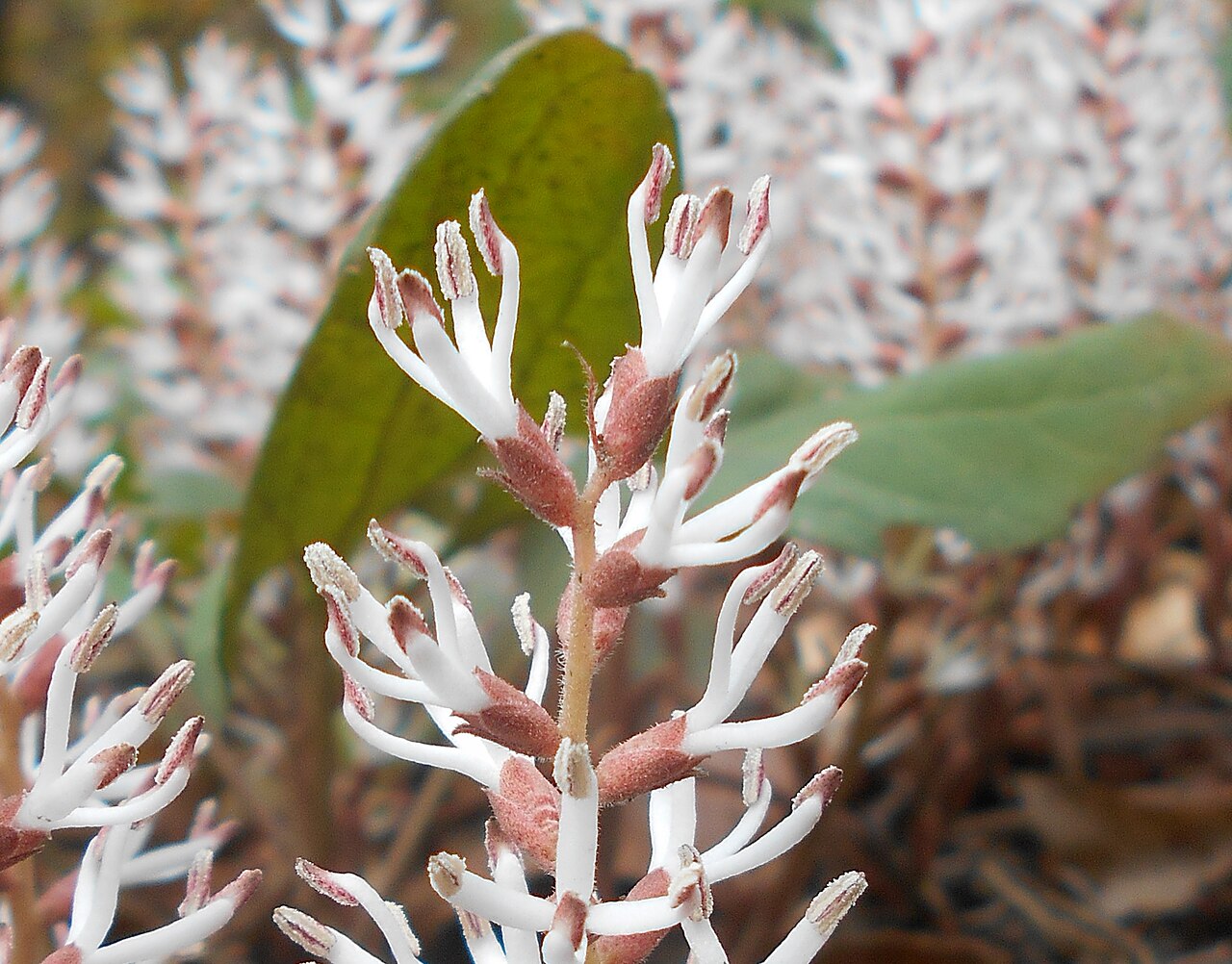
The flowers are unusual. Pachysandra flowers have no petals; the showy white parts are the thick filaments of the stamens, backed by pink or reddish bracts. Each spike, 2 to 4 inches long, is monoecious: many male flowers cover the upper part of the spike, while a few female flowers sit near the base. The spikes emerge at the base of the stems in early spring, before or just as the new leaves open, and they are noticeably fragrant on a warm afternoon. The species name procumbens means trailing, in reference to the spreading habit.
In our region bloom begins in March in southern Alabama and Mississippi and runs into April in the hills; specimens in the Alabama herbarium record are dominated by March and April collections.
Fruit & Seeds
Fruit is a small, three-parted capsule tipped with the persistent styles of the female flowers. Seed production is modest, and Allegheny Spurge spreads primarily by rhizomes rather than by seed, which is why it forms slowly expanding colonies rather than escaping into surrounding woods.
Allegheny Spurge vs. Japanese Pachysandra
The plant most people know as “pachysandra” is Pachysandra terminalis, native to Japan and widely planted for over a century as a shady groundcover. It has escaped cultivation and is treated as invasive in a number of eastern states, where it blankets the forest floor and shuts out native wildflowers. The two species look similar from the road but are easy to separate up close:
- Leaf finish and color: Allegheny Spurge has matte, blue-green leaves with silver-purple mottling; Japanese pachysandra has uniformly glossy, dark green, leathery leaves.
- Toothing: Allegheny Spurge leaves are coarsely toothed at the tip and entire at the base; Japanese pachysandra leaves are finely toothed across the outer half.
- Flower position: the flower spikes of Allegheny Spurge come from the base of the stems and are longer (2 to 4 in), pinkish white, and fragrant; Japanese pachysandra spikes are borne at the stem tips (hence terminalis), shorter, and white.
- Leaf retention: Allegheny Spurge is semi-evergreen and refreshes each spring; Japanese pachysandra is fully evergreen.
- Behavior: Allegheny Spurge spreads slowly and stays where you put it; Japanese pachysandra spreads aggressively and is a documented invasive.
Quick Facts
| Scientific Name | Pachysandra procumbens Michx. |
| Family | Buxaceae (Boxwood) |
| Plant Type | Semi-evergreen rhizomatous groundcover (herbaceous subshrub) |
| Mature Height | 9–12 in (23–30 cm) at flowering; foliage often lower |
| Mature Spread | Slowly forms colonies 2–4 ft (0.6–1.2 m) wide or more |
| Growth Rate | Slow |
| Sun Exposure | Part Sun to Shade |
| Water Needs | Average; evenly moist, well-drained soil |
| Soil Type | Humus-rich loam; native on calcareous (limestone) and loess soils |
| Soil pH | 5.5–7.5 (slightly acidic to mildly alkaline); wild plants favor near-neutral |
| Bloom Time | March – April (into May in cooler sites) |
| Flower Color | White, tinged pink to reddish; fragrant |
| Fall Color | None; leaves marble with silver and purple in cool weather |
| Fruit | Small capsule tipped with persistent styles |
| Deer Resistant | Yes (generally left alone; foliage is toxic if eaten) |
| USDA Hardiness Zones | 5–9 (best in 6–8) |
Native Range
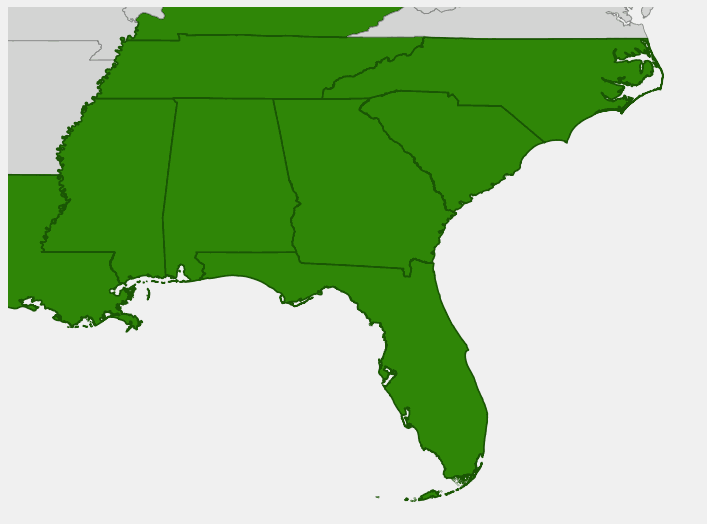
Allegheny Spurge is native to the southeastern United States. USDA PLANTS treats it as native in the lower 48 states; the Lady Bird Johnson Wildflower Center gives its native distribution as eastern Kentucky to western North Carolina, south to Louisiana and Florida. The core states are Kentucky, Tennessee, North Carolina, South Carolina, Georgia, Alabama, Mississippi, Louisiana, and the Florida Panhandle. Some references extend the range north to West Virginia, and Lady Bird Johnson Wildflower Center state lists also show scattered records in Indiana and Pennsylvania at the far edge of its distribution; those are best treated as peripheral or outlying records.
In Alabama, the Alabama Plant Atlas documents it across the northern half of the state and into the Black Belt. Herbarium specimens come from the limestone Tennessee Valley counties of Lawrence, Limestone, Lauderdale, Colbert, Franklin, and Morgan; the Ridge and Valley and Piedmont counties of Etowah, Calhoun, Cleburne, DeKalb, and Marshall; the Cumberland Plateau and Warrior basin counties of Winston, Marion, Lamar, and Bibb; and the calcareous Black Belt prairie counties of Lowndes, Marengo, Wilcox, and Bullock.
Mississippi is well documented too, with more than 100 herbarium specimens on GBIF. Collections cluster in the northeast (Tishomingo County, on the Highland Rim and Tombigbee Hills), the east-central counties of Lauderdale, Winston, Noxubee, and Newton, the loess hills of Panola, Tallahatchie, Grenada, and Yazoo, and the southwestern bluffs of Adams, Claiborne, Wilkinson, and Amite. Georgia has the fewest records of the three states, mostly from the Ridge and Valley (Bartow and Chattooga counties) and west-central Piedmont (Harris and Taylor counties), and most were collected decades ago. In Georgia it should be regarded as uncommon rather than widespread, and the Lady Bird Johnson Wildflower Center describes the plant as rare in its wild habitat, so buy nursery-propagated stock.
📋 Regional plant lists featuring Allegheny Spurge: Alabama, Georgia & Mississippi
Growing & Care Guide
Allegheny Spurge is one of the easiest native woodland groundcovers to keep alive once you accept its pace. It asks for shade, decent soil, and patience. In north Alabama, north Mississippi, and the Georgia foothills it thrives; in the hot, humid Coastal Plain it does best on north-facing slopes, in ravine bottoms, and under dense hardwood canopy, and it appreciates the shelter that keeps cold winter wind off the foliage.
Light
Plant it in part shade to full shade. Morning sun with afternoon shade is ideal, and the mottled leaf color is best in filtered light. Full sun scorches the foliage, bleaches the pattern, and leaves the plants thin and stressed, especially in Deep South summers. Dry shade under mature oaks and maples is workable once roots are established, but the densest, best-looking colonies form where the light is dappled and the soil holds moisture.
Soil & Water
The plant wants humus-rich, evenly moist but well-drained soil. In the wild it favors limestone-derived and other calcareous soils, and the Lady Bird Johnson Wildflower Center notes near-neutral pH in native stands, but it adapts to a fairly wide range of soil types from slightly acidic to mildly alkaline as long as drainage is good. In the acid, red clay of much of the Piedmont, mix leaf mold and compost into the top 6 inches and consider a light dusting of dolomitic lime if a soil test shows a very low pH. Heavy clay that stays soggy in winter is a poor choice; a berm or raised bed solves it.
Water new plantings weekly through their first summer. Established colonies tolerate short dry spells in shade, and the plant is often described as drought tolerant under tree cover, but deep watering during extended summer drought keeps foliage from crisping.
Planting Tips
Plant in fall or early spring, when soil is workable and rain is regular. Set plugs or one-gallon plants 10 to 12 inches apart for a colony that closes in three to four years; wider spacing works if you are patient, and closer spacing fills faster but costs more. Keep the crown at soil level, spread the roots, and mulch with 1 to 2 inches of shredded leaves rather than bark chips, which can smother the low crowns. Do not bury the crowns or the spikes at the base will rot.
Because it is slow, weed control matters in the first two years. Pull competing weeds by hand and top up leaf mulch in fall. Do not plant it where it will be walked on regularly; it is a viewing groundcover, not a lawn substitute.
Pruning & Maintenance
Almost none. By late winter, older leaves may look worn. Many gardeners trim tattered foliage back in February, before the flower spikes emerge at the base of the plant, so new growth and blooms show cleanly. Take care not to cut the spikes. Rake fallen tree leaves lightly off the mat in spring, but leave a thin layer of leaf litter between the crowns because that mimics the woodland floor. Colonies rarely need division; if you want to spread a colony, do so on your own terms (see below).
Pests and disease are minor. Deer typically pass it by, and the foliage is toxic to animals if eaten. In humid Deep South summers, very dense, poorly ventilated stands can develop leaf spotting; thinning the colony and avoiding overhead watering are enough.
Propagation
Divide established clumps in August or September, when the soil is warm and rain is returning, as recommended by the Lady Bird Johnson Wildflower Center. Lift a section of rhizome with at least a few stems and roots attached, replant at the same depth, and water until established. Softwood cuttings taken in spring or early summer also root. Seed is not a practical route for home gardeners.
Landscape Uses
Allegheny Spurge suits a range of shaded landscape roles:
- Groundcover under hardwoods where turf fails and mulch washes
- Woodland gardens paired with Christmas Fern, Wild Geranium, and Doll’s Eyes
- Foundation planting on shaded north and east sides of the house, in place of English ivy or Japanese pachysandra
- Underplanting around Oakleaf Hydrangea and other native shrubs
- Slope stabilization in shaded, moist locations, where rhizomes bind topsoil
- Early-season fragrance along a shady path, where the March flower spikes can be enjoyed at close range
Wildlife & Ecological Value
Allegheny Spurge is a quiet ecological player. It is not a heavy wildlife food plant, but it does the useful groundwork of a native woodland herb layer: holding soil, shading the forest floor, and providing cover close to the ground. Its value is greatest when it is planted with other natives rather than in a monoculture.
For Pollinators
The flowers open in March and April, at a time when few plants are in bloom on the forest floor, and they are fragrant. Pollination biology in Pachysandra procumbens is not well studied, and there is no reliable published list of visitors. What is clear is that the early, scented bloom gives small bees and flies a source of pollen and nectar in cool weather, and the male flowers produce abundant pollen. Planting it near other spring ephemerals such as bloodroot or trillium extends the early-season food supply for emerging solitary bees.
For Birds
Birds do not feed on the capsules, but the dense mat and its leaf litter support the insects and other invertebrates that ground-foraging woodland birds eat. A groundcover of native plants under hardwoods supports the invertebrate community that woodland birds rely on for spring nesting.
For Mammals
The foliage is toxic if eaten and the plants are widely regarded as deer resistant, so browsing is minimal. That makes Allegheny Spurge a reliable choice for shade gardens in areas with heavy deer pressure, where hostas and many wildflowers are eaten to the ground.
Ecosystem Role
In rich mesic woods, Allegheny Spurge forms patches that stabilize soil on ravine slopes and bluff sides, and the leaf mat shelters ground beetles, other soil invertebrates, and small amphibians. Because it is a slow, rhizomatous species that does not smother its neighbors, it keeps space open for trilliums, ferns, and other spring wildflowers, which is the opposite of what Japanese pachysandra does. Choosing the native species in Alabama, Georgia, and Mississippi keeps that woodland community intact and avoids introducing an invasive to the fringe of natural areas.
Cultural & Historical Uses
The French botanist André Michaux is credited as the author of Pachysandra procumbens (the “Michx.” that follows the name), and the plant has been known to gardeners for well over a century. The genus name comes from the Greek words for thick and male, referring to the stout stamens of the flowers. The species was pictured in nineteenth-century American wildflower books, and it has long been a favorite of native plant gardeners under the names Allegheny spurge, mountain spurge, and Allegheny or mountain pachysandra.
There is little documented traditional use. A search of the Native American Ethnobotany database (BRIT) returns no recorded uses for this species, and the Lady Bird Johnson Wildflower Center warns that the plant can be toxic to animals if eaten, so it should not be treated as a food or home remedy.
Its main historical footnote is a garden one. Japanese pachysandra became the default shady American groundcover, while the native species stayed a specialty plant that most nurseries did not stock. Today, interest in native groundcovers and concern over invasive pachysandra have put Allegheny Spurge back in nurseries, particularly regional native plant nurseries across the Southeast.
Frequently Asked Questions
Is Allegheny Spurge native to Alabama, Georgia, and Mississippi?
Yes. USDA lists it as native in the lower 48 states, and it is documented in all three states. It is well established in Alabama, from the Tennessee Valley to the Black Belt, and in Mississippi from Tishomingo County to the loess bluffs of the southwest. It is less common and more sparsely recorded in Georgia, mainly in the northwest and west-central parts of the state.
How is it different from Japanese pachysandra?
Allegheny Spurge has matte, blue-green, coarsely toothed leaves mottled with silver and purple, and fragrant flower spikes at the base of the stems in early spring. Japanese pachysandra (P. terminalis) has glossy dark green leaves, flower spikes at the tips of the stems, and spreads aggressively enough to be invasive in several eastern states.
Is it evergreen?
In our region it is semi-evergreen to evergreen. Leaves usually last through winter in Zones 7 to 9 but can look worn by February, and fresh growth in spring replaces the old foliage. In colder zones, leaves drop in winter.
Can it grow in full sun or dry shade?
Not in full sun; the leaves scorch and the pattern fades. In dry shade under established trees it will grow, but slowly. Amend the soil with leaf mold and water during droughts for the best results.
How fast does it spread?
Slowly. Expect a newly planted colony to knit together in three to four years at 10 to 12 inch spacing, and to keep widening gradually after that. It will not run into the woods like Japanese pachysandra or English ivy.

Looking for a nursery that carries Allegheny Spurge?
Browse our native plant nursery directory: Alabama · Georgia · Mississippi