
Bloodroot (Sanguinaria canadensis)
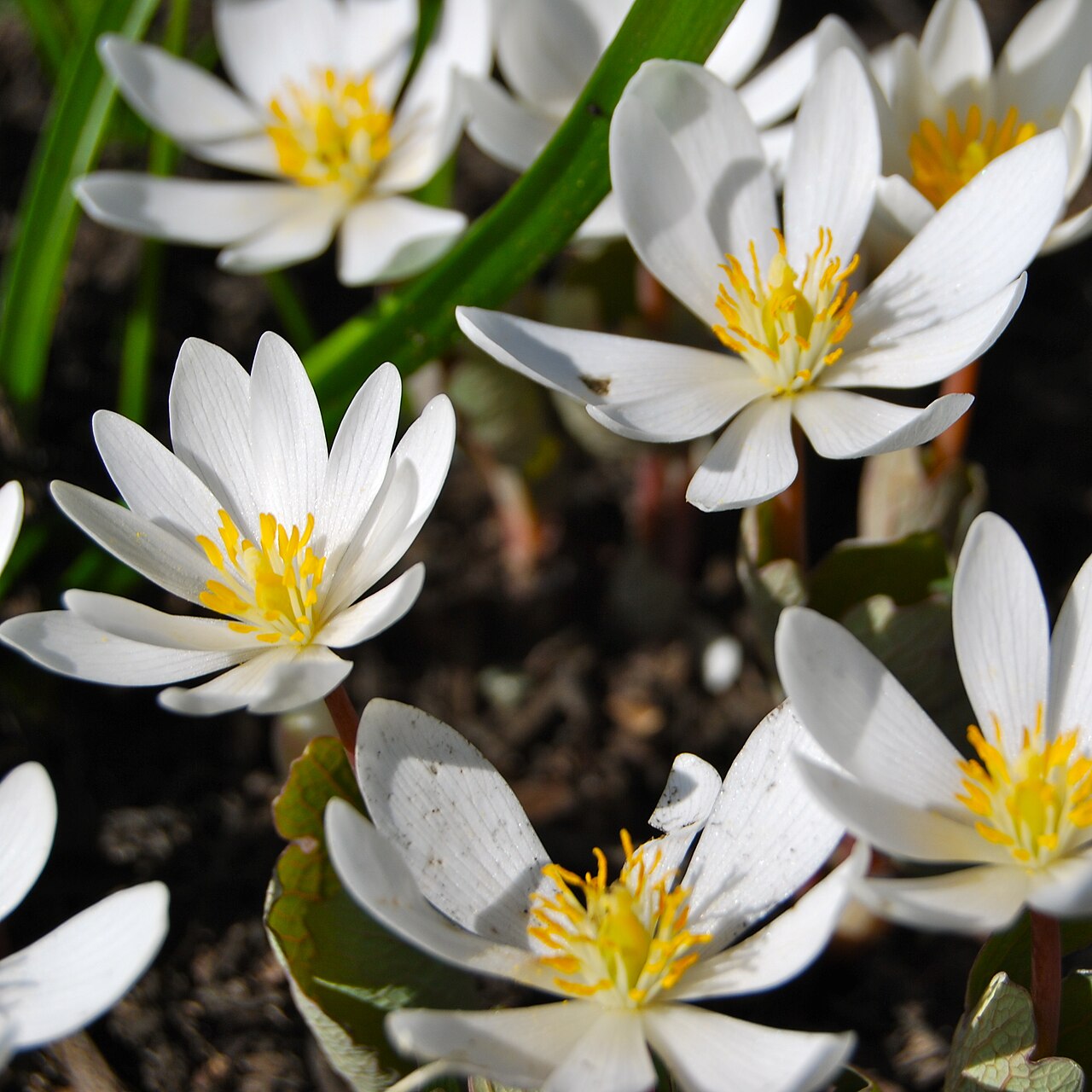
Bloodroot (Sanguinaria canadensis) announces spring with white flowers that open close to the woodland floor, often before the surrounding tree canopy has filled in. A folded leaf accompanies the emerging flower stalk, then expands into a broad, rounded, lobed blade. The flower show is brief, but the foliage gives the plant a recognizable presence after the petals fall.
In a native shade garden, bloodroot is best used as part of a seasonal sequence rather than expected to remain a showpiece all summer. Its rhizomes gradually form a colony in suitable woodland soil. The regional lists give six to twelve inches as a practical garden height, with part shade to shade and average moisture. Taller or broader leaves can develop in rich conditions, so leave room around the patch rather than planting a rigid six-inch grid.
The name refers to the colored sap in the underground rhizome. That feature is not an invitation to harvest or experiment with it: bloodroot contains toxic alkaloids and is not a home-remedy plant. Grow it for its native spring display, obtain propagated stock, and keep the roots intact. This page is a species profile for gardeners, not an endorsement of medicinal preparations.
Identification
Rhizomes & Emerging Shoots
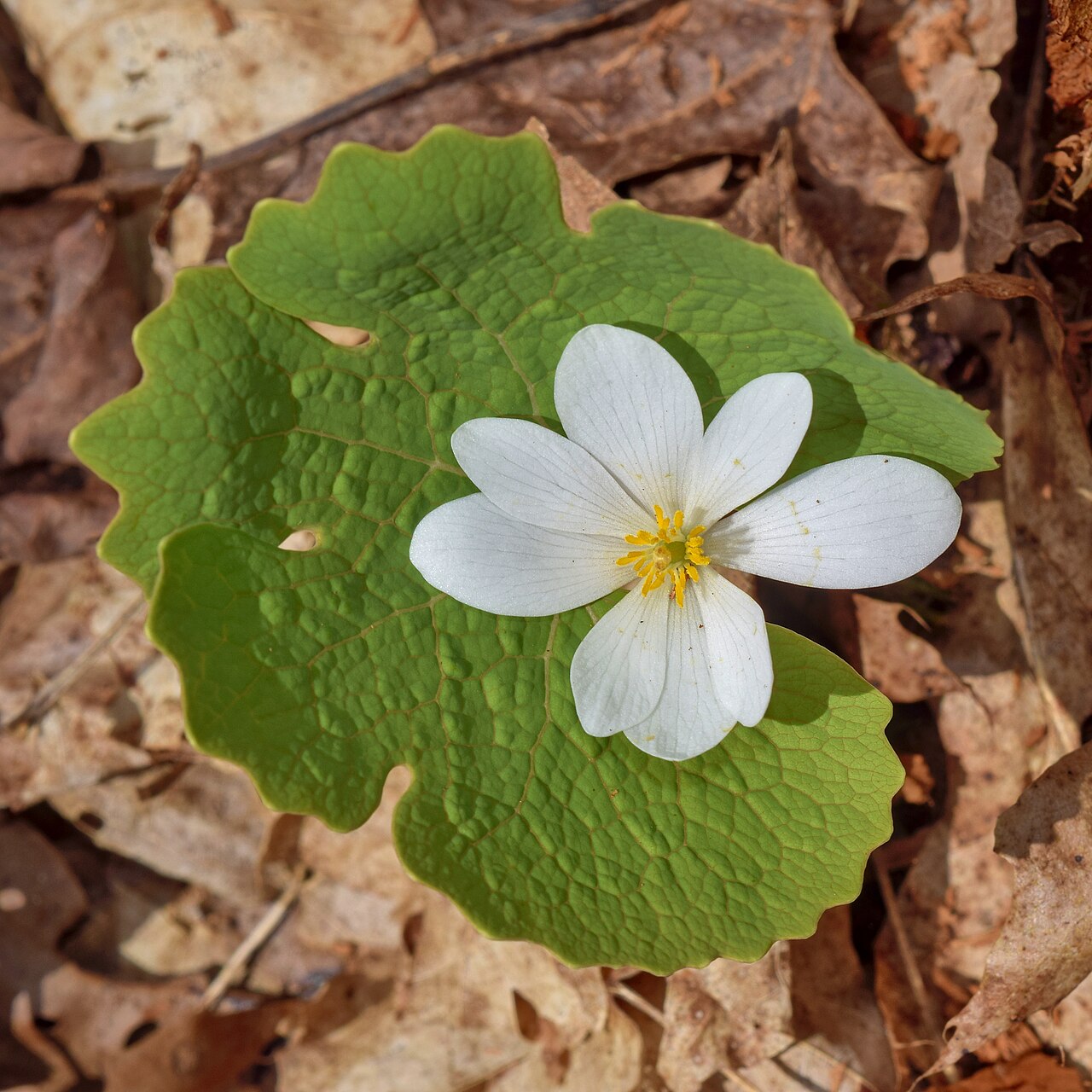
The perennial plant grows from a branching rhizome beneath the soil surface. In early spring, a leaf can appear wrapped around or alongside the flower stalk as it rises through litter. The underground sap is reddish, but there is no need to cut or dig a plant to identify it. A marked, undisturbed colony is easier to manage than one repeatedly probed for roots. The plant has no woody trunk, and the aboveground growth eventually dies back.
Leaves
The leaf is rounded in outline and divided into several broad lobes with scalloped edges. It expands after the flower opens and can become much wider than the early folded leaf suggests. This changing size is one reason to view the plant through more than one season before drawing conclusions from a photograph. The foliage is unlike the paired leaves of many woodland groundcovers and is not a compound leaf with separate leaflets.
Flowers
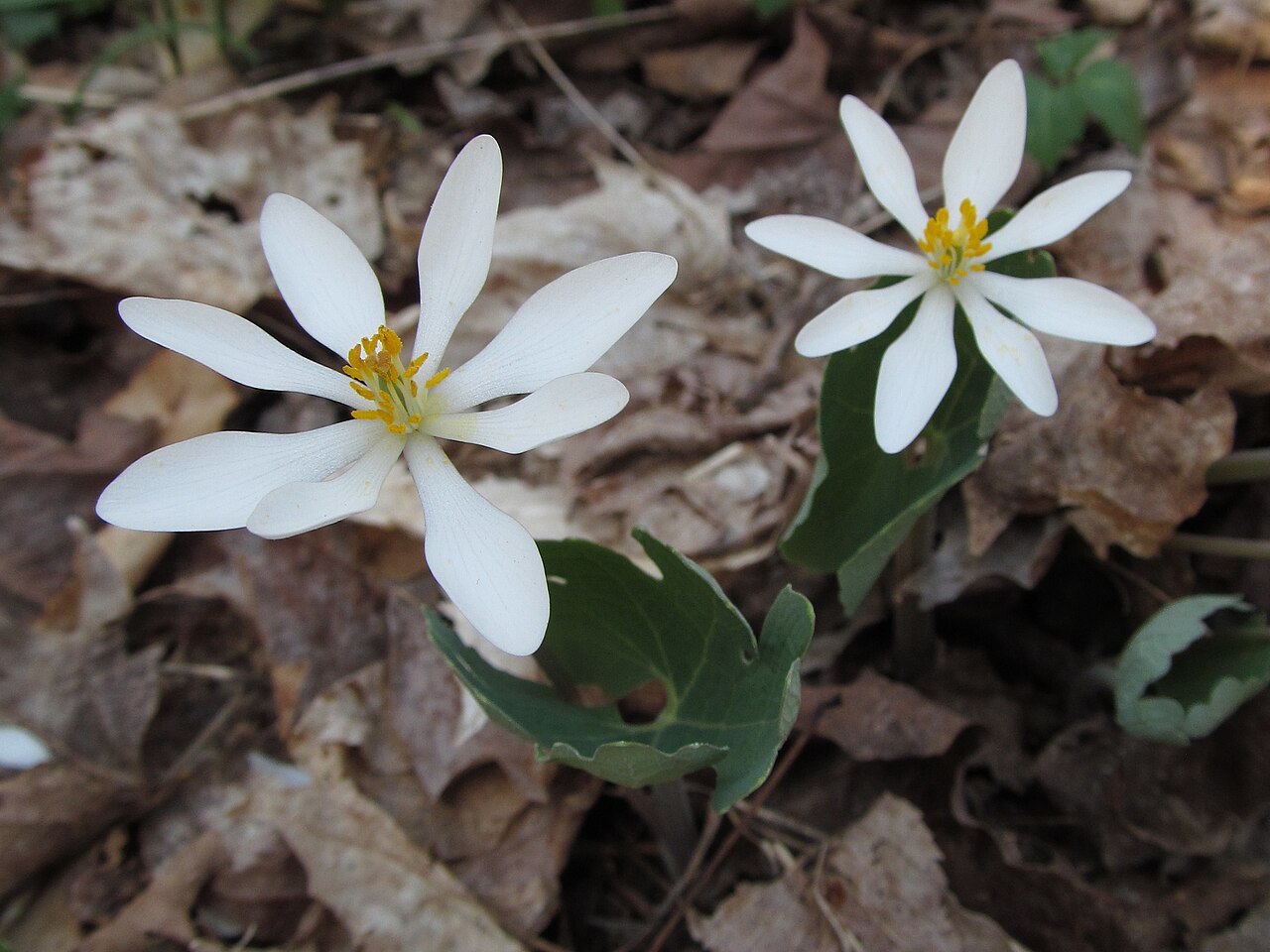
The solitary white flower has a yellow center of stamens. Petal number varies, commonly around eight to twelve, and the petals can fall relatively quickly in poor weather. Bloom is very early in the growing season, with the local calendar shifting substantially between the South and northern New England. Double-flowered garden selections exist, but their extra petals and reduced or absent seed production make them different choices from the ordinary single-flowered species for ecological planting.
Fruit & Seeds
A green elongated capsule follows successful flowering. When ripe, it releases seeds with a fleshy appendage that attracts ants, which help disperse them. Do not confuse a developing capsule with an unopened flower bud and remove it during cleanup. If natural recruitment is desired, leave at least part of the colony undisturbed through seed maturity. Seed production is not guaranteed from a sterile double-flowered cultivar.
Quick Facts
| Scientific Name | Sanguinaria canadensis L. |
| Family | Papaveraceae (poppy family) |
| Plant Type | Native rhizomatous spring woodland perennial |
| Mature Height | Usually about 6–12 inches in garden use; mature foliage can be taller |
| Mature Spread | Clumps broaden gradually through branching rhizomes |
| Growth Rate | Moderate in suitable woodland conditions |
| Sun Exposure | Part shade to shade; spring light beneath deciduous trees |
| Water Needs | Average to moist, well-drained soil; avoid prolonged saturation |
| Soil Type | Rich woodland soil with leaf-derived organic matter |
| Soil pH | Slightly acidic to near-neutral woodland conditions |
| Bloom Time | Early spring, varying with region and weather |
| Flower Color | White with yellow stamens |
| Fall Color | Foliage often becomes dormant before autumn |
| Fruit | Elongated capsule with ant-dispersed seeds |
| Deer Resistant | Do not rely on complete resistance; toxicity is not a garden-management guarantee |
| USDA Hardiness Zones | Broadly cold-hardy; commonly grown in zones 3–8 |
Native Range
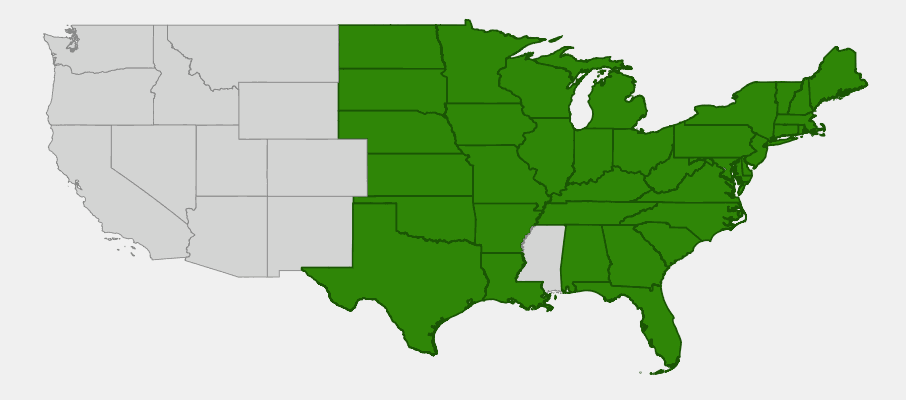
Bloodroot is native to eastern and central North America, including New England, the Great Lakes region, and much of the eastern United States. Flora of North America treats the geographically variable plants as a single species rather than recognizing every difference in leaf or petal form as a separate taxon. That is useful for gardeners comparing photographs from different parts of its range.
The species occurs in woods and thickets, often on slopes, near streams, or in floodplain settings with suitable drainage. Its presence near water should not be interpreted as a requirement for a waterlogged planting hole. The woodland canopy offers spring light followed by summer protection, while the litter layer helps buffer the soil surface. A garden that recreates those conditions is a better match than an exposed bed chosen only because it is inside a hardiness zone.
The state map follows the documented distribution in Flora of North America. That treatment notes reports from Mississippi without confirmed specimens, so Mississippi is not shaded here as a verified state record from that source. A map cannot resolve every local boundary or subsequent record; consult current local floras for restoration work. The USDA link provides an additional distribution reference, and local nursery provenance remains important.
📋 Regional plant list: New England
Growing & Care Guide
Light
A deciduous woodland setting offers the most useful pattern: brighter light before leaf-out and shade as the weather warms. Avoid assuming that a plant flowering in spring sunshine wants full summer sun. In a garden without overhead trees, use a sheltered position that does not bake after the flowers are gone. The aim is to support the leaves and rhizome through their active season, not merely to produce one attractive week of bloom.
Soil & Water
Choose humus-rich soil that retains moderate moisture but drains. Incorporate the planting into an existing woodland-style bed rather than filling a deep hole in compacted clay with a radically different mix. Keep a loose litter layer and water new plants during dry periods. Do not treat summer dormancy as an automatic signal to flood the bed: first check whether the foliage has completed its normal season and whether the soil is actually dry. Persistent saturation is not a substitute for the buffered moisture of forest soil.
Planting Tips
Use nursery-propagated plants or responsibly produced rhizomes, and follow the supplier’s handling instructions so material does not dry out before planting. Set potted plants at their original depth and keep labels in place after foliage disappears. Space plants with their later leaf size in mind, not just the width of a newly emerging shoot. A small colony can be placed near a path where the short-lived flowers will be noticed during routine visits. Avoid frequent relocation once the patch is established.
Pruning & Maintenance
Leave green foliage until it naturally declines. Cutting it immediately after bloom removes the plant’s opportunity to replenish the rhizome. Retain some seed capsules if natural recruitment is wanted, and weed carefully around the shallow perennial structures. After dormancy, the bed may appear empty, so a discreet marker prevents accidental digging or overplanting. Wear gloves when handling divided rhizomes and avoid contact with sap; clean tools afterward. Routine maintenance should not require cutting into the roots.
Propagation
Cultivated rhizome division and seed propagation are possible, but each should follow a species-specific method. Fresh seed has particular handling and dormancy needs; a nursery protocol is more dependable than treating it like a packet of annual flowers. If dividing an established garden colony, work at an appropriate dormant period, retain healthy buds, and replant promptly. Do not dig wild plants to increase a garden display. For habitat-oriented plantings, ordinary single-flowered material that can reproduce is a more functional choice than a sterile double-flowered selection.
Planning for Dormancy
Combine bloodroot with compatible plants that provide later interest without overwhelming the spring colony. Keep the planting plan and labels so a dormant patch is not mistaken for a gap that needs digging. A plant’s disappearance in summer does not necessarily mean it died, especially after a normal spring cycle. Compare emergence the following spring and assess site moisture and rhizome health only when there is a real reason, rather than disturbing the bed out of impatience.
Landscape Uses
- An early-spring colony beneath deciduous trees in a native woodland garden.
- A close-view planting beside a path so the brief flowering period is not missed.
- A seasonal companion to restrained later-emerging woodland perennials.
- An educational planting showing folded emerging leaves, open flowers, and seed capsules.
- A nursery-propagated alternative to collecting spring wildflowers from natural areas.
Wildlife & Ecological Value
For Pollinators
The single flowers expose yellow stamens and provide pollen to visiting insects early in the season. Preserve access by avoiding sprays during bloom and include other native flowers before and after this short display. Double-flowered selections change the floral structure and may not serve the same ecological role. Choose the ordinary species when seed production and insect relationships are important goals.
For Birds
Bloodroot is not a berry-producing shrub and should not be promoted as one. Its value lies within a diverse woodland community, where spring herbs, shrubs, trees, litter, and insects contribute different functions. Add complementary native fruiting plants elsewhere if bird food is a primary design objective. Clear expectations are better than assigning every native plant the same generic wildlife benefits.
For Ants & Other Small Animals
Ants are an important part of bloodroot seed dispersal: they are attracted to the seed’s fleshy appendage and can move seeds away from the parent. Avoid treating all ant activity near the patch as a pest problem. Leave some capsules to mature and preserve a suitable soil surface for this interaction. Watching seed development can reveal ecological activity that is easy to miss if the garden is cleaned immediately after flowering.
Ecosystem Role
Bloodroot occupies a seasonal niche in deciduous woodland, using early light before the canopy closes. Its rhizomes carry the plant through the dormant part of the year, and its leaves contribute to the ground-layer cycle of growth and decay. Protecting established colonies from digging, trampling, and wild harvest is often the most useful conservation action. In a garden, a stable woodland bed supports that role better than a repeatedly renovated annual-style border.
Cultural & Historical Uses
The red-orange sap gave bloodroot its name and contributed to historical use as a dye. Botanical and ethnobotanical sources also record medicinal uses, but historical use is not proof of safety or effectiveness. The plant contains potent alkaloids and should not be prepared as a home treatment.
The genus name Sanguinaria reflects the same association with blood-colored sap. Leaf size, petal form, and overall stature vary, which led earlier authors to describe several forms and names. Flora of North America interprets those differences within one variable species, helping prevent a garden collection from being mislabeled as multiple species solely because one flower has more petals.
For today’s native gardener, the responsible use is ornamental and ecological: enjoy the spring flowers, preserve the leaf cycle, and obtain cultivated stock. Do not harvest roots from wild woods or apply bloodroot products to skin. A good species profile should explain both its beauty and its limits without turning cultural history into medical advice.
Frequently Asked Questions
Why did my bloodroot flowers last only a short time?
The flowering display is naturally brief and weather can shorten it further. Follow the expanding leaves and later capsules rather than judging the plant only by how long petals remain.
Does summer disappearance mean it died?
Not necessarily. Foliage can become dormant well before autumn. Keep the site marked, avoid digging through it, and compare emergence the next spring while maintaining suitable soil conditions.
Should I choose a double-flowered cultivar?
It can be attractive, but sterile double forms do not produce seed and differ from the ordinary flower in ecological function. Choose single-flowered plants when reproduction and native-plant interactions are priorities.
Can I use the red sap as a home remedy?
No. Bloodroot contains toxic alkaloids. This guide recommends it as a garden plant, not a treatment, and does not recommend ingesting it or applying preparations to skin.
Why leave ants around the seed capsules?
Ants help disperse the seeds by carrying them for their fleshy appendage. That is a normal ecological relationship, not automatically a pest infestation. Avoid unnecessary insecticide use around the colony.
Sources & Further Reading
- NC State Extension Plant Toolbox: Sanguinaria canadensis
- NC State Extension: Bloodroot cultivation
- Flora of North America: Sanguinaria canadensis
- USDA PLANTS: Sanguinaria canadensis
Find Native Plants
Ask growers about nursery propagation and regional provenance. Browse our Maine native plant nurseries, New Hampshire native plant nurseries, Vermont native plant nurseries, Connecticut native plant nurseries directory for suppliers.