
Columbian Monkshood (Aconitum columbianum)
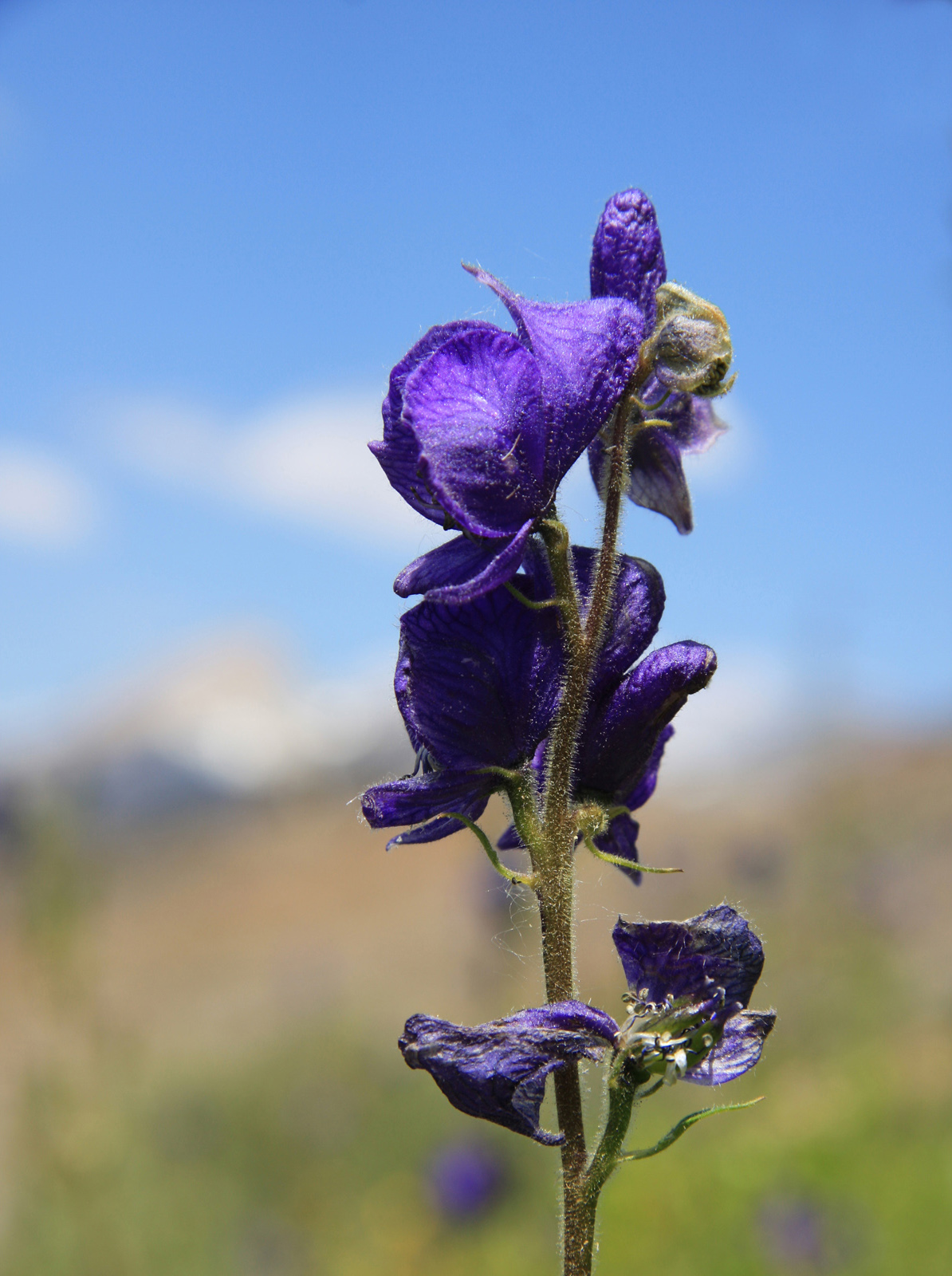
Aconitum columbianum, commonly known as Columbian Monkshood or Western Monkshood, is a tall, striking perennial wildflower of wet mountain meadows and streambanks across the western United States. Its deep purple-blue, helmet-shaped flowers are instantly recognizable and genuinely beautiful — but this is a plant to admire, photograph, and leave alone. Every part of Columbian monkshood is highly toxic, and it belongs in a wild, damp mountain meadow rather than in a home garden.
⚠ Serious Poisoning Hazard
Columbian monkshood is one of the most toxic native plants in North America. All parts — roots, stems, leaves, flowers and seeds — contain aconitine and related alkaloids that can cause severe cardiac and nerve poisoning, and the toxin can be absorbed through broken skin, not just by eating the plant. Wear gloves and wash hands thoroughly after any contact, keep it away from children, pets and livestock, and never ingest any part of this plant or use it as a home remedy. This page is for identification and conservation purposes only — it is not a planting, foraging, or medicinal guide.
This member of the buttercup family (Ranunculaceae) grows as an erect, leafy-stemmed perennial, typically 2 to 6 feet tall, from a cluster of thickened, tuberous roots. From midsummer into early fall, it sends up spikes of large, hooded, deep blue-purple flowers — the distinctive “hood” is actually an enlarged sepal that gives the plant both its common name and its old-world cousin’s nickname, “wolfsbane.” The palmately lobed leaves resemble a deeply cut maple or buttercup leaf and provide attractive texture even when the plant is not in bloom.
Columbian monkshood is widespread but never weedy across the mountainous West, from the Pacific Coast ranges to the Rocky Mountains and the Black Hills. It favors consistently moist ground — stream banks, spring seeps, wet subalpine meadows, and the edges of aspen groves — where it often grows alongside columbine, fireweed, and other moisture-loving wildflowers. Because of both its toxicity and its specific wet-soil requirements, it is best appreciated in its natural setting rather than brought into cultivation.
Identification
Columbian monkshood is usually easy to identify once it flowers, thanks to its unmistakable hooded blossoms, but the foliage alone is also distinctive among wet-meadow wildflowers.
Stems & Roots
Stems are erect, somewhat succulent, and usually unbranched below the flowering portion, reaching 2 to 6 feet tall and occasionally taller in ideal, consistently moist conditions. In dense shade or crowded growth, the upper stem can become almost vine-like, leaning on neighboring vegetation. The root system consists of a cluster of thickened, carrot-like to tuberous roots, which hold the plant’s toxic alkaloids in their highest concentration.
Leaves
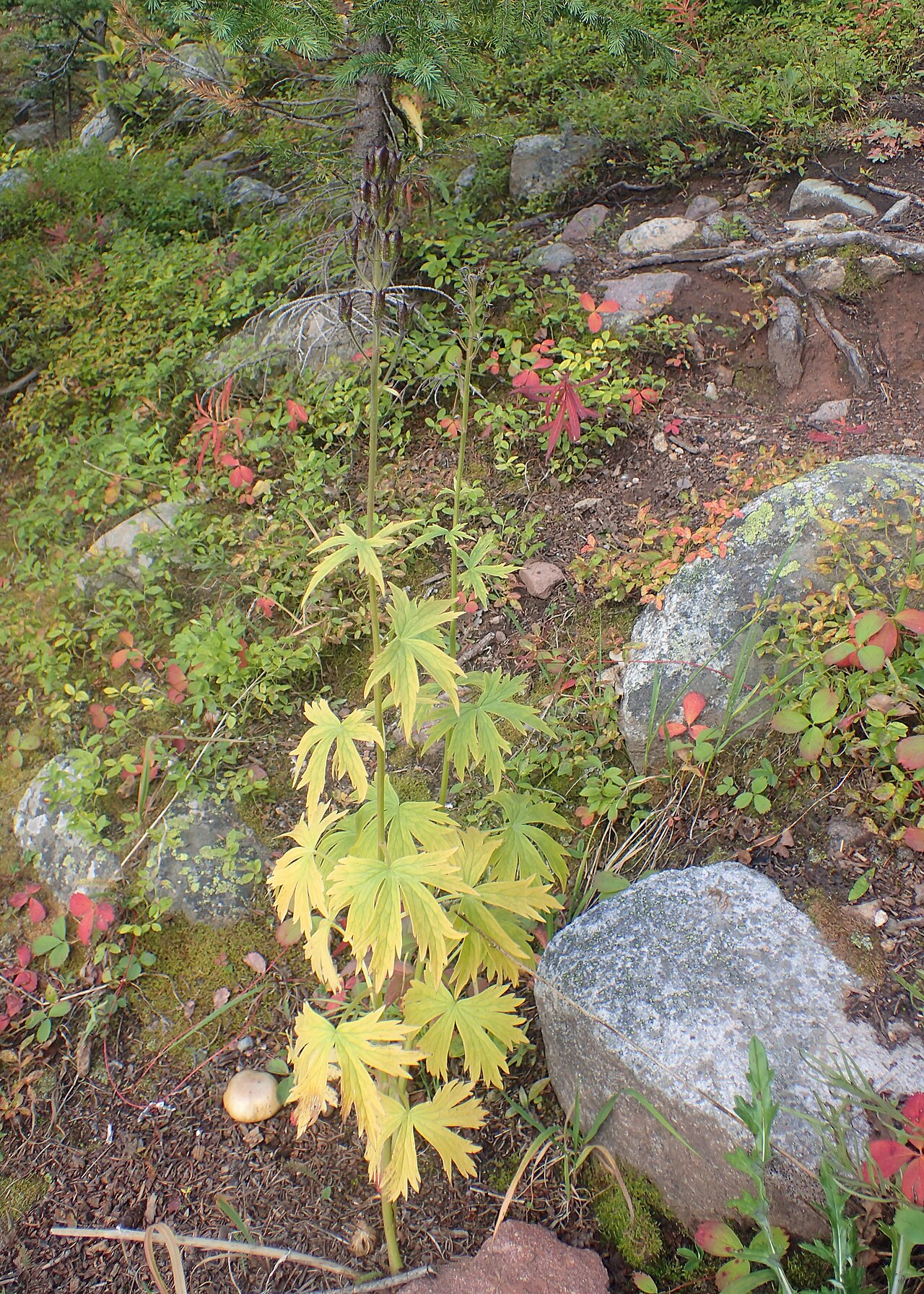
Leaves are alternate, palmately lobed into three to seven deeply cut, coarsely toothed segments, giving them a shape similar to a maple leaf or a large buttercup leaf. They range from about 2 to 6 inches across, are dark green and mostly hairless above, and become progressively smaller and simpler higher up the stem. The foliage dies back completely to the ground each fall.
Flowers
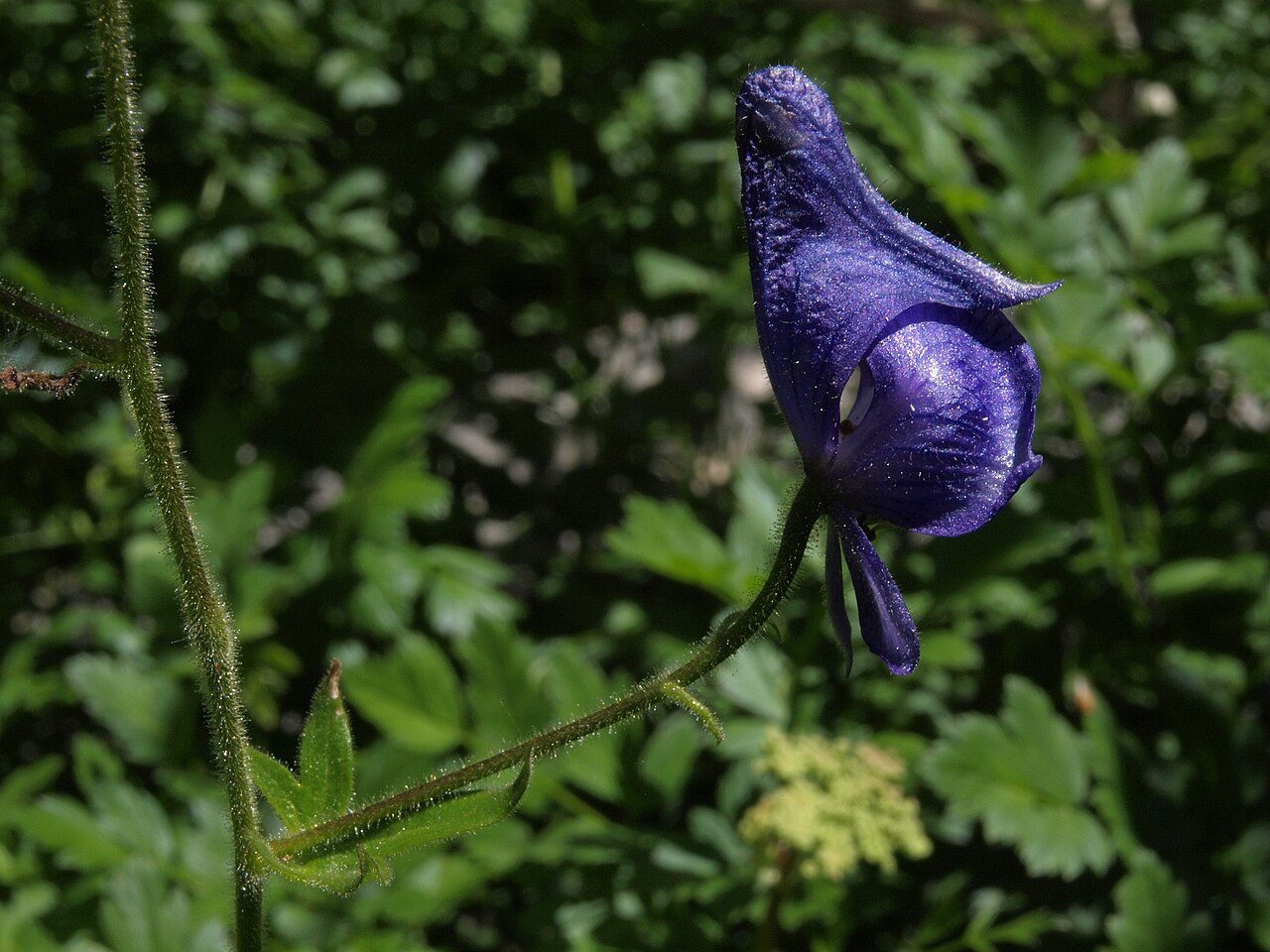
Flowers bloom from June through September depending on elevation, arranged in a loose, elongated terminal raceme atop the stem. Each flower is deep blue-purple (occasionally paler violet or, rarely, whitish), with the uppermost sepal enlarged into a tall, rounded hood that encloses the true petals and gives the flower its “monk’s hood” shape. Flowers are visited mainly by long-tongued bumblebees, which are strong enough to pry the hood open to reach the nectar and pollen inside.
Fruit & Seeds
After flowering, each flower produces a cluster of three to five dry, beaked seed pods called follicles, which split open along one side when ripe to release small, angular, wrinkled seeds. The seed heads are inconspicuous compared to the showy flowers and are easy to overlook on a plant that has finished blooming.
Quick Facts
| Scientific Name | Aconitum columbianum Nutt. |
| Family | Ranunculaceae (Buttercup) |
| Plant Type | Herbaceous perennial forb |
| Mature Height | 2–6 ft (rarely to 7 ft) |
| Mature Spread | 1–2 ft, clump-forming |
| Growth Rate | Moderate |
| Sun Exposure | Full Sun to Part Shade |
| Water Needs | High; needs consistently moist to wet soil |
| Soil Type | Rich, moist to wet loam; stream banks and seeps |
| Soil pH | Slightly acidic to neutral |
| Bloom Time | June – September |
| Flower Color | Deep blue-purple (rarely pale violet or whitish) |
| Fall Color | None; foliage dies back to the ground |
| Fruit | Inconspicuous dry follicles (seed pods), late summer |
| Deer Resistant | Yes (toxicity deters browsing) |
| USDA Hardiness Zones | 3 – 7 |
Native Range
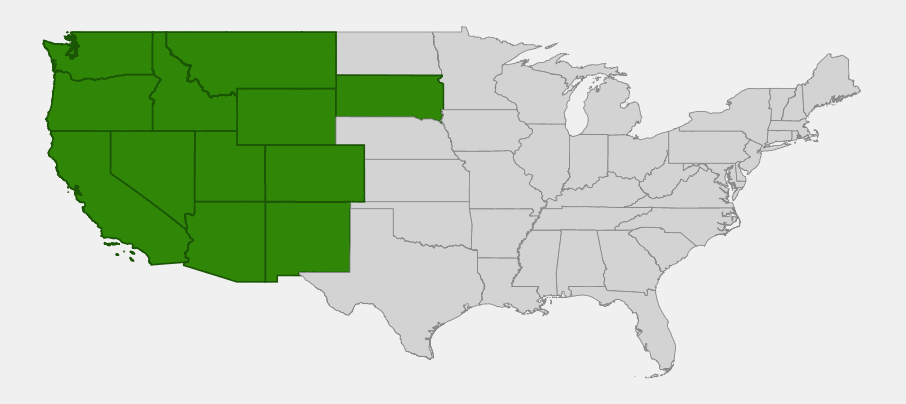
Columbian monkshood is native across much of the mountainous western United States, from the Cascade and Coast Ranges of Washington, Oregon, and California east through the Rocky Mountains of Idaho, Montana, Wyoming, Utah, Colorado, Nevada, Arizona, and New Mexico, with an outlying population in the Black Hills of South Dakota. It also occurs in British Columbia and Alberta in Canada. Scattered, taxonomically distinct populations have been reported from parts of the upper Midwest and Northeast, but those are treated separately from the typical western plant covered here and are not included in this range.
Within this broad range, Columbian monkshood is consistently a plant of wet, cool microsites rather than open dry slopes. It grows from roughly 4,000 feet in the Pacific Northwest to over 11,000 feet in the Rocky Mountains, always where soil moisture is dependable through the growing season.
Look for it along subalpine and montane stream banks, in spring-fed seeps, at the margins of wet meadows, and in moist openings within aspen and conifer forests. It often forms loose colonies rather than dense stands, mixed in with other tall, moisture-loving wildflowers.
📋 Regional plant lists featuring Columbian Monkshood: Arizona & New Mexico · Utah & Western Colorado · Montana & Wyoming · Idaho, Eastern Oregon & Eastern Washington · Western Oregon & Western Washington · North Dakota, South Dakota & Western Minnesota
Growing & Care Guide
Because of its serious toxicity, Columbian monkshood is not a plant to casually add to a typical home garden, especially where children, pets, or livestock have access. It is best left growing wild or reserved for native-plant collections, botanical gardens, and restoration plantings in wet mountain sites where it already belongs — always handled with gloves and sited well away from paths and play areas.
Light
In the wild, Columbian monkshood grows in open wet meadows in full sun at higher elevations and in dappled shade along forest-edge streambanks lower down. It adapts to a range of light as long as soil moisture stays high; more shade generally means it can tolerate less consistently wet soil, and vice versa.
Soil & Water
This species demands reliably moist to wet, rich soil and will not persist where the ground dries out for extended periods in summer. Streamside silt, seep margins, and heavy, organic wet-meadow soils suit it well. It is not a candidate for typical dry garden beds or drought-tolerant plantings.
Planting Tips
Columbian monkshood should only be planted from nursery-propagated stock, never dug from the wild, and only in a genuinely wet site that mimics its natural habitat, such as a pond margin, spring-fed low spot, or streamside restoration planting. Because of its toxicity, site it away from vegetable gardens, children’s play areas, and livestock pasture, and always wear gloves when handling the plant.
Pruning & Maintenance
The plant dies back naturally to the ground each fall and needs no routine pruning. Spent flower stalks can be cut back after seed set if seed spread is not wanted. Always wear gloves when cutting back or dividing this plant, and wash hands and tools thoroughly afterward.
Propagation
Columbian monkshood is propagated from seed, which generally needs a period of cold, moist stratification over winter to germinate the following spring, or by careful division of the tuberous root clusters in fall. Because the roots carry the highest concentration of toxins, division should only be attempted with gloves and great care.
Landscape Uses
Given the serious handling precautions it requires, Columbian monkshood is best reserved for specific, controlled settings:
- Wetland and streamside restoration plantings within its native range
- Botanical and native-plant display gardens with clear signage and controlled access
- Naturalized wet meadows on properties without small children, pets, or grazing livestock
- Pollinator habitat for long-tongued bumblebees in appropriate wet sites
Wildlife & Ecological Value
Despite — or in some ways because of — its toxicity to mammals, Columbian monkshood plays a real role in high-elevation plant communities, chiefly as a pollinator resource.
For Pollinators
The hooded flowers are specially adapted for large bumblebees, which are strong enough to force the hood open and reach the nectar and pollen inside; smaller insects generally cannot access the flower’s reward. This makes Columbian monkshood an important late-summer nectar source for bumblebee species in subalpine meadows, when many other wildflowers have finished blooming.
For Mammals
Mammalian herbivores, including deer and elk, generally avoid eating Columbian monkshood because of its strong alkaloid content, though livestock poisoning has occurred historically when animals grazed it inadvertently in dense stands, particularly when more palatable forage was scarce. This avoidance by large herbivores helps the plant persist in heavily grazed mountain meadows where more palatable wildflowers may be reduced.
Ecosystem Role
As a tall, conspicuous component of wet subalpine and montane meadows, Columbian monkshood adds structural diversity and a late-season bloom pulse to plant communities that are otherwise dominated by grasses, sedges, and shorter forbs earlier in the season. Its presence is also a useful indicator of consistently saturated soil, since it does not persist where seasonal moisture fails.
Cultural & Historical Uses
Columbian monkshood belongs to a genus, Aconitum, with a long and infamous history: Old World relatives supplied the classic poison known as “wolfsbane” and were used historically on arrow tips and in wolf and predator control. Columbian monkshood itself was recognized by Indigenous peoples across its western range as a dangerous plant, and ethnobotanical records describe cautious, highly specific traditional uses of related toxic plant material by some communities, always prepared with great care and specialized knowledge rather than casual use.
Early botanical explorers and collectors in the Rocky Mountains documented the species for its striking appearance, and it appears in nineteenth-century wildflower illustrations, including work by artist Mary Vaux Walcott. Historically, ranchers in the Rocky Mountain West have had to watch for Columbian monkshood in grazing allotments, since livestock poisoning, while uncommon, has been documented when animals consumed large quantities in early spring when the toxic young growth is most tender.
Today, Columbian monkshood’s main significance is ecological and aesthetic rather than practical: a dramatic, photogenic wildflower best enjoyed on the trail, in a wet mountain meadow, and respected for the real hazard it represents rather than put to any home use.
Frequently Asked Questions
Is Columbian monkshood really dangerous to touch?
Yes. Its alkaloids, chiefly aconitine, can be absorbed through cuts or broken skin, not just by eating the plant. Always wear gloves when handling any part of it, including while weeding, dividing, or photographing it up close, and wash your hands afterward.
Can Columbian monkshood be used as an herbal remedy?
No. It should never be ingested or applied as a home remedy in any form. Its toxic alkaloids can cause severe cardiac arrhythmia, paralysis, and death even in small amounts, and there is no safe home preparation. Any historical medicinal use of related toxic plants required specialized, expert preparation and is not something to attempt today.
Will Columbian monkshood hurt my pets or livestock?
It can. Grazing animals and pets that chew on the plant are at risk of serious poisoning, so keep it out of pastures, dog yards, and anywhere grazing animals or curious pets have access. If you suspect an animal has eaten any part of this plant, contact a veterinarian immediately.
Why would anyone plant something this toxic?
In the right setting — a controlled wetland restoration or native botanical garden without open livestock or small-child access — Columbian monkshood supports late-season bumblebees and represents an important, true-to-place native wildflower. It is not recommended for typical home landscapes.
How can I tell Columbian monkshood from larkspur or columbine?
Columbian monkshood’s flower has a tall, rounded, helmet-like hood formed by one enlarged sepal, unlike larkspur’s backward-pointing spur or columbine’s five long, backward-projecting spurs. The deeply lobed, maple-like leaves and preference for very wet soil are also useful identification clues.

Looking for a nursery that carries Columbian Monkshood?
Browse our native plant nursery directory: Arizona · California · Colorado · Idaho · Montana · Nevada & New Mexico · Oregon · South Dakota & Utah · Washington · Wyoming