
Mountain Death Camas (Anticlea elegans)
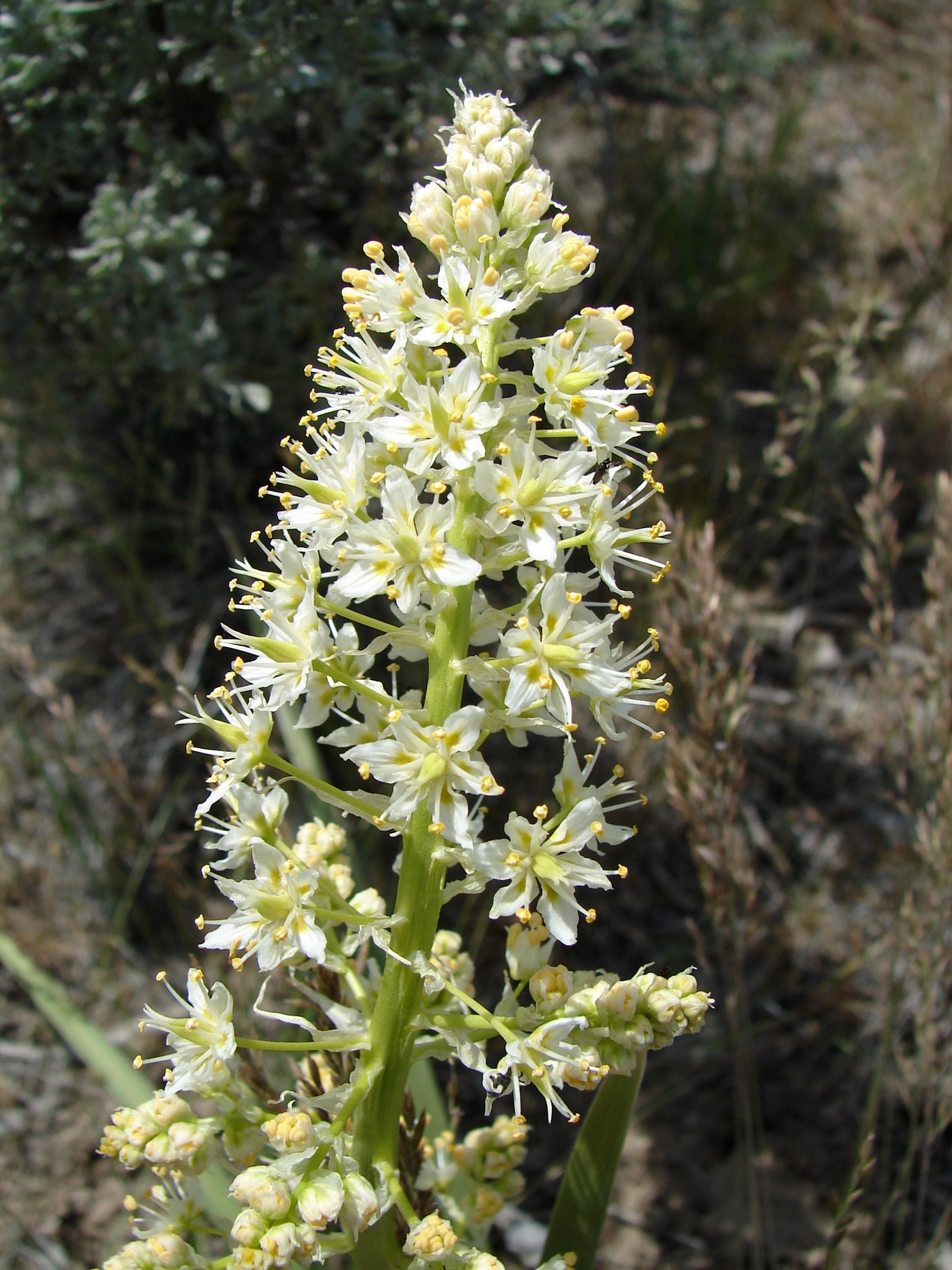
⚠ Highly poisonous — never eat any part of this plant. Every part of mountain death camas, including the bulb, contains toxic steroidal alkaloids and is dangerous to people and livestock. Its bulb has repeatedly been mistaken for the edible bulbs of camas (Camassia species) by foragers, with fatal results. The two are easy to tell apart when in flower but dangerously easy to confuse once the leaves alone are showing. Grow mountain death camas only as an ornamental or restoration plant, never as a food source, and keep bulbs away from livestock pasture and from anywhere edible camas is also being gathered.
Anticlea elegans (long known as Zigadenus elegans), commonly called Mountain Death Camas or Glaucous Death Camas, is a striking perennial wildflower in the bunchflower family (Melanthiaceae) found across a huge swath of North America, from alpine scree in the Rockies to limestone cliffs on the Great Lakes shoreline. Its common name is well earned: this is one of the most toxic native plants a hiker, gardener, or rancher is likely to encounter, and the “elegans” in its scientific name nods to the genuinely attractive, cream-colored, star-shaped flowers that belie the danger packed into the plant’s tissues.
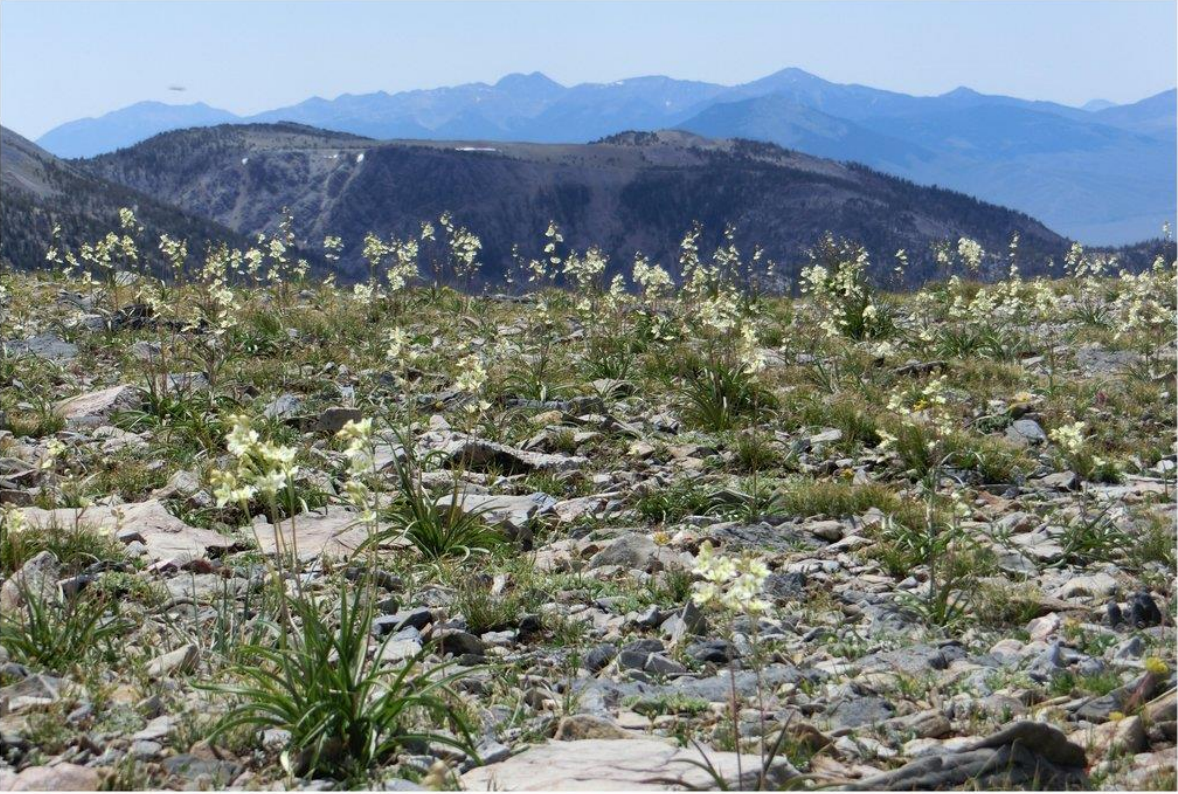
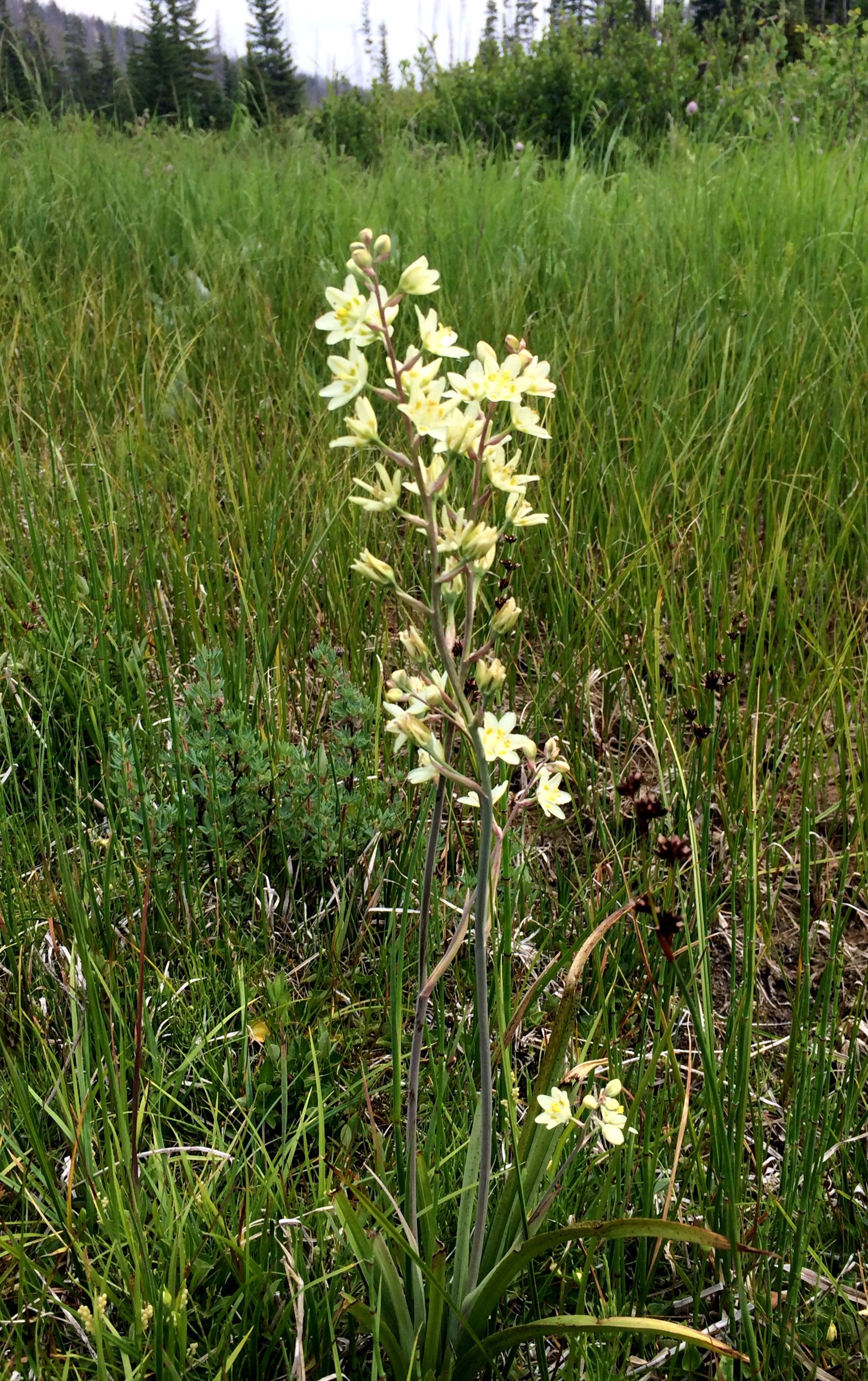
Rising from a narrow, onion-like bulb, mountain death camas sends up a tuft of grass-like, blue-green basal leaves and a single unbranched flowering stalk topped with an open cluster of greenish-cream, six-petaled flowers, each marked with a distinctive heart- or V-shaped green gland at the base of every petal. It favors open, sunny sites — rocky slopes, alpine meadows, calcareous cliffs, and prairie remnants — and is often one of the more conspicuous wildflowers on a summer hike through high-elevation meadows or western grasslands.
Mountain death camas is not planted as an ornamental nearly as often as showier prairie wildflowers, in large part because of its toxicity, but it has real value in restoration plantings on dry, rocky, or calcareous sites where few other flowering perennials thrive, and its nectar-rich flowers are visited by a surprisingly narrow, specialized set of pollinators that have evolved tolerance for its chemistry.
Identification
Mountain death camas grows from a fibrous-coated bulb buried a few inches underground, sending up a basal tuft of leaves and a single flowering stem each year. Mature plants typically stand 1 to 2½ feet tall at bloom, though exceptional specimens on good sites can reach 3 feet.
Leaves
Leaves are grass-like, linear, flat or slightly folded, 4 to 20 inches long and often coated with a waxy, blue-gray bloom (glaucous) that gives the plant its “glaucous” alternate name. They arise mostly from the base of the plant in a basal tuft, with a few smaller leaves reducing in size as they ascend the flowering stem. This is the stage at which mountain death camas is most easily confused with the basal leaves of edible camas (Camassia species) or with wild onion — all three can look similar as grass-like tufts before flowering, which is exactly when foraging mistakes happen.
Flowers
The flowering stem terminates in an open, branched cluster (panicle or raceme) 2 to 6 inches long, carrying numerous star-shaped flowers roughly ½ to ¾ inch across. Each flower has six creamy white to pale greenish-yellow tepals, every one marked near its base with a conspicuous green or yellow-green, V-shaped or heart-shaped nectar gland — a key identification feature that separates Anticlea from true Camassia, whose flowers are blue-to-violet (occasionally white) and lack this gland pattern entirely. Flowering occurs from late spring into mid-summer depending on elevation, with high alpine populations blooming weeks later than low-elevation prairie plants.
Fruit & Bulb
Flowers give way to a three-chambered, papery capsule holding numerous flattened, winged seeds that shake free as the dry capsule splits. The bulb itself is ovoid and onion-like, covered in dark, fibrous outer coats, and — critically — has no reliable “safe” visual feature that distinguishes it from an edible camas bulb once separated from the rest of the plant; identification must always be made while the plant is flowering or by an expert examining diagnostic bulb and leaf characters, never from the bulb alone.
Quick Facts
| Scientific Name | Anticlea elegans (Pursh) Rydb. (syn. Zigadenus elegans) |
| Family | Melanthiaceae (Bunchflower/Death Camas) |
| Plant Type | Herbaceous Perennial (bulb) |
| Mature Height | 1–2½ ft in bloom |
| Mature Spread | 6–12 in per clump; spreads slowly by bulb offsets and seed |
| Growth Rate | Slow to moderate |
| Sun Exposure | Full Sun to Light Shade |
| Water Needs | Low to Moderate |
| Soil Type | Well-drained; rocky, gravelly or calcareous |
| Soil pH | 6.5–8.0 (neutral to alkaline; tolerates limestone) |
| Bloom Time | Late May – August, depending on elevation |
| Flower Color | Creamy white to pale greenish-yellow |
| Fall Color | Foliage yellows and dies back; no ornamental fall color |
| Fruit | Papery three-chambered capsule, winged seeds |
| Deer Resistant | Yes — toxic to browsers as well as people |
| USDA Hardiness Zones | 3–8 |
Native Range
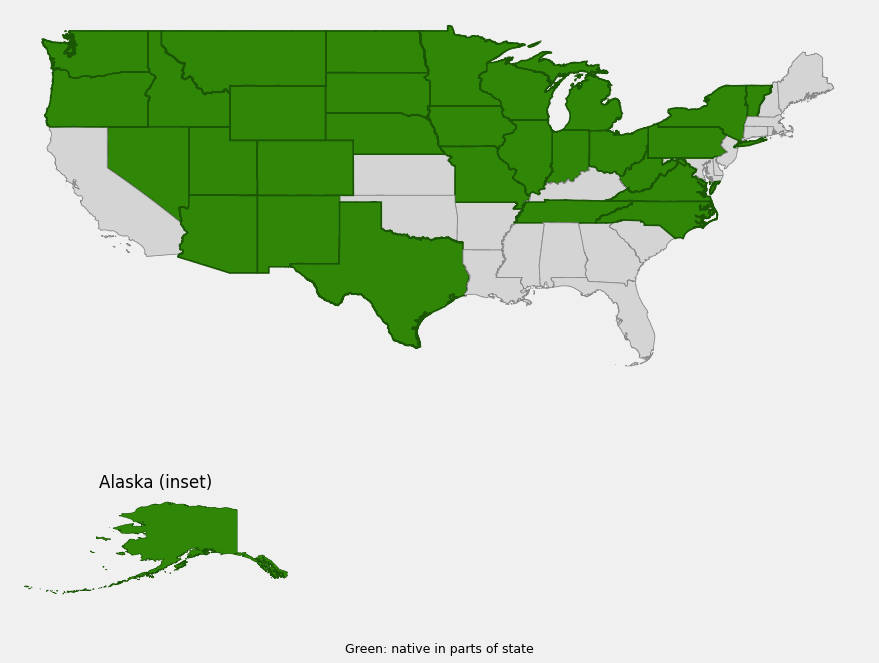
Mountain death camas has one of the broadest ranges of any North American death camas, stretching from Alaska and the Yukon south through the Rocky Mountains and Intermountain West to Arizona and New Mexico, east across the northern Great Plains and upper Midwest, and in scattered, often calcium-rich outposts through the Appalachians, the Great Lakes region, and the mid-Atlantic. It is genuinely a plant of two different worlds: in the West it is a classic mountain and high-plains wildflower of rocky slopes and alpine meadows, while its eastern populations are typically restricted to unusual, mineral-rich microhabitats such as limestone cliffs, calcareous fens, and dolomite prairies.
Across its western range, mountain death camas grows from foothill sagebrush and prairie up into alpine tundra, often forming conspicuous colonies on rocky, well-drained slopes and in subalpine meadows alongside lupines and other showy wildflowers. In the East and Midwest, by contrast, it is usually a local, somewhat rare plant restricted to specific calcareous habitats — limestone glades, dolomite prairies, and rock outcrops — where competition from more aggressive vegetation is limited by thin, mineral soils.
Mountain death camas is absent as a native plant from California and from the humid lowland Southeast; where it does occur east of the Great Plains it tends to be local and habitat-restricted rather than broadly common, so gardeners and land managers in those regions should confirm a genuinely local, calcareous-adapted source before planting rather than assuming the species is a good general regional fit.
📋 Regional plant lists featuring Mountain Death Camas: Alaska · Arizona & New Mexico · Utah & Western Colorado · Nebraska, Kansas & Eastern Colorado · Montana & Wyoming · Idaho, Eastern Oregon & Eastern Washington · Western Oregon & Western Washington · North Dakota, South Dakota & Western Minnesota · Michigan, Wisconsin & Eastern Minnesota · Illinois, Iowa & Missouri · Ohio & Indiana · Maryland, Virginia & West Virginia · North Carolina & South Carolina · Kentucky & Tennessee · New Hampshire, Maine & Vermont · New York, Pennsylvania & Northern New Jersey
Growing & Care Guide
Mountain death camas is not a plant for every garden — its toxicity rules it out for homes with grazing livestock, small children who put things in their mouths, or any setting where it might be mistaken for an edible bulb — but where it fits, it is an undemanding, long-lived perennial for dry, rocky, sunny sites that few other flowering plants tolerate well.
Light
Plant in full sun for the best flowering and the sturdiest growth; at lower, hotter elevations light afternoon shade can help prevent the foliage from scorching, but in cooler mountain gardens full sun all day is ideal.
Soil & Water
Give it sharply drained, rocky or gravelly soil — heavy, poorly drained clay encourages bulb rot. Eastern-range gardeners working with calcareous or limestone-derived soils will find this species particularly well suited, since many eastern populations are restricted to exactly that chemistry in the wild. Established plants are drought tolerant and need only modest supplemental water beyond natural rainfall, with a dry summer dormancy actually mimicking its natural cycle in much of its range.
Planting Tips
Set bulbs or container-grown plants in fall at a depth of about 3 to 4 inches, spacing clumps 10 to 12 inches apart. Because the bulb is toxic and visually similar to edible alliums and camas, label plantings clearly, keep them well away from any vegetable or herb garden, and never plant them where young children might dig and sample bulbs.
Pruning & Maintenance
Maintenance is minimal: remove spent flowering stalks after seed drop if a tidier appearance is wanted, and allow foliage to yellow and die back naturally before cutting it, since the bulb is rebuilding its reserves during this period. Established clumps are long-lived and rarely need division.
Landscape Uses
With its toxicity firmly in mind, mountain death camas has a legitimate place in several settings:
- Native plant and restoration plantings on dry, rocky, or calcareous sites
- Rock gardens away from edible plantings and foot traffic by small children
- Pollinator gardens focused on specialist bee and fly visitors
- Interpretive or botanical garden displays, clearly labeled, to teach plant identification and toxic-lookalike awareness
- Prairie and alvar restoration on appropriate calcareous sites in its eastern range
Wildlife & Ecological Value
Mountain death camas occupies an unusual ecological niche: a toxic plant that nonetheless supports a narrow, specialized community of pollinators adapted to tolerate — or avoid ingesting — its chemistry.
For Pollinators
The flowers are visited by a range of flies, small native bees, and other insects, but the plant is best known among pollinator researchers for its relationship with a handful of specialist bee species in the genus Andrena that are so closely tied to death camas flowers that they are sometimes called “death camas bees.” These specialists appear to have evolved tolerance for compounds that are toxic to honey bees and many other pollinators, which can experience significant mortality if they forage heavily on death camas flowers — a reminder that the plant’s toxicity is not limited to vertebrates.
For Birds
Mountain death camas is not a significant food source for birds; seed-eating songbirds generally avoid the toxic seed. Its main value to birds is indirect, as part of the diverse native plant community of the rocky, open habitats it occupies.
For Mammals
Mountain death camas is genuinely dangerous to grazing livestock, particularly sheep, as well as cattle and horses, and poisoning cases are well documented across its western range, especially on overgrazed range in early spring when little other green forage is available and death camas is often among the first plants to emerge. Wild ungulates generally avoid it, and ranchers managing rangeland where it is present typically monitor stocking and grazing timing carefully to reduce livestock exposure.
Ecosystem Role
As an early, often abundant bloomer on otherwise sparsely vegetated rocky and alpine sites, mountain death camas adds floral diversity and a nectar source for its specialist pollinators at a time and place where options are limited. Its toxicity likely also functions as an effective defense against the heavy grazing pressure common in open alpine and prairie habitats, allowing it to persist and spread on sites where more palatable plants are repeatedly cropped back.
Cultural & Historical Uses
Mountain death camas has no history of safe food or medicinal use — quite the opposite. Indigenous peoples across its range were well aware of its toxicity and took care to distinguish it from the edible bulbs of true camas (Camassia species), which were, and remain, an important traditional food plant in many of the same regions. Historical accounts from Lewis and Clark’s expedition and from early Euro-American settlers repeatedly record poisonings, sometimes fatal, when death camas bulbs were harvested or cooked by mistake alongside edible camas, underscoring just how easily the two can be confused once dug from the ground.
Ranchers and agricultural extension services in the western United States have documented mountain death camas as a significant cause of livestock poisoning for well over a century, and government bulletins on poisonous range plants have featured it prominently since the early 1900s as part of broader efforts to help ranchers identify and manage toxic rangeland species.
Today, mountain death camas’s main cultural relevance is as a cautionary example in foraging education: nearly every modern guide to wild edible camas includes a warning about this species specifically, underscoring how important careful, in-flower identification is before anyone digs a wild bulb for food.
Frequently Asked Questions
Is mountain death camas really deadly?
Yes. All parts of the plant, especially the bulb, contain toxic steroidal alkaloids that can cause severe illness or death in people and livestock if ingested. There is no record of safe traditional food use for this species — treat every part of it as inedible.
How do I tell it apart from edible camas (Camassia)?
The safest method is to identify plants only while they are in flower. Mountain death camas has creamy white to greenish-yellow, star-shaped flowers with a distinctive V-shaped green gland at the base of each petal, while true camas has blue-to-violet (rarely white) flowers without that gland pattern. The basal leaves of the two can look very similar before flowering, which is exactly when foraging accidents happen — never harvest camas bulbs from a site where death camas is not in flower and confirmed absent.
Is it safe to grow in a home garden?
It can be grown responsibly in gardens without grazing livestock or small children who might put bulbs or foliage in their mouths, kept well away from any edible plantings, and clearly labeled. It is not recommended near pastures, playgrounds, or vegetable gardens.
Does the toxicity affect pollinators too?
It can. While a handful of specialist native bees appear adapted to visit death camas flowers safely, honey bees and some other generalist pollinators can be harmed by heavy foraging on this plant, so it is not considered an ideal honey bee forage plant despite producing nectar.
Why does it grow in such different habitats, from alpine peaks to Great Lakes cliffs?
Mountain death camas tolerates a wide range of climates as long as the soil is well drained and often mineral-rich. In the West this means rocky mountain slopes and high meadows; in the East and Midwest it is usually confined to unusual calcareous habitats like limestone cliffs and dolomite prairies, where thin, alkaline soils limit competition from more aggressive vegetation.

Looking for a nursery that carries Mountain Death Camas?
Browse our native plant nursery directory: Alaska & Arizona · Colorado · Idaho, Illinois, Indiana & Iowa · Maryland, Michigan, Minnesota, Missouri & Montana · Nebraska, Nevada, New Mexico, New York, North Carolina & North Dakota · Oregon · Pennsylvania, South Dakota, Tennessee, Texas, Utah & Virginia · Washington · West Virginia, Wisconsin & Wyoming