
Gray’s Sedge (Carex grayi)
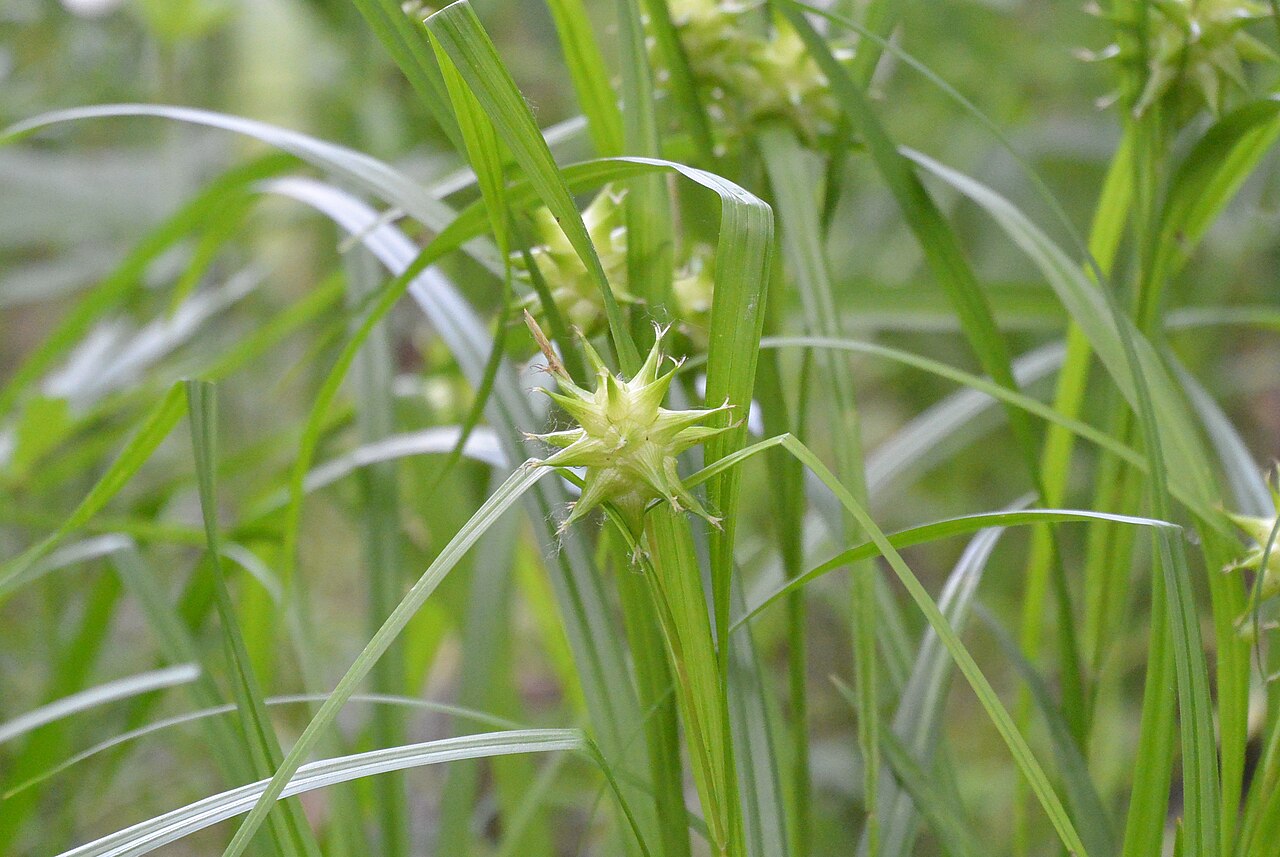
Carex grayi, known as Gray’s sedge or mace sedge, is one of the most instantly recognizable native sedges in North America — and that is saying something in a genus notorious for being nearly impossible to tell apart. Named for the nineteenth-century botanist Asa Gray, this clump-forming perennial of the Cyperaceae (sedge family) produces spiky, ball-shaped seed heads that look remarkably like a medieval mace or a tiny green sea urchin, a feature that has made it a favorite of plant collectors and dried-arrangement crafters as much as native-plant gardeners.
In the wild, Gray’s sedge grows in the damp, part-shaded bottomlands and floodplain forests of the eastern and midwestern United States, often standing in water for part of the season before drying out as summer progresses. It reaches 2 to 3 feet in height, with broad, bright green, arching leaves topped by those unmistakable star-spiked fruiting heads in early to midsummer. The seed heads persist well after the leaves fade, giving the plant multi-season interest that few sedges can match.
Because of its bold texture and tolerance of both wet soil and shade, Gray’s sedge has become a go-to native plant for rain gardens, pond margins, and shaded low spots where few other ornamentals perform. It asks little beyond consistent moisture and rewards the gardener with a conversation-starting seed head that children and adults alike enjoy discovering.
Identification
Gray’s sedge is a tufted, clump-forming perennial with the triangular stems typical of the sedge family. It does not spread aggressively by rhizome, instead slowly enlarging its base clump over the years.
Leaves
The leaves are relatively broad for a sedge — up to ½ inch wide — flat, bright to medium green, and arch outward from the base in a loose, fountain-like clump 1½ to 2½ feet tall. The foliage has a coarser, more substantial texture than many fine-leaved sedges, giving the plant good visual weight in a planting.
Flowers
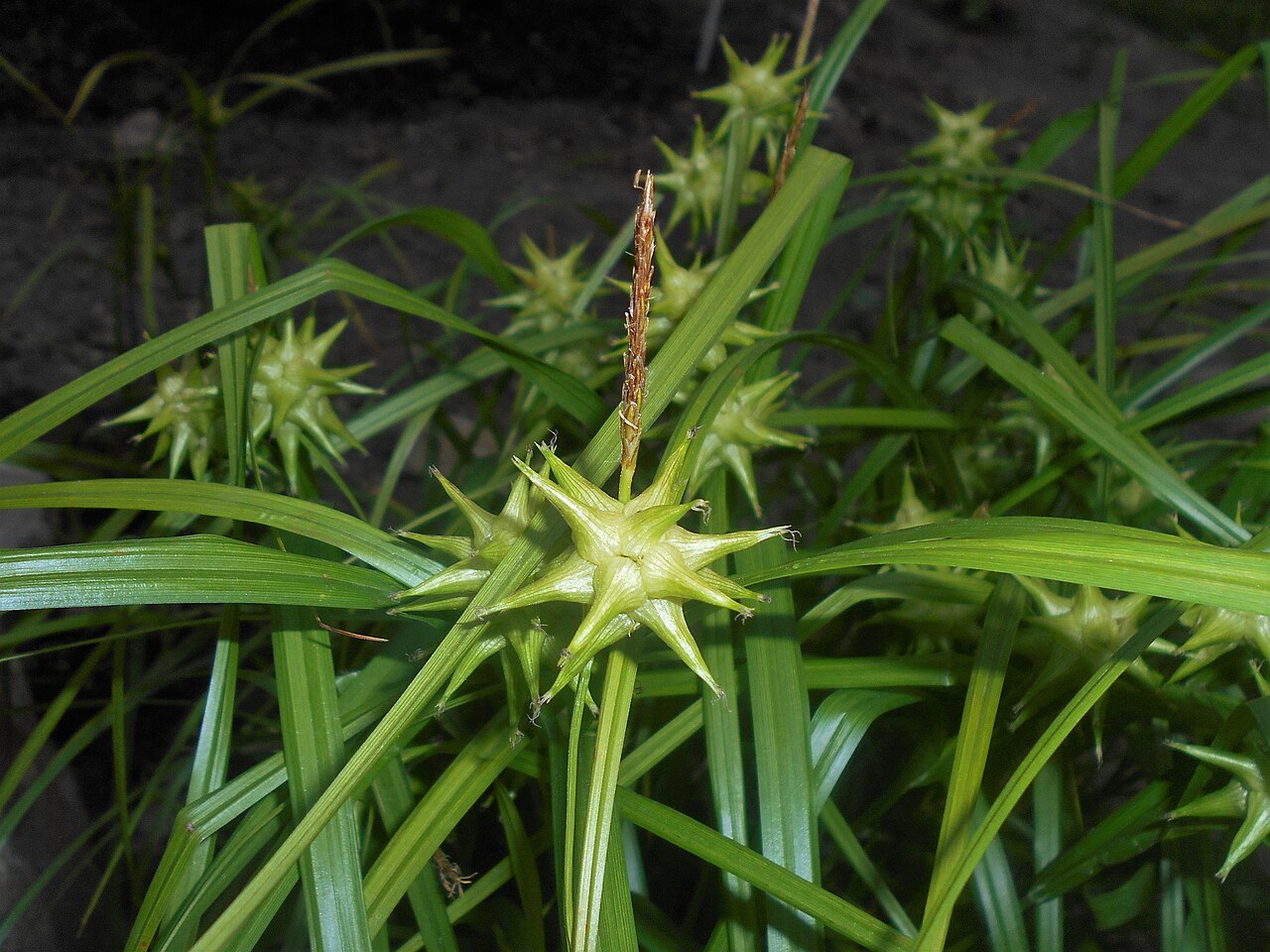
Flowering occurs in late spring to early summer. As in other sedges, male and female flowers are separated into different spikes on the same plant: a slender terminal male spike sits above several rounded, ball-like female spikes along the upper stem. The flowers themselves are inconspicuous green structures; the show comes later, once the fruits mature.
Fruit & Seeds
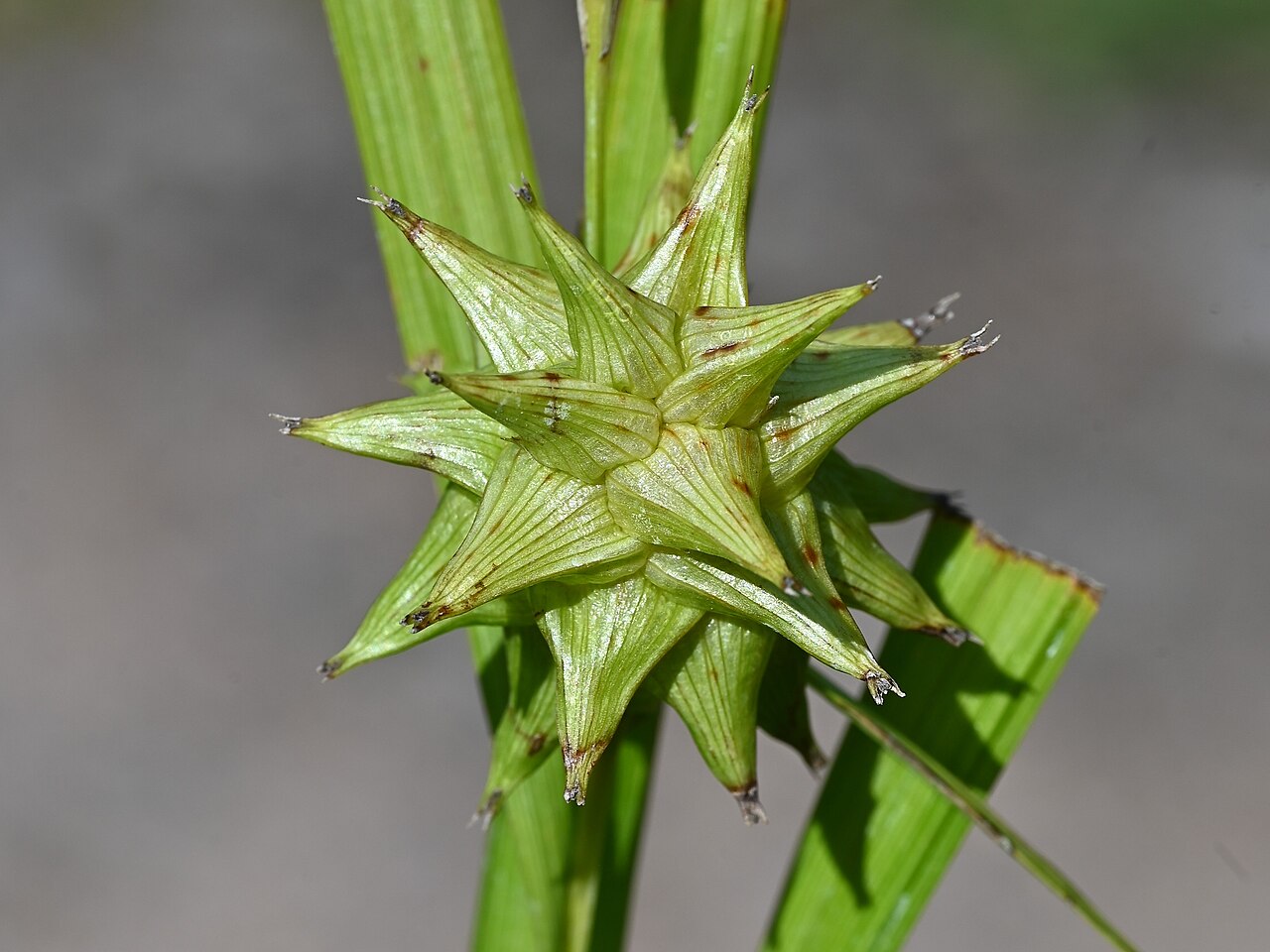
The signature feature of Gray’s sedge is its fruit: each female spike matures into a dense, spherical cluster of large, inflated perigynia with long, sharp, spreading beaks, together forming a spiky green ball roughly ¾ to 1¼ inches across — the “mace” that gives the plant its common name. These seed heads ripen to a pale straw color by late summer and often persist on the dried stems into fall, making this one of the easiest native sedges to identify from a distance, let alone up close.
Quick Facts
| Scientific Name | Carex grayi |
| Family | Cyperaceae (Sedge) |
| Plant Type | Perennial Sedge (Graminoid) |
| Mature Height | 18–36 in (45–90 cm) |
| Mature Spread | 18–24 in clump |
| Growth Rate | Moderate |
| Sun Exposure | Part Shade to Full Shade; tolerates more sun with ample moisture |
| Water Needs | Medium to High; thrives in consistently moist to seasonally wet soil |
| Soil Type | Rich, loamy to clay bottomland soil |
| Soil pH | 5.5–7.0 (slightly acidic to neutral) |
| Bloom Time | May – June |
| Flower Color | Green, ripening to pale straw |
| Fall Color | Foliage yellows and dies back after frost |
| Fruit | Large spiky, mace-like seed heads, persisting into fall |
| Deer Resistant | Yes, generally unpalatable |
| USDA Hardiness Zones | 4–9 |
Native Range
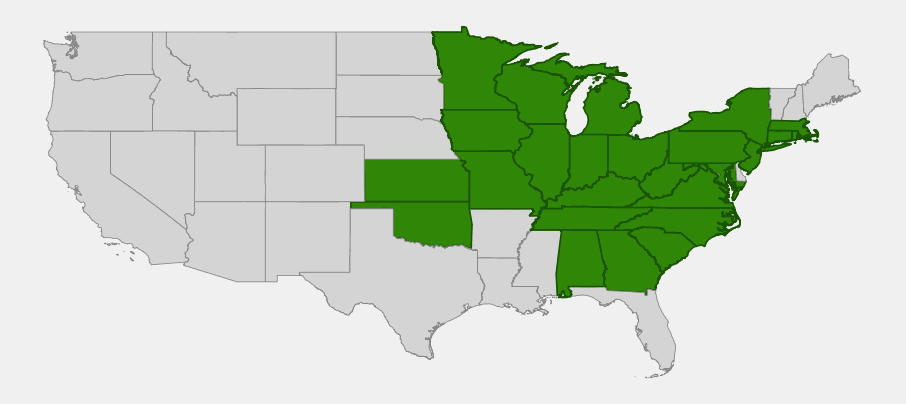
Gray’s sedge is native to the eastern and midwestern United States, with a range centered on the Ohio and Mississippi River valleys and the southern Great Lakes states. It is found from Kansas, Oklahoma, and Missouri east through Illinois, Indiana, Ohio, Michigan, and Wisconsin to Pennsylvania, New York, and the mid-Atlantic, with a scattered southern presence into the Carolinas and a rare, local foothold in New England.
Across this range it is a plant of bottomland hardwood forests, stream terraces, and the edges of ponds and sloughs — anywhere that seasonal flooding or a consistently high water table keeps the soil damp for most of the year. It often grows alongside other moisture-loving sedges in the dappled light beneath a floodplain forest canopy, though it will also take more open conditions where soil moisture is reliable.
Gray’s sedge is not considered weedy or invasive anywhere within or outside this native range, and there are no reports of it naturalizing beyond the states where it occurs naturally.
📋 Regional plant lists featuring Gray’s Sedge: Georgia, Alabama & Mississippi · Arkansas, Louisiana, Eastern Oklahoma & Eastern Texas · Illinois, Iowa & Missouri · Ohio & Indiana · Kentucky & Tennessee · Maryland, Virginia & West Virginia · Michigan, Wisconsin & Eastern Minnesota · North Carolina & South Carolina · Nebraska, Kansas & Eastern Colorado · Connecticut, Massachusetts & Rhode Island · New York, Pennsylvania & Northern New Jersey
Growing & Care Guide
Gray’s sedge is an easygoing plant for anyone with a damp, shaded corner of the garden — the kind of spot where lawn grass drowns and most perennials sulk. Give it consistent moisture and it rewards you with years of trouble-free growth.
Light
Part shade to full shade is ideal, matching its natural floodplain-forest habitat. It can tolerate considerably more sun, even full sun, provided the soil never dries out — a classic trade-off for a wetland-edge plant.
Soil & Water
This sedge wants rich, consistently moist to seasonally wet soil and is an excellent choice for rain garden basins, pond and stream margins, and low spots that collect water after storms. It tolerates brief standing water during the growing season but is not a true aquatic — it needs the soil to drain between soakings rather than staying permanently submerged.
Planting Tips
Plant in spring or fall, spacing clumps 18 to 24 inches apart. Choose the lowest, dampest part of a planting bed, or site it at the edge of a rain garden where it will catch runoff without sitting in deep standing water for extended periods. Water generously through the first season to help roots establish.
Pruning & Maintenance
Minimal care is needed. Cut back old foliage in late winter if desired, though many gardeners leave the dried seed heads standing through winter for visual interest and wildlife value, removing them only once new growth begins in spring. Divide congested clumps every few years to maintain vigor.
Propagation
Division of established clumps in spring is the fastest, most reliable method. Seed can also be collected from the dried mace-like heads in late summer and sown after a period of cold-moist stratification, though division produces blooming-size plants much sooner.
Landscape Uses
- Rain gardens and bioswales where soil moisture fluctuates
- Pond and stream margins for a natural, textural edge
- Shaded low spots where turf grass fails
- Woodland garden accents prized for the unusual seed heads
- Dried arrangements and seed-pod crafts
- Rain barrel overflow areas and downspout basins
Wildlife & Ecological Value
Gray’s sedge is a quietly valuable member of bottomland forest and wetland-edge plant communities, supporting insects and small wildlife even though its showiest feature — the seed head — is built for wind and water dispersal rather than pollinators.
For Pollinators
As a wind-pollinated species, Gray’s sedge offers no nectar, but its foliage serves as a larval host for several satyr and skipper butterflies whose caterpillars specialize on sedges, and the dense clumps provide shelter for beneficial insects.
For Birds
Waterfowl and marsh birds feed on sedge seeds where plants grow near open water, and the dense tussocks provide nesting and loafing cover for ground-nesting birds in wetland-edge habitats.
For Mammals
Muskrats and other wetland mammals use sedge clumps for forage and nesting material near water. Deer generally avoid browsing the tough, gritty foliage, making this a reliably deer-resistant choice for shaded wet gardens.
Ecosystem Role
By tolerating seasonal flooding and anchoring soil along stream and pond margins, Gray’s sedge helps stabilize banks and filter runoff in bottomland habitats, while its persistent seed heads disperse via floodwater, allowing the species to colonize newly disturbed floodplain ground after storms.
Cultural & Historical Uses
Gray’s sedge commemorates Asa Gray, the towering figure of nineteenth-century American botany whose taxonomic work shaped the modern understanding of North American flora; the species was named in his honor by the botanist John Carey. Unlike many native sedges, which were historically valued chiefly for their fiber, Gray’s sedge does not have a notable documented history of Indigenous or pioneer utilitarian use, likely because its coarse, spiny seed heads make it impractical for weaving or cordage compared to finer-leaved wetland sedges and rushes.
Its modern cultural footprint is almost entirely horticultural: the distinctive mace-like seed heads have made it a favorite subject for botanical illustration, dried flower arrangements, and nature photography, and it has been cultivated as an ornamental curiosity in gardens well outside its native range, including in European botanical collections, for well over a century.
Today, Gray’s sedge is best known among native-plant gardeners and restoration ecologists as a reliable, low-maintenance choice for wet, shaded sites, a role that has only grown as rain gardens and stormwater landscaping have become standard practice in home and municipal design.
Frequently Asked Questions
Why is it called mace sedge?
The common name refers to the large, round, spiky seed heads, whose inflated beaked perigynia radiate outward in a ball shape reminiscent of a medieval mace weapon or a spiked flail head.
Does Gray’s sedge need standing water to grow well?
No. It tolerates brief seasonal flooding but grows best in consistently moist, well-drained soil rather than a permanently flooded site. A rain garden basin or pond margin that dries between storms suits it perfectly.
Will the seed heads hurt pets or children who touch them?
The beaked perigynia are stiff and pointed but not truly sharp or toxic; they can feel prickly to bare skin but pose no real hazard. They are a popular, safe novelty for children exploring a native garden.
Can Gray’s sedge grow in full sun?
Yes, provided the soil stays consistently moist. In drier sun it tends to struggle, so part shade with reliable moisture is the more forgiving choice for most gardens.
Is Gray’s sedge easy to confuse with other sedges?
Once it fruits, no — the large, spherical, spiky seed head is unmistakable among North American sedges. Before fruiting, the foliage alone looks like many other broad-leaved woodland sedges, so gardeners should wait for the seed head or buy verified nursery stock to be certain of the species.

Looking for a nursery that carries Gray’s Sedge?
Browse our native plant nursery directory: AL · CT, GA · IL, IN, IA, KS · KY, MD, MA, MI, MN, MO · NJ, NY, NC, OH, OK · PA, RI, SC, TN, VA · WV, WI