
Gray Oak (Quercus grisea)
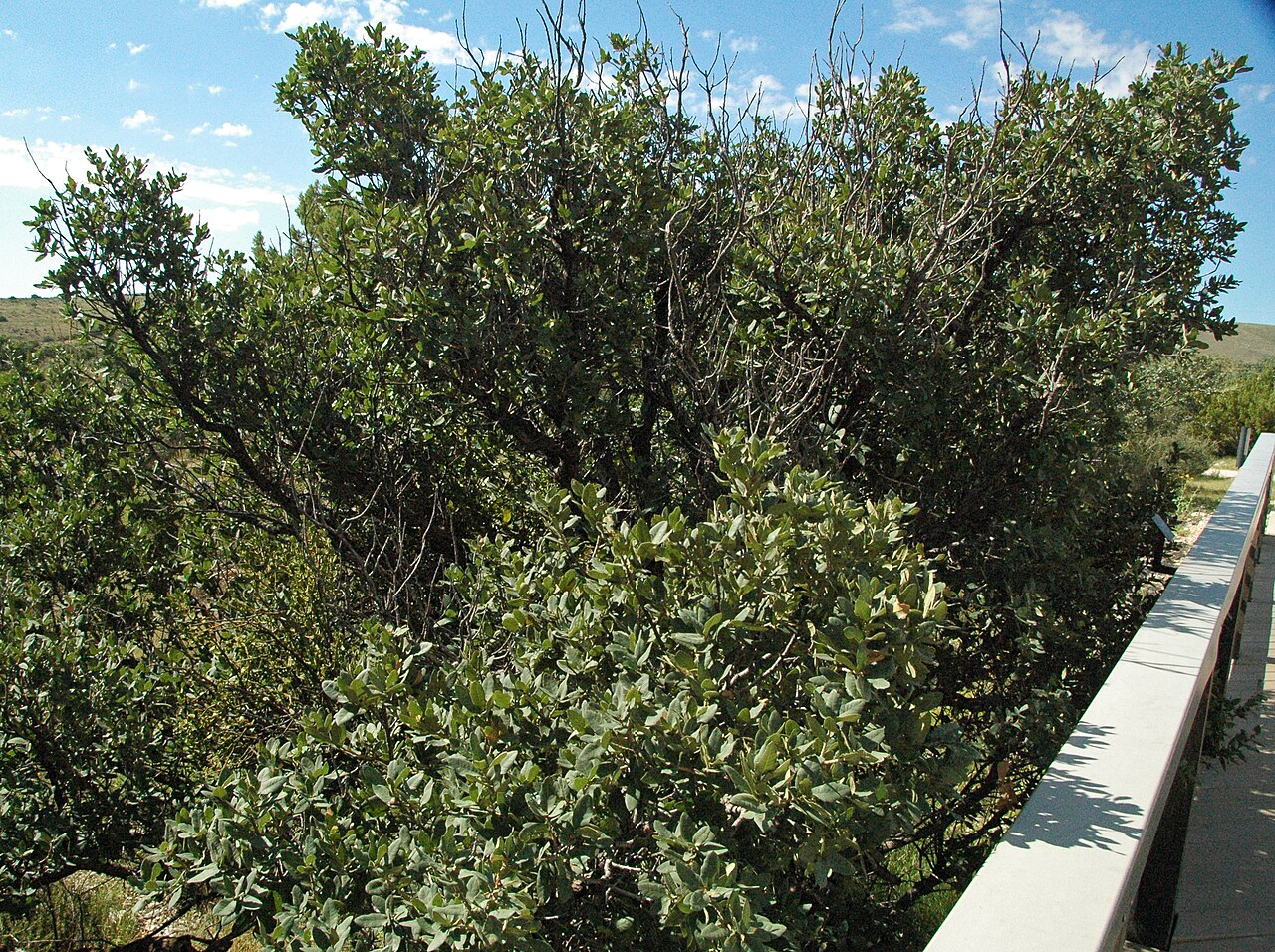
Quercus grisea, the Gray Oak, is a tough evergreen to semi-evergreen oak of the mountain foothills and canyons of the American Southwest — a shrub or small tree built to handle thin rocky soil, scant rainfall, and a wide swing between hot dry summers and cold mountain winters. Also called Shin Oak or Scrub Oak locally (names it shares with several unrelated southwestern oaks, so the scientific name matters here), it takes its common and species names from the dusty, blue-gray cast of its foliage, a trait shared by few other oaks in the region.
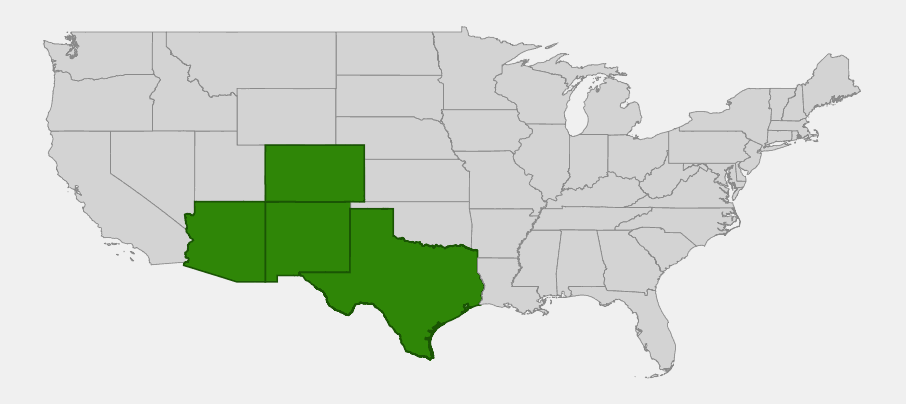
Unlike the Texas and Gulf Coast live oaks that dominate at lower, wetter elevations, Gray Oak is a plant of the mountains: it is most often found between about 4,000 and 9,000 feet in the sky island ranges and foothills of Arizona, New Mexico, west Texas, and southern Colorado, where it forms dense thickets and woodlands with junipers and pinyon pines.
It is a genuinely scrappy, resilient plant — slow-growing, long-lived, able to resprout from the root crown after fire or drought dieback — and while it rarely reaches imposing size, mature specimens in favorable canyons can become respectable small trees with real shade value.
Identification
Gray Oak is usually a multi-stemmed shrub 6 to 15 feet tall in drier, more exposed sites, but in moist canyons with deeper soil it can grow into a small to medium tree up to 20–30 feet, occasionally larger, with an irregular, rounded crown of twisted branches. Growth is slow. The trunk, where a single trunk forms at all, rarely exceeds about 2 feet in diameter.
Bark & Stems
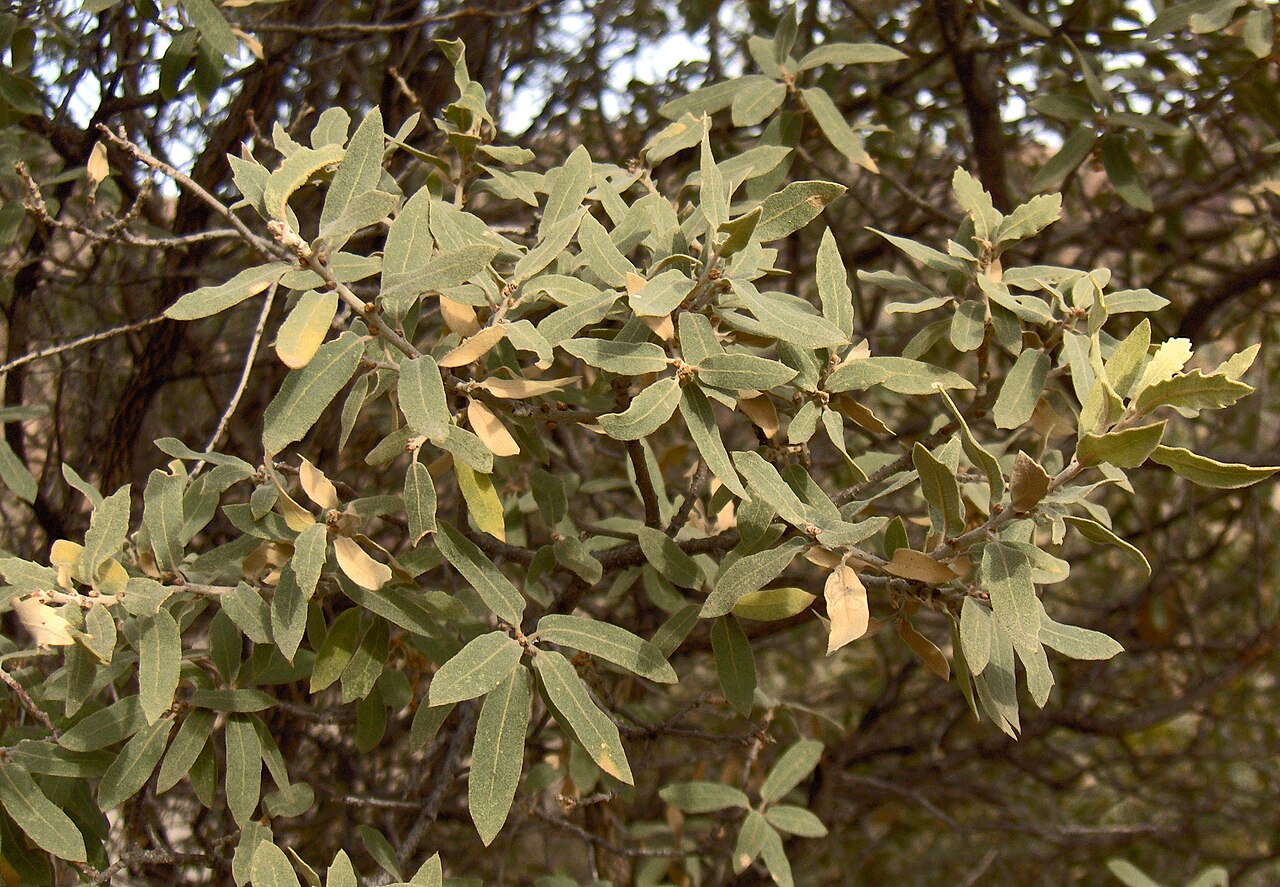
Bark is light gray and fissured into small, somewhat square or checkered plates — paler and rougher than the dark bark of the live oaks farther east and south. Young twigs are stout, reddish-brown, and covered in fine gray down, which fades as the stem matures.
Leaves
Leaves are evergreen to tardily deciduous (dropping in a hard winter or extended drought), leathery, and oblong to elliptic, 1 to 2 inches long, with entire or finely toothed margins. The defining field mark is color: leaves are a dusty, grayish blue-green above and felted gray beneath, giving the whole plant a distinctive pale, dusty look at a distance that is the easiest way to pick it out among the region’s many small oaks.
Flowers
Male catkins are slim, yellowish-green, and appear with new growth in spring, typically March through May depending on elevation and that year’s moisture. Female flowers are tiny, reddish, and inconspicuous, in the leaf axils of new growth.
Fruit & Seeds
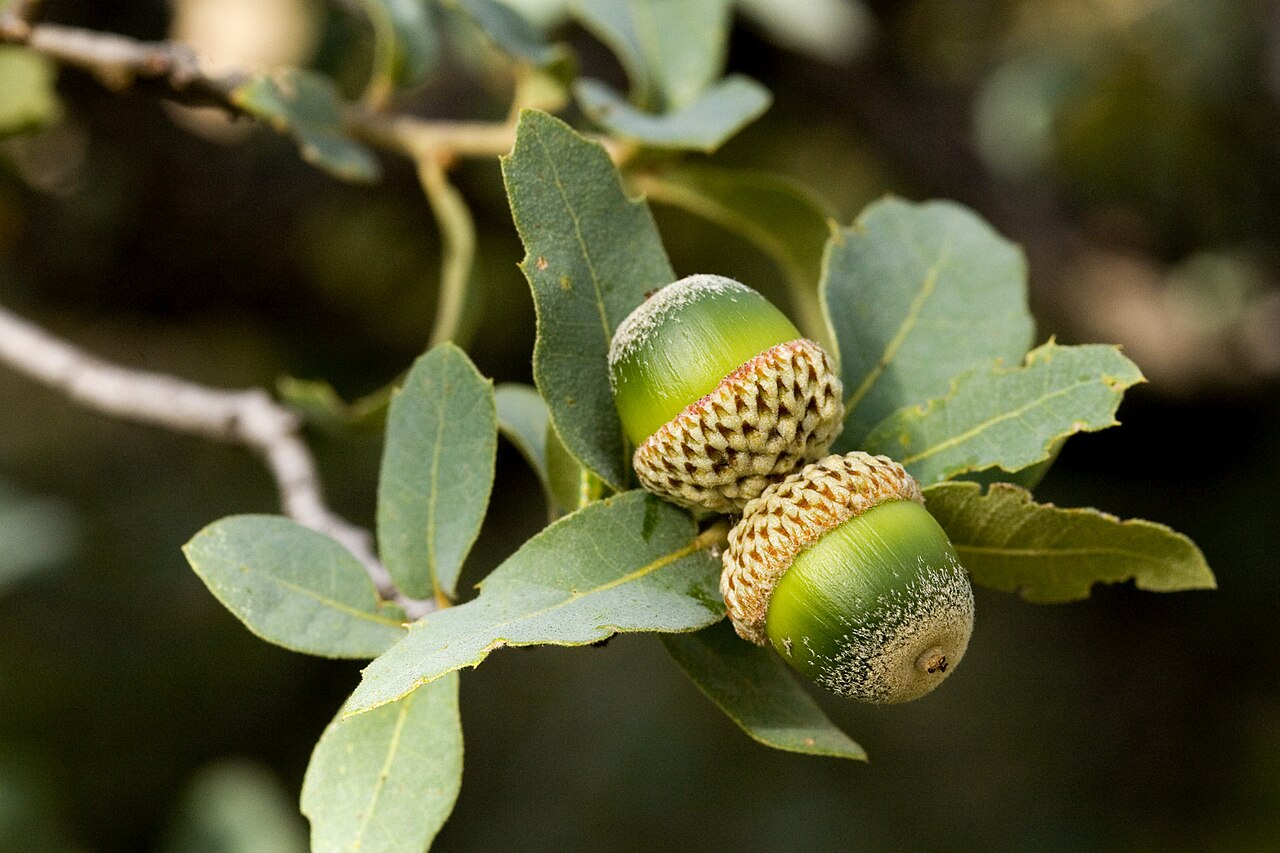
Acorns are oval, roughly ½ to ¾ inch long, borne singly or in pairs, and sit in a shallow, scaly, finely hairy cup that covers about half the nut. They mature in one season and are light brown at ripeness, typically dropping in fall.
Quick Facts
| Scientific Name | Quercus grisea |
| Family | Fagaceae (Beech) |
| Plant Type | Evergreen to Semi-Evergreen Shrub or Small Tree |
| Mature Height | 6–30 ft (shrubby on dry sites, tree-form in moist canyons) |
| Mature Spread | 8–20 ft |
| Growth Rate | Slow |
| Sun Exposure | Full Sun to Part Shade |
| Water Needs | Low; good drought tolerance |
| Soil Type | Rocky, igneous or limestone-based; well-drained |
| Soil pH | Neutral to alkaline |
| Bloom Time | March – May |
| Flower Color | Yellowish-green (catkins) |
| Fall Color | None to bronze in hard winters |
| Fruit | Small oval acorns, scaly hairy cups |
| Deer Resistant | No (foliage and acorns browsed) |
| USDA Hardiness Zones | 6 – 9 |
Native Range
Gray Oak occurs through the mountains and foothills of the American Southwest, with its core range in New Mexico and Arizona, extending into the Trans-Pecos region of west Texas — where it is common in the Chisos and Davis Mountains and easily seen in Big Bend National Park — and into the southern Rocky Mountain foothills of Colorado. South of the border it continues through the Sierra Madre and central highlands of Mexico.
It is a mountain and foothill species, typically found between roughly 4,000 and 9,000 feet, growing on rocky, igneous or limestone-derived slopes, canyon sides, and streambanks in a semi-arid climate of mild winters, dry springs, and hot summers punctuated by monsoon rain. It is frequently found alongside Arizona White Oak, junipers, and pinyon pines in open woodland and chaparral-like plant communities.
Gray Oak is genuinely scarce through much of its range — more a characteristic presence than a dominant one — but it is locally abundant in favorable canyons and foothill woodlands. It is not a lowland desert plant and should not be confused with the many unrelated “scrub oak” species of hotter, lower desert habitats.
📋 Regional plant lists featuring Gray Oak: Arizona & New Mexico · Utah & Western Colorado (native to the western Colorado portion of this list’s area). Its west Texas range is not currently covered by a regional list on this site.
Growing & Care Guide
Gray Oak is a low-water, low-maintenance choice for southwestern gardens willing to accept its slow growth rate in exchange for genuine toughness and a long lifespan.
Light
Full sun to light part shade suits it best, matching the open woodland and rocky hillside conditions where it grows naturally. It tolerates intense high-elevation sun well.
Soil & Water
Plant it in rocky, well-drained soil — igneous or limestone-derived substrates both work, mirroring the geology of its native canyons. It is drought tolerant once established, needing supplemental water mainly during the first two to three years. Avoid heavy clay or poorly drained sites, which do not reflect its native rocky-slope habitat and can lead to root problems.
Planting Tips
Use small container stock and plant in fall or early spring at higher elevations to avoid transplanting into peak summer heat. Because growth is slow, be patient — this is a long-term planting, not a quick shade solution. Give it room; whether it develops as a single small tree or a spreading thicket depends partly on site conditions and partly on whether lower growth is pruned out.
Pruning & Maintenance
Prune in winter dormancy to shape or remove dead wood. Gray Oak resprouts readily from the root crown after fire, frost dieback, or heavy pruning, so renovation pruning of an overgrown shrub is generally well tolerated. It is not notably prone to oak wilt, which is primarily a concern for live oaks of Texas and the Southeast, but good pruning hygiene (clean tools, avoiding unnecessary wounds) is still good practice for any oak.
Landscape Uses
Gray Oak fits a specific but useful role in southwestern landscaping:
- Xeriscaping in higher-elevation, rocky southwestern gardens
- Wildlife hedgerow or thicket planting for cover and mast
- Erosion control on rocky slopes and canyon banks
- Native woodland restoration in oak-juniper-pinyon plant communities
- Low-water specimen shrub or small tree where space and patience allow
Wildlife & Ecological Value
Gray Oak is a steady, if modest, contributor to wildlife habitat across the mountain foothills and sky island ranges it occupies.
For Birds
Wild Turkey and a variety of resident and migratory songbirds feed on the acorn crop, while the dense branching of shrub-form plants offers nesting cover and protection from weather and predators in otherwise open, rocky terrain.
For Mammals
Acorns are eaten by deer, ground squirrels, and other small mammals, and the dense, often thicket-forming growth provides browse and shelter. Mule deer browse the foliage, particularly where it grows alongside more palatable woodland shrubs.
For Pollinators
Pollination is by wind, as in all oaks, but the plant hosts various moth and insect larvae, contributing to the food web that supports insectivorous birds in oak-juniper woodland.
Ecosystem Role
As one of the characteristic woody plants of Madrean oak-juniper-pinyon woodland, Gray Oak helps anchor thin mountain soils, provides mid-story structure in otherwise open terrain, and — through its root-crown resprouting — helps these woodlands recover after the periodic fires typical of the region.
Cultural & Historical Uses
Indigenous peoples of the Southwest historically gathered acorns from Gray Oak and related regional oaks, processing them to remove bitter tannins before grinding them into meal, much as other oak acorns were used across North America. The dense wood was used for tool handles and fuel, valued for burning hot and slow in a region where good firewood was not always abundant.
Because Gray Oak hybridizes with several related oaks — including Arizona White Oak, Gambel Oak, Mohr Oak, and Sandpaper Oak — where their ranges overlap, local identification and naming of “scrub oak” or “shin oak” in the Southwest has always been somewhat fluid, and the plant has never had the singular cultural prominence of the live oaks farther east. It remains, instead, a quietly essential part of the mountain woodlands it grows in.
Frequently Asked Questions
Is Gray Oak the same as the Scrub Oak sold at Southwest nurseries?
Not necessarily — “scrub oak” and “shin oak” are used loosely for several unrelated southwestern oak species, including Quercus turbinella. Confirm the scientific name, Quercus grisea, before buying if you specifically want this species.
Does Gray Oak get susceptible to oak wilt?
Oak wilt is primarily a disease of live oaks and red oaks in Texas and the Southeast; it is not a major documented concern for Gray Oak in its mountain Southwest range, though general good pruning hygiene is still wise for any oak.
How tall does Gray Oak get?
It is usually a shrub 6 to 15 feet tall on dry, exposed sites, but can grow into a small tree 20 to 30 feet tall in moister canyon settings with deeper soil.
What elevation does Gray Oak need?
It is a mid-to-high elevation mountain species, typically found between about 4,000 and 9,000 feet — it is not adapted to low desert heat.
Is Gray Oak drought tolerant?
Yes, once established. It grows naturally on thin, rocky soils in a semi-arid climate and needs little supplemental water beyond the first few years after planting.

Looking for a nursery that carries Gray Oak?
Browse our native plant nursery directory: New Mexico · Arizona · Texas · Colorado