
Coastal Plain Willow (Salix caroliniana)
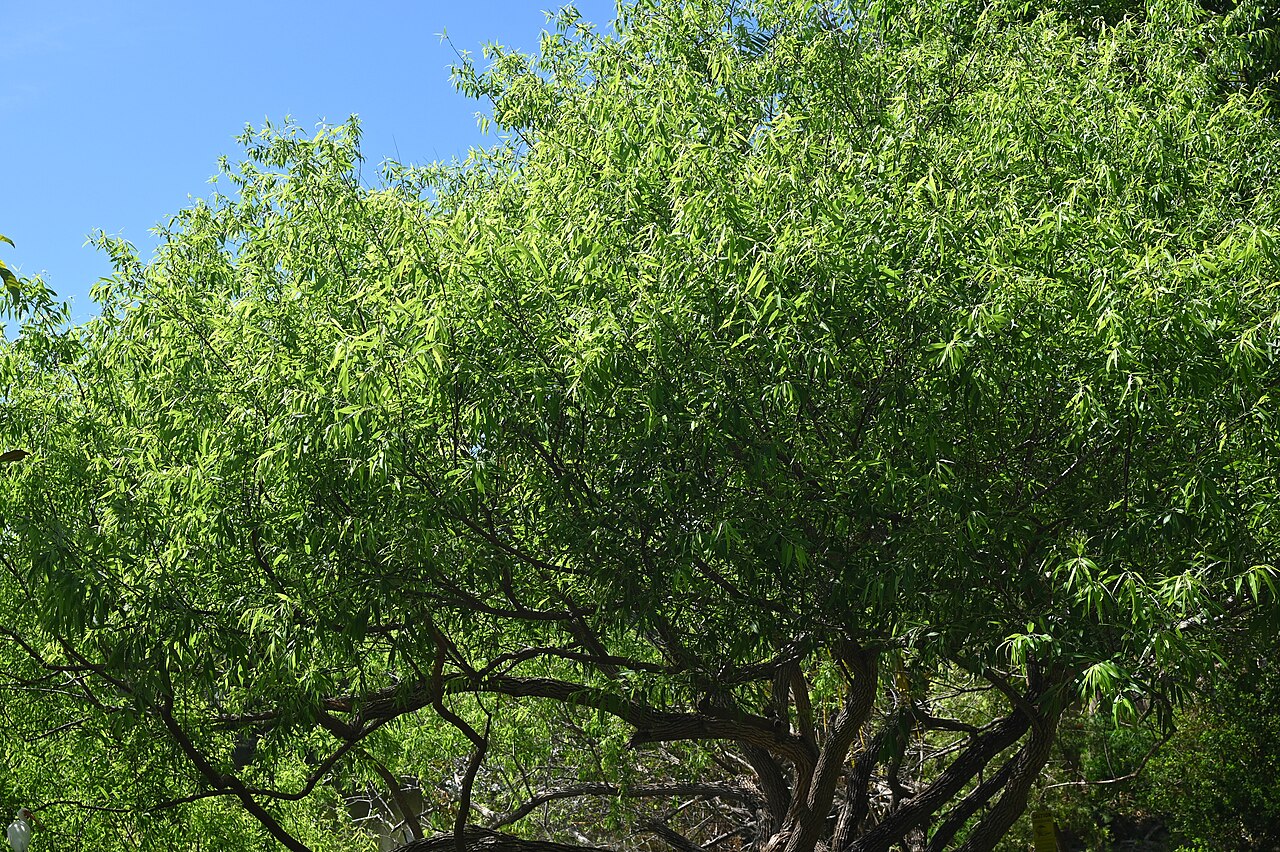
Salix caroliniana, known as Coastal Plain Willow or Carolina Willow, is the common streamside and swamp-edge willow of the southeastern United States, a fast-growing small tree that thrives with its roots in standing water. It is one of the most familiar native trees along the shores of Florida’s lakes and the Everglades, where it often grows as an emergent species rooted directly in shallow water, forming the dense willow “heads” that dot the sawgrass marsh.
A member of the Salicaceae (willow family), Coastal Plain Willow typically grows as a multi-stemmed large shrub or small tree 15 to 30 feet tall, with slender, often drooping branches and narrow, finely toothed leaves that are silvery-green beneath. Like all willows, it is dioecious — male and female catkins appear on separate plants — and its early-spring blooms are an important nectar and pollen source for bees at a time when little else is flowering.
Coastal Plain Willow is prized in restoration and rain-garden work for its ability to stabilize wet, eroding soil along streambanks, pond margins, and the edges of retention ponds, while asking for almost nothing from the gardener beyond consistently wet ground. It is also an obligate wetland species, meaning it is found almost exclusively in wet or seasonally flooded soils and is a reliable indicator of wetland habitat.
Identification
Coastal Plain Willow grows as a shrubby, multi-trunked small tree, typically 15 to 30 feet tall, occasionally taller, with a rounded, somewhat open crown and slender, flexible branches.
Bark & Stems
Young twigs are slender, reddish-brown to yellow-brown, and often finely hairy when new, becoming smooth with age. Older bark is gray-brown and develops shallow, somewhat scaly ridges. Like other willows, the wood is soft, light, and brittle at the joints, and branches break easily in storms.
Leaves
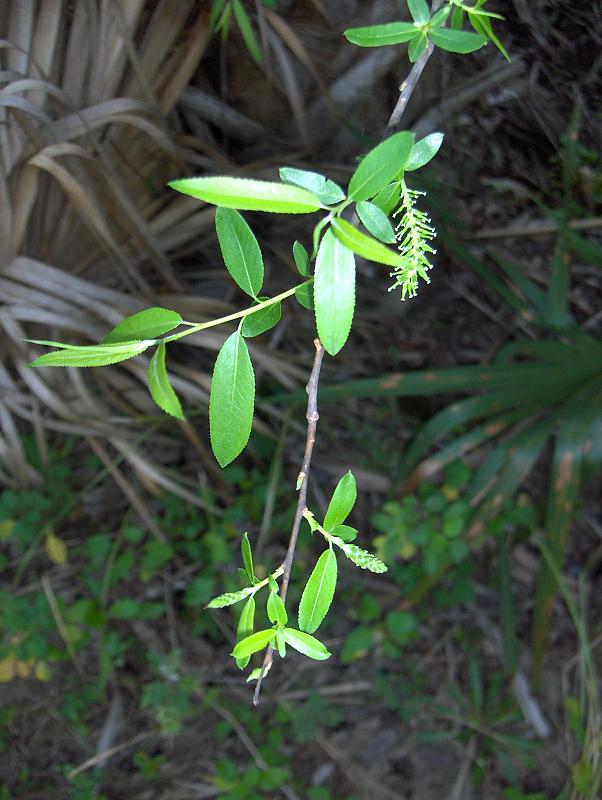
Leaves are simple, alternate, and narrowly lance-shaped, 2 to 6 inches long and less than an inch wide, tapering to a slender point. The upper surface is dull to shiny green; the underside is distinctly whitish or silvery with fine hairs, a useful field mark that separates it from Black Willow (Salix nigra), whose leaves are green on both sides. Margins are finely and evenly toothed.
Flowers & Fruit
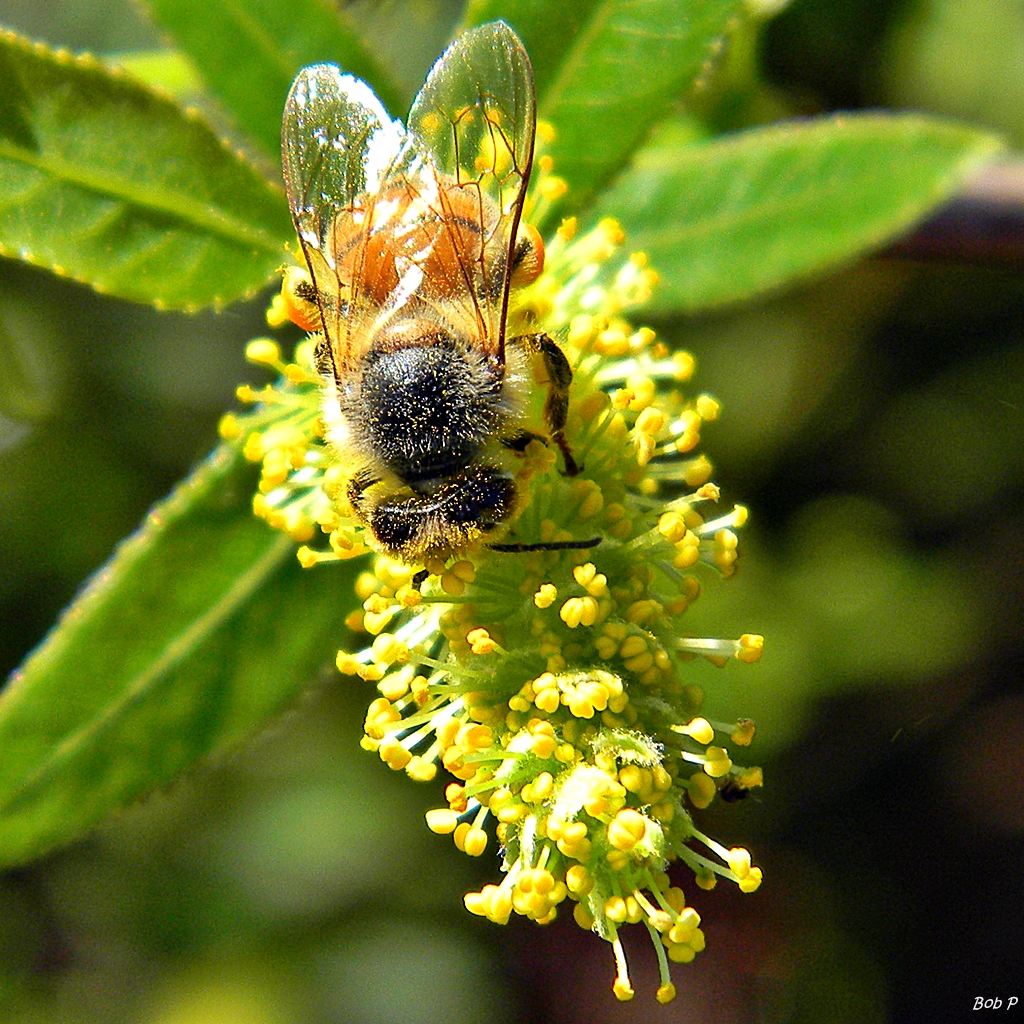
Flowers appear in late winter to early spring, before or with the new leaves, as upright, cylindrical catkins 1 to 2½ inches long. Male catkins are showier, covered in pollen-laden yellow stamens that draw honeybees and native bees; female catkins are slimmer and greenish. Fertilized female catkins mature into clusters of small capsules that split open to release tiny seeds carried on cottony tufts, typically in late spring.
Quick Facts
| Scientific Name | Salix caroliniana |
| Family | Salicaceae (Willow) |
| Plant Type | Deciduous Tree / Large Shrub |
| Mature Height | 15–30 ft |
| Mature Spread | 15–25 ft, multi-stemmed |
| Growth Rate | Fast |
| Sun Exposure | Full Sun to Part Shade |
| Water Needs | Wet; tolerates standing water |
| Soil Type | Wet sand, muck, or clay along water |
| Soil pH | 5.5–7.5 |
| Bloom Time | Late winter to early spring |
| Flower Color | Yellow (male) / greenish (female) catkins |
| Fall Color | Yellow-green, not showy |
| Fruit | Small capsules with cottony-tufted seeds |
| Deer Resistant | No (deer and rabbits browse young growth) |
| USDA Hardiness Zones | 7–11 |
Native Range
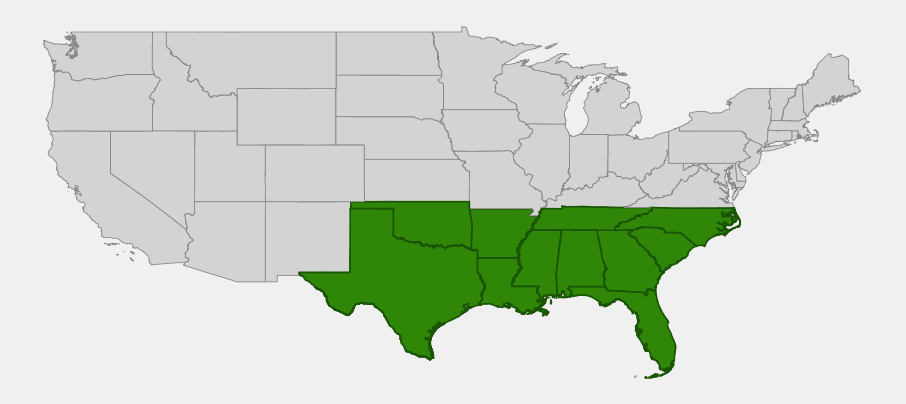
Coastal Plain Willow is native to the southeastern United States, with its heaviest concentration across Florida and the Gulf and South Atlantic coastal plains. It ranges from North and South Carolina south through Georgia, Alabama, Mississippi, Louisiana, and Florida, and west through Arkansas, Oklahoma, and Texas, with outlying populations in Tennessee. Its range also extends south into Mexico, Central America, and the Caribbean.
Within this range it is a classic wetland-edge tree, found along the banks of rivers, streams, lakes, and ponds, in cypress sloughs, and as an emergent species rooted in shallow standing water in the Everglades and similar marsh systems. It is especially abundant in central and southern Florida, where it is one of the dominant woody colonizers of disturbed wet ground and lake margins.
Despite its broad native range across the Southeast, Coastal Plain Willow is strictly a wetland species and should not be planted on dry upland sites, where it performs poorly; gardeners farther north or outside its mapped range should instead look to locally native willows such as Black Willow (Salix nigra).
📋 Regional plant lists featuring Coastal Plain Willow: Georgia, Alabama & Mississippi · Arkansas, Louisiana, Eastern Oklahoma & Eastern Texas · North Carolina & South Carolina · Kentucky & Tennessee
Growing & Care Guide
Coastal Plain Willow is one of the easiest native trees to establish in consistently wet ground, asking little more than water and sun. It is a workhorse for restoration plantings, rain gardens, and pond edges throughout its range.
Light
Best growth and the densest flowering occur in full sun, though it tolerates light shade along forested stream edges. In heavier shade it becomes leggier and flowers less.
Soil & Water
This willow wants consistently wet soil and tolerates periodic flooding and even permanently saturated or standing water better than almost any other small tree in its range. It grows in sand, muck, or clay as long as moisture is reliable, and it is not a good choice for average or dry garden soil, where it will struggle and decline.
Planting Tips
Plant bare-root or container stock in late winter to early spring. Coastal Plain Willow roots easily from live stakes and cuttings pushed directly into wet soil, making it one of the fastest and cheapest ways to stabilize an eroding streambank or pond edge. Space multi-stemmed clumps 10 to 15 feet apart for a naturalistic thicket, or further apart for individual specimen trees.
Pruning & Maintenance
Prune out dead, crossing, or storm-damaged wood in late winter while dormant; the brittle branches are prone to breakage in wind, so avoid planting directly over structures or parking areas. The tree responds well to hard coppicing if a denser, shrubbier form is desired.
Propagation
Coastal Plain Willow propagates readily from hardwood cuttings or live stakes taken in the dormant season and set directly into moist soil, a technique widely used in streambank bioengineering and wetland restoration.
Landscape Uses
Coastal Plain Willow earns its keep in several wet-site roles:
- Streambank and pond-edge stabilization using live stakes or rooted whips
- Rain gardens and stormwater basins that hold water after storms
- Wetland and wildlife habitat restoration plantings
- Screening or informal hedging along wet property lines
- Erosion control on lakeshores and marsh edges
Wildlife & Ecological Value
Coastal Plain Willow punches above its weight ecologically, supporting pollinators, birds, and the broader wetland food web.
For Pollinators
Blooming in late winter and early spring when few other plants are flowering, its catkins are a critical early nectar and pollen source for honeybees and native bees emerging from dormancy, as well as for some of the first butterflies of the season, including mourning cloaks and question marks that overwinter as adults.
For Birds
Dense willow thickets along water provide nesting cover and foraging habitat for red-winged blackbirds, warblers, and other wetland-edge songbirds; the tiny willow seeds and the insects the foliage attracts are both part of the food supply.
For Mammals & Other Wildlife
White-tailed deer and rabbits browse the young shoots, and beavers use willow stems for both food and construction material where their ranges overlap. The dense root systems along stream edges also shelter fish and amphibians by stabilizing banks and shading the water.
Ecosystem Role
As a pioneer species on freshly disturbed or flooded wet ground, Coastal Plain Willow stabilizes soil, filters runoff before it reaches open water, and often forms the first woody structure that allows other wetland trees and shrubs to establish nearby.
Cultural & Historical Uses
Like other willows, Coastal Plain Willow bark contains salicin, the compound from which aspirin was originally derived, and Indigenous peoples across its range historically chewed or brewed willow bark for its pain-relieving and fever-reducing properties. This is a documented historical use, not a recommendation — modern willow-bark preparations are not standardized and should not substitute for medical treatment.
The flexible young stems have long been used in basketry and simple woven construction by Indigenous peoples and later settlers throughout the Southeast, taking advantage of the willow’s fast growth and pliable wood. Live willow stakes cut and replanted directly in wet soil were also a traditional, low-cost way to stabilize streambanks long before the term “bioengineering” existed.
Today, Coastal Plain Willow is valued mainly for restoration and erosion-control work rather than timber, since the wood is soft, light, and not durable; its greatest contribution remains ecological rather than economic.
Frequently Asked Questions
How is Coastal Plain Willow different from Black Willow?
The easiest field mark is the leaf underside: Coastal Plain Willow leaves are whitish or silvery beneath, while Black Willow (Salix nigra) leaves are green on both sides. Coastal Plain Willow is also more concentrated in the Deep South and Florida, while Black Willow ranges much farther north.
Can Coastal Plain Willow grow in a normal, dry garden bed?
No. It is an obligate wetland species that needs consistently wet to saturated soil. In average or dry soil it grows poorly and often declines within a few years.
Does Coastal Plain Willow have showy flowers?
The catkins are modest rather than showy, but they bloom very early in the season when they are an important nectar source for bees — their value is ecological more than ornamental.
Is Coastal Plain Willow a good tree to plant near a house?
Its brittle, fast-growing branches are prone to storm breakage, and its water-seeking roots can be aggressive near pipes or foundations in wet soil, so it is best planted well away from structures, along open streambanks, pond edges, or in dedicated wetland plantings.
Is willow bark safe to use as medicine?
Willow bark has a long history of traditional use for pain and fever, but homemade preparations are not standardized in dosage and can cause stomach upset or interact with medications; this is historical context, not a treatment recommendation.

Looking for a nursery that carries Coastal Plain Willow?
Browse our native plant nursery directory: Alabama & Arkansas · Florida & Georgia · Louisiana & Mississippi · North Carolina & Oklahoma · South Carolina, Tennessee & Texas