Hairy Golden Aster (Heterotheca villosa)
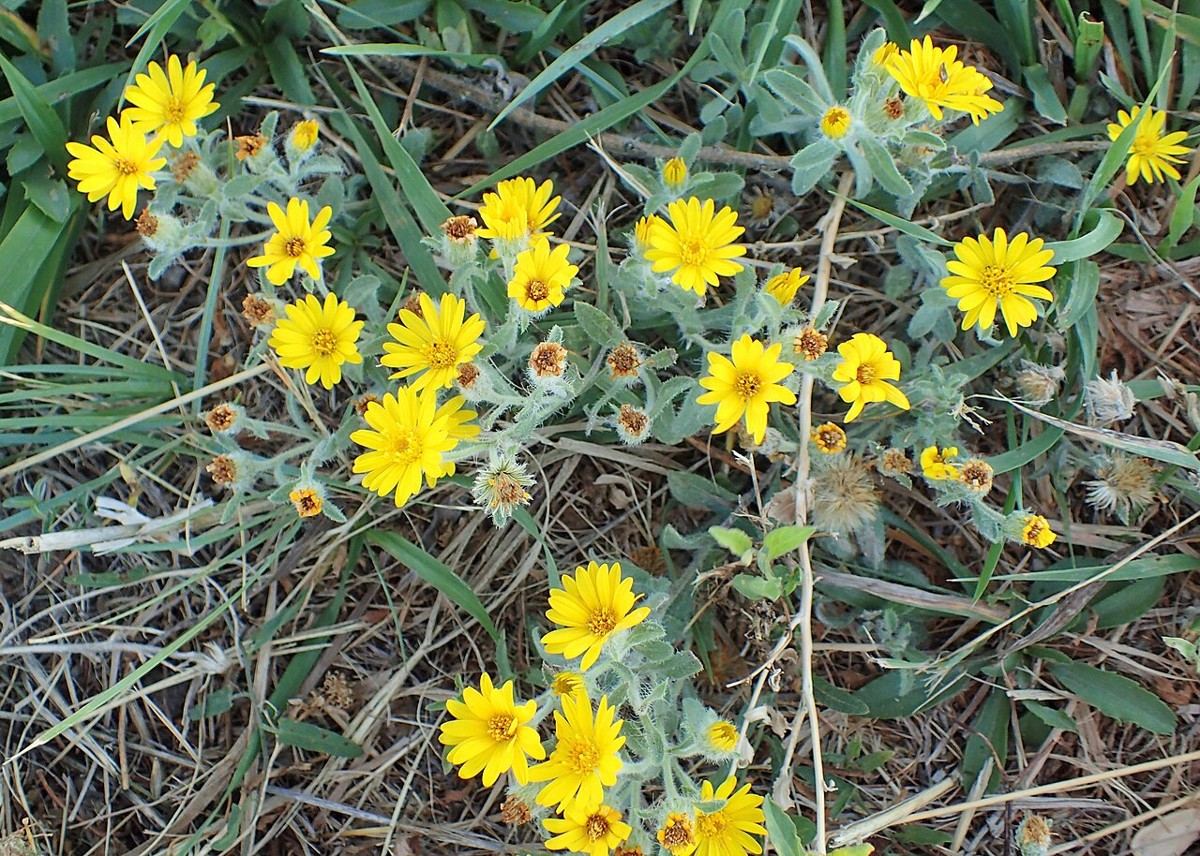
Heterotheca villosa, commonly called hairy golden aster or hairy false goldenaster, is a low, shrubby perennial wildflower of the Asteraceae (aster) family found throughout dry, open country across the western and central United States. Its gray-green foliage, covered in fine silvery hairs, forms spreading mounds that burst into masses of bright yellow, daisy-like flowers from midsummer into fall, often when little else is still blooming.
Hairy golden aster is a tough, sun-loving plant of rocky slopes, sandy plains, roadsides, and open pine or sagebrush country, from low desert basins to subalpine meadows. Its dense coat of hairs gives the whole plant a soft, grayish cast and helps it conserve moisture through long dry spells, making it one of the most drought-tolerant native wildflowers available for western gardens.
In the landscape, hairy golden aster earns its keep as a long-blooming, low-water groundcover or border plant that asks for almost nothing once established. Its late-season flowers are a magnet for native bees and butterflies at a time of year when nectar sources are scarce, making it a quietly valuable addition to any pollinator garden in its native range.
Identification
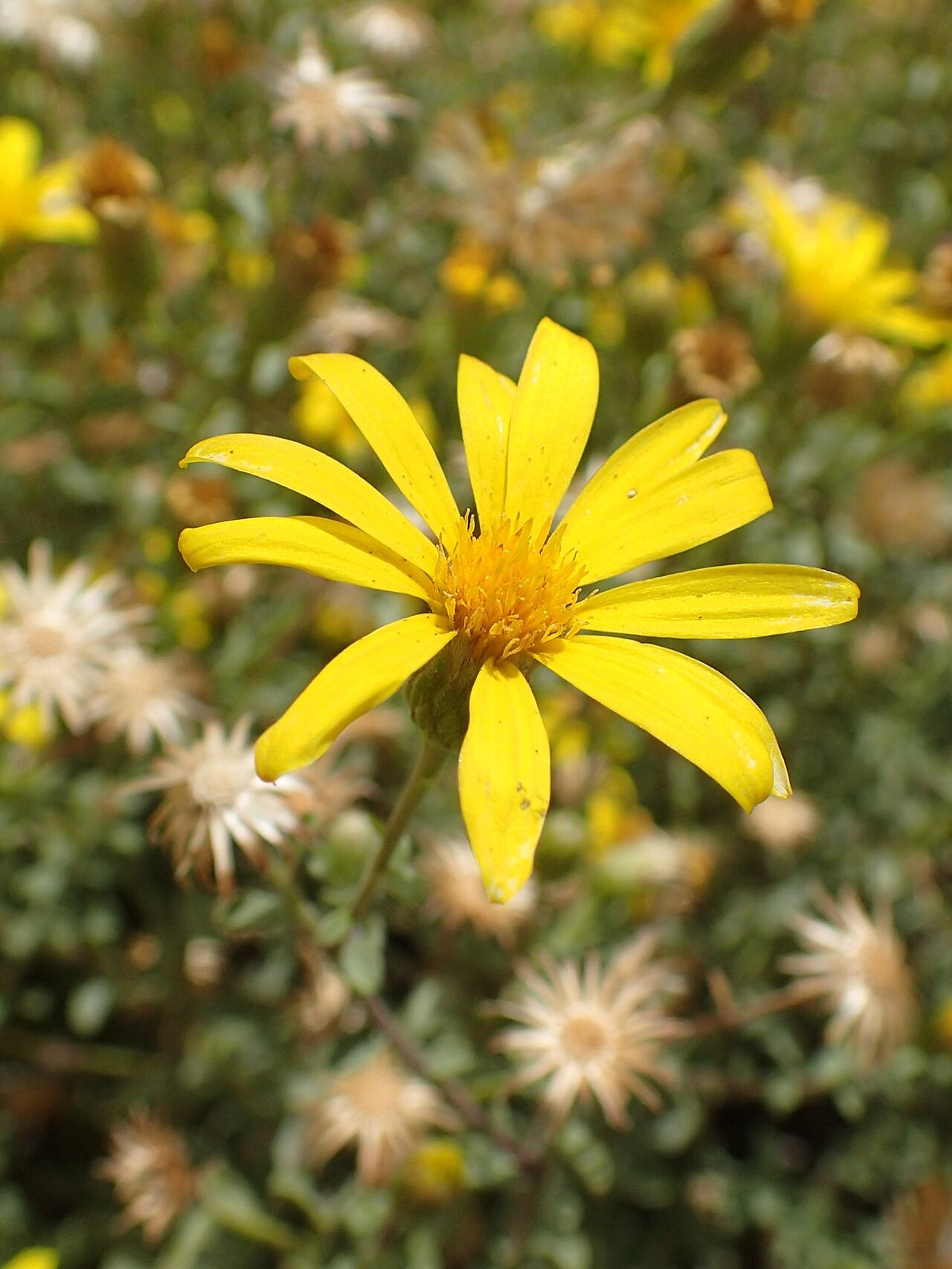
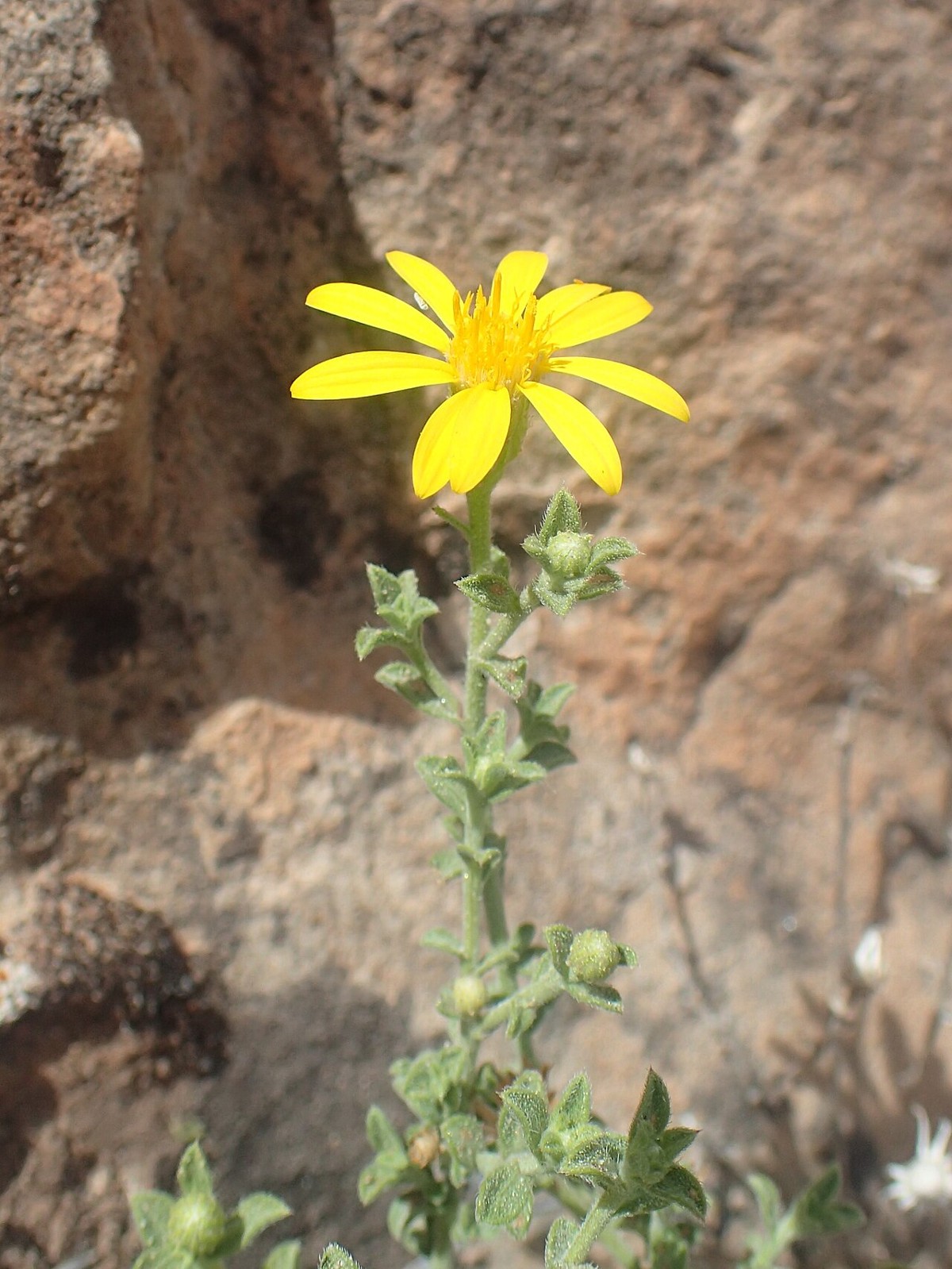
Hairy golden aster is a woody-based perennial that forms low, rounded clumps, typically 6 to 18 inches tall and somewhat wider, though plants in favorable sites can reach 2 feet. The entire plant — stems, leaves, and flower bracts — is covered in dense, soft, spreading hairs that give it a grayish-green or silvery appearance and a slightly sticky, resinous feel.
Stems
Stems are numerous, branching from a woody base, and ascending to erect. They are stiff but not truly woody above the base, and the dense hairiness is especially noticeable along young growth.
Leaves
Leaves are simple, alternate, and sessile (stalkless), ranging from narrowly oblong to lance-shaped, usually ¾ to 2 inches long. They are gray-green and densely hairy on both surfaces, with smooth (entire) margins. Basal leaves are often somewhat larger than those higher on the stem.
Flowers
Flower heads are bright yellow and daisy-like, about ¾ to 1½ inches across, with 15 to 35 narrow ray florets surrounding a cluster of yellow disk florets. Heads are borne singly or in loose, open clusters at the stem tips. Bloom runs from June into October, peaking in late summer, and is among the longest-flowering of the western native asters.
Fruit & Seeds
Like other asters, the fruit is a small, hairy achene topped with a tuft of bristly pappus that carries the seed on the wind, similar to a miniature dandelion seed.
Quick Facts
| Scientific Name | Heterotheca villosa |
| Family | Asteraceae (Aster) |
| Plant Type | Herbaceous / Woody-based Perennial |
| Mature Height | 6 in – 2 ft |
| Mature Spread | 1–2 ft |
| Growth Rate | Moderate |
| Sun Exposure | Full Sun |
| Water Needs | Low |
| Soil Type | Dry, well-drained; sandy, rocky or gravelly |
| Soil pH | 6.0–8.0 (neutral to alkaline) |
| Bloom Time | June – October |
| Flower Color | Yellow |
| Fall Color | Gray-green foliage persists; no notable fall color change |
| Fruit | Small hairy achene with bristly pappus |
| Deer Resistant | Yes (aromatic, hairy foliage generally avoided) |
| USDA Hardiness Zones | 3–9 |
Native Range
Hairy golden aster is one of the most widely distributed native wildflowers of western and central North America, ranging from the Pacific slopes of Washington, Oregon, and California east across the Rocky Mountain states to the Great Plains of Nebraska, Kansas, and the Dakotas. County-level botanical records confirm it as a native, well-established species across this entire swath of dry country, from low desert basins to mountain foothills and high plains.
Across this huge range, hairy golden aster occupies dry, open, often disturbed or rocky ground: sagebrush flats, shortgrass and mixed-grass prairie, piñon-juniper and ponderosa pine woodlands, roadcuts, and gravelly slopes. It is strongly associated with full sun and well-drained soils, and it tolerates heat, cold, wind, and extended drought better than almost any other native aster.
Because its range spans so many climate zones, local populations vary somewhat in height, hairiness, and bloom timing, and botanists recognize several regional varieties. All share the same basic appearance and the same preference for dry, sunny, open sites, and all are valuable, low-maintenance choices for native gardens throughout their home range.
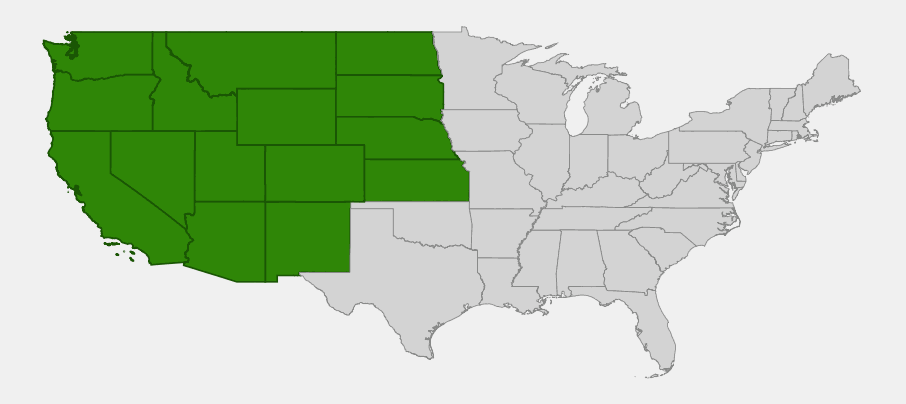
📋 Regional plant lists featuring hairy golden aster: California & Nevada · Arizona & New Mexico · Utah & Western Colorado · Nebraska, Kansas & Eastern Colorado · Montana & Wyoming · Idaho, Eastern Oregon & Eastern Washington · North Dakota, South Dakota & Western Minnesota
Growing & Care Guide
Hairy golden aster is about as forgiving as native wildflowers come. It thrives on neglect, making it an excellent choice for dry, sunny spots where many other perennials struggle.
Light
Give it full sun. This species flowers sparsely and grows leggy in shade; it needs at least six to eight hours of direct sun to form its characteristic tight, floriferous mounds.
Soil & Water
Plant it in lean, fast-draining soil — sandy, gravelly, or rocky ground is ideal, and heavy clay should be amended with grit before planting. Once established, hairy golden aster needs little to no supplemental water and is genuinely drought tolerant; overwatering or rich soil tends to produce floppy, short-lived plants.
Planting Tips
Set out container plants in spring or fall, spacing them 12 to 18 inches apart to allow for their spreading habit. Avoid mulching heavily around the crown, since good air circulation and dry conditions at the base help prevent rot in humid spells.
Pruning & Maintenance
Shear plants back by about a third in late winter or early spring to keep growth compact and encourage fuller bloom. Deadheading spent flower heads can extend the bloom season, though leaving some seed heads in place benefits seed-eating birds.
Propagation
Propagate from seed sown in fall or stratified seed sown in spring, or by dividing established clumps. Softwood cuttings taken in early summer also root readily.
Landscape Uses
- Xeriscaping and water-wise gardens in hot, dry sites
- Rock gardens and gravel beds
- Dry slopes and roadside plantings for erosion control
- Pollinator gardens — especially valuable for late-season nectar
- Border edging or mass planting as a low, mounding groundcover
Wildlife & Ecological Value
For Pollinators
Hairy golden aster is an important late-season nectar and pollen source, visited heavily by native bees, honeybees, butterflies, and skippers at a time when many other flowers have finished blooming. Its long bloom window helps bridge the gap between summer and fall-flowering species.
For Birds
Seed-eating birds, including sparrows and finches, feed on the ripe achenes through fall and into winter if seed heads are left standing.
For Mammals
The dense, hairy foliage is generally unpalatable to deer and most browsing mammals, which is part of why the species persists so well on heavily grazed rangeland.
Ecosystem Role
As a drought-tolerant pioneer of disturbed and open ground, hairy golden aster helps stabilize dry, exposed soils on slopes and roadcuts, and its long bloom period supports pollinator communities through the leanest part of the growing season.
Cultural & Historical Uses
Several Indigenous peoples across the plant’s extensive range used hairy golden aster and related Heterotheca species in traditional medicine, including as a treatment for headaches and as a smoke or poultice for various ailments. These uses are documented in historical ethnobotanical records and are noted here as history, not as guidance for use.
The plant’s drought tolerance and persistence on marginal land have made it a useful indicator species for rangeland ecologists studying dry grassland and sagebrush steppe condition across the Intermountain West.
In more recent decades, hairy golden aster has gained attention as a low-water landscaping plant, appearing in xeriscape and native-plant demonstration gardens throughout its range as water-conscious gardening has grown in popularity.
Frequently Asked Questions
Is hairy golden aster easy to grow?
Yes. It is one of the easiest native wildflowers to establish, as long as it has full sun and well-drained soil. Its biggest enemy is kindness — too much water or rich soil weakens the plant.
Does hairy golden aster spread aggressively?
No. It forms a slowly expanding clump rather than running or self-seeding aggressively, making it well behaved in garden beds.
What months does it bloom?
Bloom typically runs from June through October, with the heaviest flowering in late summer, making it one of the longer-blooming native perennials for dry gardens.
Is hairy golden aster deer resistant?
Generally yes. Its dense, hairy, somewhat resinous foliage is not a preferred browse for deer, though no plant is completely deer-proof under heavy pressure.
Can it be grown outside its native range?
It is best kept within its native dry western and central states, where it supports local pollinators and fits local growing conditions. In wetter eastern climates it tends to struggle with excess humidity and soil moisture.

Looking for a nursery that carries hairy golden aster?
Browse our native plant nursery directory: California · Arizona · Colorado · Idaho & Kansas · Montana · Nebraska, Nevada, New Mexico & North Dakota · Oregon · South Dakota & Utah · Washington · Wyoming