Mountain Silverbell (Halesia tetraptera)
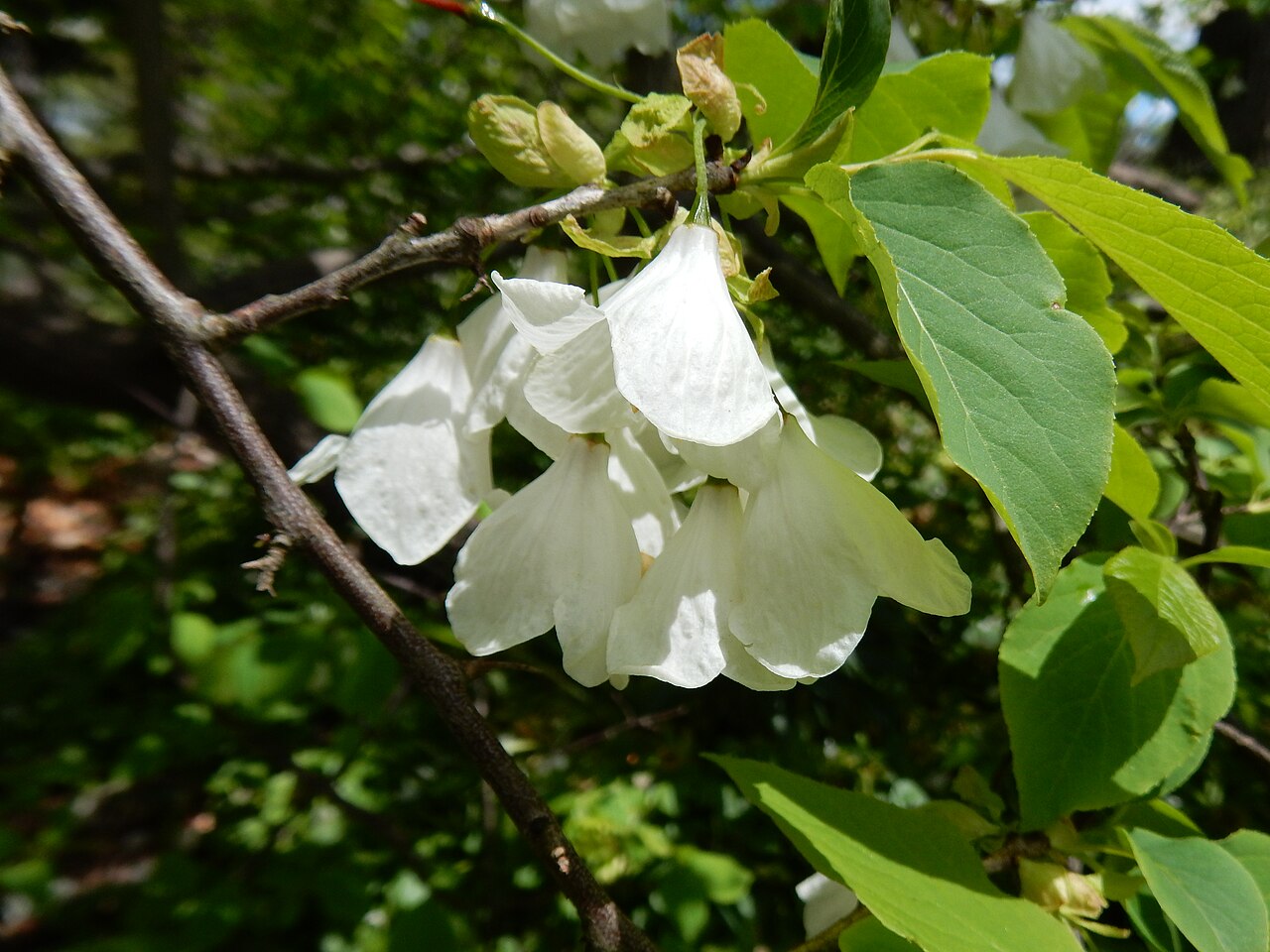
Halesia tetraptera, commonly called Mountain Silverbell, is a small to medium native flowering tree of the Appalachian Mountains, prized for the drifts of dangling, bell-shaped white flowers that cover its branches each spring before the leaves fully expand. It belongs to the storax family (Styracaceae) and is one of the signature understory and mid-canopy flowering trees of Appalachian cove forests, often blooming alongside flowering dogwood, serviceberry, and redbud to create one of the most striking native spring displays in the eastern mountains.
Taxonomically, Mountain Silverbell has a tangled history. USDA PLANTS currently lists Halesia tetraptera and Halesia carolina as two separate accepted names, though many botanists have treated the widespread, often larger-growing mountain populations traditionally as Halesia carolina var. monticola, a robust upland form distinct from the typically smaller-statured Halesia carolina of the Piedmont and coastal plain. This page follows that distinction and treats Mountain Silverbell as the higher-elevation, Appalachian Mountain population of the species complex, separate from the lower-elevation Carolina Silverbell profiled elsewhere on this site, even though the two intergrade in places and share nearly all of their natural history, flowers, and landscape uses.
Mountain Silverbell typically grows 30 to 60 feet tall in the wild, sometimes considerably taller in favorable cove-forest sites, with a rounded to irregular crown and smooth gray bark that develops shallow furrows and scaly ridges with age. In cultivation it is valued as one of the best native flowering trees for part shade, offering a long season of interest from its April flower display through fall color and winged seed pods that persist into winter.
Identification
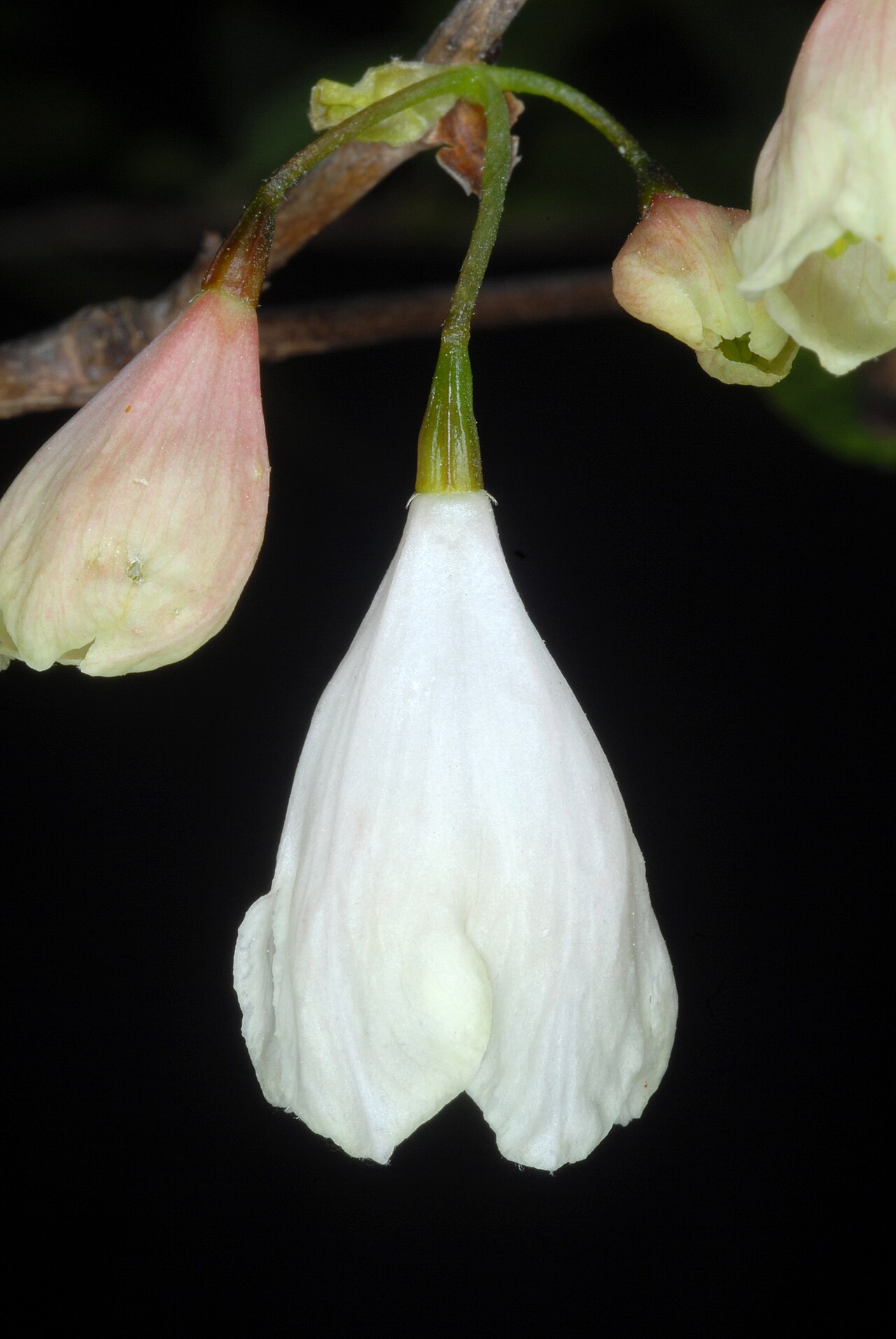
Mountain Silverbell is best identified in bloom by its abundant, pendulous, bell-shaped white (occasionally pale pink) flowers hanging in clusters along bare or just-leafing branches, a distinctive silhouette among Appalachian understory trees in April and early May.
Bark & Stems
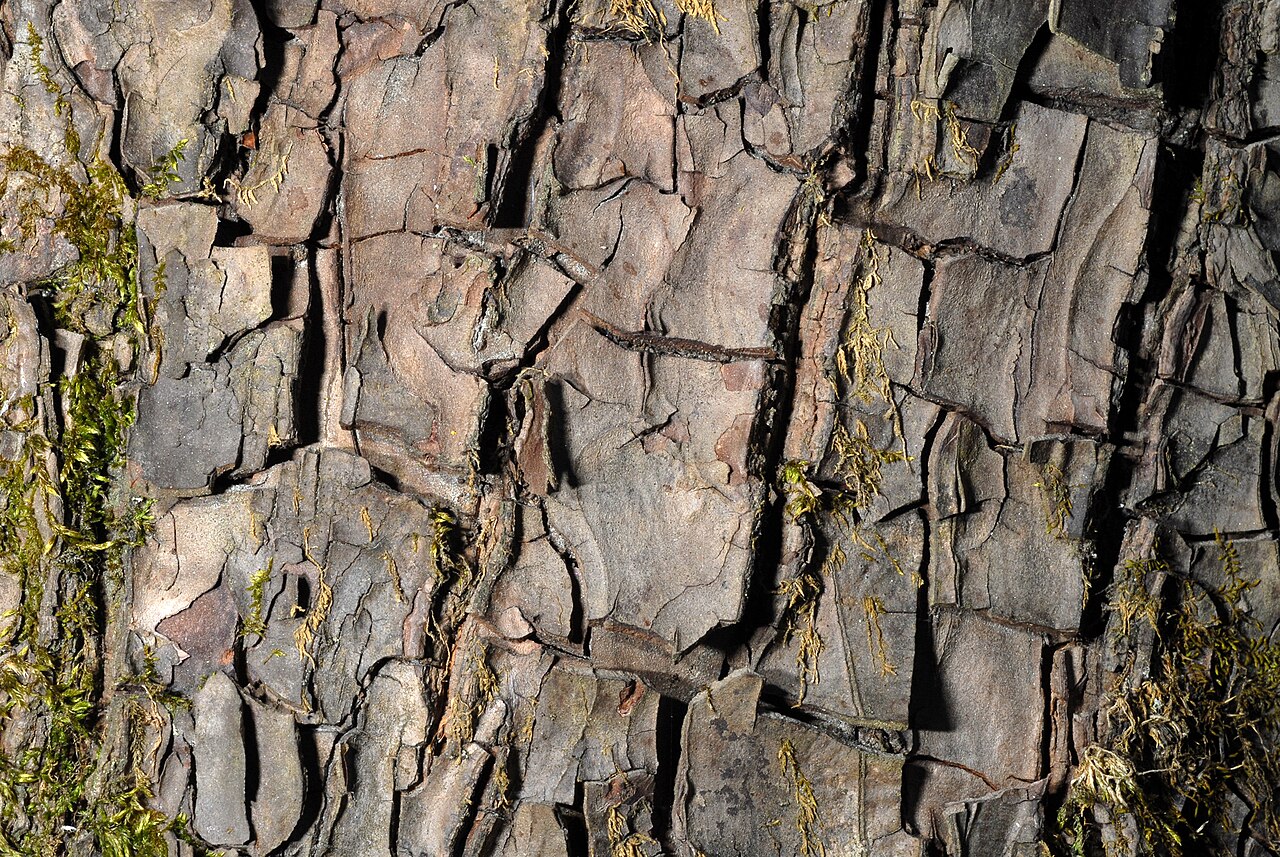
Young bark is smooth and gray, developing with age into shallow furrows separating flat, often blocky or scaly plates, sometimes taking on a mottled, almost puzzle-piece texture on older trunks. Twigs are slender and reddish-brown, with small, hairy buds.
Leaves
Leaves are simple, alternate, elliptical to oblong, 3 to 6 inches long, with finely toothed margins and a somewhat irregular, wavy surface texture. They emerge just as or shortly after the flowers open, are medium to dark green through summer, and turn a soft yellow in fall, a secondary but welcome season of interest.
Flowers
Flowers are white (rarely blushed pink), bell- or lantern-shaped, four-lobed, and about ½ to ¾ inch long, hanging in clusters of two to five on slender stalks along the previous year’s growth. They open in April to early May, often before or just as the leaves emerge, and are lightly fragrant, drawing early-season pollinators at a critical time in the spring nectar calendar.
Fruit & Seeds
The fruit is a distinctive four-winged, dry, woody capsule about 1 to 2 inches long, green ripening to tan-brown, persisting on the branches well into winter after the leaves have dropped. This four-winged seed pod is a reliable identification feature even outside the flowering season and gives the genus its scientific epithet, tetraptera (“four-winged”).
Quick Facts
| Scientific Name | Halesia tetraptera (syn. H. carolina var. monticola) |
| Family | Styracaceae (Storax) |
| Plant Type | Deciduous flowering tree |
| Mature Height | 30–60 ft |
| Mature Spread | 20–35 ft |
| Growth Rate | Moderate |
| Sun Exposure | Part shade to full sun |
| Water Needs | Moderate |
| Soil Type | Rich, moist, well-drained woodland soil |
| Soil pH | Slightly acidic |
| Bloom Time | April–early May |
| Flower Color | White, occasionally pale pink |
| Fall Color | Yellow |
| Fruit | Four-winged dry capsule, 1–2 in., persists into winter |
| Deer Resistant | Moderately |
| USDA Hardiness Zones | 5–8 |
Native Range
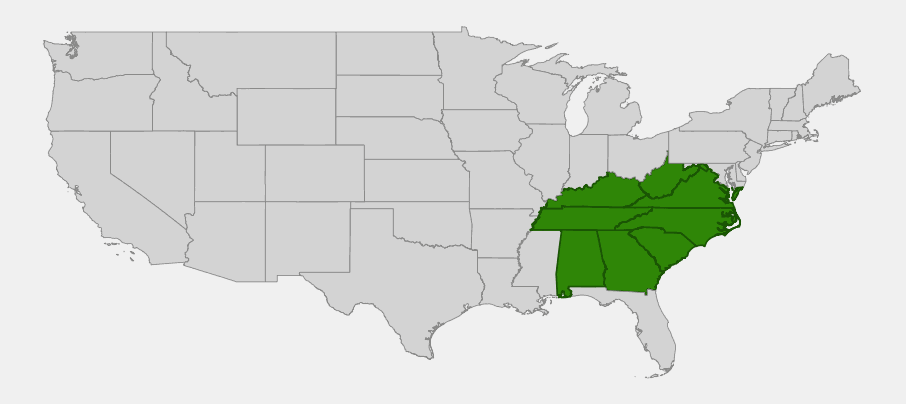
Mountain Silverbell is a tree of the Appalachian Mountains, found from the mountains of West Virginia and Virginia south through the Blue Ridge and Great Smoky Mountains of North Carolina, Tennessee, South Carolina, and Georgia into the mountains of northern Alabama, and west into the Cumberland Plateau and Appalachian foothills of eastern Kentucky. Within this range it is especially characteristic of rich, moist cove forests at middle to upper elevations, often growing alongside yellow buckeye, eastern hemlock, and American beech in some of the most botanically diverse forest communities in eastern North America.
This upland, mountain-centered distribution distinguishes Mountain Silverbell from the related Carolina Silverbell populations found at lower elevations across the Piedmont and coastal plain of the Southeast, which tend to grow in drier, more open woodland settings outside the high-elevation cove forest habitat favored here. The two forms intergrade where their ranges meet along the base of the mountains, which is part of why their taxonomic treatment has long been debated.
Mountain Silverbell is not native to the Atlantic or Gulf coastal plains, the Midwest, or anywhere outside the southern and central Appalachian uplands; plantings well outside this mountain range, however common in cultivation across the East, represent garden introductions rather than natural populations.
Native Range
| U.S. States | Alabama, Georgia, Kentucky, North Carolina, South Carolina, Tennessee, Virginia, West Virginia |
| Mexico or Canadian Provinces | None |
| Ecoregion | Southern and central Appalachian Mountains |
| Elevation Range | 1,000–5,000 ft |
| Habitat | Rich, moist cove forests, mountain stream bottoms |
| Common Associates | Yellow buckeye, eastern hemlock, American beech, tulip poplar |
📋 Mountain Silverbell is native to parts of the areas covered by Maryland, Virginia, and West Virginia, Kentucky and Tennessee, North Carolina and South Carolina, and Georgia, Alabama and Mississippi.
Growing & Care Guide
Light
Mountain Silverbell blooms best with at least a half day of sun but is naturally adapted to the dappled light of a forest understory and performs beautifully in part shade, making it a good choice for woodland gardens where many flowering trees struggle.
Soil & Water
This tree wants rich, moist, well-drained, slightly acidic soil reminiscent of its native cove-forest habitat. It does not tolerate prolonged drought or heavy, poorly drained clay well, and benefits from consistent soil moisture, especially while young.
Planting Tips
Site Mountain Silverbell where it will get morning sun and afternoon shade, or dappled light beneath taller canopy trees, mimicking its natural cove-forest setting. Amend heavy soils with organic matter to improve drainage and moisture retention, and mulch well to keep roots cool and moist.
Pruning & Maintenance
Prune after flowering to remove dead or crossing branches and shape young trees, since next year’s flower buds set on the current season’s growth soon after bloom. The species is relatively pest- and disease-free compared with many ornamental flowering trees, needing little routine maintenance once established.
Propagation
Propagate from seed, which has a complex double dormancy and often takes one to two years to germinate even after proper warm and cold stratification; many growers find softwood cuttings taken in early summer more reliable for producing new plants true to a selected form.
Landscape Uses
- Specimen flowering tree for woodland gardens and shaded landscapes
- Understory planting beneath taller native shade trees
- Native alternative to non-native ornamental flowering trees
- Spring-interest companion to dogwood, redbud, and serviceberry
- Restoration planting in cove-forest and mountain riparian settings
Wildlife & Ecological Value
For Pollinators
The abundant spring flowers are an important early-season nectar source for native bees, including bumblebees and mining bees emerging in April, as well as for hummingbirds passing through on migration when few other mountain trees are yet in bloom.
Birds
Songbirds use the tree’s branching structure for nesting and foraging for insects drawn to the flowers and foliage; the persistent winter seed capsules offer limited but available forage for some seed-eating birds in lean months.
Mammals
Squirrels and other small mammals occasionally feed on the seeds, and deer browse young foliage and twigs, though Mountain Silverbell is not a heavily preferred browse species.
Ecosystem Role
As a mid-canopy flowering tree characteristic of rich Appalachian cove forests, Mountain Silverbell contributes to the layered structure and spring floral diversity of one of the most species-rich temperate forest types in North America, and its early bloom helps sustain pollinator populations during a critical gap in the spring nectar flow.
Cultural & Historical Uses
Mountain Silverbell has long been admired by botanists and mountain residents alike for its spectacular, reliable spring flower display, and it was introduced into cultivation by plant collectors working in the southern Appalachians as early as the 18th century, making it one of the longer-cultivated native American flowering trees in both American and European gardens. Its light, close-grained wood saw occasional local use for small items, though it was never an important timber species given the tree’s modest size and scattered mountain distribution.
The genus name Halesia honors Stephen Hales, an 18th-century English clergyman and scientist known for pioneering work in plant physiology, reflecting the tree’s early place in the era’s scientific interest in newly described American flora.
Today Mountain Silverbell remains valued primarily as an ornamental and ecological restoration tree, cherished in both its native Appalachian cove forests and in gardens nationwide for the same quality that first drew early botanists to it: a dependable, graceful flush of white bell-shaped flowers each spring.
Frequently Asked Questions
What is the difference between Mountain Silverbell and Carolina Silverbell?
Mountain Silverbell refers to the typically larger, higher-elevation Appalachian Mountain populations of the Halesia carolina species complex, historically classified as H. carolina var. monticola, while Carolina Silverbell as commonly treated refers to the smaller-statured, lower-elevation Piedmont and coastal plain populations. The two intergrade where their ranges meet and share nearly identical flowers, fruit, and care requirements.
How fast does Mountain Silverbell grow, and how tall does it get?
It grows at a moderate pace and typically reaches 30 to 60 feet in the wild, generally staying somewhat smaller, around 25 to 40 feet, in cultivated landscape settings.
Does Mountain Silverbell need shade?
It tolerates and often thrives in part shade, reflecting its native cove-forest understory habitat, though it flowers most abundantly with at least several hours of direct sun.
When does Mountain Silverbell bloom?
Typically in April to early May in its native Appalachian range, often just before or as the leaves emerge, producing one of the showiest native spring flower displays in the eastern mountains.
Is Mountain Silverbell easy to grow from seed?
Not especially; seeds have a complex double dormancy and can take one to two years to germinate even with proper stratification, so many gardeners start with nursery-grown stock or propagate selected forms from softwood cuttings instead.
Looking for a nursery that carries native plants for your area? Visit our regional nursery directories: Pennsylvania to Virginia (includes Virginia & Tennessee), West Virginia to Wyoming, Kentucky to Montana (includes Kentucky), Nebraska to Oklahoma (includes North Carolina), and Colorado to Hawaii (includes Georgia & South Carolina), and Alabama to Arkansas for growers near Mountain Silverbell’s native range.