
Rock Elm (Ulmus thomasii)
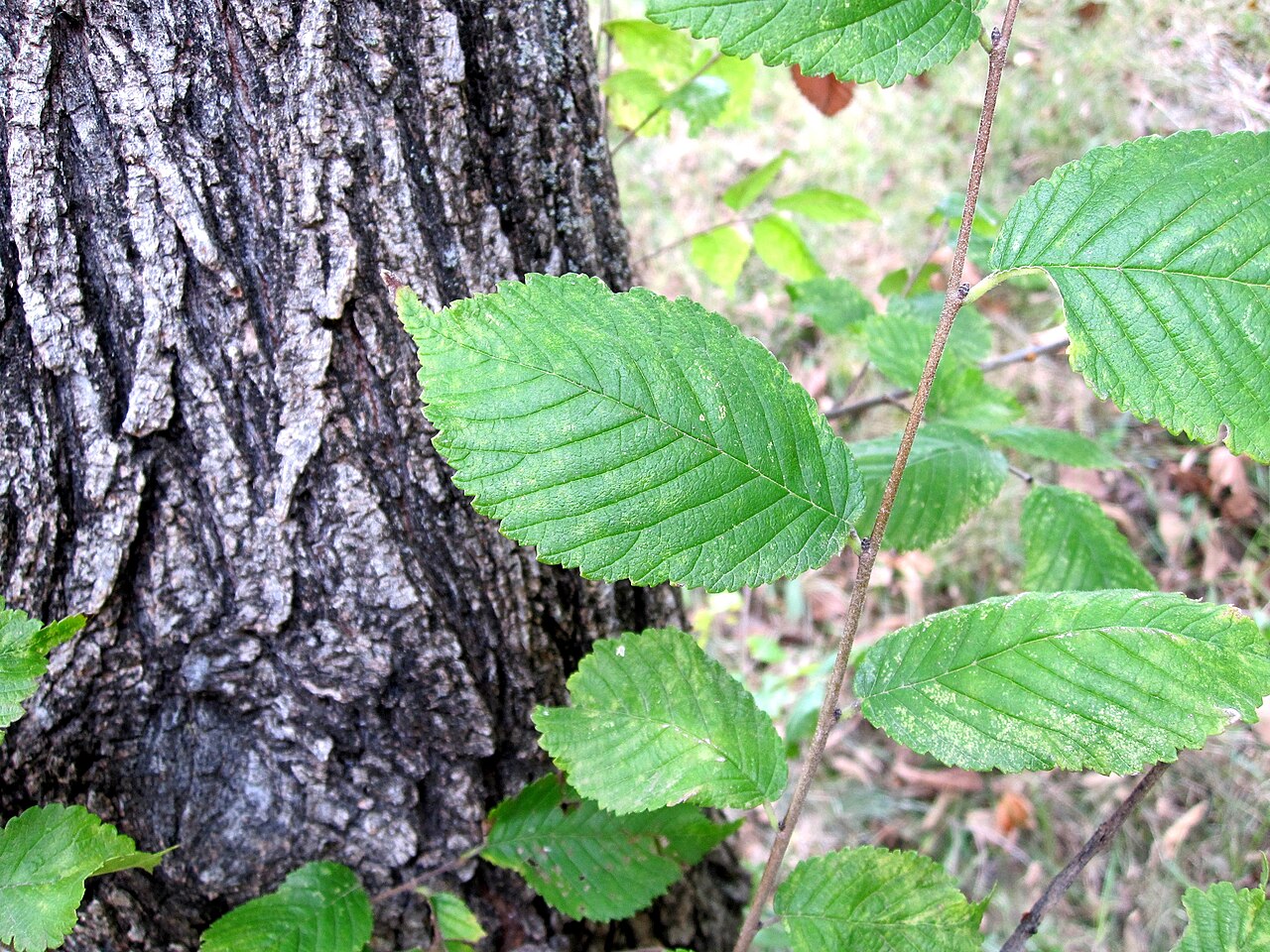
Ulmus thomasii, commonly known as Rock Elm or Cork Elm, is one of North America’s toughest and least appreciated native elms. It takes both common names from the same trait: a tendency to develop thick, irregular corky ridges, or “wings,” along its branches and young trunk, giving older stems a rugged, armored look unlike any other native elm. Its wood is correspondingly dense and strong — among the hardest and heaviest of all North American hardwoods — which once made it prized for shipbuilding, tool handles, and other uses demanding exceptional strength and shock resistance.
Rock Elm is a medium to large deciduous tree, usually 60 to 80 feet tall, with a distinctive narrow, often drooping or “feather-duster” branching pattern that sets it apart from the vase-shaped silhouette of American elm. It favors well-drained, often rocky or gravelly soils — frequently limestone-influenced uplands, ridges, and stream terraces — a habitat preference reflected in its common name and one that distinguishes it from the wetter bottomland sites favored by American elm and slippery elm.
Rock Elm has suffered along with other native elms from Dutch elm disease, and populations have declined significantly across its range since the mid-20th century, though it tends to show somewhat greater resistance than American elm. Combined with its naturally scattered, often uncommon distribution even before the disease arrived, Rock Elm is now considered a tree of conservation interest in several states, making surviving specimens and thoughtful new plantings valuable for both biodiversity and the species’ long-term future.
Identification
Rock Elm is best distinguished from American and slippery elm by its distinctive corky-winged twigs and branches, narrower and more upright crown, and smaller, less asymmetrical leaves. Look for the combination of these traits together, since corky wings alone can occasionally appear on other elms.
Bark & Stems
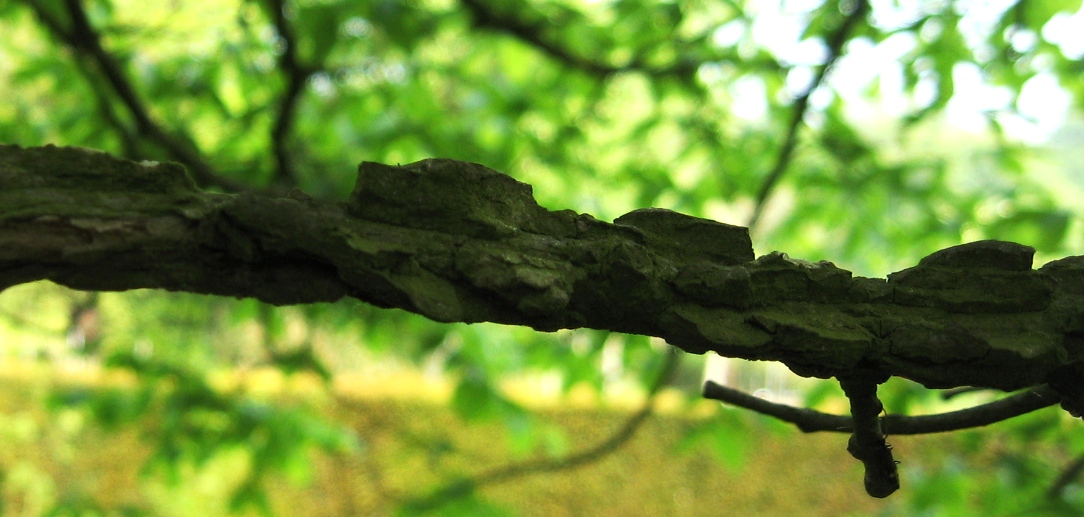
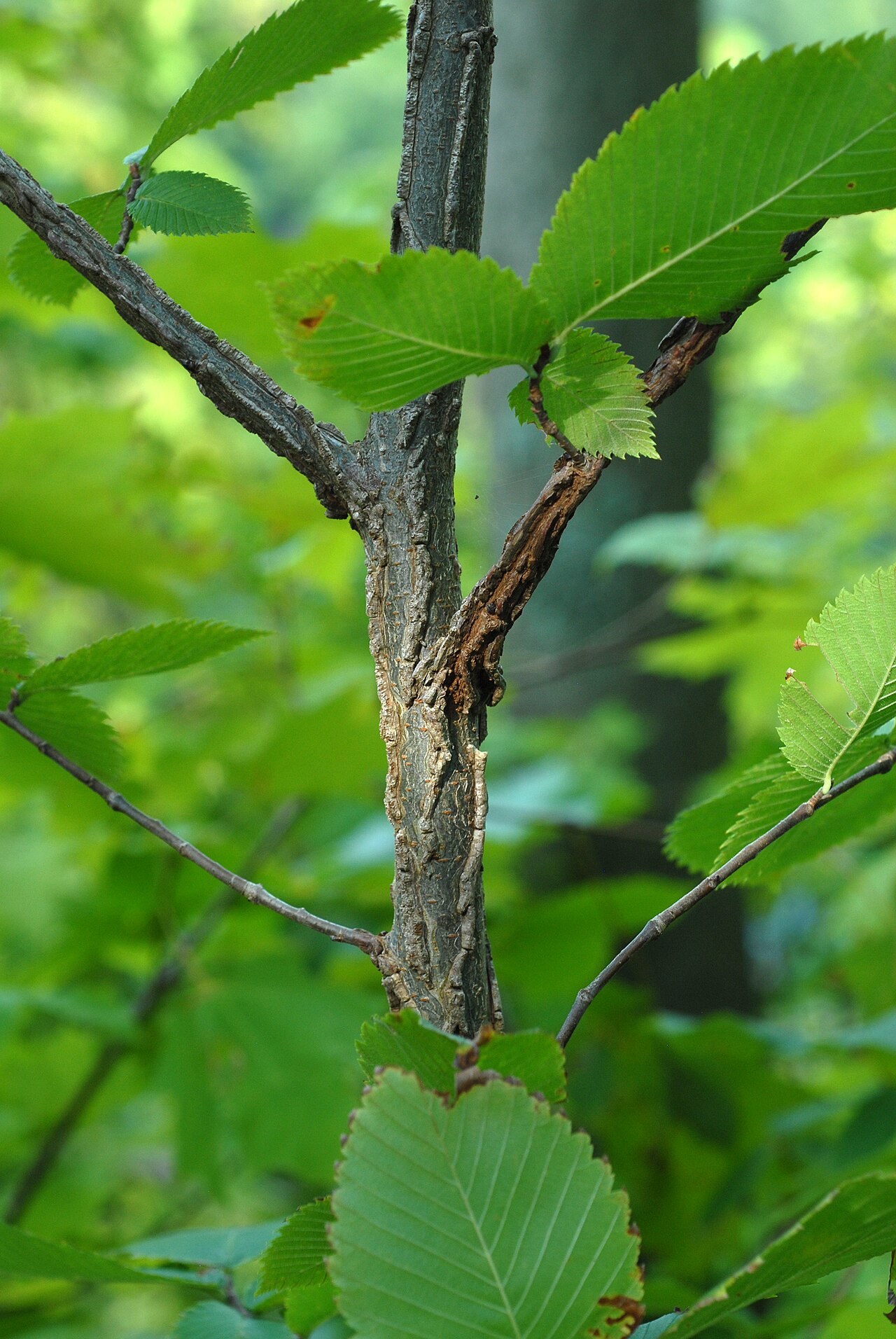
Mature bark is gray-brown, deeply furrowed into flat-topped ridges, generally paler and more tightly patterned than American elm’s bark. The most diagnostic feature is on the branches and young trunk: irregular, thick corky ridges or wings develop along many branches, especially on vigorous young growth, giving the tree a rough, winged texture that is unusual among elms (though it can occasionally occur on winged elm and some American elms as well).
Leaves
Leaves are alternate, simple, and elliptical to obovate, 2 to 4 inches long, with the classic elm pattern of doubly serrate margins and a somewhat asymmetrical (oblique) leaf base. Compared with American elm, Rock Elm leaves are notably smaller, thicker, and glossier, with a firm, leathery texture. The upper surface is dark green and smooth to slightly rough, the underside paler and softly hairy along the veins.
Flowers
Flowers are small, greenish, and wind-pollinated, appearing in drooping clusters in early spring before the leaves emerge — typical of native elms. They are inconspicuous and not ornamentally significant, but mark the start of the growing season well ahead of most other trees.
Fruit & Seeds
The fruit is a flattened, winged samara about ½ inch long, elliptical, downy along the margins, and ripening in late spring to early summer shortly after flowering. Like other elms, Rock Elm produces an abundant seed crop most years, dispersed by wind before most hardwoods have even finished leafing out.
Quick Facts
| Scientific Name | Ulmus thomasii |
| Family | Ulmaceae (Elm) |
| Plant Type | Deciduous tree |
| Mature Height | 60–80 ft |
| Mature Spread | 25–40 ft |
| Growth Rate | Slow to moderate |
| Sun Exposure | Full sun to part shade |
| Water Needs | Low to moderate |
| Soil Type | Well-drained, often rocky or limestone-influenced |
| Soil pH | Neutral to alkaline |
| Bloom Time | Early spring, before leaf-out |
| Flower Color | Greenish, inconspicuous |
| Fall Color | Yellow |
| Fruit | Flattened, downy-margined samara, ~½ in. |
| Deer Resistant | Moderately |
| USDA Hardiness Zones | 3–7 |
Native Range
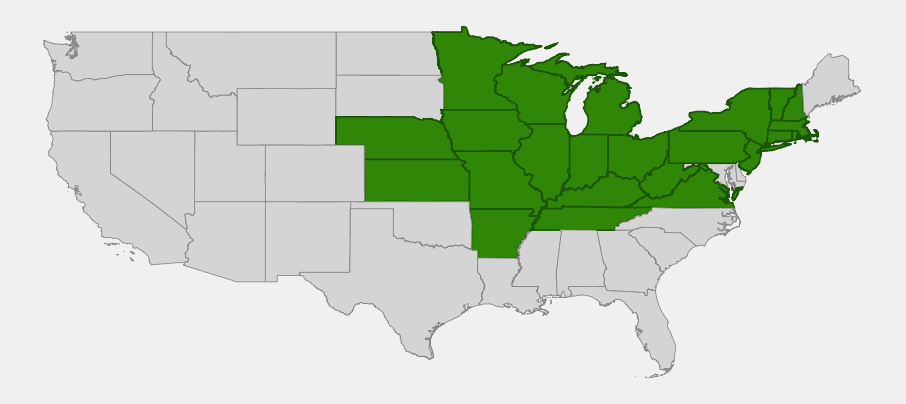
Rock Elm’s range centers on the Great Lakes region and upper Midwest, where it is most frequent in Michigan, Wisconsin, Minnesota, Iowa, and Illinois, extending south through Missouri, Kentucky, Tennessee, and a disjunct area in northern Arkansas and east through Indiana, Ohio, Pennsylvania, and New York. Scattered populations continue east into New England, including Connecticut, Massachusetts, Rhode Island, New Hampshire, and Vermont, and south along the Appalachian ridge and valley country into Virginia and West Virginia. An isolated western outpost reaches into eastern Nebraska and Kansas.
Throughout this range, Rock Elm is consistently a tree of drier, better-drained, often rocky or limestone-influenced upland sites — ridgetops, rocky slopes, stream terraces, and dry woods — in contrast to American elm and slippery elm, which favor moist bottomlands and floodplains. This habitat preference means Rock Elm was never as abundant or widespread within its range as American elm, even before Dutch elm disease began reducing elm populations generally across eastern North America.
Rock Elm is not native to the Deep South, the Atlantic or Gulf coastal plains, the Great Plains west of its narrow Nebraska-Kansas outpost, or anywhere west of the Rocky Mountains; plantings outside its historical range should be understood as cultivated introductions rather than naturally occurring populations.
Native Range
| U.S. States | Arkansas, Connecticut, Illinois, Indiana, Iowa, Kansas, Kentucky, Massachusetts, Michigan, Minnesota, Missouri, Nebraska, New Hampshire, New Jersey, New York, Ohio, Pennsylvania, Rhode Island, Tennessee, Vermont, Virginia, West Virginia, Wisconsin |
| Canada | Southern Ontario, southern Quebec |
| Ecoregion | Great Lakes mixed forest, Interior Low Plateau, northeastern uplands |
| Elevation Range | Near sea level–2,500 ft |
| Habitat | Dry, rocky uplands, ridges, limestone terraces, stream bluffs |
| Common Associates | Bur oak, shagbark hickory, eastern hophornbeam, chinquapin oak |
📋 Rock Elm is native to parts of the areas covered by Illinois, Iowa & Missouri, Ohio and Indiana, Michigan, Wisconsin, & Eastern Minnesota, Kentucky and Tennessee, Arkansas, Louisiana, Eastern Oklahoma, and Eastern Texas, Maryland, Virginia, and West Virginia, New York, Pennsylvania, and Northern New Jersey, Connecticut, Massachusetts, and Rhode Island, New Hampshire, Maine and Vermont, and Nebraska, Kansas, and Eastern Colorado.
Growing & Care Guide
Light
Rock Elm grows best in full sun but tolerates part shade, especially as a young understory tree. In its native rocky uplands it is often found in relatively open, well-lit woodland conditions.
Soil & Water
This elm wants well-drained, often rocky or limestone-influenced soil; it is notably more drought-tolerant and less tied to moist bottomlands than American or slippery elm. Avoid consistently wet or poorly drained sites, which favor its wetland-adapted elm relatives instead.
Planting Tips
Choose an upland site with good drainage, ideally with some limestone influence if possible. Rock Elm grows slowly compared to American elm, so give it time, and plant where its narrow, upright, somewhat irregular branching habit — quite different from American elm’s classic vase shape — can be appreciated rather than hidden among faster, broader-crowned trees.
Pruning & Maintenance
Prune in late winter to remove dead or damaged wood and establish good branch spacing while young. Watch for Dutch elm disease symptoms — flagging, wilting branches, yellowing out of season — and remove and destroy infected wood promptly to slow local spread. Rock Elm shows somewhat better resistance than American elm, but it is not immune.
Propagation
Propagate from seed collected as soon as it ripens in late spring to early summer; elm seed loses viability quickly and generally germinates best when sown fresh rather than stored. Because Rock Elm is less commonly propagated commercially than American elm, seed from local, open-grown trees is the most reliable source for native plantings.
Landscape Uses
- Specimen or shade tree for dry, rocky, or limestone-influenced sites
- Restoration planting on upland woodlands and ridgetops
- Conservation planting to support regional Rock Elm genetic diversity
- Windbreak or hedgerow tree in agricultural landscapes
- Alternative to American elm where drier soils rule out wetland-adapted elms
Wildlife & Ecological Value
For Pollinators
As a wind-pollinated tree, Rock Elm offers little direct nectar value, but its very early spring bloom provides some of the first available pollen for generalist bees active before most other plants have flowered.
Birds
Songbirds forage its canopy for insects, and the dense, often irregular branching provides good nesting cover. Seed-eating birds take advantage of its abundant early-summer samara crop.
Mammals
Squirrels feed on the seeds and buds, and deer browse young foliage and twigs, though Rock Elm is not a preferred browse species compared with more palatable natives.
Ecosystem Role
Rock Elm’s affinity for dry, rocky uplands makes it an important structural tree in habitats that many other large hardwoods cannot colonize, and its deep, strong root system helps stabilize thin soils on slopes and ridges. As native elm populations continue to recover unevenly from Dutch elm disease, surviving and newly planted Rock Elms contribute meaningfully to the genetic and ecological resilience of eastern elm woodlands.
Cultural & Historical Uses
Rock Elm’s extraordinarily dense, strong, and shock-resistant wood made it one of the most commercially valuable North American hardwoods in the 19th and early 20th centuries, used for shipbuilding (particularly ship frames and keels), heavy tool handles, wagon parts, and other applications demanding exceptional toughness. Its wood was often favored over American elm’s for uses requiring maximum strength, though the tree was never as widely available due to its naturally more limited and scattered distribution.
The corky-winged bark that gives the tree its alternate name, Cork Elm, became a recognizable identifying feature for foresters and loggers seeking out this uncommon, high-value timber tree among more common elm species in mixed hardwood stands.
Today, with Dutch elm disease having reduced elm populations broadly across its range, Rock Elm draws renewed interest less for commercial timber and more for conservation planting and the genetic diversity it offers as part of ongoing efforts to restore healthy elm populations to eastern North American forests.
Frequently Asked Questions
How is Rock Elm different from American elm?
Rock Elm has a narrower, more upright and irregular crown rather than American elm’s classic vase shape, smaller and more leathery leaves, and distinctive thick corky wings on many branches. It also favors dry, rocky upland soils rather than American elm’s moist bottomlands.
Is Rock Elm resistant to Dutch elm disease?
It shows somewhat greater resistance than American elm, but it is not immune and can still be infected and killed by the disease. Monitoring and removing infected wood promptly remains important.
Why is Rock Elm called Cork Elm?
Because many branches and young trunks develop thick, irregular corky ridges or “wings” of bark, a texture reminiscent of cork and distinctive enough to give the tree both of its common names.
Where does Rock Elm grow best in a landscape?
On dry, well-drained, often rocky or limestone-influenced upland soils. It is a poor choice for wet or poorly drained sites, which suit American or slippery elm far better.
Is Rock Elm rare?
It was never as abundant as American elm even before Dutch elm disease, owing to its narrower habitat preferences, and populations have declined further since the disease arrived, making it a tree of conservation interest in parts of its range.
Looking for a nursery that carries native plants for your area? Visit our regional nursery directories: Alabama to Arkansas, Colorado to Hawaii (includes Connecticut), Idaho to Kansas (includes Illinois, Indiana, Iowa & Kansas), Kentucky to Montana (includes Kentucky, Massachusetts, Michigan, Minnesota & Missouri), Nebraska to Oklahoma (includes Nebraska, New Hampshire, New Jersey, New York & Ohio), Pennsylvania to Virginia (includes Pennsylvania, Rhode Island, Tennessee, Vermont & Virginia), and West Virginia to Wyoming (includes West Virginia & Wisconsin) for growers near Rock Elm’s native range.

