
White Arrow Arum (Peltandra sagittifolia)
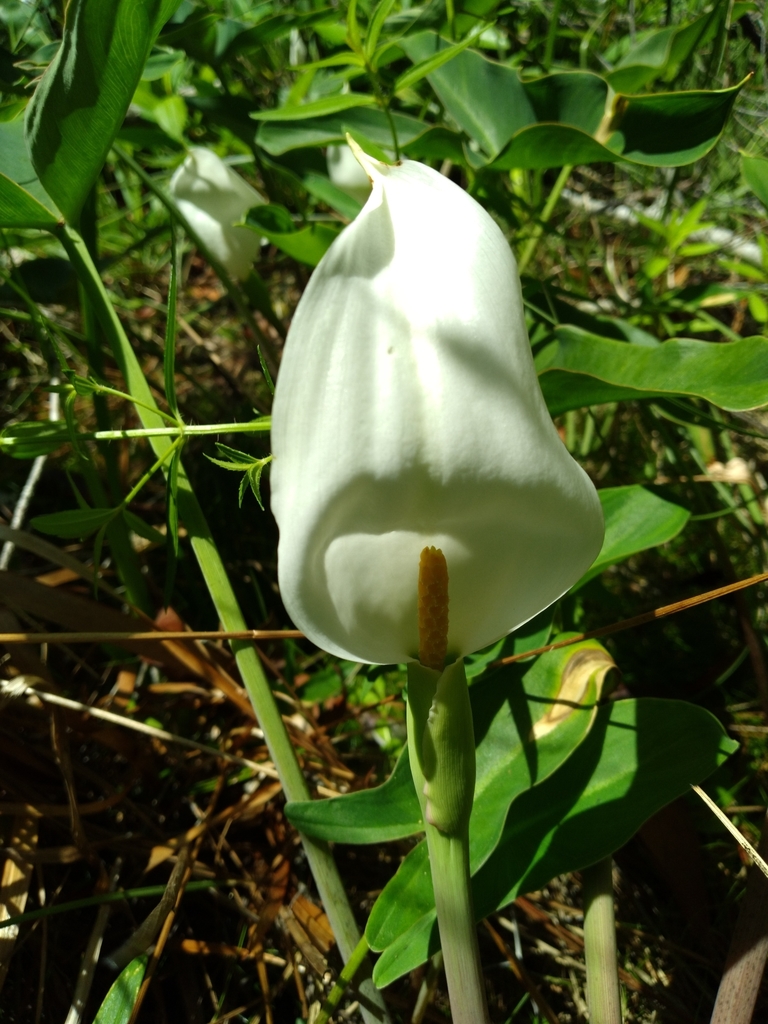
Peltandra sagittifolia, known as White Arrow Arum or spoonflower, is a perennial aroid of shady, acidic wetlands on the southeastern Coastal Plain. It grows from a thick underground rhizome and sends up glossy, arrowhead-shaped leaves on long stalks, usually 1 to 2 feet tall. In late spring and early summer it produces one of the most elegant flowers in southern swamps: a pure white, open, spoon- or hood-shaped spathe wrapped around a slender yellow spadix. Later in the season the spathes give way to clusters of bright red berries.
It belongs to the arum family (Araceae), along with jack-in-the-pulpit and the familiar green arrow arum (Peltandra virginica). The two arrow arums share the arrow-shaped leaf, which is what sagittifolia (“arrow-leaved”) refers to, but they are easy to tell apart in flower and fruit. White arrow arum has a white, flaring spathe and red berries; green arrow arum has a narrow, tightly rolled green spathe and green to blackish berries. White arrow arum is also the rarer, more southern and more particular of the two, favoring seepage bogs and bay swamps rather than open marshes.
White arrow arum ranges from southeastern North Carolina to central Florida and west to Mississippi. It is an excellent plant for a shady bog garden or the wet margin of a woodland pond, and it is offered by some southeastern native plant nurseries. This guide covers how to identify it, where it grows, how to grow it, and its value to wildlife.
Identification
Out of flower, white arrow arum is easily mistaken for green arrow arum or for arrowheads (Sagittaria). The flower and fruit settle the question, and the leaf veins help too.
Leaves
The leaves are arrowhead-shaped (sagittate), with two backward-pointing basal lobes, and usually 4 to 10 inches long on stalks that may be longer than the blade. They are glossy, rather thick and dark green. Like other Peltandra, the leaves have a strong midrib and prominent side veins that run toward the margin and then join a vein running parallel to the edge. Arrowheads (Sagittaria), by contrast, have veins that all radiate from the leaf base. White arrow arum leaves tend to be somewhat narrower and more slender-lobed than those of green arrow arum, but leaf shape varies.
Flowers
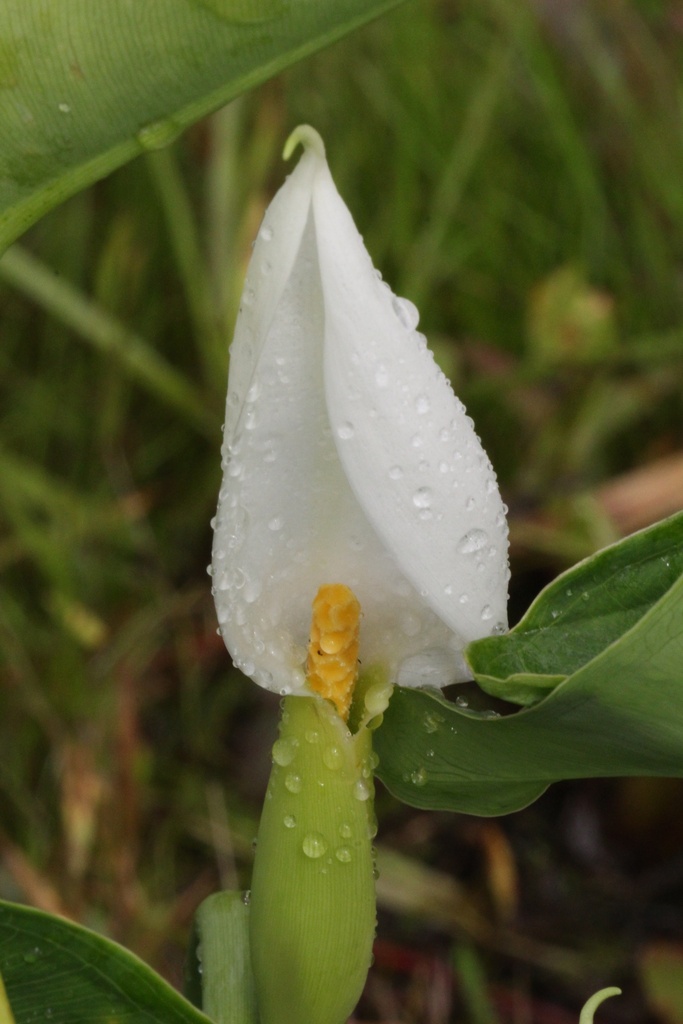
Each flowering stalk carries a single spathe about 3 to 4 inches long. It is pure white inside and out, opens wide at the top into a hood or spoon shape, and stays open while in flower. Inside is the spadix, a slender yellow spike packed with tiny unisexual flowers: male (pollen-bearing) flowers on the upper part and female flowers near the base. The lower part of the spathe stays closed around the developing fruit. Bloom time is spring into early summer, mainly April to June, earlier in Florida.
Fruit
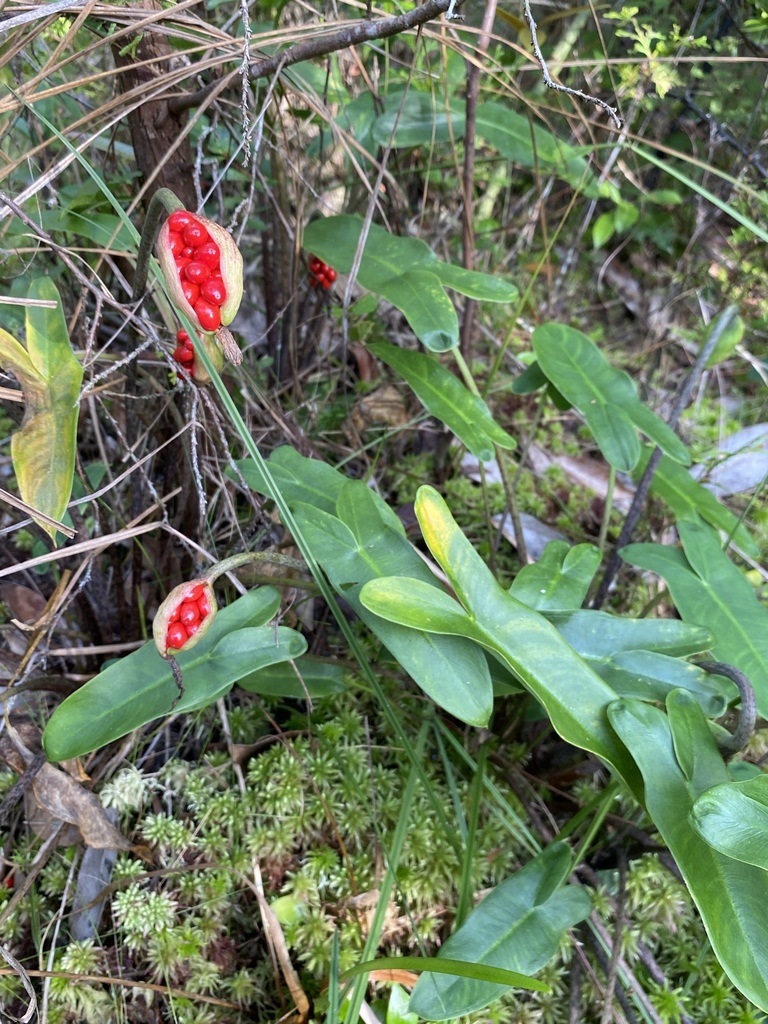
After pollination, the flowering stalk bends down and the base of the spathe enlarges into a green, pod-like case around the fruits. When ripe in late summer and fall, it splits to reveal a cluster of glossy, bright red berries, each containing one or a few seeds embedded in a gelatinous pulp. This red fruit is one of the clearest differences from green arrow arum.
Roots & Rhizome
The plant grows from a thick, starchy rhizome with fleshy roots that anchor it in soft, wet peat and muck. Clumps expand slowly as the rhizome branches. Like all aroids, the plant contains needle-like calcium oxalate crystals, which make raw leaves and roots painfully irritating if eaten.
Quick Facts
| Scientific Name | Peltandra sagittifolia (syn. Peltandra glauca) |
| Family | Araceae (arum family) |
| Plant Type | Herbaceous wetland perennial from a rhizome |
| Mature Height | 1–2 ft |
| Mature Spread | 1–2 ft; clumps expand slowly |
| Growth Rate | Slow to moderate |
| Sun Exposure | Part shade to shade |
| Water Needs | High; saturated soil or shallow water |
| Soil Type | Acidic peat, muck or wet sandy peat |
| Soil pH | About 4.0–6.0 (acidic) |
| Bloom Time | April–June (earlier in Florida) |
| Flower Color | White spathe, yellow spadix |
| Fall Color | None; leaves die back in winter |
| Fruit | Cluster of bright red berries, late summer–fall |
| Deer Resistant | Yes; foliage contains irritating calcium oxalate crystals |
| USDA Hardiness Zones | 7–10 |
Native Range
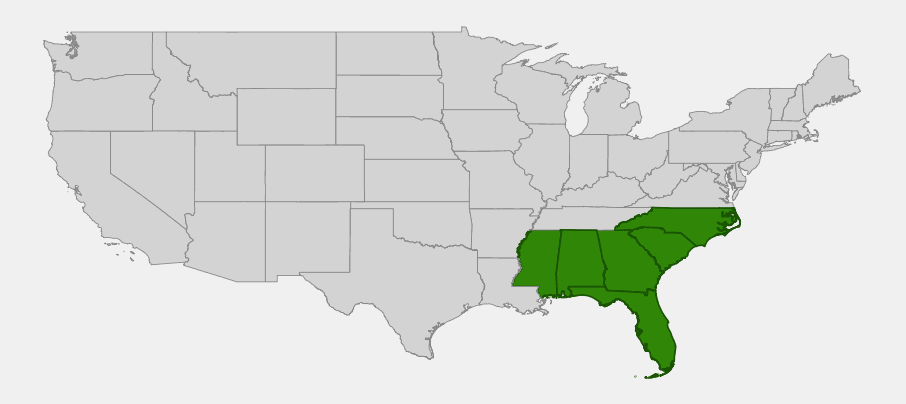
White arrow arum is a southeastern Coastal Plain species. USDA PLANTS records it from six states: North Carolina, South Carolina, Georgia, Florida, Alabama and Mississippi. It reaches its northern limit in the bays and savannas of southeastern North Carolina and extends south to central Florida and west along the Gulf Coastal Plain to Mississippi.
In Florida it grows in the Panhandle and the northern and central peninsula, south to about the Lake Wales Ridge region, where it occurs in seepage swamps and bayheads. Throughout its range it is local and patchy, because its preferred habitats are scattered and small.
It favors acidic, nutrient-poor, constantly wet places with some shade: bay swamps and bayheads, seepage slopes and hillside bogs, the edges of blackwater streams and shrub bogs, and wet, shaded flatwoods. The Lady Bird Johnson Wildflower Center notes that it is similar to green arrow arum in habitat preference but not as cold hardy. Green arrow arum, by contrast, is common in sunny marshes and pond edges across much of eastern North America.
📋 Regional plant lists featuring White Arrow Arum: North & South Florida · Alabama, Georgia & Mississippi · North & South Carolina
Growing & Care Guide
White arrow arum is a rewarding plant for a shady, wet spot where few other flowering plants thrive. It is grown by some southeastern native and bog plant nurseries. Buy nursery-propagated plants; it is local in the wild and should not be dug from natural areas.
Light
Part shade to fairly deep shade suits it best, such as the dappled light under sweetbay, tupelo or red maple. It tolerates morning sun if the soil stays wet, but strong afternoon sun in the Deep South scorches the leaves.
Soil & Water
Plant in acidic, organic soil that is constantly wet: peat, muck, or a peat and sand mix. It grows well in saturated soil or in shallow water up to a few inches deep, but it does not like deep water. It will not tolerate drying out or alkaline, lime-rich soil or water. In a bog garden, use rainwater or other low-mineral water if possible.
Planting Tips
Plant rhizomes or potted plants in spring with the top of the rhizome just below the soil surface. Space plants about 12 to 18 inches apart. Good companions include cinnamon fern, netted chain fern, pitcher plants on the sunnier edge, and sphagnum moss, which helps keep the soil acidic and wet. A lined shade bog or the wet margin of a woodland pond is ideal.
Pruning & Maintenance
White arrow arum needs very little care. Remove dead leaves after they die back in winter. Leave the fruiting heads to ripen if you want the red berries and possible seedlings. No fertilizer is needed. Wear gloves when handling it in quantity if your skin is sensitive, because the sap contains irritating crystals.
Propagation
Divide established clumps in early spring by cutting the rhizome into sections, each with a growing point and roots. Seeds can be sown fresh, cleaned of pulp, on the surface of wet peat mix and kept constantly moist and warm; they lose viability if they dry out. Seedlings take a few years to bloom.
Landscape Uses
- Shade bog gardens: one of the few showy flowers for a wet, shaded bog
- Woodland pond margins: in saturated soil or very shallow water at the edge
- Rain gardens in shade: where water stands for part of the year under trees
- Wetland restoration: in bayheads and seepage swamps within its native range
- Container water gardens: in a tub of wet peat kept in part shade
Wildlife & Ecological Value
White arrow arum is a modest but distinctive part of southeastern swamp and bog communities, and its red berries stand out in late-season wetlands.
For Pollinators
The spathe and spadix attract small insects, especially small flies and beetles, which crawl into the spathe and move pollen between the male and female flowers. Pollination biology of white arrow arum has been studied less than that of green arrow arum, whose flowers are pollinated mainly by a small chloropid fly.
For Birds
The red berries may be eaten by birds and other wildlife, and their color suggests birds as dispersers. Green arrow arum seeds are known to be eaten by wood ducks and other waterfowl, and white arrow arum likely provides similar food where it grows.
For Mammals
The calcium oxalate crystals in the leaves and roots discourage browsing by deer and most other mammals.
Ecosystem Role
White arrow arum is part of the herb layer of bayheads, seepage bogs and swamp edges, habitats that depend on a steady supply of groundwater. Its presence indicates acidic, nutrient-poor, continuously wet conditions. Many of these seepage habitats have been lost to drainage and development, or have become overgrown, which is why the species is local and uncommon across much of its range.
Cultural & Historical Uses
The species was first described by the French botanist André Michaux in the early 19th century and was later moved to Peltandra by the American botanist Thomas Morong. It has also been known as Peltandra glauca. The genus name Peltandra comes from Greek words meaning “shield” and “male,” referring to the shield-shaped male flowers on the spadix.
The name spoonflower refers to the shape of the open white spathe. Green arrow arum, its common relative, was an important food for Native Americans in the East, who baked or dried the starchy rhizomes thoroughly to break down the irritating crystals; the food is often called tuckahoe. There is less record of specific uses of white arrow arum, which is much less common.
Today white arrow arum is valued mainly by bog gardeners and wetland enthusiasts as one of the prettiest native aroids of the Southeast. Its white spathes in spring and red berries in fall make it worth seeking out from a native plant nursery for a shady, wet corner of the garden.
Frequently Asked Questions
How is white arrow arum different from green arrow arum?
White arrow arum has a pure white, open spathe and bright red berries. Green arrow arum (Peltandra virginica) has a narrow, green, tightly wrapped spathe and green to blackish berries. White arrow arum is limited to the southeastern Coastal Plain and favors shady, acidic seepage bogs and bay swamps.
Is white arrow arum poisonous?
The leaves, roots and berries contain needle-like calcium oxalate crystals, as in other aroids. Eating raw plant parts causes painful burning and swelling of the mouth and throat. Keep it away from pets and children who might chew it.
Can I grow it in a regular garden bed?
Only if the soil stays constantly wet and acidic. It is a bog and swamp plant. A lined bog garden, the edge of a pond, or a container of wet peat in part shade works much better than an ordinary bed.
Does white arrow arum grow in full sun?
It tolerates morning sun if kept wet, but it prefers part shade to shade. In hot afternoon sun the leaves often burn.
Is it the same as calla lily?
No, though they are related. Calla lilies sold as cut flowers are Zantedeschia from southern Africa. White arrow arum is a native North American plant, though its white spathe looks similar.

Looking for a nursery that carries White Arrow Arum?
Browse our native plant nursery directory: Alabama · Florida & Georgia · Mississippi · North Carolina · South Carolina