
Dwarf Pawpaw (Asimina pygmea)
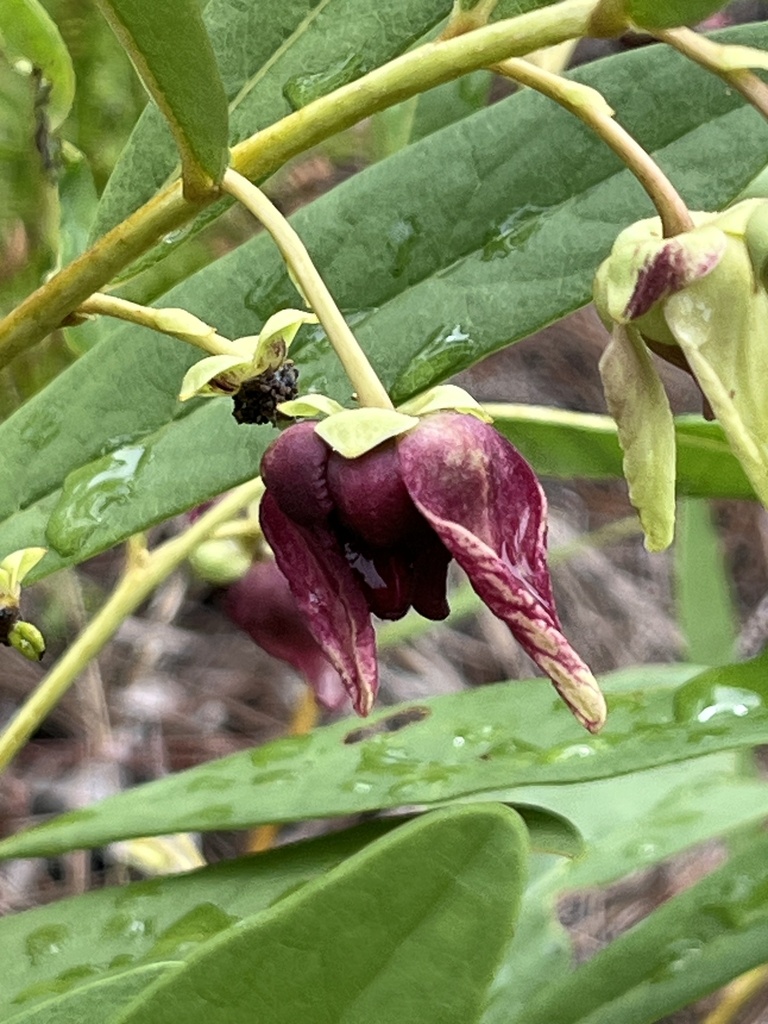
Asimina pygmea, the Dwarf Pawpaw, is the smallest member of the pawpaw genus: a low, often unbranched shrub that usually stands less than a foot tall in the pine flatwoods and savannas of Florida and southeastern Georgia. In spring it hangs small, nodding, deep maroon flowers from the leaf axils, and in summer it can bear miniature pawpaw fruits. It belongs to the custard-apple family (Annonaceae), a mostly tropical family whose only temperate North American genus is Asimina.
The name is spelled Asimina pygmea by USDA PLANTS and the Atlas of Florida Plants. Many other sources, including iNaturalist and Plants of the World Online, use the spelling Asimina pygmaea; both refer to the same plant. Its relatives include the familiar tree pawpaw (A. triloba) and the large-flowered pawpaws of Florida’s sandy scrubs and flatwoods.
Much of the plant is hidden. A long, thick taproot and underground stems let it survive the frequent fires of its pine flatwoods home and resprout within weeks. That same root system makes it hard to transplant, and it is rarely sold. It is worth knowing as a characteristic flatwoods plant and as a larval host for the zebra swallowtail.
Identification
Several small pawpaws grow in Florida, and they can be hard to tell apart without flowers. Dwarf pawpaw is the shortest, with the darkest red flowers, and its narrow, blue-green leaves are a good clue.
Stems & Roots
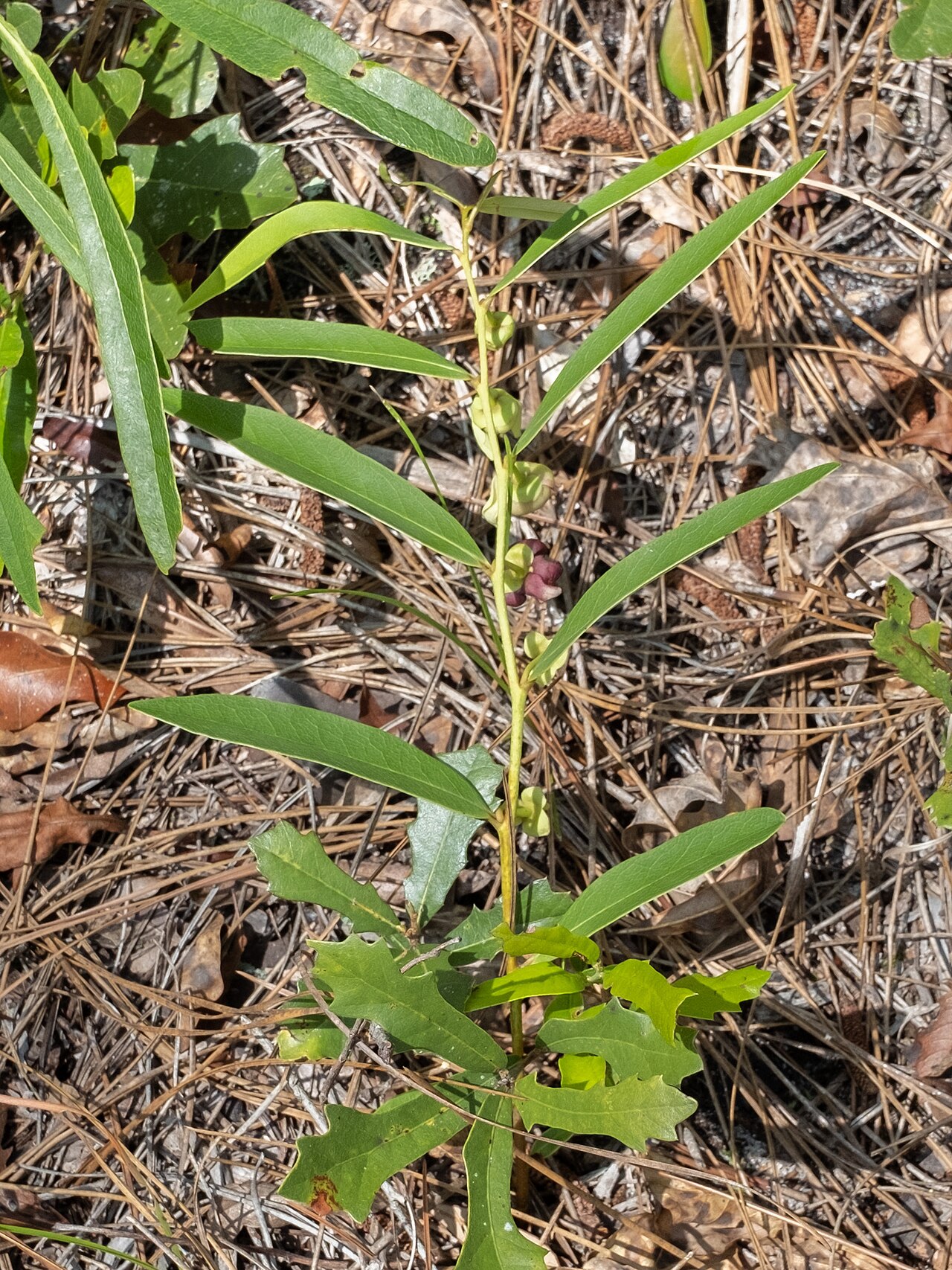
Each plant sends up one or a few slender, upright stems, usually 4 to 12 inches tall and occasionally to about 20 inches. Stems are smooth and often reddish-brown. Below ground, a long, woody taproot and creeping underground stems store food reserves, so a patch of stems may be a single plant.
Leaves
The leaves are alternate, leathery, oblanceolate to narrowly obovate (widest above the middle), about 2 to 4 inches long, with smooth edges. They are dull blue-green to gray-green above, paler and finely net-veined beneath, and usually smooth or nearly so. They often stand stiffly upright or angled along the stem. Like other pawpaws, crushed leaves have an unpleasant smell.
Flowers
The flowers appear in spring, mostly March through May (occasionally into June), on new growth. They hang singly on short, curved stalks from the leaf axils. Each flower has three outer petals about ½ to 1 inch long that are dark maroon to purplish-red, often with paler margins, and three smaller inner petals of the same color. The flowers have a faint, rather unpleasant fermenting odor.
Woolly pawpaw (A. incana) and bigflower pawpaw (A. obovata) have large creamy-white flowers. Netted pawpaw (A. reticulata) has white to cream flowers. Smallflower pawpaw (A. parviflora) has small maroon flowers but is a taller, hairy-leaved shrub of hammocks.
Fruit & Seeds
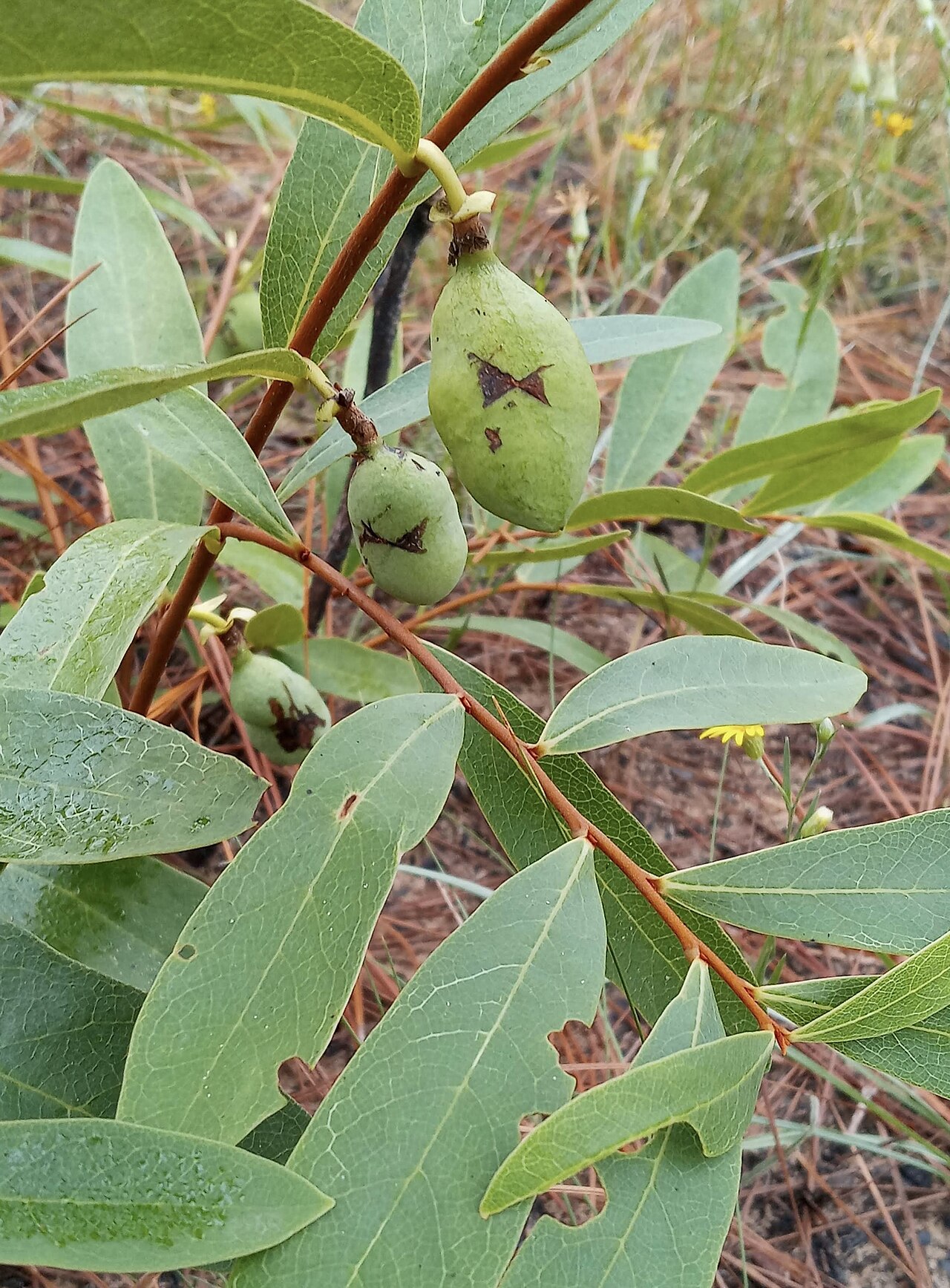
Pollinated flowers develop into short, oblong to bean-shaped fruits about 1 to 2 inches long, green ripening to yellowish-green in summer, with a few large, flat, brown seeds. Fruit set is often low. The fruits are soft when ripe and are eaten by wildlife.
Quick Facts
| Scientific Name | Asimina pygmea (also spelled A. pygmaea) |
| Family | Annonaceae (custard-apple family) |
| Plant Type | Dwarf deciduous shrub (subshrub) with a deep taproot |
| Mature Height | 4–12 in (occasionally to about 20 in) |
| Mature Spread | 6–12 in per stem; slowly forms small colonies |
| Growth Rate | Slow |
| Sun Exposure | Full sun to light, filtered shade |
| Water Needs | Low to moderate; tolerates seasonally damp and dry periods |
| Soil Type | Acidic sand and sandy peat |
| Soil pH | About 4.5–6.0 |
| Bloom Time | March–May (sometimes into June) |
| Flower Color | Deep maroon to purplish-red |
| Fall Color | Leaves turn yellowish before dropping |
| Fruit | Small oblong pawpaw, green to yellow-green, 1–2 in |
| Deer Resistant | Mostly; foliage is unpalatable |
| USDA Hardiness Zones | 8b–10a |
Native Range
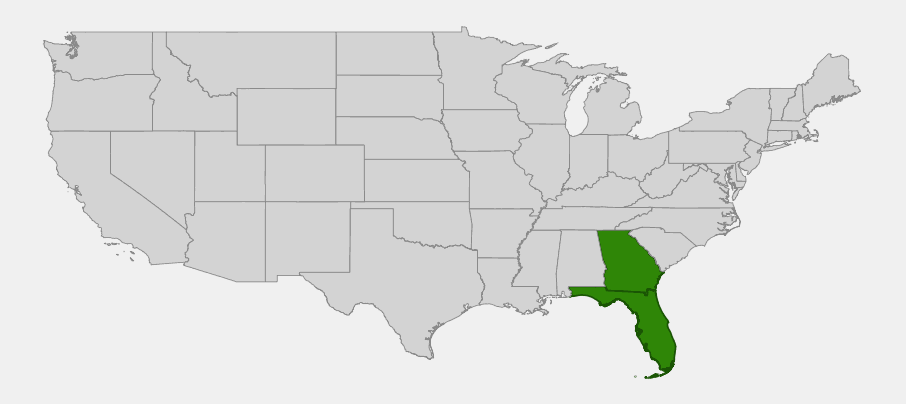
Dwarf pawpaw is native only to Florida and southeastern Georgia. USDA PLANTS and the Lady Bird Johnson Wildflower Center record it from both states. In Georgia it is limited to the southeastern Coastal Plain. In Florida it is widespread across the northern and central peninsula, from the Georgia line south through the central ridge and flatwoods through much of the central peninsula.
Its typical habitat is mesic pine flatwoods: open stands of longleaf or slash pine over a dense groundcover of saw palmetto, wiregrass, gallberry and other low shrubs. It also grows in wet to mesic savannas, low sandy fields, the edges of sandhills and pine plantations, and roadsides through these habitats. LBJ describes its habitat as sandy peat of pine-palmetto flats, savannas, low sandy fields and low sand ridges.
Dwarf pawpaw is not state-listed and is still common where flatwoods remain, but it depends on fire. Where fire is excluded, palmetto and shrubs grow tall and shade it out, and it persists only as scattered, non-flowering stems.
📋 Regional plant lists featuring Dwarf Pawpaw: North & South Florida · Alabama, Georgia & Mississippi
Growing & Care Guide
Dwarf pawpaw is rarely offered by nurseries, and it is a slow, particular plant in gardens. Its deep taproot makes established plants nearly impossible to move, so never dig plants from the wild. If you find it for sale from a Florida native nursery, buy young container-grown plants and plant them where they can stay permanently. In many cases the best way to “grow” it is to protect and burn or mow an existing patch of flatwoods where it already occurs.
Light
It does best in full sun or the light, broken shade of an open pine canopy. In dense shade it survives as a few leaves but rarely flowers.
Soil & Water
Plant it in acidic, sandy soil with low fertility, ideally in a spot that is moist in summer but never waterlogged for long. Water regularly through the first growing season while the taproot develops. After that it needs little or no irrigation in Florida. Avoid fertilizer and lime.
Planting Tips
Plant small container plants in the rainy season or in late winter, disturbing the root ball as little as possible. Pawpaws are slow to establish and may show little top growth for a year or two while the root grows. Set them among low flatwoods companions such as wiregrass, gopher apple, blueberries and dwarf wax myrtle rather than in a mulched bed.
Pruning & Maintenance
No pruning is needed. In a natural area, burn or mow the surrounding vegetation every few years in the dormant season; the plant resprouts quickly from its roots. In a garden, keep taller neighbors from overtopping it.
Propagation
Grow it from fresh seed, which must not dry out. Sow ripe seeds in deep containers or outdoors in late summer; they germinate slowly, often the following spring or later, and put down a long root before much top growth. Root sprouts and transplants rarely survive.
Landscape Uses
- Pine flatwoods restoration: a characteristic groundcover shrub of fire-maintained flatwoods
- Butterfly gardens: a low-growing larval host for zebra swallowtails in Florida gardens
- Natural areas and wild yards: protect existing plants when developing a lot in flatwoods
- Native plant collections: an unusual, maroon-flowered relative of the pawpaw for collectors
Wildlife & Ecological Value
Dwarf pawpaw is small but plays a real role in flatwoods ecology, especially for one of Florida’s most striking butterflies.
For Pollinators
Pawpaw flowers are pollinated mainly by beetles and flies, which are drawn by the dark color and faint fermenting scent. The flowers offer little nectar, and fruit set is often low.
For Birds
Fruits may be eaten by birds such as wild turkey, though the plants produce few fruits.
For Mammals
Raccoons, opossums, foxes and other mammals, as well as gopher tortoises, eat fallen pawpaw fruits and disperse the seeds. The foliage contains acetogenins, which make it unpalatable to most browsers.
Ecosystem Role
All Asimina species are the larval hosts of the zebra swallowtail (Eurytides marcellus), and in Florida the low pawpaws of flatwoods and scrub are important hosts. Pawpaws are also the host plants for the pawpaw sphinx moth. Caterpillars that feed on pawpaw leaves take in the plant’s acetogenins, which may help protect them from predators. Like other flatwoods shrubs, dwarf pawpaw resprouts vigorously from its deep roots after fire.
Cultural & Historical Uses
The naturalist William Bartram described this plant as Annona pygmaea in his Travels (1791), based on his journeys through Georgia and Florida in the 1770s. It was later moved to Asimina, a genus named by Michel Adanson in 1763 from asiminier, the French colonists’ version of a Native American name for the pawpaw. The spelling of the species epithet has varied between pygmaea and pygmea ever since.
The fruits of tree pawpaw were widely eaten by Native Americans and settlers, but the small, sparse fruits of dwarf pawpaw were of little importance as food. Pawpaw seeds and leaves contain acetogenins, compounds that are toxic in quantity, so the plant is not used medicinally.
Today dwarf pawpaw is mostly of interest to botanists, naturalists and butterfly enthusiasts. Its ability to resprout after fire makes it a good example of how many flatwoods plants keep most of their mass underground, and its spring flowers are one of the early signs of the season in north and central Florida’s pinelands.
Frequently Asked Questions
Is dwarf pawpaw the same as the pawpaw tree?
No. It is a different species in the same genus. The common pawpaw (Asimina triloba) is a small tree of eastern hardwood forests with large edible fruits. Dwarf pawpaw is a knee-high shrub of Florida and Georgia flatwoods with small fruits.
Is the fruit edible?
The fruits are small and few, and they are rarely eaten by people. Wildlife eats them. Pawpaw seeds and other plant parts contain toxic compounds and should not be eaten.
Why is it spelled two different ways?
USDA PLANTS and the Atlas of Florida Plants use Asimina pygmea, while many other references use Asimina pygmaea. Both names refer to the same species.
Can I transplant dwarf pawpaw from a lot being cleared?
It rarely survives, because the long taproot is almost always broken. If you rescue plants with permission, dig as deep as possible and expect losses. Growing from seed or buying container-grown plants works better. Never dig plants from protected lands.
Does dwarf pawpaw attract butterflies?
Yes. Like all pawpaws, it is a larval host for the zebra swallowtail. Females lay eggs singly on young leaves in spring and summer.

Looking for a nursery that carries Dwarf Pawpaw?
Browse our native plant nursery directory: Florida & Georgia