
Peelbark St. John’s-Wort (Hypericum fasciculatum)
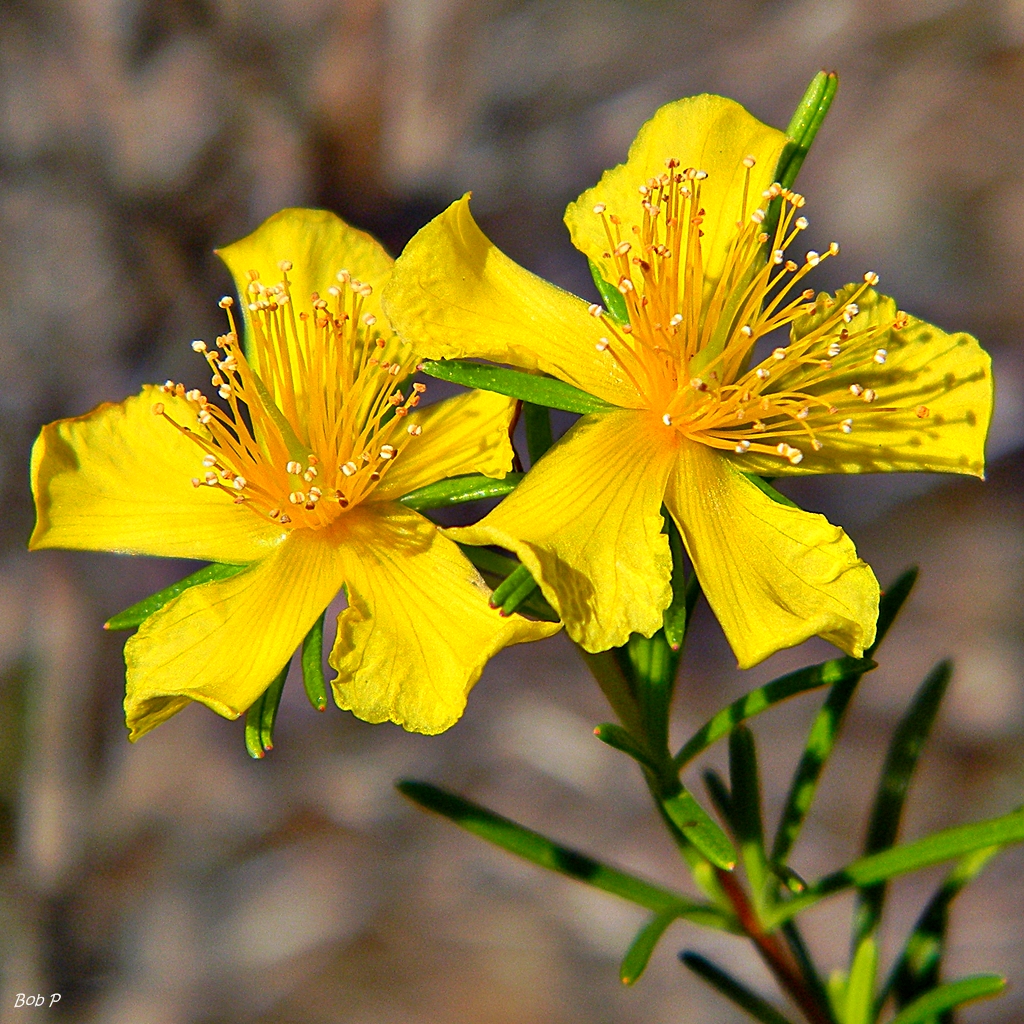
Peelbark St. John’s-Wort (Hypericum fasciculatum), also called sandweed, is an evergreen shrub of wet pinelands, pond margins and cypress swamps on the southeastern Coastal Plain. It is one of the most common native St. John’s-worts in Florida, and in bloom its bright yellow, five-petaled flowers stand out against a fine, almost conifer-like mass of needle-shaped leaves. It belongs to the St. John’s-wort family (Hypericaceae; some references, including the Atlas of Florida Plants, place Hypericum in the broader Clusiaceae).
Both of its names describe what makes it distinctive. The reddish-brown bark of older stems flakes and peels off in thin, papery sheets, hence “peelbark.” And the species name fasciculatum comes from the Latin fasciculus, “little bundle,” for the short shoots in the leaf axils that hold tufts of extra leaves. The plant blooms over a very long season, from spring well into fall, and in south Florida it can flower in almost any month.
Peelbark St. John’s-wort is a natural choice for rain gardens, pond edges, wet ditches and low spots that stay soggy for part of the year, places where many landscape shrubs fail. This guide covers how to identify it, where it grows, how to grow it, and why its flowers are so popular with native bees.
Identification
Florida and the Southeast have dozens of native Hypericum species, and several of the shrubby ones look alike. Peelbark St. John’s-wort is best recognized by a combination of needle-like leaves with bundles of smaller leaves in their axils, peeling reddish bark, five-petaled flowers and a wet habitat.
Growth Form & Bark
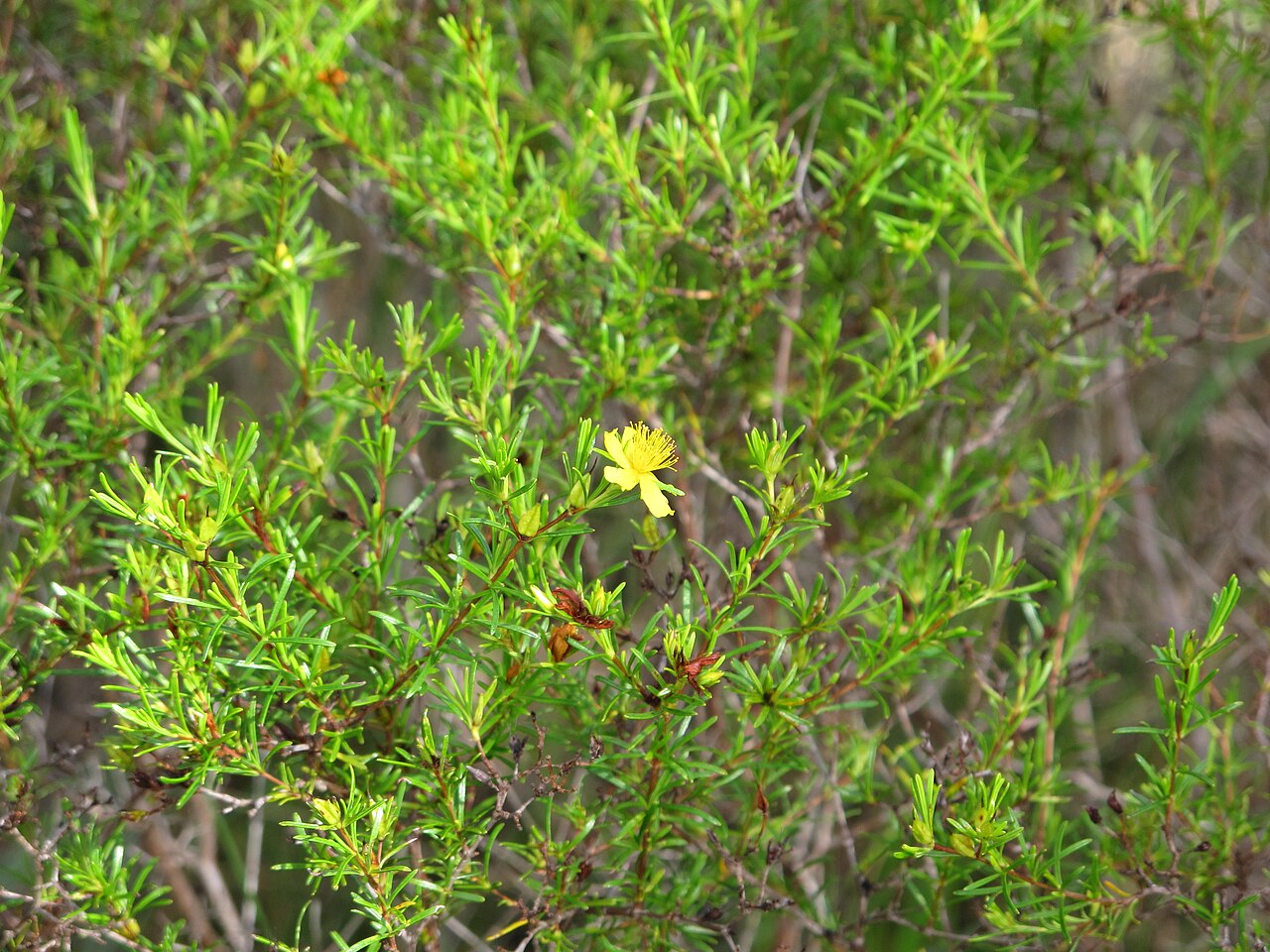
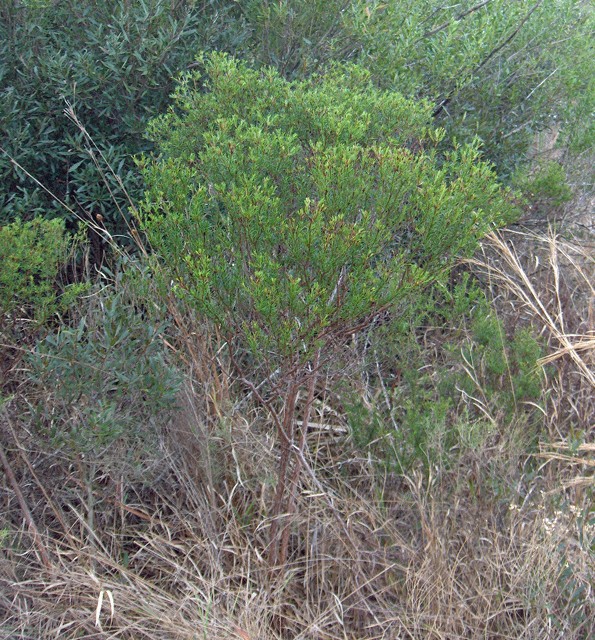
It is a much-branched evergreen shrub, usually 2 to 5 feet tall and about as wide, with a rounded crown. In deep, permanently wet sites it can grow taller, occasionally to about 10 feet. Young twigs are flattened or narrowly winged on two sides. Older stems are reddish brown with thin bark that exfoliates in papery sheets and chips, and in standing water the plant can form spongy, prop-like adventitious roots near the base, a little like a miniature mangrove.
Leaves
The leaves are opposite, stalkless and needle-like, about 1/2 to 1 inch long and barely 1/16 inch wide, with the edges rolled under. They are dotted with tiny translucent glands, a feature of the genus. In the axil of each main leaf sits a short shoot carrying a bundle (fascicle) of smaller leaves, so the stems look densely clothed in fine foliage.
Flowers
The flowers are bright yellow and about 3/4 inch across, borne singly or a few together at the branch tips. Each has five narrow green sepals, five spreading petals about 1/4 to 3/8 inch long, and a showy central brush of many yellow-orange stamens. Flowering runs mainly from April to November, with the heaviest bloom in late spring and summer, and individual flowers last only a day or so.
Fruit & Look-alikes
The fruit is a small, narrowly egg-shaped, reddish-brown capsule that splits to release many tiny seeds. Similar species include Atlantic St. John’s-wort (H. tenuifolium), a plant of drier flatwoods and scrub, and the very similar H. brachyphyllum, which has shorter, more tightly folded leaves. Myrtleleaf St. John’s-Wort and Fourpetal St. John’s-Wort share its habitats but have broad, clasping leaves.
Quick Facts
| Scientific Name | Hypericum fasciculatum |
| Family | Hypericaceae (St. John’s-wort family); Clusiaceae in some references |
| Plant Type | Evergreen shrub |
| Mature Height | 2–5 ft (occasionally to about 10 ft in permanently wet sites) |
| Mature Spread | 2–5 ft |
| Growth Rate | Moderate |
| Sun Exposure | Full sun |
| Water Needs | High; moist to wet, seasonally flooded soil |
| Soil Type | Wet sand, peaty sand and muck |
| Soil pH | Acidic (about 4.5–6.5) |
| Bloom Time | April–November; nearly year-round in south Florida |
| Flower Color | Bright yellow |
| Fall Color | None; evergreen |
| Fruit | Small reddish-brown capsule |
| Deer Resistant | Generally yes; seldom browsed |
| USDA Hardiness Zones | 8–10 |
Native Range
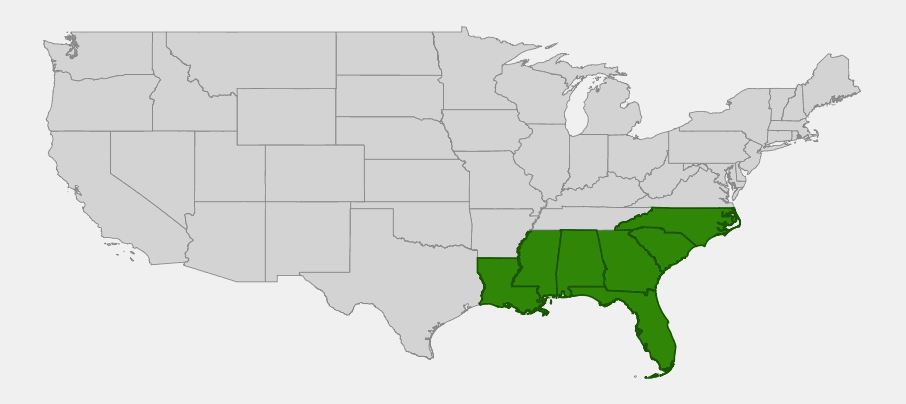
Peelbark St. John’s-wort is a Coastal Plain shrub. USDA PLANTS and the Lady Bird Johnson Wildflower Center record it in seven states: North Carolina, South Carolina, Georgia, Florida, Alabama, Mississippi and Louisiana. The University of North Carolina’s Flora of the Southeastern United States describes its range as eastern North Carolina south to south Florida and west to southern Mississippi and eastern Louisiana. Some sources also list it from Cuba, but that record is uncertain.
Florida is the center of its range, and the Atlas of Florida Plants records it nearly throughout the state, from the western Panhandle to the southern peninsula. It is common in wet pine flatwoods and savannas, along the margins of ponds, lakes and depression marshes, in cypress domes and swamp edges, in wet prairies, and in roadside ditches. In the Carolinas it is mostly a plant of upland depression ponds, beaver ponds and wet pine savannas near the coast.
It is adapted to the fire and flooding cycles of the Coastal Plain. Plants survive months of standing water in the wet season, and they resprout from the base after the frequent fires that keep flatwoods and savannas open.
📋 Regional plant lists featuring Peelbark St. John’s-Wort: North & South Florida · Alabama, Georgia & Mississippi · North & South Carolina · Arkansas, Louisiana, Eastern Oklahoma & Eastern Texas
Growing & Care Guide
Peelbark St. John’s-wort is easy to grow if you give it what it wants: sun and wet feet. It is not a plant for dry, sandy beds, and the Florida Wildflower Foundation notes that it does not tolerate drought. In a low, damp spot it needs almost no attention and blooms for months. It is occasionally available from nurseries that specialize in native plants.
Light
Plant it in full sun. It tolerates a little shade but becomes sparse and flowers poorly under a canopy.
Soil & Water
It thrives in acidic, moist to wet sand or peaty soil and tolerates seasonal flooding, including standing water for long periods. It also grows in ordinary garden soil that is kept consistently moist, but it declines in dry, well-drained sand unless watered regularly. Avoid alkaline fill. No fertilizer is needed.
Planting Tips
Use it at the edge of a pond or retention basin, in a rain garden or bioswale, or in a low corner that stays wet after rain. Space plants about 3 feet apart for a loose mass. It mixes well with other wetland natives such as pitcher plants, meadow beauties, yellow-eyed grasses and other St. John’s-worts, which extend the season of yellow flowers. Water new plants until they are established, even in wet sites, if the season turns dry.
Pruning & Maintenance
Little care is needed. Older plants can become leggy; cut a few of the oldest stems back near the base in late winter to encourage fresh growth, or cut the whole plant back by about half every few years. In natural areas, fire does this job, and the plant resprouts quickly after burning.
Propagation
Grow it from seed sown on the surface of a moist, peaty mix in spring; the tiny seeds need light to germinate and should not be covered. Softwood cuttings taken in spring or early summer also root readily in a moist medium.
Landscape Uses
- Rain gardens and bioswales: a long-blooming shrub for basins that flood and drain
- Pond and lake edges: sunny shorelines with saturated, acidic soil
- Pollinator gardens: an important pollen source for native bees through summer and fall
- Wetland and flatwoods restoration: in wet pinelands, wet prairies and depression marsh margins
- Fine-textured accent: soft, needle-like evergreen foliage that contrasts with broad-leaved plants
Wildlife & Ecological Value
Peelbark St. John’s-wort is a valuable wildlife plant in wet pinelands because it blooms for so long and offers cover in otherwise open habitats.
For Pollinators
The flowers have no nectar but produce abundant pollen, and they are visited heavily by bees. The Florida Wildflower Foundation lists polyester, yellow-faced, large carpenter, bumble, leafcutter, resin and sweat bees among its visitors, and the plant is included in bee studies at Archbold Biological Station. Bumblebees collect the pollen by buzzing the stamens. Green orchid bees, an introduced species in south Florida, also visit it.
For Birds
The dense, evergreen branches provide cover for small birds in open flatwoods and marshes, and the abundant insects attracted to the flowers are food for warblers, wrens and other insect-eating birds. The tiny seeds are of limited value as bird food.
For Mammals
Small mammals use the thick, low growth for cover. It is rarely browsed by deer, possibly because Hypericum foliage contains bitter compounds.
Ecosystem Role
It is a characteristic shrub of fire-maintained wet pinelands and depression marsh edges, where it helps stabilize saturated soil and resprouts after burns. Where fire is excluded, it can become denser along pond margins as part of the shrub zone that develops between upland and open water.
Cultural & Historical Uses
The French naturalist Jean-Baptiste Lamarck described Hypericum fasciculatum in 1797, choosing a name that points to the bundled leaves. The genus name Hypericum comes from Greek and is usually explained as “above images” or “above icons,” from the ancient European practice of hanging St. John’s-wort above religious images to ward off evil. The common name “St. John’s-wort” refers to the European species that blooms around the feast of St. John the Baptist in late June.
The St. John’s-wort sold as an herbal supplement is the European Hypericum perforatum, not this native shrub. The Florida Wildflower Foundation, citing Dan Austin’s Florida Ethnobotany, warns that native St. John’s-worts contain hypericin-type compounds and can cause dermatitis or sensitivity to sunlight. Do not use peelbark St. John’s-wort medicinally.
The local name “sandweed” is used in Florida and appears in the Atlas of Florida Plants. Today the plant is valued mainly by restoration ecologists and native gardeners, who use it to bring months of yellow flowers and a busy population of native bees to wet, sunny places.
Frequently Asked Questions
Why is it called peelbark St. John’s-wort?
The reddish-brown bark of older stems peels off in thin, papery sheets and flakes. This is one of the easiest ways to tell it from other needle-leaved St. John’s-worts.
Will it grow in a dry yard?
Not well. It is a wetland shrub that needs moist to wet soil, and it does not tolerate drought. For a dry, sandy site, look at Atlantic St. John’s-wort or other upland species instead.
Is it the same as the St. John’s-wort used in supplements?
No. Supplements are made from the European Hypericum perforatum. Native St. John’s-worts can cause skin irritation or sun sensitivity in some people, and should not be used as herbal remedies.
How long does it bloom?
From spring through fall, mainly April to November, and nearly year-round in south Florida. Each flower lasts about a day, but new ones open continually.
Can it stand in water?
Yes. It tolerates long periods of standing water during the wet season and can form spongy prop roots near the base when flooded, which makes it a good choice for pond margins and retention basins.

Looking for a nursery that carries Peelbark St. John’s-Wort?
Browse our native plant nursery directory: Alabama · Florida & Georgia · Louisiana & Mississippi · North Carolina · South Carolina