
Hercules’ Club (Zanthoxylum clava-herculis)
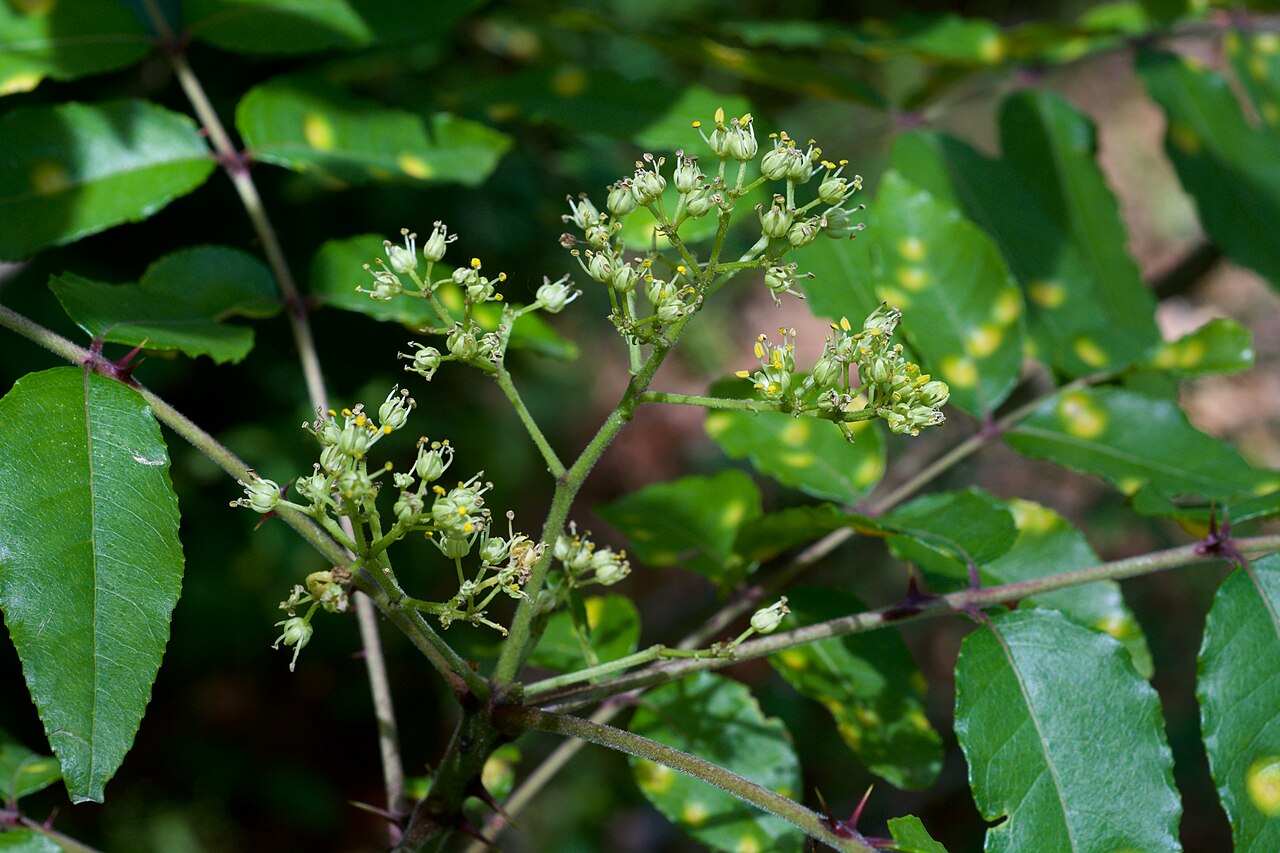
Zanthoxylum clava-herculis, known as Hercules’ Club, toothache tree or southern prickly ash, is a small, aromatic native tree of the southeastern United States. Its trunk is studded with corky, pyramid-shaped knobs, its branches and leaf stalks carry sharp prickles, and its glossy compound leaves smell of citrus when crushed. In spring it produces clusters of small greenish-yellow flowers, and female trees follow with small husks that split to show shiny black seeds.
It belongs to the citrus family (Rutaceae), and it is a key larval host plant for the giant swallowtail butterfly. The name Hercules’ club refers to the heavy, knobby club carried by the Greek hero, and the species name clava-herculis means the same thing in Latin. The Atlas of Florida Plants writes the common name as Hercules-club, while USDA PLANTS uses Hercules’ club. Older references sometimes use the synonym Zanthoxylum macrophyllum. Do not confuse it with devil’s walkingstick (Aralia spinosa), an unrelated spiny tree that is also called Hercules’ club.
Chewing the bark or leaves numbs the mouth and tongue, which is the source of the name toothache tree. It is native from Virginia south to Florida and west to Arkansas, Oklahoma and Texas, mostly on the Coastal Plain, where it grows in coastal hammocks, on dunes and shell mounds, and along fencerows. This guide covers identification, range, care and wildlife value. Be aware that it is very thorny: plant it away from paths and play areas.
Identification
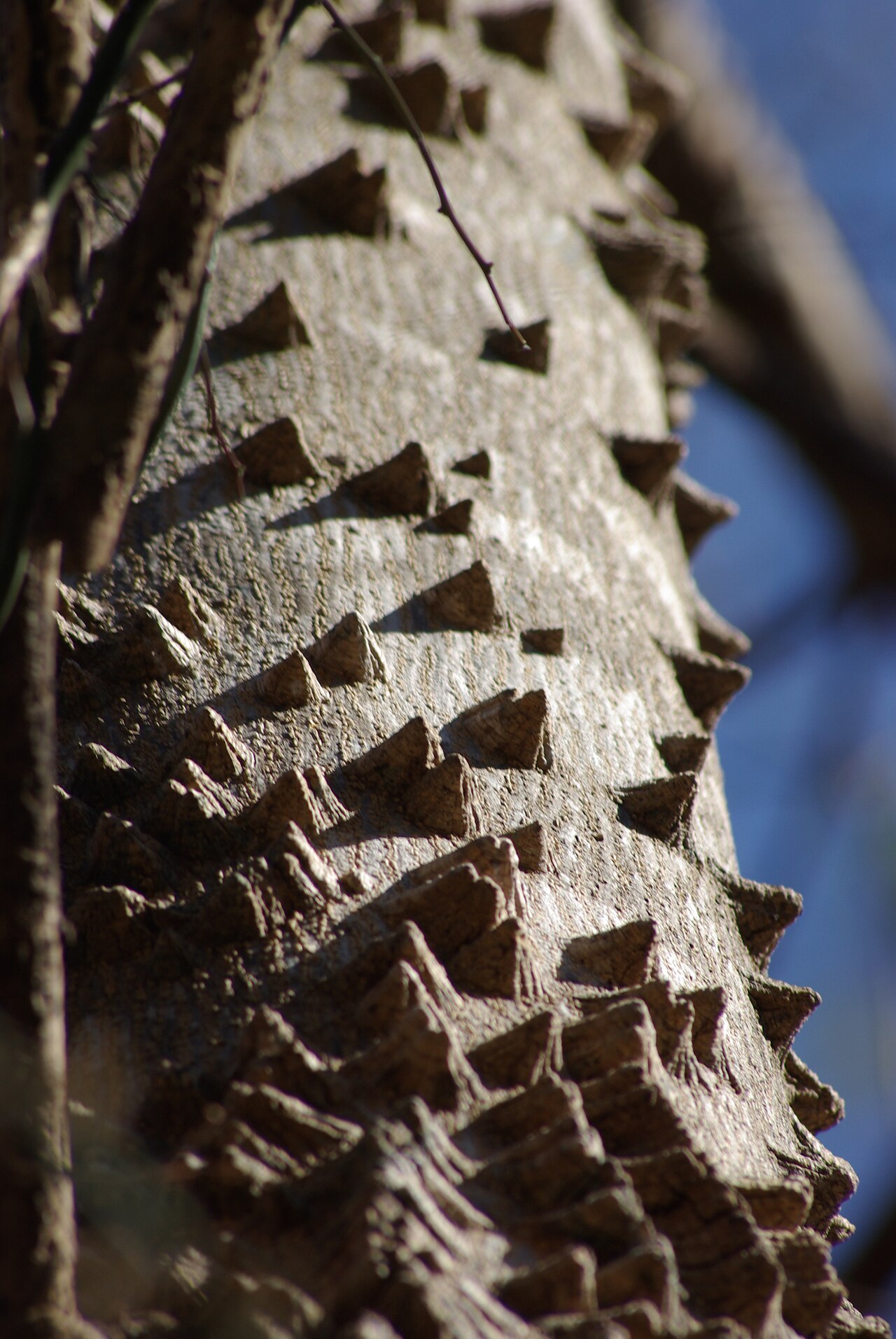
No other eastern tree has the same combination of corky, prickle-tipped knobs on the trunk, prickly branches, and glossy, aromatic, compound leaves. The knobs develop as the tree ages; young trees and saplings show only prickles.
Bark & Trunk
The bark is light gray and smooth between the knobs. On older trunks, the prickles become raised, corky, cone- or pyramid-shaped knobs up to about an inch tall, sometimes so crowded that the trunk looks armored. Twigs and branches carry stout, sharp, often paired prickles, and prickles also occur along the leaf stalks.
Leaves
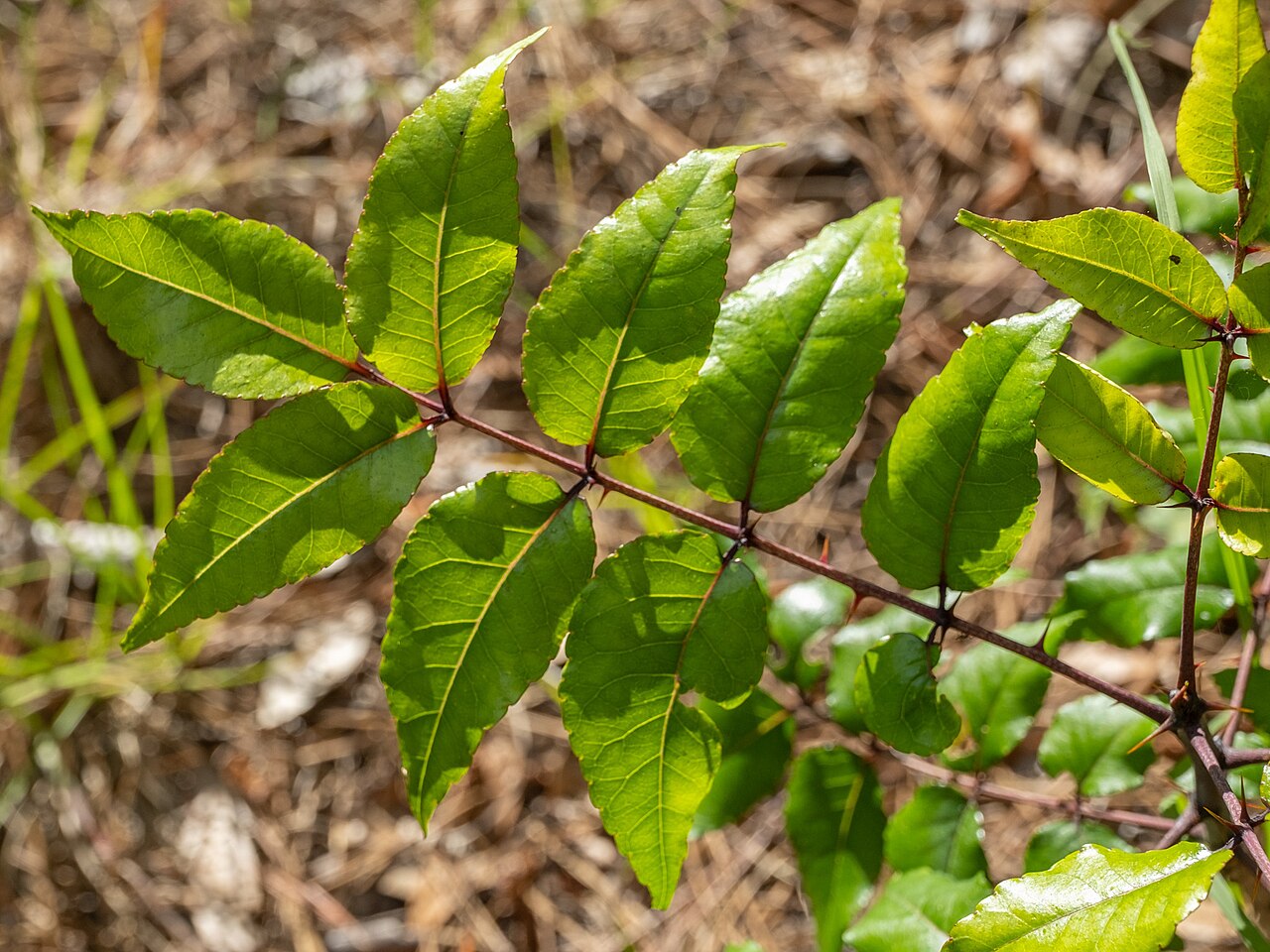
The leaves are alternate and pinnately compound, 5 to 10 inches long, with about 5 to 19 leaflets. Each leaflet is lance-shaped to ovate, 1 to 3 inches long, glossy and leathery, with a slightly curved midrib and an uneven base. The margins have small rounded teeth with translucent oil glands in the notches. Crushed leaves have a strong citrus smell. The leaves are deciduous, dropping in fall or early winter.
Flowers
Male and female flowers are on separate trees. The small, greenish-yellow to whitish flowers grow in branched clusters at the tips of the new shoots in spring, usually March to May depending on latitude. Male flowers have five yellow-tipped stamens; female flowers have two or three small pistils.
Fruit & Seeds
On female trees, each flower produces two or three small, rounded, reddish-brown, warty husks (follicles) about ¼ inch across. In summer and fall they split open to reveal a single shiny, black seed that often dangles from the open husk for a while.
Similar Species
Northern prickly ash (Z. americanum) is a smaller, thicket-forming shrub of the Midwest and Northeast with dull, hairy leaflets and flowers that open before the leaves. Texas Hercules’ club (Z. hirsutum) of Texas and Oklahoma is a smaller tree with fewer, smaller, wavy leaflets. Lime prickly ash (Z. fagara) of south Florida and south Texas is evergreen, with small leaflets and a winged leaf stalk. Devil’s walkingstick (Aralia spinosa) has huge, twice-compound leaves and large, airy clusters of white flowers in summer.
Quick Facts
| Scientific Name | Zanthoxylum clava-herculis L. (syn. Z. macrophyllum); Atlas name Hercules-club |
| Family | Rutaceae (citrus family) |
| Plant Type | Deciduous small tree or large shrub |
| Mature Height | 15–30 ft (occasionally to 50 ft) |
| Mature Spread | 10–20 ft |
| Growth Rate | Moderate to fast |
| Sun Exposure | Full sun to part shade |
| Water Needs | Low to moderate; drought tolerant once established |
| Soil Type | Sandy, shelly or loamy, well-drained soils |
| Soil pH | Acidic to alkaline, about 5.5–8.0 |
| Bloom Time | Spring (March–May) |
| Flower Color | Greenish yellow |
| Fall Color | Yellowish; not showy |
| Fruit | Small reddish-brown husks with shiny black seeds, summer–fall |
| Deer Resistant | Yes; prickly and aromatic |
| USDA Hardiness Zones | 7a–10a |
Native Range
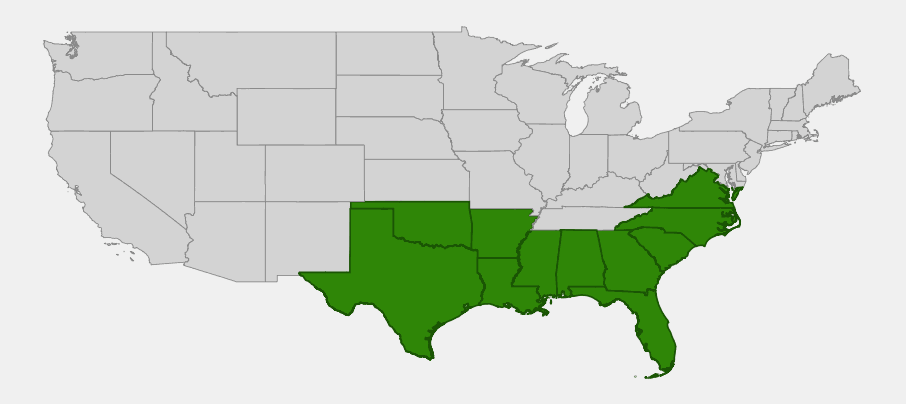
Hercules’ club is native to the southeastern United States. USDA PLANTS lists it in Virginia, North Carolina, South Carolina, Georgia, Florida, Alabama, Mississippi, Louisiana, Arkansas, Oklahoma and Texas. It is most common on the Atlantic and Gulf Coastal Plains. In Florida, the Atlas of Florida Plants maps it in the panhandle and through much of the peninsula, including many coastal counties.
It does not occur in Canada or Mexico.
It grows in coastal hammocks, on stabilized dunes and barrier islands, on shell mounds, in sandy upland woods and old fields, and along fencerows and woodland edges, where birds have dropped its seeds. Inland it grows in open woods and on river bluffs. It tolerates salt spray and poor sandy soils.
📋 Regional plant lists featuring Hercules’ Club: North & South Florida · Alabama, Georgia & Mississippi · North & South Carolina · Maryland, Virginia & West Virginia · Arkansas, Louisiana, Eastern Oklahoma & Eastern Texas
Growing & Care Guide
Hercules’ club is a tough, drought-tolerant tree for butterfly gardens and coastal landscapes, and it is sold by some native plant nurseries, especially in Florida. Its prickles are sharp, so plant it where people and pets will not brush against it, and wear heavy gloves when handling it.
Light
It grows in full sun to part shade. Trees in sun are denser and flower and fruit more heavily.
Soil & Water
It prefers well-drained sandy, shelly or loamy soil and tolerates poor, dry sand and alkaline soils. Water new plants until they are established; after that, it is very drought tolerant. It has good tolerance of salt spray and can be planted near the coast, though not on the front dune.
Planting Tips
Plant container-grown trees in fall or winter in a spot away from walkways, play areas and windows you need to reach for maintenance. It is a good choice for the back of a butterfly garden, a wildlife hedge, or a mixed coastal hammock planting. Because male and female flowers are on separate trees, only female trees produce seed, but both sexes serve as host plants for giant swallowtail caterpillars. Trees may sucker to form small groups over time.
Pruning & Maintenance
Prune in winter to remove crossing branches or lower limbs, wearing heavy gloves and eye protection. Remove unwanted suckers and seedlings while they are small. Otherwise it needs little care. Expect giant swallowtail caterpillars to eat some leaves in summer; they rarely do lasting damage, so do not spray them.
Propagation
Collect seed from female trees when the husks split in late summer or fall. Clean the seed and sow it in fall outdoors, or store it cold and moist for about two to three months before spring sowing. Germination can be slow and irregular. Root suckers can also be dug and transplanted in winter.
Landscape Uses
- Butterfly gardens: larval host for the giant swallowtail
- Coastal landscapes: salt- and drought-tolerant small tree
- Wildlife hedges and barriers: prickly screen that also feeds birds
- Specimen and conversation tree: its knobby trunk is unforgettable
- Habitat restoration: coastal hammocks, fencerows and old fields
Wildlife & Ecological Value
Hercules’ club is one of the most important host plants for the giant swallowtail, North America’s largest butterfly, and it also supports pollinators and fruit-eating birds.
For Pollinators
The spring flowers attract bees, flies and other small insects. Its leaves are a major larval host for the giant swallowtail (Papilio cresphontes), whose caterpillars are camouflaged to look like bird droppings.
For Birds
The shiny black seeds are eaten by songbirds, which spread them along fencerows and woodland edges. The prickly branches give protected cover and nest sites to small birds.
For Mammals
The prickles and aromatic, numbing chemicals in the bark and leaves discourage browsing by deer and other mammals.
Ecosystem Role
Seedlings often appear along fences and under trees where birds perch, so Hercules’ club is a common pioneer in old fields and coastal thickets. Its foliage supports a specialized group of insects that feed on citrus-family plants.
Cultural & Historical Uses
Carl Linnaeus named Zanthoxylum clava-herculis in 1753, using a Latin version of the name Hercules’ club. The genus name Zanthoxylum means “yellow wood”, after the yellowish heartwood of many species.
The bark and leaves contain compounds that cause tingling and numbness when chewed, similar to those in Sichuan pepper, which comes from Asian species of the same genus. In the rural South, people chewed the bark to dull toothaches, and it was also used in folk remedies, giving rise to names such as toothache tree and pepperwood. These traditional uses should not be copied; the plant can cause irritation, and its effects on health are not well studied.
In citrus-growing regions, giant swallowtail caterpillars are known as orange dogs because they also feed on citrus leaves. Native Hercules’ club and its relatives give these butterflies host plants well away from commercial groves, and it is often planted in butterfly gardens for that reason.
Frequently Asked Questions
Why is it called the toothache tree?
Chewing its bark or leaves causes tingling and numbness in the mouth, so people in the rural South once chewed it to dull toothaches. It should not be used as a remedy.
Is Hercules’ club the same as devil’s walkingstick?
No. Both are spiny native trees sometimes called Hercules’ club, but devil’s walkingstick (Aralia spinosa) is in the ginseng family, with huge twice-compound leaves and large clusters of white summer flowers. Zanthoxylum clava-herculis is in the citrus family and has a knobby, corky trunk.
Is Hercules’ club dangerous?
Its sharp prickles can scratch and puncture skin, so plant it away from paths and play areas and wear gloves when working near it. The bark and leaves cause numbness and should not be eaten.
Does Hercules’ club attract butterflies?
Yes. It is a major larval host for the giant swallowtail butterfly, and its spring flowers are visited by many small pollinators.
Do I need a male and a female tree?
Only female trees produce seeds, and they need a male tree nearby to set seed. For butterflies, any tree will do, because caterpillars feed on the leaves of both sexes.

Looking for a nursery that carries Hercules’ Club?
Browse our native plant nursery directory: Alabama & Arkansas · Florida & Georgia · Louisiana & Mississippi · North Carolina & Oklahoma · South Carolina, Texas & Virginia