
Maga (Thespesia grandiflora)
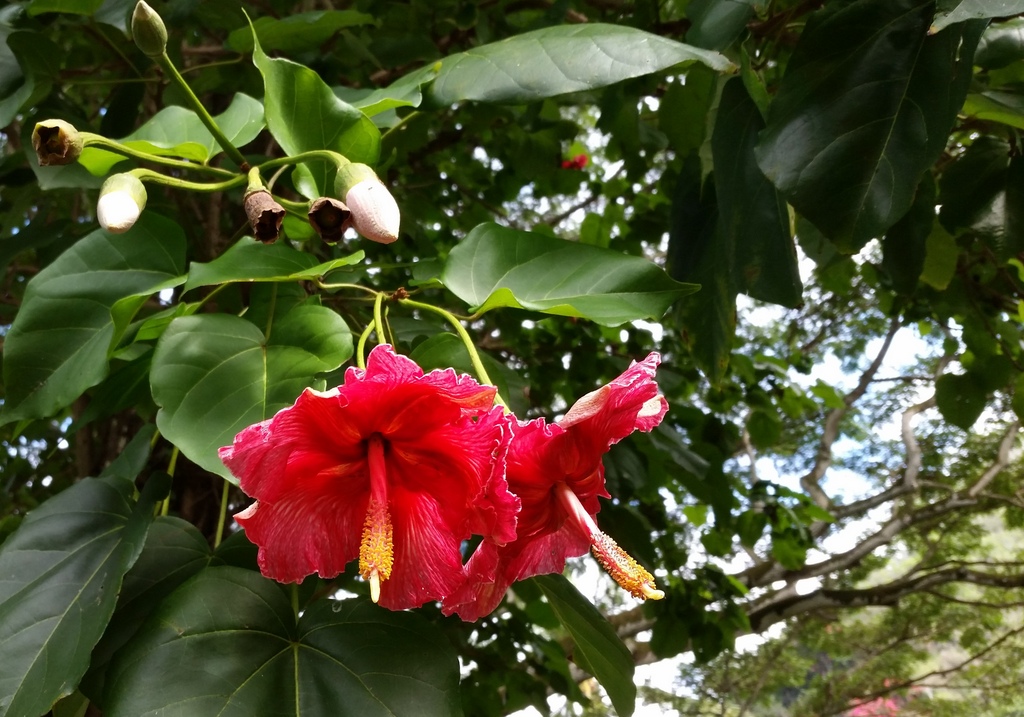
Thespesia grandiflora, known in Puerto Rico as maga or maga colorada, is a medium-sized evergreen tree found in the wild nowhere else in the world. It belongs to the mallow family (Malvaceae), the same family as hibiscus and cotton, and its large red to rose-pink flowers look so much like hibiscus blossoms that many people call it amapola, the Puerto Rican name for hibiscus. The flower of the maga is recognized as the national flower of Puerto Rico.
In the wild, maga is a tree of the moist limestone hills of western and north-central Puerto Rico: the lower slopes of the Cordillera Central and the northern karst belt with its haystack hills (mogotes). Because it has been planted for generations along roads, in plazas, schoolyards and home gardens, it now grows across the whole archipelago, and it is grown as an ornamental in south Florida, Hawaii and other tropical places.
Maga is one of the best native trees for Puerto Rican gardens. It flowers on and off through the year, keeps a neat, rounded crown, tolerates a wide range of soils, and produces a hard, durable wood. This guide covers how to identify it, where it grows naturally, how to plant and care for it, and its place in the island’s ecology and culture.
Identification
Maga is easy to recognize when in flower. Out of flower, its long-stalked, heart-shaped leaves and straight trunk help separate it from the many other broadleaf trees of Puerto Rican forests and gardens.
Form & Bark
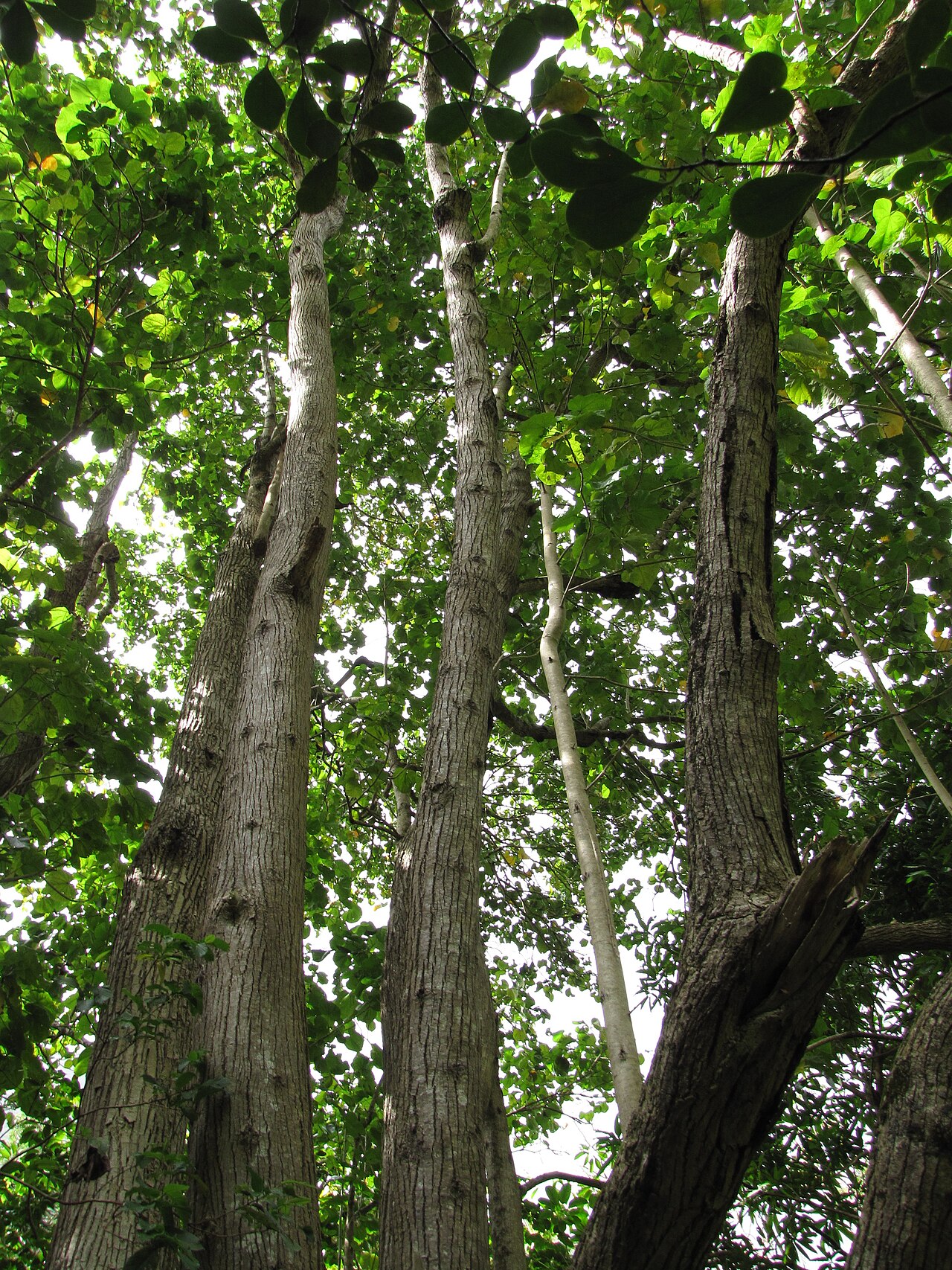
Maga grows as a straight-trunked tree, usually 30 to 50 feet tall with a dense, rounded or oval crown up to about 20 feet across. Young trees are narrow and upright. The bark is dark gray to brown and becomes noticeably furrowed with age.
Leaves
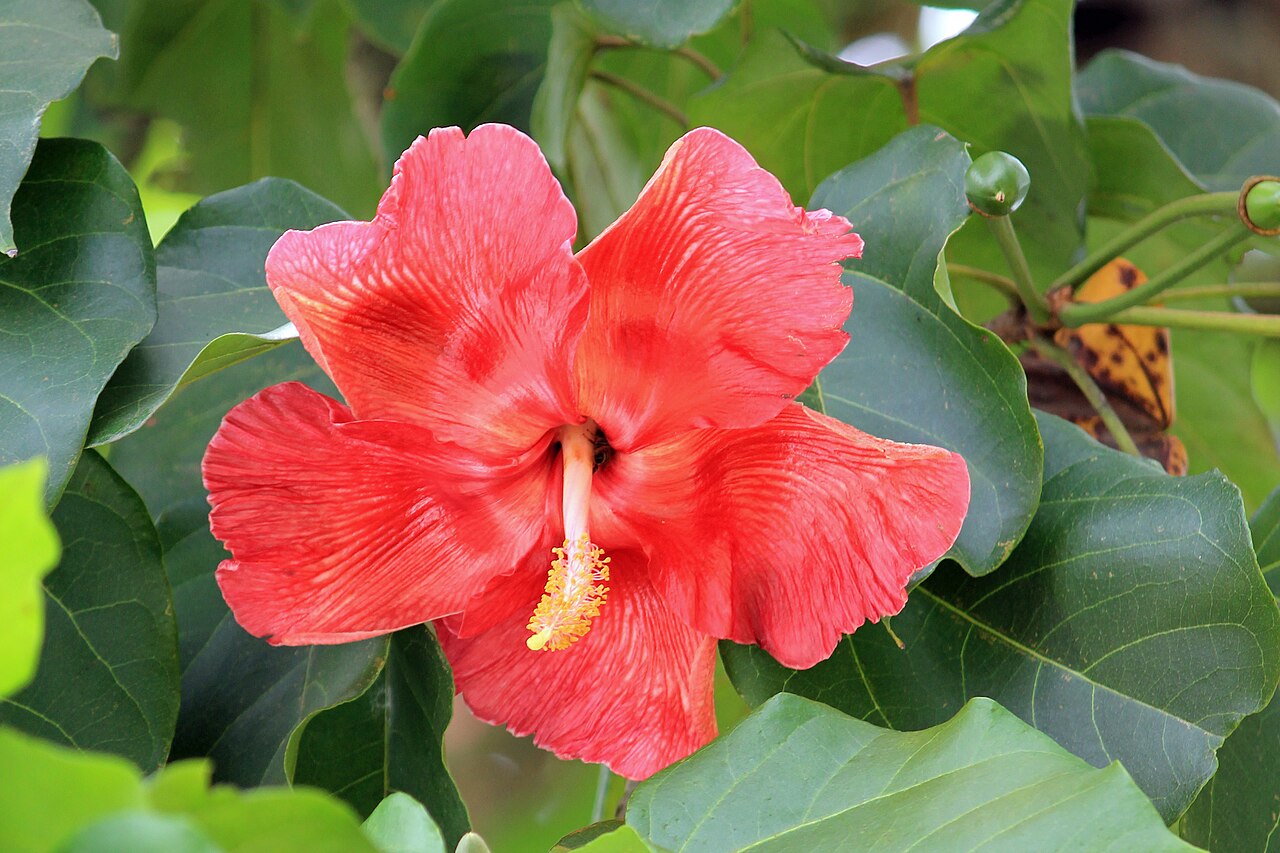
The leaves are alternate, simple and heart-shaped (broadly ovate with a heart-shaped base), with smooth edges and a long leaf stalk. They are bright to dark green, leathery and shiny above, and roughly 4 to 8 inches long. The tree is evergreen, dropping a few old leaves at a time rather than all at once.
Flowers
The flowers are borne singly on long stalks from the leaf axils, and a tree can carry flowers in almost any month. Each one is trumpet- or cup-shaped, about 6 inches across, with five large, overlapping petals. They open a deep rose-pink to red and age to a bronzy crimson. Several buds may form on a twig, but usually only one opens at a time. A pale staminal column, covered with yellow anthers near its tip, rises from the center of the flower, as in hibiscus.
Pale green flower buds, pointed and bullet-shaped, are often seen on the same branches as open flowers.
Fruit & Seeds
The fruit is smooth, green and nearly round, about 1¼ to 2 inches across. Inside, 1 to 12 brown seeds sit in a white, pulpy matrix. As the seeds ripen the fruit softens and drops easily from its stalk; birds and bats carry many fruits away, eat the fleshy wall and drop the seeds.
Quick Facts
| Scientific Name | Thespesia grandiflora DC. (syn. Montezuma speciosissima) |
| Family | Malvaceae (mallow family) |
| Plant Type | Evergreen tree; endemic to Puerto Rico |
| Mature Height | 30–50 ft |
| Mature Spread | 15–20 ft |
| Growth Rate | Fast when young (about 3 ft a year), then slow |
| Sun Exposure | Full sun to light shade; does not tolerate deep shade |
| Water Needs | Moderate; tolerates short dry spells once established |
| Soil Type | Sandy loam to clay, including thin soils over limestone; best on deep, well-drained soils |
| Soil pH | Very acid to slightly alkaline (about 4.5–7.5) |
| Bloom Time | Year-round, heaviest in spring and summer |
| Flower Color | Deep rose-pink to red, aging to bronzy crimson |
| Fall Color | None; evergreen |
| Fruit | Smooth, round green fruit 1¼–2 in across with 1–12 seeds |
| Deer Resistant | Not a concern in Puerto Rico, which has no native deer |
| USDA Hardiness Zones | 10b–12; frost-sensitive |
Native Range
Maga is endemic to Puerto Rico, which means it is native nowhere else. USDA PLANTS lists it as native only in Puerto Rico, and the Smithsonian’s Flora of the West Indies records it as a Puerto Rico endemic. Its natural populations grew in the humid, lower limestone mountains of the western and north-central parts of the main island, on the lower slopes of the Cordillera Central and in the northern karst belt.
Planting has spread maga well beyond that natural range. It is one of the most common ornamental and street trees in Puerto Rico and is now found throughout the main island and on the smaller islands of the archipelago. Between 1934 and 1945 it was also planted by the hundreds of thousands in what is now El Yunque National Forest. Outside Puerto Rico it is grown as an ornamental in south Florida, Hawaii, Central America and other Caribbean islands, but it is not native in any of those places.
Maga is limited by cold rather than by soil. It thrives in frost-free climates and is damaged by temperatures near freezing, so in the continental U.S. it can be grown outdoors only in the warmest parts of south Florida.
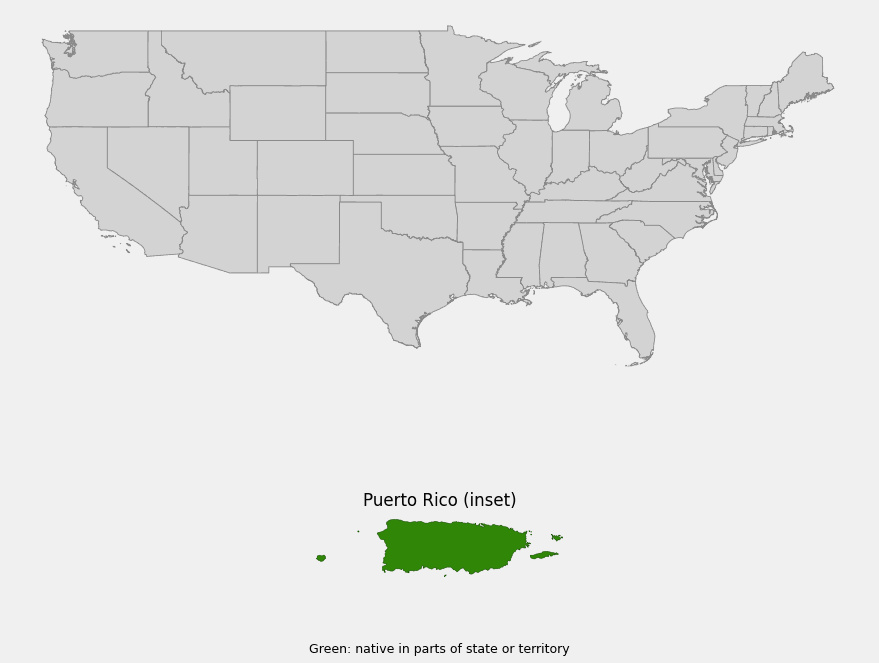
📋 Regional plant lists featuring Maga: Puerto Rico
Growing & Care Guide
Maga is an easy, adaptable tree in Puerto Rico and other frost-free places. Plant it where it has room to reach its full height and where its flowers can be seen up close, near a patio, entrance or along a walk.
Light
Plant maga in full sun or light shade. It is intolerant of deep shade: in forest plantings it was soon overtopped and shaded out by faster trees, and in the wild it grows best along forest edges, roadsides and openings.
Soil & Water
It grows in soils from sandy loam to clay and from very acid to slightly alkaline, including thin soils over limestone, although growth is very slow there. The best wild trees grow on the deep soils of lower limestone slopes and the alluvial hollows between karst hills. Water young trees regularly through their first dry season. Established trees tolerate periods of drought but grow and flower better with moderate, regular moisture. Avoid sites with standing water.
Planting Tips
Plant at the start of the rainy season so the roots establish before the drier months. Set the tree at the same depth it grew in the pot, water deeply and add a ring of mulch, kept away from the trunk. Allow about 15 to 20 feet from buildings and power lines. Its roots are not known for lifting sidewalks or curbs, one reason it is a popular street tree.
Pruning & Maintenance
Maga needs little pruning. Remove dead or damaged branches and lift lower limbs if you need clearance. Heavy pruning is of little use because older trees respond with many sprouts along the trunk and branches. A scale insect (Asterolecanium pustulans) sometimes causes leaf loss and twig dieback, and the pink bollworm of cotton also feeds in the fruit, but serious damage is uncommon.
Propagation
Sow seed as soon as it is removed from ripe fruit. Fresh seed germinates within about a week at 70 to 80 percent, but germination drops sharply after two weeks of dry storage. Move seedlings to containers when the first true leaves appear and give them full sun for a few weeks before planting out. Container trees are ready in about six months, and trees in the open usually begin flowering at 5 to 10 years. Woody cuttings also root.
Landscape Uses
- Specimen and shade tree: a long-flowering focal point for yards, plazas and schoolyards
- Street tree: its upright crown and moderate size suit roadsides and medians
- Native reforestation: a candidate for planting in the karst region and lower montane areas of its natural range
- Pollinator and bird gardens: its nectar-rich flowers attract bees and hummingbirds
- Heritage plantings: as the national flower, it is a natural choice for cultural and memorial plantings
Wildlife & Ecological Value
As an endemic tree, maga is part of the island’s unique natural heritage, and its long flowering season makes it a reliable source of nectar for wildlife.
For Pollinators
The large, nectar-rich flowers attract bees and other insects. Puerto Rico’s hummingbirds, such as the green mango and the Puerto Rican emerald, are known to visit large tubular and cup-shaped red flowers like the maga’s.
For Birds
Besides hummingbirds, the dense evergreen crown gives cover and nesting sites to songbirds such as bananaquits and Puerto Rican spindalises, and insect-eating birds forage among its leaves.
For Mammals
Puerto Rico’s native land mammals are bats, and fruit-eating bats carry off ripe maga fruit, eat the fleshy wall and drop the seeds, helping spread the tree.
Ecosystem Role
In the wild, maga is part of the moist limestone forest of the karst region, contributing to the canopy and leaf litter that protect thin karst soils.
Cultural & Historical Uses
The maga is Puerto Rico’s national flower. Its large red blossom appears in art, crafts, poetry and logos, and the tree is planted at many schools, plazas and public buildings. Because it is often confused with hibiscus, it is a common reminder that the island has its own native flowering trees.
Maga heartwood is a rich chocolate brown, reminiscent of old mahogany, and when available it has sold for more than mahogany. It is very durable and highly resistant to the West Indian drywood termite. Today it is used mostly for musical instruments and crafts, occasionally for furniture and interior trim, and small stems serve as fence posts. Between 1934 and 1945 about 400,000 maga seedlings were planted in what is now El Yunque National Forest, but few survived the competition of faster-growing trees.
The species was described by the Swiss botanist Augustin Pyramus de Candolle and has also been placed in the genus Montezuma as Montezuma speciosissima, a name still found in older literature. Its closest well-known relative is the portia tree or seaside mahoe (Thespesia populnea), a widespread coastal tree of the tropics.
Frequently Asked Questions
Is maga a hibiscus?
No, although it is in the same family. Maga belongs to the genus Thespesia, which is more closely related to cotton than to Hibiscus. The flowers look similar, which is why maga is sometimes called amapola, the Puerto Rican name for hibiscus.
Where is maga native?
Only in Puerto Rico. Its natural habitat is the moist limestone hills of the northern karst belt and the lower Cordillera Central, but it is now planted throughout the island.
How big does a maga tree get?
Usually 30 to 50 feet tall with a crown about 15 to 20 feet wide, so it fits in most yards if planted away from buildings and power lines.
When does maga bloom?
It can flower in any month, with the heaviest bloom usually in spring and summer.
Can I grow maga in Florida?
Yes, in frost-free parts of south Florida, where it is grown as an ornamental. It is not native to Florida, and it is damaged by temperatures near freezing.

Looking for a nursery that carries Maga?
Our nursery directory does not yet include Puerto Rico. Browse the native plant nursery directory by state: Alabama–Arkansas · California · Colorado–Hawaii · Idaho–Kansas · Kentucky–Montana · Nebraska–Oklahoma · Oregon · Pennsylvania–Virginia · Washington · West Virginia–Wyoming