
Broad Halberd Fern (Tectaria heracleifolia)
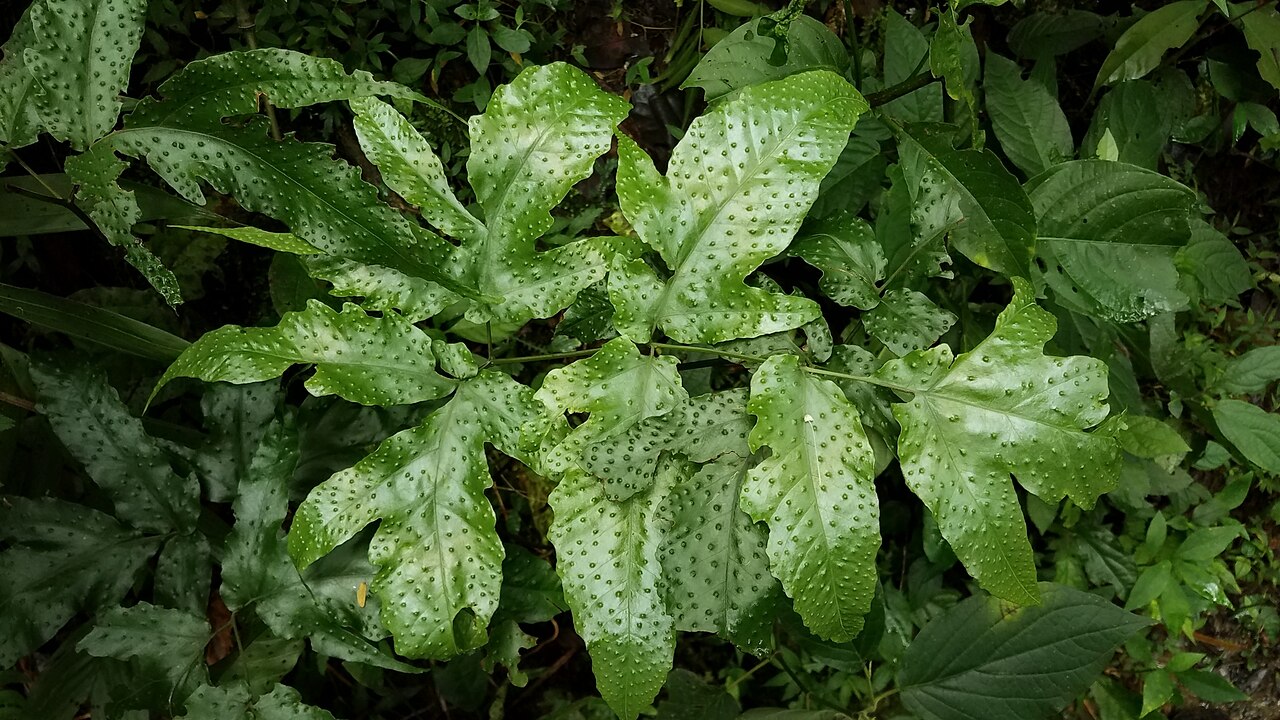
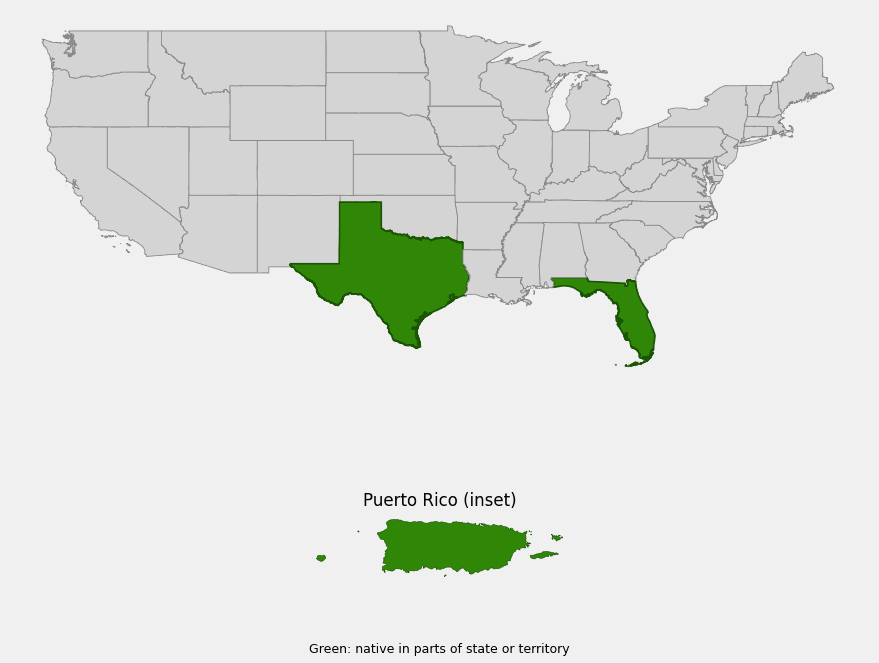
Tectaria heracleifolia, known as Broad Halberd Fern, is a bold tropical fern with large, glossy, deeply lobed fronds shaped like the head of a halberd, a medieval pole weapon. It grows on moist limestone in deep shade, often on the walls of sinkholes and the rocky floors of tropical hardwood hammocks. It belongs to the Tectaria family (Tectariaceae). USDA PLANTS lists it as native in Puerto Rico and in two mainland states, Florida and Texas. In Mexico it is called helecho lengua de ciervo.
In Puerto Rico the Institute for Regional Conservation (IRC) records broad halberd fern on limestone in Guánica State Forest, on the dry southwest coast, and in Río Abajo State Forest in the northern karst, with a report from El Yunque. In Florida it is a rare fern of the rockland hammocks of Miami-Dade County north to Martin County, with outlying populations in sinkholes farther north, and the Atlas of Florida Plants lists it as state Threatened. In Texas it is one of the state’s rarest ferns, known from sinkholes and caves on the Edwards Plateau.
For gardeners in South Florida and Puerto Rico, broad halberd fern is a striking native for shady limestone gardens, though it needs steady moisture and humidity. This guide covers identification, range, care and the reasons it should only be bought from nurseries.
Identification
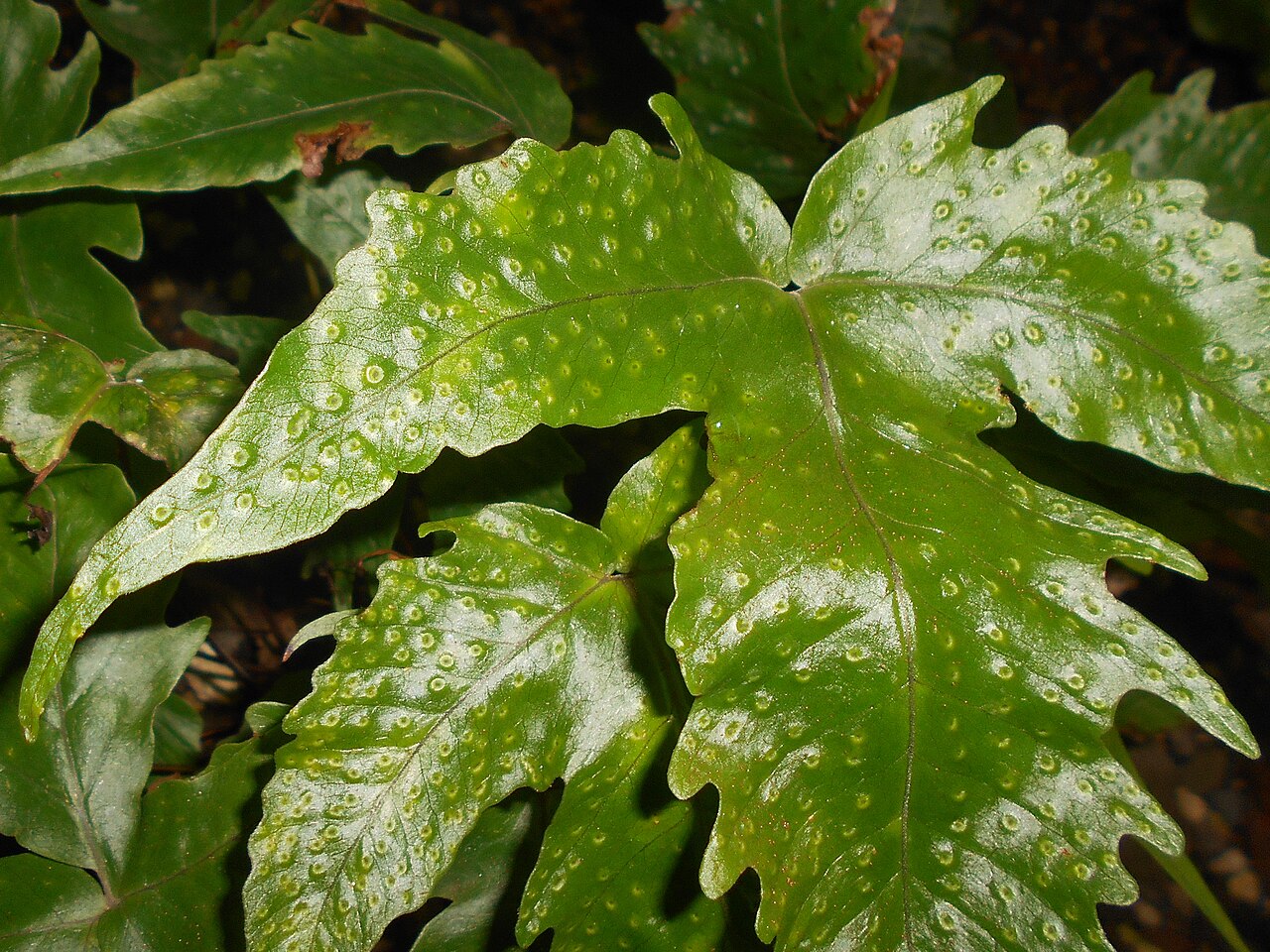
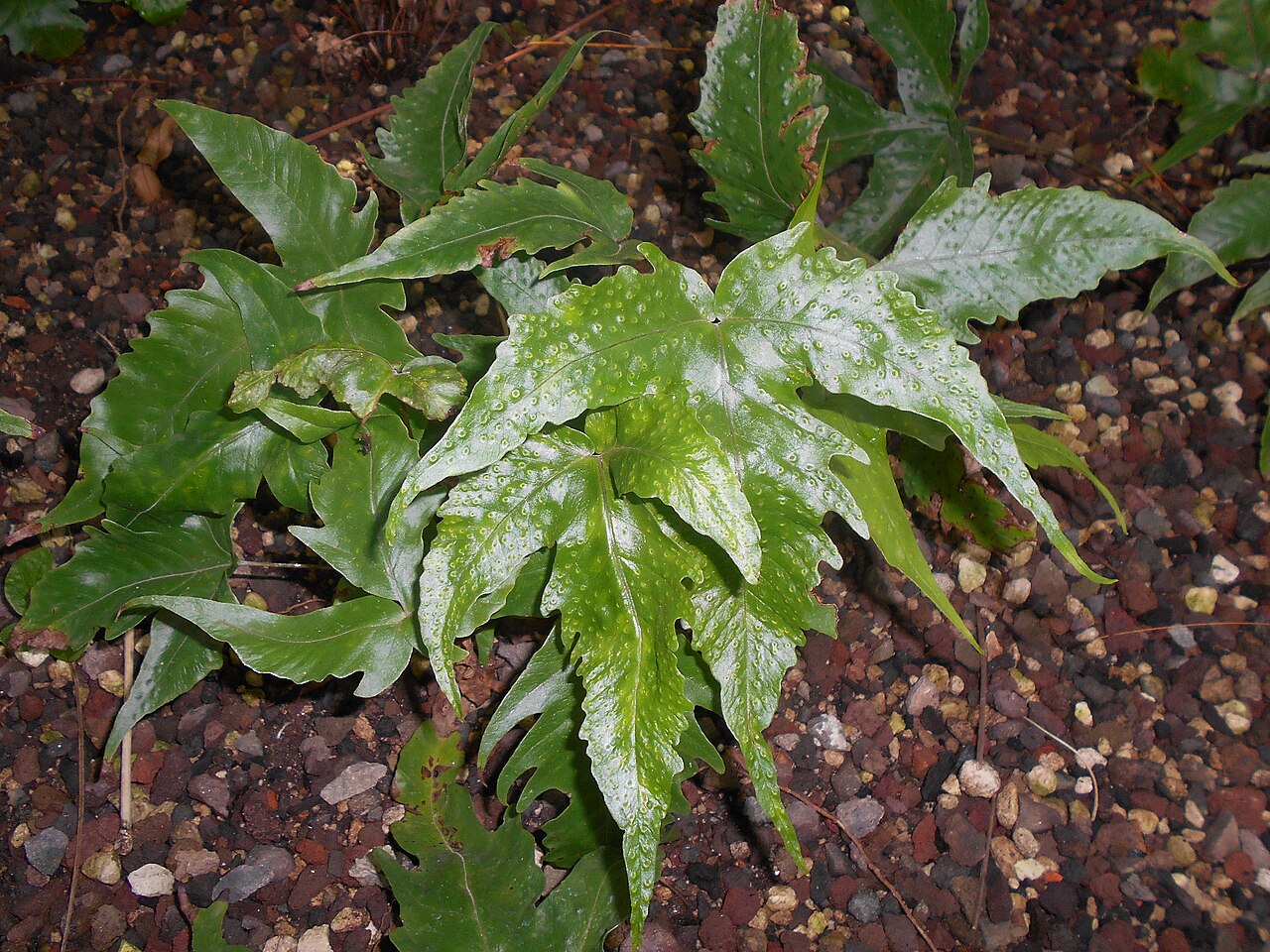
Few native ferns have fronds like broad halberd fern: broad, firm and glossy, with a few large lobes or leaflets rather than many small ones. The round sori, scattered in rows over the underside, are visible as dots from above.
Rhizome
The fern grows from a short, upright or ascending rhizome, up to about ¾ inch thick, covered with two-colored, lance-shaped scales. The fronds arise in a loose clump. Plants do not run or form wide colonies, but several crowns may grow close together on a rock face.
Fronds
Fronds are about 1 to 2 feet long or more; IRC gives 6 to 24 inches or more, and Mexican accounts give 12 to 28 inches (30 to 70 cm). The stalk (stipe) is often longer than the blade and is straw-colored to reddish brown and shiny, with a few scales near the base. The blade is firm, triangular in outline, about 8 to 14 inches long, and either simple and lobed or divided into a terminal segment plus up to four pairs of side pinnae. The lowest pair of pinnae is much larger than the rest and is strongly lobed on its lower side, which gives the frond its broad, halberd-like or five-pointed outline. Fronds tend to hang or arch outward from rock faces.
Sori & Spores
The sori are round and arranged in rows, one row always running beside the main vein of each pinna. Each sorus is covered by a thick, round, persistent indusium attached at its center (peltate). From above, the sori often show as a pattern of small dots or bumps on the glossy blade. The fern produces spores mainly from spring into summer in Florida.
Similar Species
Florida has several other native halberd ferns, all rarer and smaller: least halberd fern (Tectaria fimbriata), Tectaria coriandrifolia and their hybrid T. ×amesiana. The non-native incised halberd fern (Tectaria incisa), which escapes in South Florida, has fronds with many pairs of pinnae. Broad halberd fern is the largest and broadest-leaved native of the group.
Quick Facts
| Scientific Name | Tectaria heracleifolia (Willd.) Underw.; USDA common name: broad halberd fern (syn. Aspidium heracleifolium) |
| Family | Tectariaceae (halberd fern family); sometimes placed in Dryopteridaceae |
| Plant Type | Evergreen terrestrial fern, usually on limestone rock |
| Mature Height | 1–2 ft (fronds sometimes longer) |
| Mature Spread | 1–2 ft clump |
| Growth Rate | Slow |
| Sun Exposure | Light shade to moderate shade |
| Water Needs | High; needs constant moisture and humidity |
| Soil Type | Moist limestone rock with some organic matter; humus pockets |
| Soil pH | Alkaline to neutral (limestone) |
| Bloom Time | Does not flower; spores mainly spring–summer |
| Flower Color | None (fern) |
| Fall Color | None; evergreen |
| Fruit | None; reproduces by spores |
| Deer Resistant | Generally; ferns are rarely browsed |
| USDA Hardiness Zones | 10–11 (native populations persist in sheltered sinkholes in colder zones) |
Native Range
Broad halberd fern ranges through the American tropics. Plants of the World Online describes its native range as Florida to the Caribbean and southern Texas to the Guianas and Ecuador, and IRC lists the Lesser and Greater Antilles, the Bahamas, Mexico, Central America and South America. In Mexico it grows along the Sierra Madre Oriental in Nuevo León, Tamaulipas, San Luis Potosí and Veracruz, with records in Chiapas, typically in humid ravines and along shaded streams. USDA PLANTS lists it as native in Puerto Rico, Florida and Texas.
In Puerto Rico IRC classes it as a lithophyte, a plant that grows on rock. It is recorded as present in Guánica State Forest, the island’s best-known coastal dry forest, and in Río Abajo State Forest in the northern karst country of limestone hills and sinkholes (mogotes), with a report from El Yunque National Forest. In Florida, IRC records it from Miami-Dade County north to Martin County, with disjunct populations in Hernando and Citrus counties, and notes that it is very rare north of the Miami River; in Broward County it is known only from Fern Forest Nature Center. Its Florida habitats are rockland hammocks and limestone sinkholes, including the Royal Palm Hammock in Everglades National Park, where John Kunkel Small reported it in 1918. The Atlas of Florida Plants lists the species as state Threatened.
In Texas, the fern was first collected in 1847 by Ferdinand Lindheimer and is rare, found only in particular microhabitats such as sinkholes and caves, according to the Ferns of Texas project of the Botanical Research Institute of Texas (BRIT). Its best-known Texas site is in Edwards County on the Edwards Plateau, where it grows on the vertical wall of the 140-foot-deep Devil’s Sinkhole. Because the Edwards Plateau is included in PlantNative’s South & West Texas list, the fern appears on that list, but it should be treated there as a rarity, not a landscape plant for open ground.
📋 Regional plant lists featuring Broad Halberd Fern: Puerto Rico · North & South Florida · South & West Texas
Growing & Care Guide
IRC describes broad halberd fern as grown by enthusiasts, and it is occasionally offered by native and fern specialty nurseries in South Florida. It is more demanding than common landscape ferns, because in nature it lives on constantly moist rock in humid shade. Because it is state Threatened in Florida and rare everywhere on the mainland, buy only nursery-propagated plants and never remove it from sinkholes, hammocks or caves.
Light
Light to moderate shade, as IRC recommends. The best spot is under a dense tree canopy or on the shady side of a wall, out of direct afternoon sun. Too much light yellows and scorches the fronds.
Soil & Water
Grow it on or among limestone rock with pockets of leaf mold, or in a container of loose, fast-draining but moisture-retentive mix with crushed limestone or oyster shell. IRC notes that it needs constantly moist limestone and has low drought tolerance, so water often during dry weather and keep humidity high. It does not tolerate flooding by salt or brackish water, and salt wind can burn the leaves.
Planting Tips
Set the rhizome at the surface, wedged between rocks or on a limestone ledge, rather than burying it. A planting beside a pond, waterfall or shaded rock wall, where the air stays humid, imitates a sinkhole. In zone 9 and colder areas, grow it in a container and protect it from frost.
Pruning & Maintenance
Remove old or damaged fronds at the base. Mulch lightly with leaf litter to hold moisture around the roots. It grows slowly, so avoid heavy fertilizer; IRC notes it can grow in nutrient-poor soils but needs some organic content to thrive.
Propagation
IRC notes that it can be grown from spores, with difficulty. Sow fresh spores on a sterile, moist medium under humid cover and expect slow progress. Established clumps with several crowns can sometimes be divided carefully.
Landscape Uses
- Limestone and rock gardens: a bold accent on shaded rock
- Sinkhole and grotto plantings: beside water features and shaded walls
- Hammock restoration: in rockland hammock projects within its South Florida range
- Containers: for humid, shaded patios and conservatories
- Puerto Rico native gardens: a native fern for shady limestone yards in karst regions
Wildlife & Ecological Value
Broad halberd fern is a small but distinctive part of the shaded rock flora of hammocks, sinkholes and karst forests.
For Pollinators
As a fern it reproduces by spores and offers no nectar or pollen.
For Birds
Its broad fronds give cover to small birds and insects on the forest floor, but it is not an important food plant.
For Mammals
It has little direct value to mammals and is seldom browsed.
Ecosystem Role
Ferns like broad halberd fern are indicators of intact, humid limestone habitats. In Florida, most of the rockland hammocks of the Miami Rock Ridge have been lost to development, and the fern now survives mainly in protected hammocks and sinkholes. Its presence on a sinkhole wall is a sign that the site still holds the cool, moist microclimate on which many rare ferns depend.
Cultural & Historical Uses
The German botanist Carl Ludwig Willdenow described the fern in 1810 as Aspidium heracleifolium, from Hispaniola, and Lucien Underwood transferred it to Tectaria in 1906. The genus name comes from the Latin tectum, roof. The species name heracleifolia means “with leaves like Heracleum“, the cow parsnip, whose large lobed leaves resemble the fern’s fronds.
The Texas population is one of the classic botanical surprises of the Edwards Plateau. Ferdinand Lindheimer, the German-born “father of Texas botany”, found the fern in 1847, and today Devil’s Sinkhole, a State Natural Area best known for its huge colony of Mexican free-tailed bats, shelters it on its shaded walls.
In South Florida the broad halberd fern belongs to the rich fern flora of the Miami Rock Ridge hammocks, explored and described by botanists such as John Kunkel Small in the early twentieth century. Many of those hammocks have since been lost to development, and the fern survives mainly in parks and preserves such as Castellow Hammock, Matheson Hammock and Everglades National Park.
Frequently Asked Questions
Is broad halberd fern native to Puerto Rico?
Yes. USDA PLANTS lists Tectaria heracleifolia as native in Puerto Rico, and IRC records it on limestone in Guánica and Río Abajo state forests.
Is broad halberd fern protected in Florida?
The Atlas of Florida Plants lists it as state Threatened. Buy nursery-propagated plants only and never collect it from the wild.
Where does broad halberd fern grow in Texas?
It is very rare in Texas, limited to sinkholes and caves on the Edwards Plateau. The best-known site is the wall of Devil’s Sinkhole in Edwards County.
Why are there dots on the top of the fronds?
The dots mark the round sori on the underside of the frond, where spores are produced. They are normal and not a disease.
Is broad halberd fern hard to grow?
It is more demanding than common landscape ferns. It needs shade, constant moisture, high humidity and a limestone or humus-rich rooting spot, and it grows slowly.

Looking for a nursery that carries Broad Halberd Fern?
Our nursery directory does not yet include Puerto Rico. Browse the native plant nursery directory by state: Alabama–Arkansas · California · Colorado–Hawaii · Idaho–Kansas · Kentucky–Montana · Nebraska–Oklahoma · Oregon · Pennsylvania–Virginia · Washington · West Virginia–Wyoming