
Canada Toadflax (Nuttallanthus canadensis)
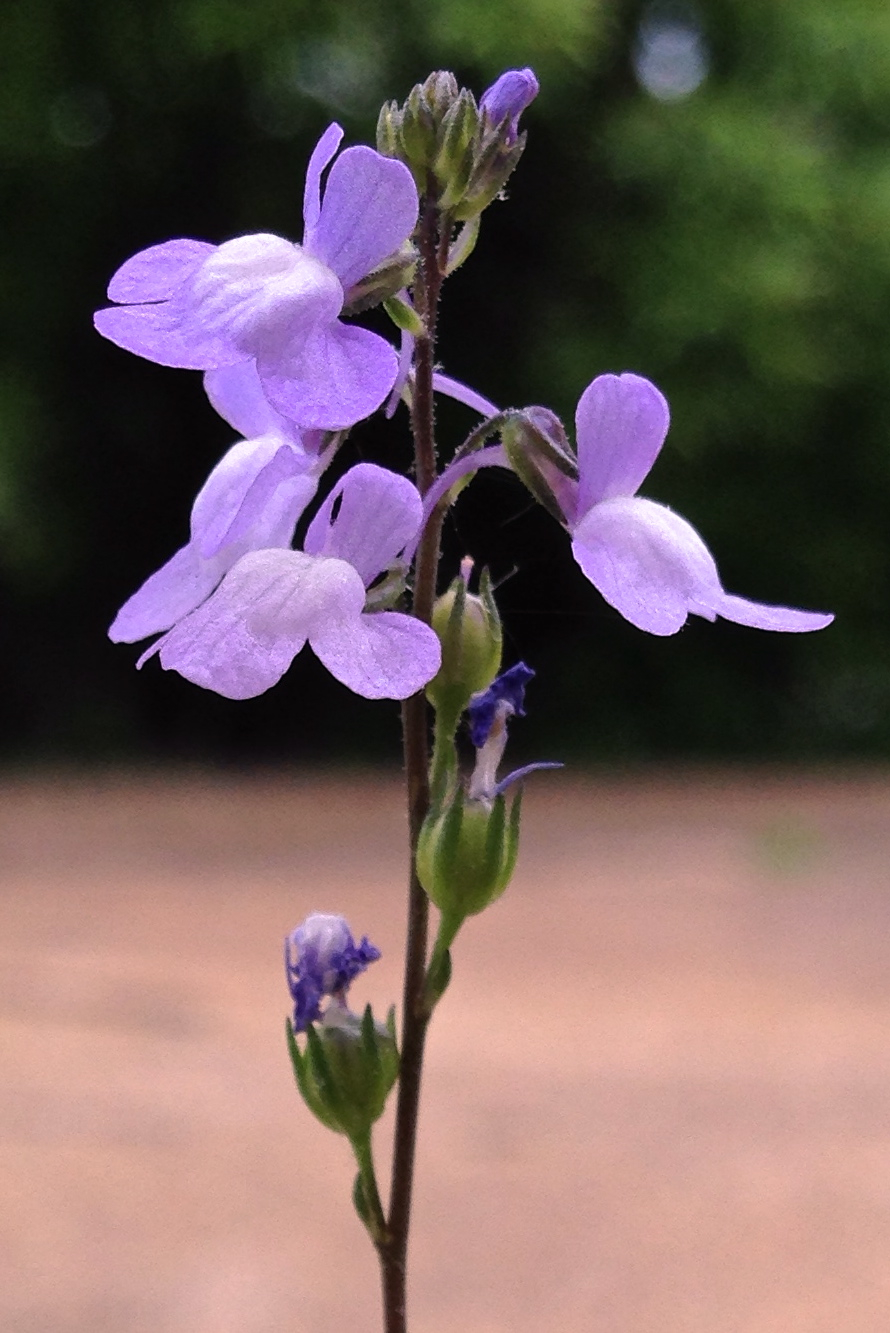
Nuttallanthus canadensis, known as Canada Toadflax, blue toadflax or old-field toadflax, is a delicate annual or biennial wildflower of sandy fields, roadsides, dunes and other open, sparsely vegetated ground. In spring it sends up wiry, nearly leafless stems 6 inches to 2 feet tall, topped with loose spikes of small blue-violet flowers. Each flower looks like a tiny snapdragon, with a white, puffed-up palate on the lower lip and a slender spur behind. It belongs to the plantain family (Plantaginaceae), which now includes many former figwort-family genera such as snapdragons and toadflaxes.
Canada toadflax was long known as Linaria canadensis, and many field guides still use that name. In 1988 the British botanist D.A. Sutton moved the New World toadflaxes into their own genus, Nuttallanthus, named for the naturalist Thomas Nuttall. Its closest garden-familiar relative is the Eurasian butter-and-eggs (Linaria vulgaris), a yellow-flowered weed that has spread across North America, but Canada toadflax is a true native and far less aggressive.
Few gardeners plant it on purpose, yet Canada toadflax has a lot to offer: a haze of lavender-blue in April and May on poor, sandy soil where little else blooms, a steady supply of nectar for small bees and early butterflies, and foliage that feeds the caterpillars of the common buckeye butterfly. This guide covers how to recognize it, where it grows, and how to let it seed into meadows, lawns and sandy gardens.
Identification
Canada toadflax is easy to overlook when not in bloom, but the combination of very thin, upright flowering stems, linear leaves and small spurred violet flowers makes it distinctive in spring. Two close relatives, Texas toadflax (N. texanus) and Florida toadflax (N. floridanus), look similar and are separated mainly by flower size and seed details.
Rosettes & Stems
The plant has two kinds of shoots. In fall and winter it forms a low mat of short, trailing, sterile shoots with small, oblong, often opposite or whorled leaves, a little like a creeping thyme. In spring one or several erect flowering stems rise from this base. They are slender, smooth, often somewhat waxy, and usually 6 to 24 inches tall, occasionally taller on good soil. The flowering stems are sparsely leafy and branch little, so a patch of toadflax looks airy and see-through.
Leaves
Leaves on the flowering stems are alternate, narrowly linear, about ½ to 1¼ inches long and less than ⅛ inch wide, smooth and stalkless. They are few and well spaced, and the stems can look nearly leafless by the time the flowers open. The leaves on the basal shoots are shorter and wider and are usually gone or withering by flowering time.
Flowers
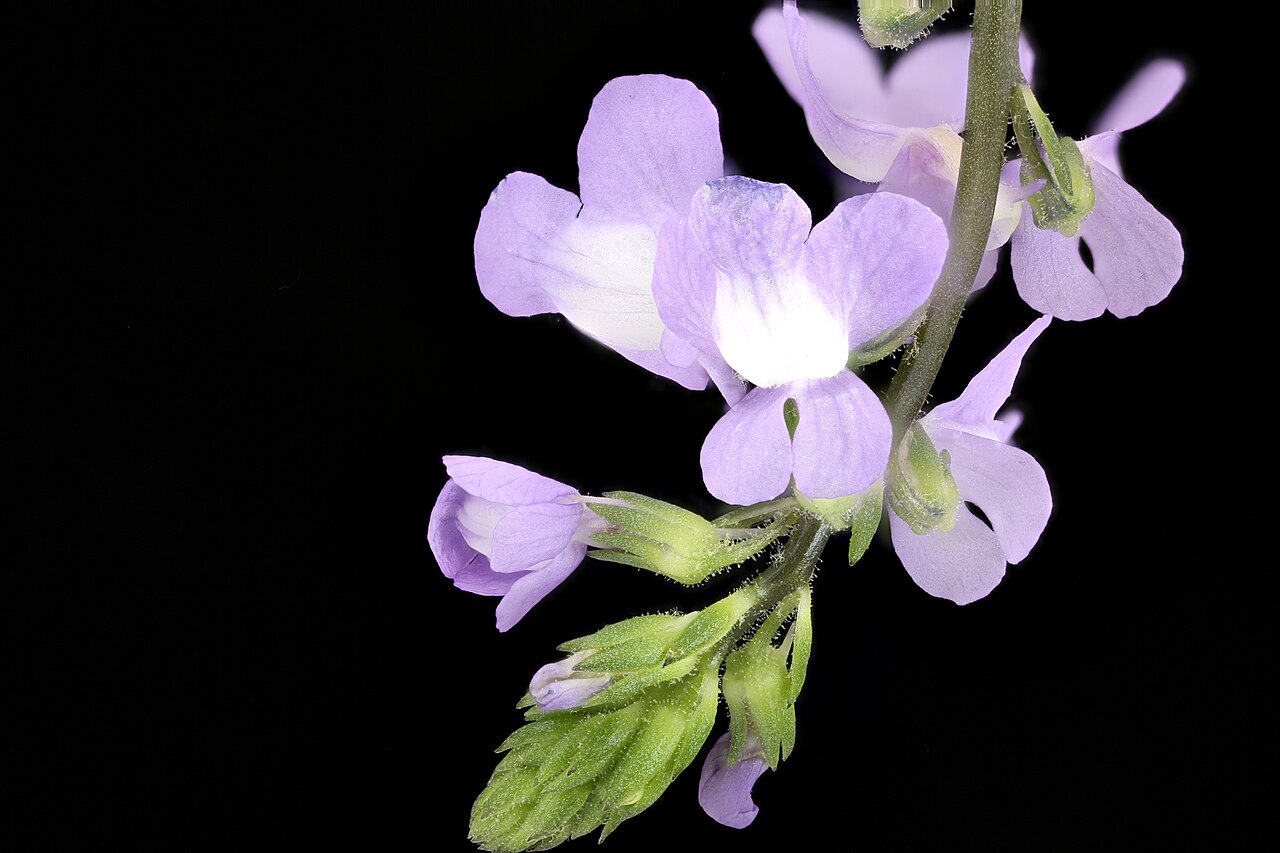
Flowers are borne in a slender terminal raceme that keeps lengthening for weeks, with buds above and seed capsules below. Each flower is about ⅓ to ½ inch long, light blue to blue-violet, and two-lipped: two small upright lobes above, and a larger three-lobed lower lip with a raised white, two-ridged palate that nearly closes the throat. A thin, curved spur about ¼ inch long projects backward and downward from the base and holds nectar. Plants also produce some small, closed (cleistogamous) flowers that self-pollinate without opening.
Texas toadflax has larger flowers, usually over ½ inch long with a longer spur, and is more common in the South and West. Butter-and-eggs is easily separated by its yellow and orange flowers and much leafier stems.
Fruit & Seeds
After flowering, each blossom leaves a small, rounded capsule about ⅛ inch across that opens at the top by small pores. The capsules hold many tiny, dark, angular seeds that shake out as the dry stems sway in the wind. A single plant produces seed in large numbers, which is how toadflax persists in disturbed ground and reappears after soil is scraped or burned.
Quick Facts
| Scientific Name | Nuttallanthus canadensis (syn. Linaria canadensis) |
| Family | Plantaginaceae (plantain family) |
| Plant Type | Winter annual or biennial herb |
| Mature Height | 6–24 in (occasionally to about 30 in) |
| Mature Spread | 3–8 in |
| Growth Rate | Fast |
| Sun Exposure | Full sun |
| Water Needs | Low; tolerates dry, sandy soil once established |
| Soil Type | Sandy, gravelly or thin, well-drained soil |
| Soil pH | Acidic to neutral (about 5.0–7.0) |
| Bloom Time | March–June in most areas; later in the North |
| Flower Color | Light blue to blue-violet with a white palate |
| Fall Color | None; the plant persists as a small green winter rosette |
| Fruit | Small rounded capsule with tiny angular seeds |
| Deer Resistant | Usually; rarely browsed |
| USDA Hardiness Zones | 3–9 |
Native Range
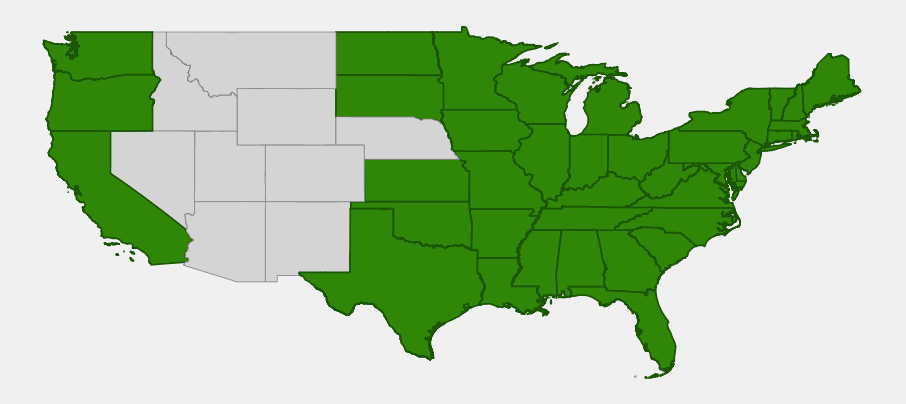
Canada toadflax has a wide but patchy range. USDA PLANTS lists it as native in 39 states and the District of Columbia. In the East it grows from Maine and the Great Lakes south to Florida and west to the Dakotas, Kansas, Oklahoma and Texas. In the West it occurs along the Pacific Coast in Washington, Oregon and California, and the Lady Bird Johnson Wildflower Center treats these western populations as part of its native range. In Canada it is found in southern Ontario, Quebec, New Brunswick and Nova Scotia.
It is most common on the Atlantic and Gulf Coastal Plain, where sandy soils, old fields and pine-oak sandhills give it plenty of open ground, and in sandy country around the Great Lakes, such as dunes, oak savannas and barrens. Farther inland it is more scattered, tied to sand prairies, rock outcrops, glades and disturbed sites. It has also been introduced to parts of South America and East Asia, where it behaves as a minor weed.
Because it thrives after disturbance, it turns up in some unexpected places: abandoned tennis courts and parking lots, railroad ballast, quarry floors, lawn edges and recently burned woodland. These are not signs of an invasive habit. They reflect a plant adapted to bare, nutrient-poor sand that would naturally be opened up by fire, floods, shifting dunes and grazing animals.
📋 Regional plant lists featuring Canada Toadflax: New York, Pennsylvania & Northern New Jersey · Ohio & Indiana · Michigan, Wisconsin & Eastern Minnesota · Kentucky & Tennessee · Nebraska, Kansas & Eastern Colorado · Connecticut, Massachusetts & Rhode Island · New Hampshire, Maine & Vermont · Maryland, Virginia & West Virginia · Delaware, Southern New Jersey & Long Island · Illinois, Iowa & Missouri · Alabama, Georgia & Mississippi · North & South Florida
Growing & Care Guide
Canada toadflax is grown from seed, not from transplants, and it behaves like what it is: a short-lived pioneer of bare, sunny ground. Give it a spot with little competition and it will reseed itself year after year. Try to coddle it in rich, mulched beds and it will disappear.
Light
Full sun gives the best flowering and sturdiest stems. Plants tolerate a little light shade, but they become sparse and floppy as shade increases.
Soil & Water
Choose lean, well-drained soil: sand, gravel, thin soil over rock, or a sandy lawn edge. Toadflax is well adapted to dry spring and summer conditions because it completes most of its growth during the cool, moist part of the year. It needs no fertilizer, and rich or heavily watered soil only encourages competing plants that crowd it out.
Planting Tips
Sow seed in fall directly onto bare, raked soil and press it in lightly without covering, since the seeds are tiny. Seedlings appear in fall or early spring and form small rosettes before flowering the following spring. Mixing the seed with dry sand helps spread it evenly. It is a good addition to seed mixes for sandy meadows, alongside spring wildflowers and short bunchgrasses.
Pruning & Maintenance
Leave flowering stems standing until the capsules are brown and dry so the plants can reseed. Avoid heavy mulch where you want it to return, because the seedlings need bare or thinly vegetated ground. In a meadow, light raking, mowing in late summer or occasional burning keeps the open patches it depends on. If it shows up in a lawn, mowing after the seed has dropped in early summer lets it come back next year.
Propagation
Propagate entirely by seed. Collect stems when the capsules are dry, shake the seed into a paper bag, and sow it in fall. Seed needs no special treatment when sown outdoors, as winter conditions prepare it for spring germination. Plants do not divide or transplant well once they have bolted.
Landscape Uses
- Sandy meadows and prairie plantings: fills gaps between bunchgrasses and later-blooming wildflowers in spring
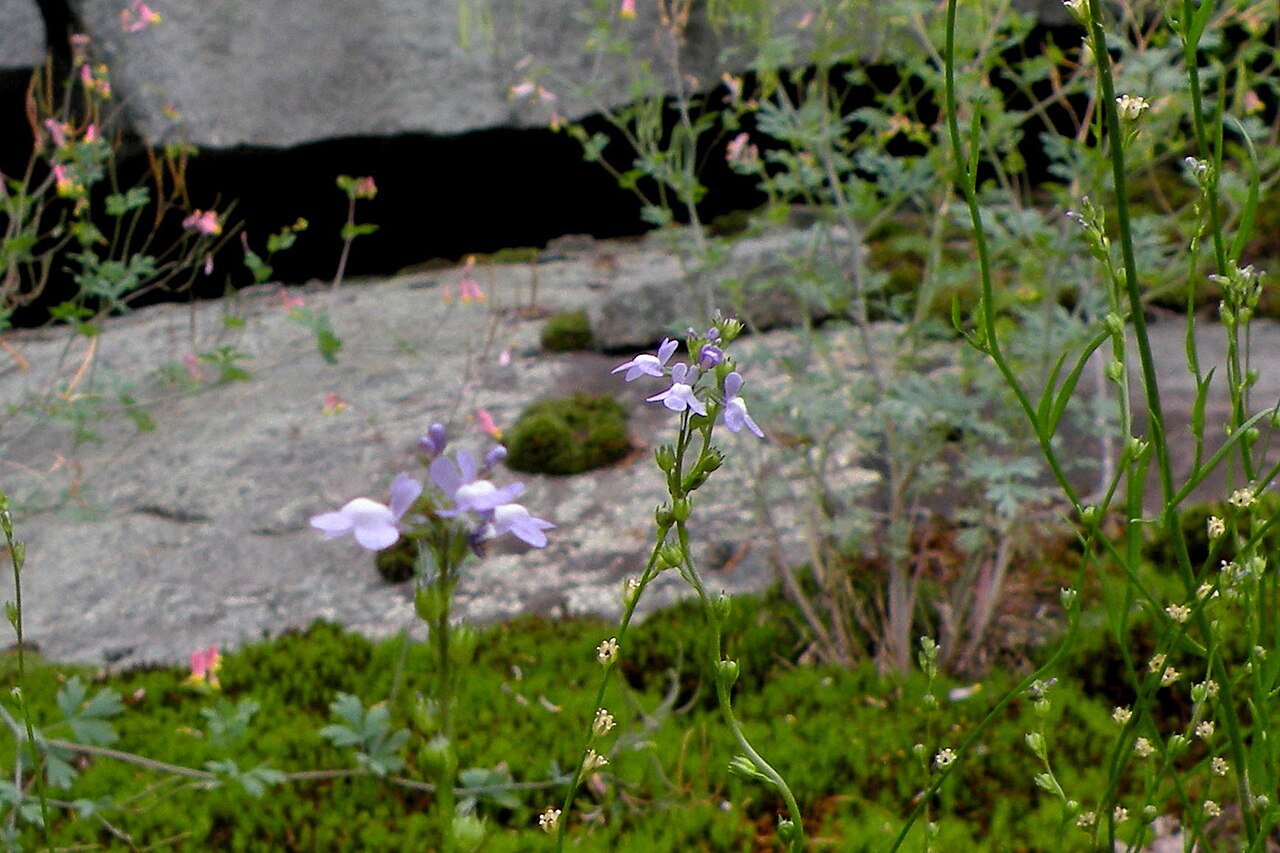
- Rock and gravel gardens: airy spikes rise from crevices and thin soil
- Pollinator and butterfly gardens: early nectar for small bees and butterflies, and a larval host for the common buckeye
- Lawn alternatives and lawn edges: tolerates mowing after it has set seed
- Restoration of sand barrens and old fields: a quick native cover on disturbed sandy ground
Wildlife & Ecological Value
A patch of Canada toadflax may look insignificant, but it is part of the early-season food web of open, sandy habitats, at a time of year when few other flowers are blooming in those places.
For Pollinators
The nectar sits at the bottom of the narrow spur, and the closed throat of the flower has to be pushed open, so the best pollinators are bees strong enough to part the lips, along with butterflies and moths that can reach the nectar with long tongues. Small bees, including mason bees and sweat bees, and early-season butterflies such as skippers and sulphurs visit it. Canada toadflax is also a larval host for the common buckeye (Junonia coenia), whose caterpillars feed on plants in the plantain and snapdragon group.
For Birds
The tiny seeds are eaten in small amounts by sparrows, finches and other ground-feeding birds in old fields and barrens. More importantly, the open, sparsely vegetated habitat it shares with lupines and bunchgrasses supports birds such as field sparrows and, in some regions, prairie warblers and grasshopper sparrows.
For Mammals
Canada toadflax has little importance to mammals. Its stems are thin and low in bulk, and deer generally leave it alone.
Ecosystem Role
As a winter annual, it germinates in fall, grows through the cool season, flowers in spring and dies by early summer, leaving its seed to wait for the next opening. This life cycle lets it use bare sand that is too hot and dry for most plants in midsummer. Its abundance in a sand prairie or barren is often a sign of recent fire, grazing or other disturbance that has kept the ground open.
Cultural & Historical Uses
Linnaeus described the species in 1753 as Antirrhinum canadense, placing it with the snapdragons. It was later moved to Linaria, the Old World toadflax genus, and in 1988 to Nuttallanthus, a genus of four New World species that honors Thomas Nuttall, the English-born botanist who explored much of North America in the early nineteenth century.
The name “toadflax” comes from the European Linaria, whose narrow leaves resemble those of flax (Linum). “Toad” may refer to the flower’s mouth-like opening or simply mark the plant as a lesser or false flax. Few uses of Canada toadflax by Native Americans are recorded, which is not surprising for such a small, short-lived plant.
In recent years Canada toadflax has gained appreciation among native plant gardeners and lawn-alternative enthusiasts. Its delicate spires appear unbidden in sandy yards across the Southeast and Northeast in spring, and many gardeners now choose to leave them, as a native, pollinator-friendly alternative to weeds such as henbit and chickweed.
Frequently Asked Questions
Is Canada toadflax invasive?
No. It is native across much of the United States and southern Canada. It is a short-lived pioneer that appears on bare, disturbed sandy ground and fades as taller plants fill in. Do not confuse it with butter-and-eggs (Linaria vulgaris) or Dalmatian toadflax (L. dalmatica), which are invasive yellow-flowered toadflaxes from Eurasia.
Is it an annual or a perennial?
It behaves as a winter annual or biennial. Seeds germinate in fall or early spring, the plant overwinters as a small rosette of trailing shoots, flowers in spring and dies after setting seed. It persists in a garden by reseeding.
How do I tell Canada toadflax from Texas toadflax?
Canada toadflax has smaller flowers, usually under ½ inch long with a short spur. Texas toadflax (N. texanus) has larger flowers with a longer spur, and the two also differ in seed surface. Some older references treat Texas toadflax as a variety of Canada toadflax.
Does Canada toadflax attract butterflies?
Yes. Small butterflies and bees visit the flowers for nectar, and the plant is a larval host for the common buckeye butterfly.
Can I grow it in a lawn?
Yes, in a thin, sandy lawn that is not heavily fertilized. Delay the first spring mowing until the plants have dropped their seed, usually by late May or June in most areas, and they will come back the next year.

Looking for a nursery that carries Canada Toadflax?
Browse our native plant nursery directory: Alabama & Arkansas · California · Connecticut, Delaware, Florida & Georgia · Illinois, Indiana, Iowa & Kansas · Kentucky, Louisiana, Maine, Maryland, Massachusetts, Michigan, Minnesota, Mississippi & Missouri · New Hampshire, New Jersey, New York, North Carolina, North Dakota, Ohio & Oklahoma · Oregon · Pennsylvania, Rhode Island, South Carolina, South Dakota, Tennessee, Texas, Vermont & Virginia · Washington · West Virginia & Wisconsin