
Late Boneset (Eupatorium serotinum)
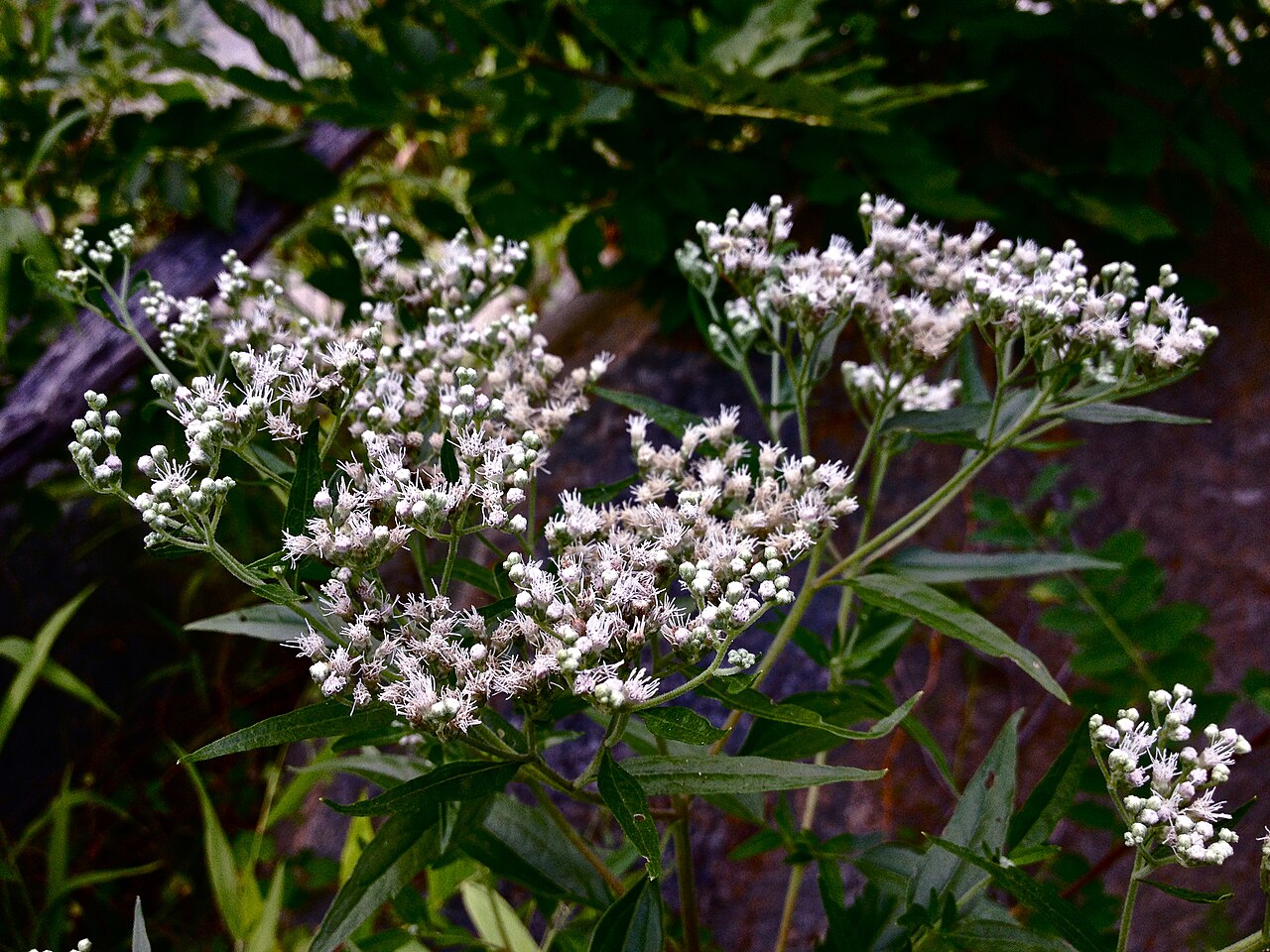
Eupatorium serotinum, known as Late Boneset or lateflowering thoroughwort, is a tall, bushy perennial wildflower of the eastern and central United States. From late summer into fall it is covered with broad, flat-topped clusters of small, fuzzy white flower heads. Few native plants attract as many insects at once: on a warm September afternoon a single clump can host bees, wasps, butterflies, flies and beetles all at the same time.
Late boneset is a member of the aster family (Asteraceae). The species name serotinum means “late,” because it flowers several weeks after its well-known relative, common boneset. It is a tough, adaptable plant of moist ground and disturbed places: old fields, roadsides, ditches, floodplains, forest edges and the margins of ponds and marshes. Because it seeds freely and colonizes bare soil quickly, many people know it as a weed of pastures and vacant lots rather than as a garden plant.
That same vigor makes it a useful plant for gardeners who want an easy, late-season pollinator plant for informal meadows, rain gardens and wild corners. This guide covers how to identify it, where it grows, how to manage it in a garden so it doesn’t take over, and why it is so valuable to insects in the fall.
Identification
There are many white-flowered Eupatorium species in the East, and some are hard to tell apart. Late boneset is one of the easiest: it is tall, it blooms late, and its leaves have distinct stalks.
Stems & Growth Habit
Late boneset grows 2 to 6 feet tall from a short rhizome or a woody crown. The stems are stout, round and covered in short, soft hairs, especially toward the top, and they branch freely in the upper half. A mature plant forms a broad, multi-stemmed clump. Stems die back to the ground in winter, and the dry, brown flower stalks often stand into the following spring.
Leaves
The leaves are opposite, lance-shaped to narrowly egg-shaped, and usually 3 to 8 inches long and 1 to 3 inches wide. They have coarsely toothed edges, a long tapering tip and three prominent veins running from the base. Unlike those of several related species, each leaf has a distinct stalk (petiole) up to an inch or more long. The upper leaves become smaller and narrower.
Common boneset (Eupatorium perfoliatum) has stalkless leaves whose bases join around the stem, so the stem seems to pierce the leaf. White snakeroot (Ageratina altissima) has broader, more heart-shaped leaves with long stalks, brighter white flowers, and grows mostly in shade.
Flowers
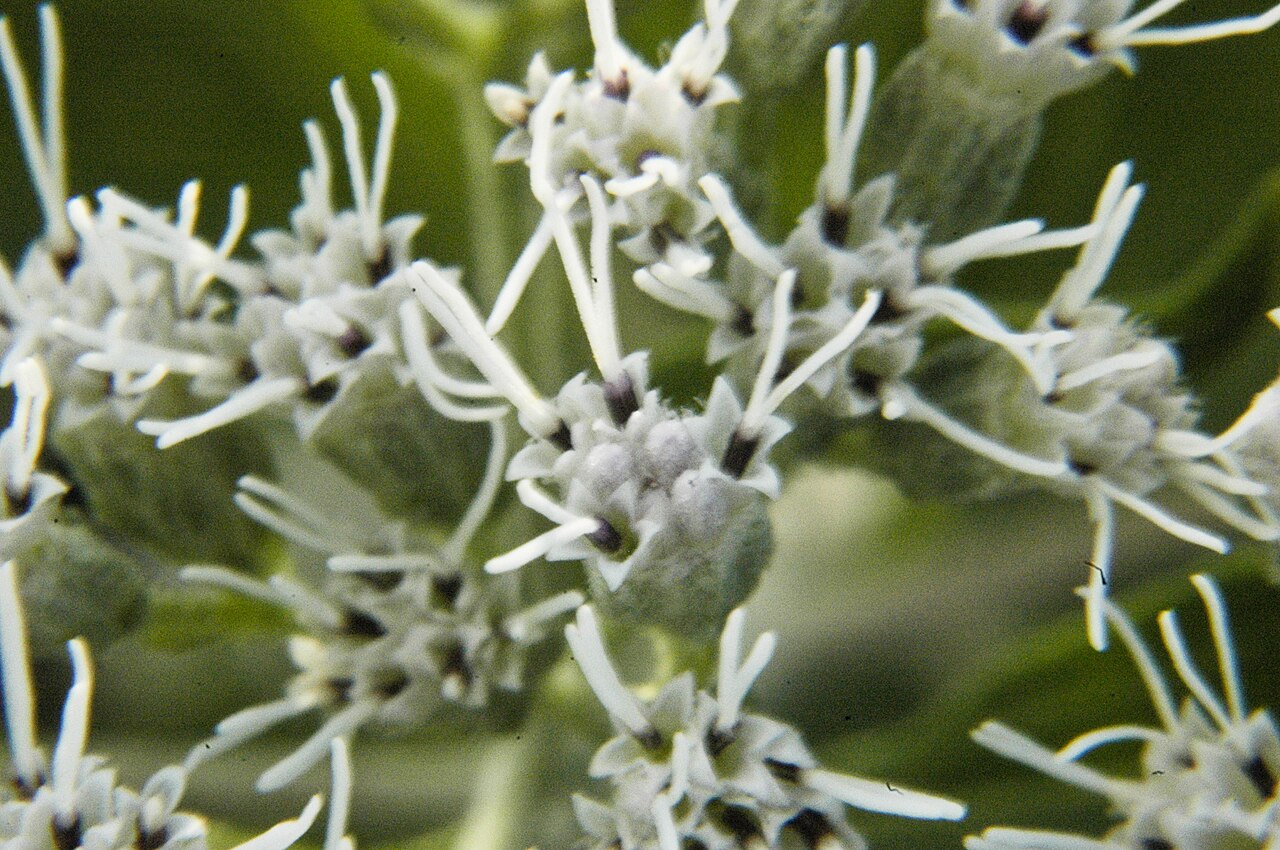
Flowering begins in late August or September and continues into October, and into November in the Deep South. The flower heads are arranged in large, rounded to flat-topped, branched clusters (corymbs) that are often 6 to 12 inches or more across. Each head is only about a quarter-inch long and holds about 9 to 15 white tubular disk florets, with no petal-like ray flowers. Long, white, two-branched styles stick out of the florets and give the clusters a soft, fuzzy look. The flowers have a light, musky scent.
Fruit & Seeds
Each floret produces a small, dark, ribbed seed (achene) about one-eighth inch long, topped with a tuft of white bristles (pappus) that carries it on the wind. Seeds ripen from October to December. A single plant produces thousands of them, which explains how quickly late boneset appears on newly disturbed soil.
Quick Facts
| Scientific Name | Eupatorium serotinum Michx. |
| Family | Asteraceae (aster family) |
| Plant Type | Herbaceous perennial wildflower |
| Mature Height | 2–6 ft |
| Mature Spread | 2–3 ft |
| Growth Rate | Fast |
| Sun Exposure | Full sun to part shade |
| Water Needs | Medium to high; moist soil, tolerates brief flooding and some drought |
| Soil Type | Clay, loam or sand; tolerates poor and disturbed soils |
| Soil pH | About 5.5–7.5 |
| Bloom Time | August–October (to November in the South) |
| Flower Color | White |
| Fall Color | None notable; seed heads turn tan and fluffy |
| Fruit | Small achene with a white pappus, dispersed by wind |
| Deer Resistant | Yes; bitter foliage is rarely browsed |
| USDA Hardiness Zones | 5–9 |
Native Range
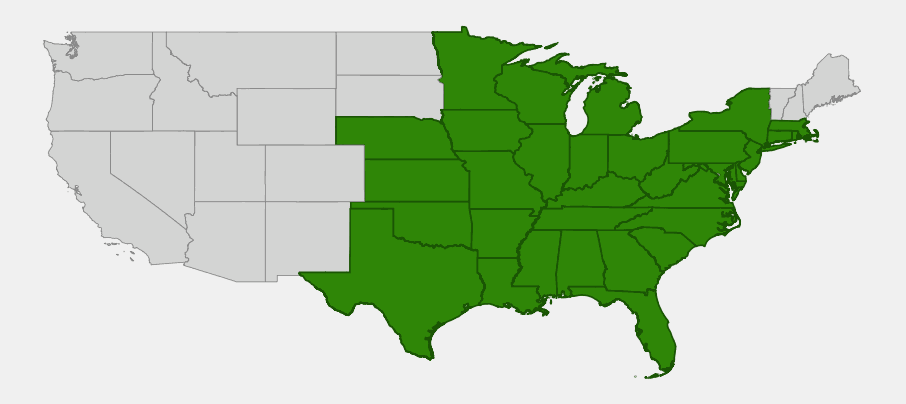
Late boneset is native to the eastern and central United States. USDA PLANTS records it from 32 states and the District of Columbia, from Massachusetts, New York and southern Michigan south to Florida, and west to Minnesota, Iowa, Nebraska, Kansas, Oklahoma and Texas. Its range continues south into eastern Mexico. It is absent from northern New England. USDA lists it as introduced in Canada, where it has turned up in southern Ontario.
It is most abundant in the Southeast and lower Midwest, in the Coastal Plain, the Mississippi and Ohio valleys and the southern Great Plains, where it is one of the most common fall wildflowers along roads, ditches and field edges. It becomes scattered toward the northern edge of its range in New England, New York, Michigan, Wisconsin and Minnesota, where it may be uncommon or rare.
Late boneset thrives on soil that has been disturbed, flooded or cleared. It readily moves into abandoned farm fields and drained or partly filled wetlands, and it is one of the first perennials to colonize floodplains after high water. Over the past century it has likely spread northward along roads, rail lines and rivers, so the northern edge of its range is still shifting.
📋 Regional plant lists featuring Late Boneset: New York, Pennsylvania & Northern New Jersey · Ohio & Indiana · Michigan, Wisconsin & Eastern Minnesota · Kentucky & Tennessee · Nebraska, Kansas & Eastern Colorado · Connecticut, Massachusetts & Rhode Island · New Hampshire, Maine & Vermont · Maryland, Virginia & West Virginia · Delaware, Southern New Jersey & Long Island · Illinois, Iowa & Missouri · Alabama, Georgia & Mississippi · North & South Florida
Growing & Care Guide
Late boneset is easy to grow. The challenge is not keeping it alive but keeping it where you want it. It suits informal, naturalistic plantings better than tidy borders, and given a sunny, moist spot it will reward you with a cloud of white flowers and a steady stream of pollinators at the end of the season.
Light
Full sun gives the most compact plants and heaviest bloom. It also grows in part shade, especially at woodland edges, but plants there tend to be taller, lankier and less floriferous.
Soil & Water
Late boneset prefers moist to wet soil, from heavy clay to sandy loam, and tolerates periodic flooding, which makes it a good choice for rain gardens, ditches and low spots. Once established it also handles summer dry spells well. It needs no fertilizer; rich soil only makes it taller and floppier.
Planting Tips
Plant nursery-grown plants or seedlings in spring or fall, 2 to 3 feet apart. It looks best in groups with other late bloomers such as goldenrods, asters, ironweeds and grasses, which help hold up the tall stems. Because it reseeds generously, place it where some spread is welcome: a meadow, a wildlife area, a pond edge or the back of a large rain garden.
Pruning & Maintenance
To keep plants shorter and bushier, cut stems back by about a third to a half in early summer, before about the end of June. They will branch and still bloom on time. To limit self-seeding, cut off the flower clusters as they fade, but leave some seed heads standing if you want to feed birds and leave stems for overwintering insects. Pull unwanted seedlings while they are small, because older plants develop tough crowns. Cut the old stalks back in late winter or spring.
Propagation
Late boneset grows easily from seed. Sow it on the soil surface in fall or early spring; it needs light to germinate and benefits from a few weeks of cold, moist stratification. Seedlings often bloom in their first or second year. Established clumps can also be divided in early spring.
Landscape Uses
- Pollinator gardens: one of the busiest late-season nectar plants for bees, wasps, flies and butterflies
- Rain gardens and swales: tolerates both standing water and short dry spells
- Meadows and wildlife areas: adds height and white flowers among goldenrods, asters and grasses
- Restoration of disturbed ground: quickly covers bare, moist soil in old fields and floodplains
- Pond and stream edges: in sunny, moist soil above the water line
Wildlife & Ecological Value
Late boneset may look like a roadside weed, but entomologists know it as one of the best native plants for observing insects in fall. Its abundant, easy-to-reach flowers bloom when much of the landscape is fading.
For Pollinators
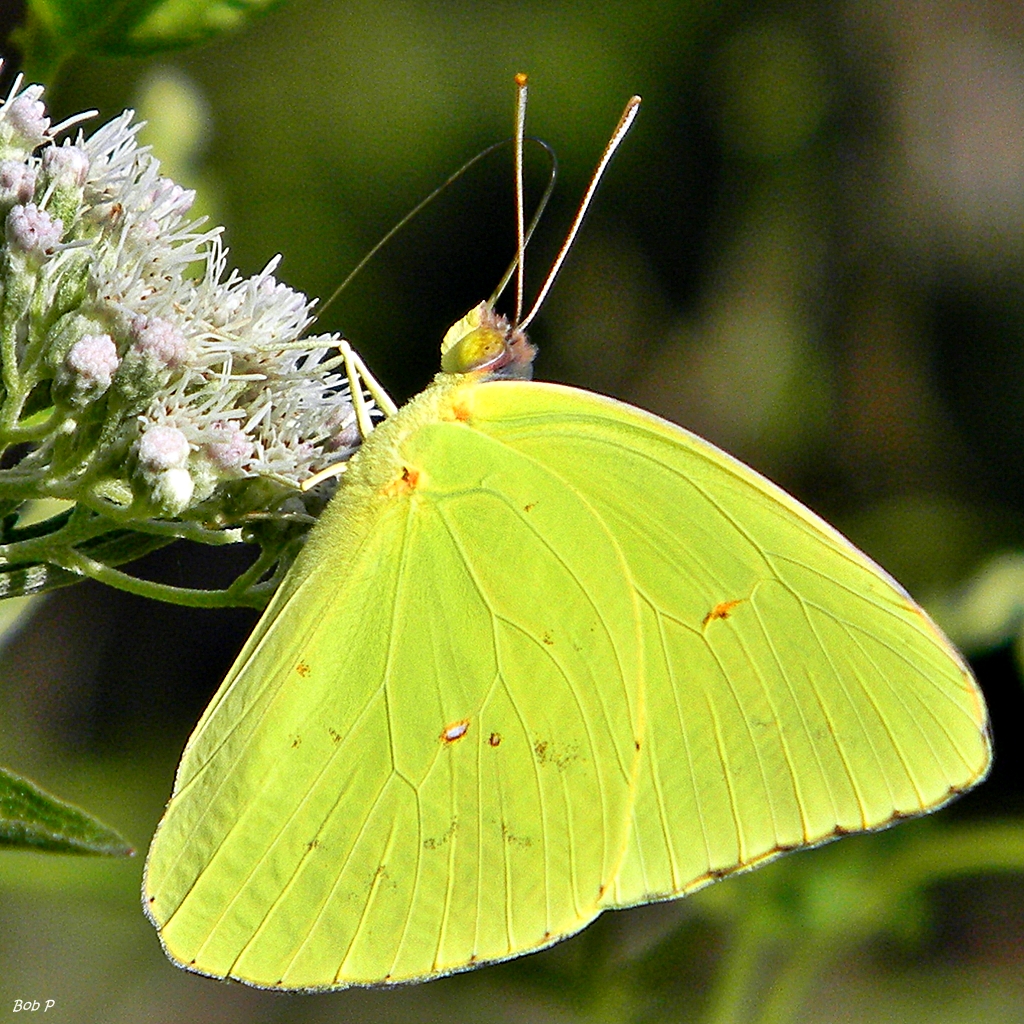
The shallow tubular florets offer nectar to a huge range of insects. Honey bees, bumble bees, sweat bees and many other native bees visit it, along with large numbers of wasps (including paper wasps, great golden digger wasps and thread-waisted wasps), flower flies, soldier beetles and butterflies such as monarchs, cloudless sulphurs, skippers and hairstreaks. The Xerces Society notes it as having special value to native bees and as a plant that supports beneficial insects used in biological pest control. Many of the predatory and parasitic wasps that visit it help control garden pests.
For Birds
Small seed-eating birds such as American goldfinches, sparrows and juncos eat some of the seeds in fall and winter. The insects drawn to the flowers also feed songbirds, and the dense clumps provide cover.
For Mammals
The foliage is bitter, and deer and rabbits generally avoid it. Like other Eupatorium species it contains pyrrolizidine alkaloids, and livestock usually leave it alone in pastures.
Ecosystem Role
Late boneset is a pioneer species that colonizes bare, moist soil after floods, clearing and fire, holding soil in place until longer-lived plants take over. Its leaves and stems host the caterpillars of several moths, and the boneset stem midge (Neolasioptera perfoliata) forms swollen galls on its stems. Some butterflies and moths, such as queens, visit the withered plants to collect alkaloids that they use in courtship and chemical defense.
Cultural & Historical Uses
The French botanist André Michaux described Eupatorium serotinum in 1803 in his flora of North America. The genus name honors Mithridates VI Eupator, a king of Pontus in the first century B.C. who was said to have used a related plant as medicine. The common name “boneset” belongs mainly to E. perfoliatum, which was widely used in folk medicine to treat “break-bone fever,” a flu-like illness. Late boneset shares the name because of the family resemblance, not because of a strong medicinal history of its own.
For farmers, late boneset has long been a weed of pastures, hay fields and fallow ground, and it can become dense on poorly managed land. To naturalists and gardeners, it is better known today as a “bug magnet,” a plant that makes a fall walk along a field edge exciting for anyone interested in insects.
A note on safety: plants in this genus contain pyrrolizidine alkaloids, which can damage the liver. Late boneset should not be used as an herbal remedy or tea. Handling the plant in the garden is not a problem.
Frequently Asked Questions
Is late boneset invasive?
No. It is a native plant, but it is aggressive in the sense that it reseeds heavily, especially on moist, disturbed soil. Deadhead it after flowering or pull extra seedlings if you want to limit its spread.
How is late boneset different from common boneset?
Common boneset (Eupatorium perfoliatum) has stalkless leaves joined around the stem and usually blooms in July and August. Late boneset has stalked leaves, grows taller, and blooms later, from late August into fall.
Does late boneset attract butterflies?
Yes. Monarchs, sulphurs, skippers, hairstreaks and other butterflies use it as a fall nectar source, along with large numbers of bees and wasps.
Is late boneset poisonous?
It contains pyrrolizidine alkaloids, like other Eupatorium species, and should not be eaten or used as a tea or herbal remedy. Livestock and deer generally avoid it.
Can I grow late boneset in a rain garden?
Yes. It tolerates standing water after storms as well as short dry periods, and its fall flowers fill a gap when many rain garden plants have finished blooming. Give it room, as it spreads by seed.

Looking for a nursery that carries Late Boneset?
Browse our native plant nursery directory: Alabama & Arkansas · Connecticut, Delaware, Florida & Georgia · Illinois, Indiana, Iowa & Kansas · Kentucky, Louisiana, Maryland, Massachusetts, Michigan, Minnesota, Mississippi & Missouri · Nebraska, New Jersey, New York, North Carolina, Ohio & Oklahoma · Pennsylvania, Rhode Island, South Carolina, Tennessee, Texas & Virginia · West Virginia & Wisconsin