
Telegraphweed (Heterotheca grandiflora)
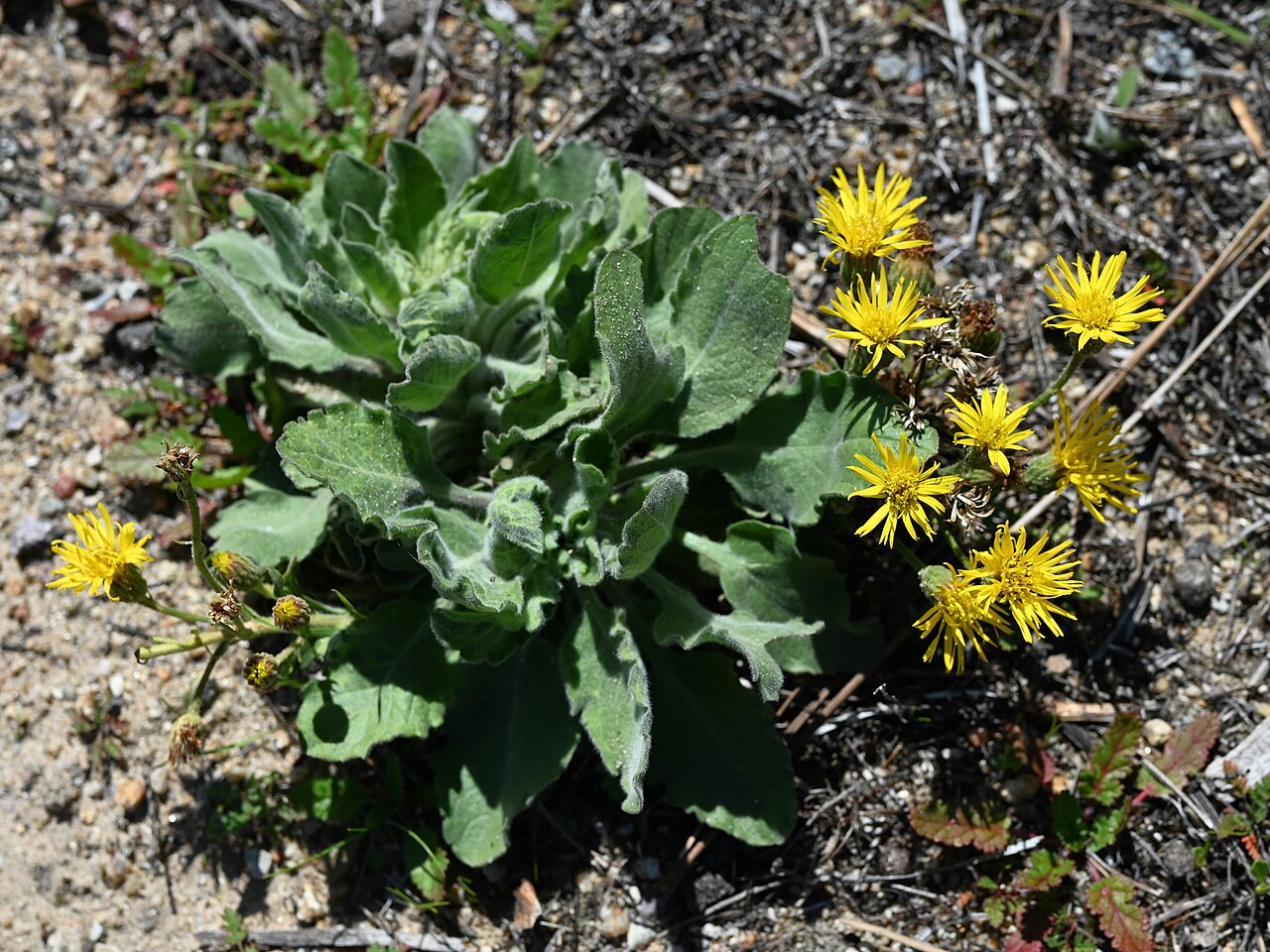
Heterotheca grandiflora, known as Telegraphweed (USDA: telegraphweed; also written telegraph weed), is a tall, sticky, sun-loving member of the aster family (Asteraceae) that is one of the most familiar yellow wildflowers of California roadsides, sandy lots, washes and burned hillsides. From a flat rosette of soft, gray-green, hairy leaves it sends up a stiff, leafy stalk that can reach 5 feet or more. Through summer and fall the top of the stalk branches into a broad spray of bright yellow daisies, each about an inch across.
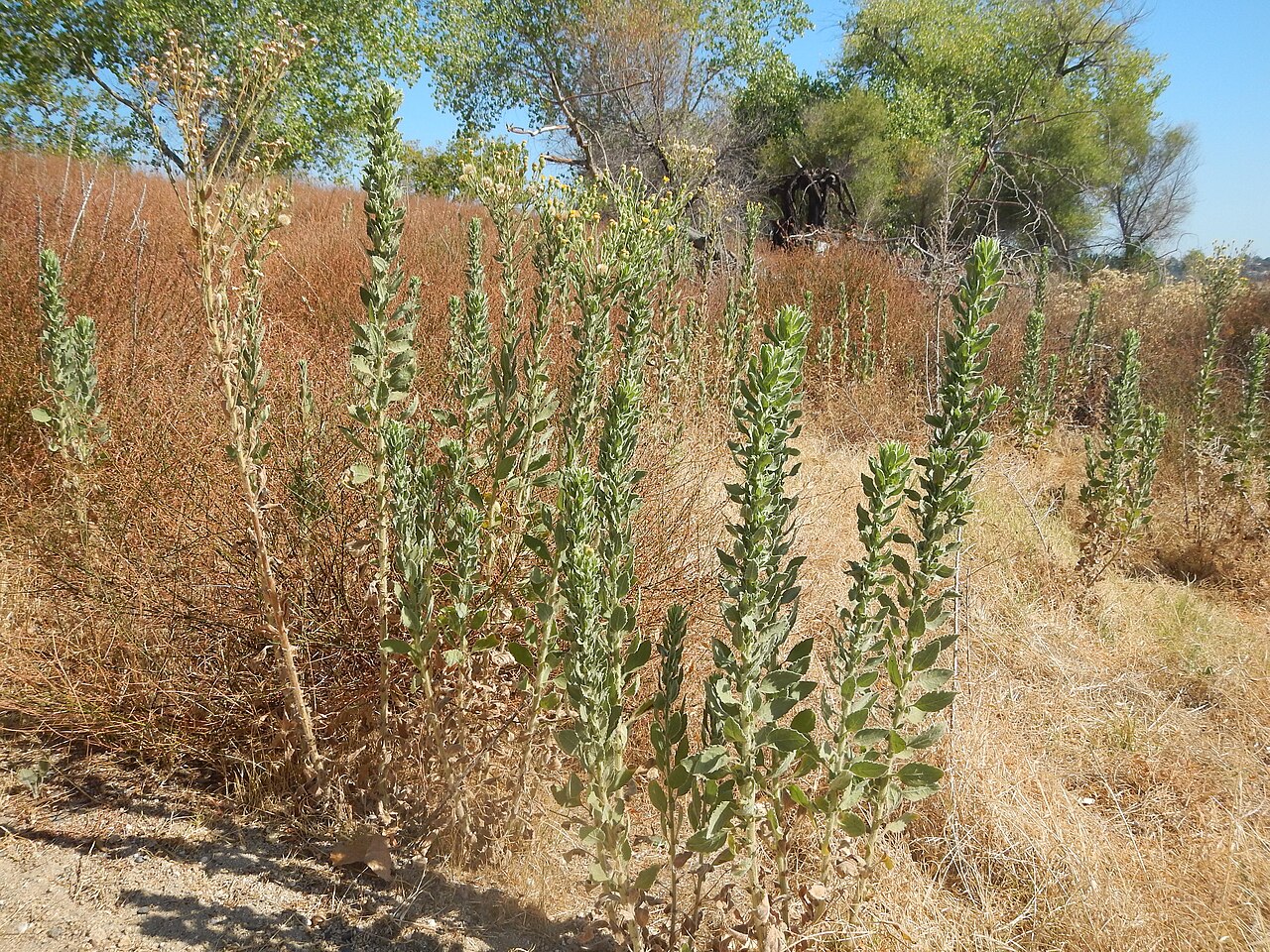
The common name is said to come from the plant’s habit of growing in straight, unbranched columns along roads and railroads, like rows of telegraph poles. Brush against it and you will notice its other trademark: the stems and leaves are covered in glandular hairs that leave a sticky, resinous residue and a strong camphor-like smell on your hands and clothes. It is a close relative of camphorweed and of the golden-asters, and like them it is tough, drought-tolerant and quick to colonize open ground.
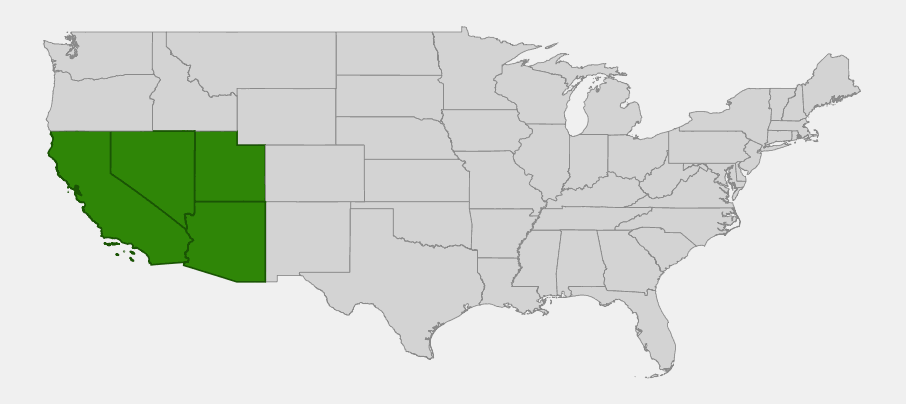
Telegraphweed is native to California and Baja California, and USDA PLANTS also lists it as native in Arizona, Nevada and Utah. It is usually an annual or short-lived biennial, and it can behave weedily, appearing in large numbers after fire, grading or other disturbance and fading as other vegetation fills in. It has also been introduced to Hawaii, where it is naturalized on several islands and is treated as a weed. This guide covers identification, range, its role in western ecosystems, and where it can fit in a native landscape.
Identification
Telegraphweed is easy to recognize once you have smelled it. Several other yellow composites of the West look similar from a distance, including camphorweed (Heterotheca subaxillaris), hairy golden-aster (H. villosa) and the introduced stinkwort (Dittrichia graveolens), so check the leaves, hairs and flower heads.
Stems & Habit
Young plants form a basal rosette of leaves lying close to the ground, often through winter and spring. In summer a single stout, erect stem grows from the rosette, usually 1½ to 5 feet tall and occasionally much taller. The stem is densely covered with long spreading hairs and shorter, sticky, gland-tipped hairs. It is usually unbranched for most of its length and branches only near the top, where the flowering heads are borne. The whole plant has a sharp, resinous, camphor-like odor.
Leaves
The leaves are alternate, oblong to ovate, about 1 to 3 inches long, with smooth or slightly toothed edges. They are soft and gray-green from a dense covering of hairs. The lower leaves have short stalks, often with small leafy flaps at the base. The upper leaves are smaller, stalkless and often clasp the stem. The stem stays densely leafy almost to the top, which gives non-flowering plants their distinctive column-like look.
Flowers
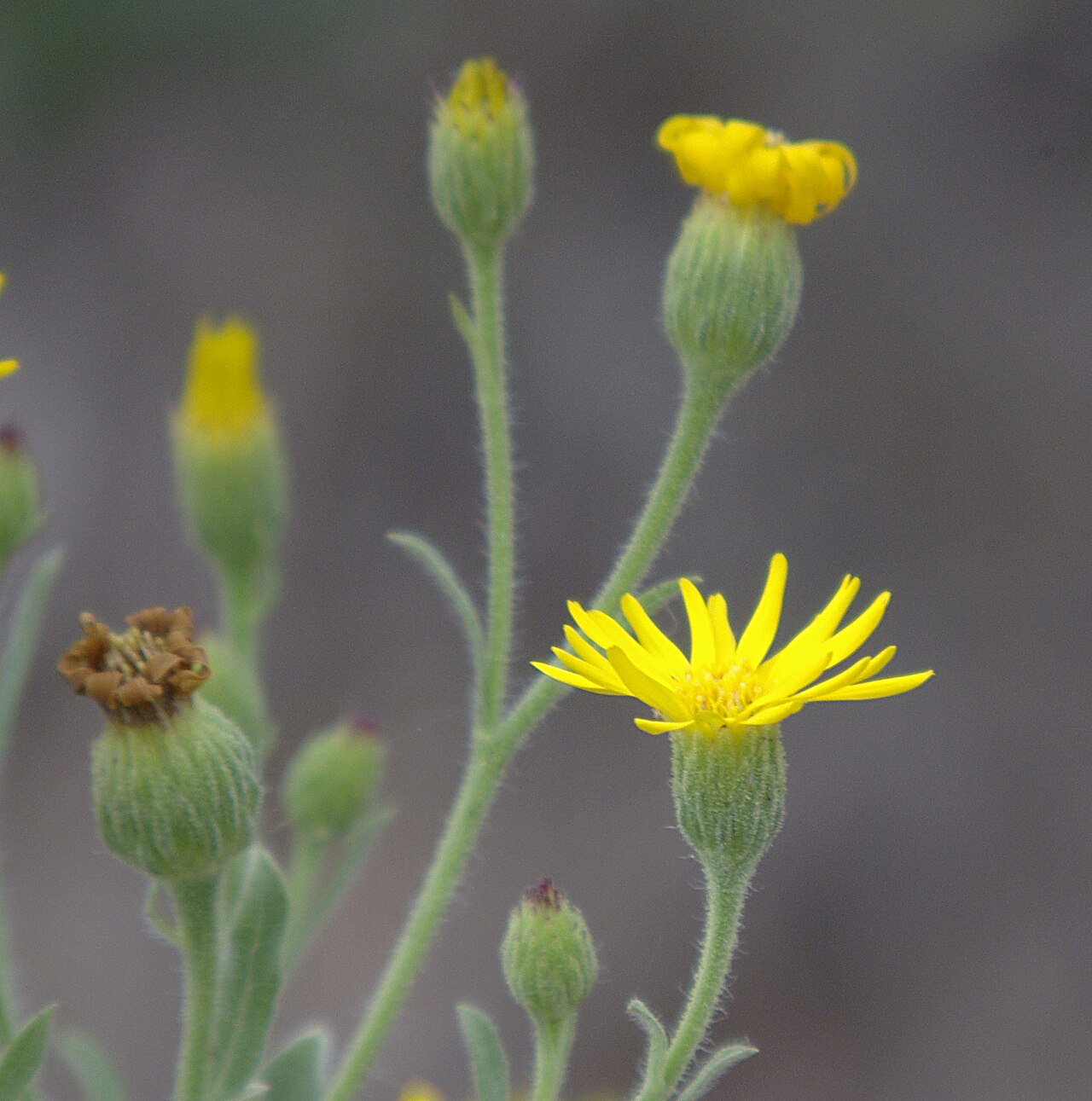
The flower heads are about ¾ to 1¼ inches across, in loose, flat-topped to rounded clusters at the branch tips. Each head has a ring of 20 to 35 narrow, bright yellow ray florets around a yellow to orange-yellow disk. The bracts below the head are narrow, overlapping, and sticky with glands. Telegraphweed can bloom in almost any month in coastal southern California, but the main show is from late spring through fall, peaking in late summer.
Fruit & Seeds
The fruits are small, hairy achenes. As the genus name (Greek hetero, different, and theke, case) suggests, the ray and disk florets produce slightly different seeds: the disk achenes carry a tuft of bristly, tawny pappus that helps them drift on the wind, while the ray achenes have little or no pappus and tend to fall near the parent. A single large plant produces thousands of seeds, which is why telegraphweed can quickly fill a disturbed site.
Quick Facts
| Scientific Name | Heterotheca grandiflora (syn. H. floribunda) |
| Family | Asteraceae (aster family) |
| Plant Type | Annual or short-lived biennial (rarely perennial) herb |
| Mature Height | 1½–5 ft (occasionally taller) |
| Mature Spread | 1–2 ft |
| Growth Rate | Fast |
| Sun Exposure | Full sun |
| Water Needs | Low; very drought tolerant |
| Soil Type | Sandy, gravelly or disturbed soils; dunes, washes, roadsides |
| Soil pH | About 6.0–8.0 |
| Bloom Time | Mainly May–November; nearly year-round in mild coastal areas |
| Flower Color | Bright yellow rays and yellow disk |
| Fall Color | None; stems dry to tan |
| Fruit | Small hairy achenes, most with a bristly pappus |
| Deer Resistant | Yes; the sticky, aromatic foliage is seldom browsed |
| USDA Hardiness Zones | Grown as an annual; native range roughly zones 7–10 |
Native Range
Telegraphweed is one of the most widespread wildflowers in California. It grows from the northern Sacramento Valley and the Sierra Nevada foothills south through the Central Valley, the Coast Ranges and coastal plains, and the southern California mountains and valleys to Baja California. It is especially abundant on sandy soils near the coast and inland, in the foothills around the Central Valley, and throughout southern California. Most populations are at low to middle elevations, from near sea level to roughly 5,000 feet.
USDA PLANTS records telegraphweed as native in Arizona, California, Nevada and Utah. Outside California it is much more scattered, mostly along roads, washes and disturbed ground in the warmer desert and lower-elevation regions of those states. Some regional floras treat these outlying populations as recent arrivals that spread along highways, so in parts of Arizona, Nevada and Utah you are most likely to meet it on roadsides rather than in undisturbed native vegetation.
Telegraphweed is not native to Hawaii. USDA PLANTS lists it as introduced there, and it has naturalized on Maui, Kahoʻolawe and other islands, where it grows in dry disturbed areas, pastures and even high-elevation sites on Haleakalā. It is also sometimes found as a weed in other warm-climate regions. Within its native range, it is a natural part of open, sunny, recently disturbed habitats.
📋 Regional plant lists featuring Telegraphweed: Idaho, Eastern Oregon & Eastern Washington · Utah & Western Colorado · Arizona & New Mexico
Growing & Care Guide
Telegraphweed is not a typical garden perennial. It is a fast, self-sowing annual that colonizes bare ground, and most gardeners meet it as a volunteer rather than a planted flower. It can still earn a place in large, informal native plantings, restoration sites and pollinator meadows where its late-season color and toughness are welcome, as long as you are comfortable with it reseeding.
Light
Plant or allow telegraphweed only in full sun. In shade it becomes lanky, flowers poorly and is quickly outcompeted.
Soil & Water
It prefers loose, sandy or gravelly soils with good drainage, and it tolerates poor, low-nutrient ground. Once its taproot is established it needs no irrigation in its native range. Summer watering only makes it taller and floppier, and it does not like heavy, wet clay.
Planting Tips
The easiest way to grow it is to scatter seed on bare, loosened soil in fall or winter, so the rains can germinate it. Seedlings form rosettes in winter and spring and bolt into flower in summer. Because it reseeds freely, start with a small patch and decide after one season how much you want. Seed is occasionally offered by native seed suppliers for erosion control and restoration.
Pruning & Maintenance
Little care is needed. If you want to limit spreading, cut flowering stalks before the seed heads ripen, or pull unwanted seedlings while they are still small rosettes. Wear gloves: the sticky glandular hairs leave a strong-smelling resin that is hard to wash off. Dead stalks can be left standing through winter for seed-eating birds and insects, then cut down.
Propagation
Grow from seed. No pretreatment is required, and fresh seed germinates readily on the soil surface or just under it with cool, moist conditions. Plants are not usually propagated by cuttings or division, since they are short-lived.
Landscape Uses
- Restoration of disturbed sandy ground: a fast native cover on graded, burned or eroded sites in its native range
- Late-season pollinator meadows: adds yellow color and nectar from late summer into fall, when little else blooms
- Coastal dune and bluff plantings: tolerates sand, wind and salt air
- Naturalistic and wild gardens: best where self-sowing is welcome
- Educational plantings: a good example of a fire-following and disturbance-adapted native annual
Wildlife & Ecological Value
Telegraphweed is a pioneer plant. It moves into open ground after fire, floods, landslides or human disturbance, holds the soil, and feeds insects in the dry season until longer-lived shrubs and perennials return.
For Pollinators
The yellow flower heads are visited by many native bees, including small sweat bees, leafcutter bees and bumblebees, along with honey bees, butterflies, beetles and flower flies. Because it blooms heavily in late summer and fall, when many California wildflowers are dormant, it is a valuable late nectar and pollen source in dry landscapes.
For Birds
Seed-eating songbirds such as finches and sparrows forage on the ripe seed heads, and the insects that live on the plant provide food for insect-eating birds. The tall stalks also serve as perches in open, low vegetation.
For Mammals
The sticky, strong-smelling foliage is unpalatable, and deer and livestock rarely eat it. Small mammals may eat fallen seeds. Its resistance to grazing is one reason it can become abundant in heavily used pastures and roadsides.
Ecosystem Role
As an early colonizer, telegraphweed stabilizes bare soil and provides quick cover after fire or disturbance. Its flowers, seeds and foliage support a variety of insects in the dry season. Where it is native it is a normal stage in the recovery of disturbed ground. In Hawaii, where it is introduced, it competes with native vegetation in dry areas and is considered a weed.
Cultural & Historical Uses
Telegraphweed was described in 1841 by the English-born botanist Thomas Nuttall, who traveled through California in the 1830s. Its synonym, Heterotheca floribunda, was published by George Bentham from specimens collected in the same era. The plant’s sticky, camphor-scented foliage and tall, pole-like stems made it a familiar sight along California’s early roads, railroads and telegraph lines, which is the most commonly given explanation for its name.
There is little well-documented traditional use specific to telegraphweed, and it is not recommended for home remedies. The resin on its glandular hairs can irritate sensitive skin.
To many Californians telegraphweed is simply part of the late-summer landscape, the yellow flowers that line the roadsides long after the hills have turned gold. It is a native plant that thrives on disturbance, and it is a reminder that not every native wildflower is rare or fragile. Some, like telegraphweed, are tough opportunists that are very good at what they do.
Frequently Asked Questions
Is telegraphweed native?
Yes, in the Southwest. USDA PLANTS lists it as native in California, Arizona, Nevada and Utah, and it is also native to Baja California. In Hawaii it is introduced and naturalized, and is treated as a weed.
Why is it called telegraphweed?
Its tall, straight, mostly unbranched stalks often grow in rows along roads and railroads, reminding early observers of telegraph poles. The name has been in use since the era when telegraph lines followed those routes.
Why does telegraphweed smell and feel sticky?
The stems, leaves and flower bracts are covered in gland-tipped hairs that secrete an aromatic, resinous substance. It smells strongly of camphor or turpentine and helps deter grazing animals and some insects.
Is telegraphweed invasive?
In its native range it is a natural colonizer of disturbed ground, though it can become very abundant on roadsides, vacant lots and after fires. It is considered weedy in Hawaii and some other places where it has been introduced. In gardens, deadhead it before seeds ripen if you want to control its spread.
How tall does telegraphweed get?
Most plants reach 1½ to 5 feet in flower. With extra water or rich soil, some grow even taller, but they also become floppier. In poor, dry soil it can bloom at well under a foot.

Looking for a nursery that carries Telegraphweed?
Browse our native plant nursery directory: Arizona · California · Nevada · Utah