
Texas Vervain (Verbena halei)
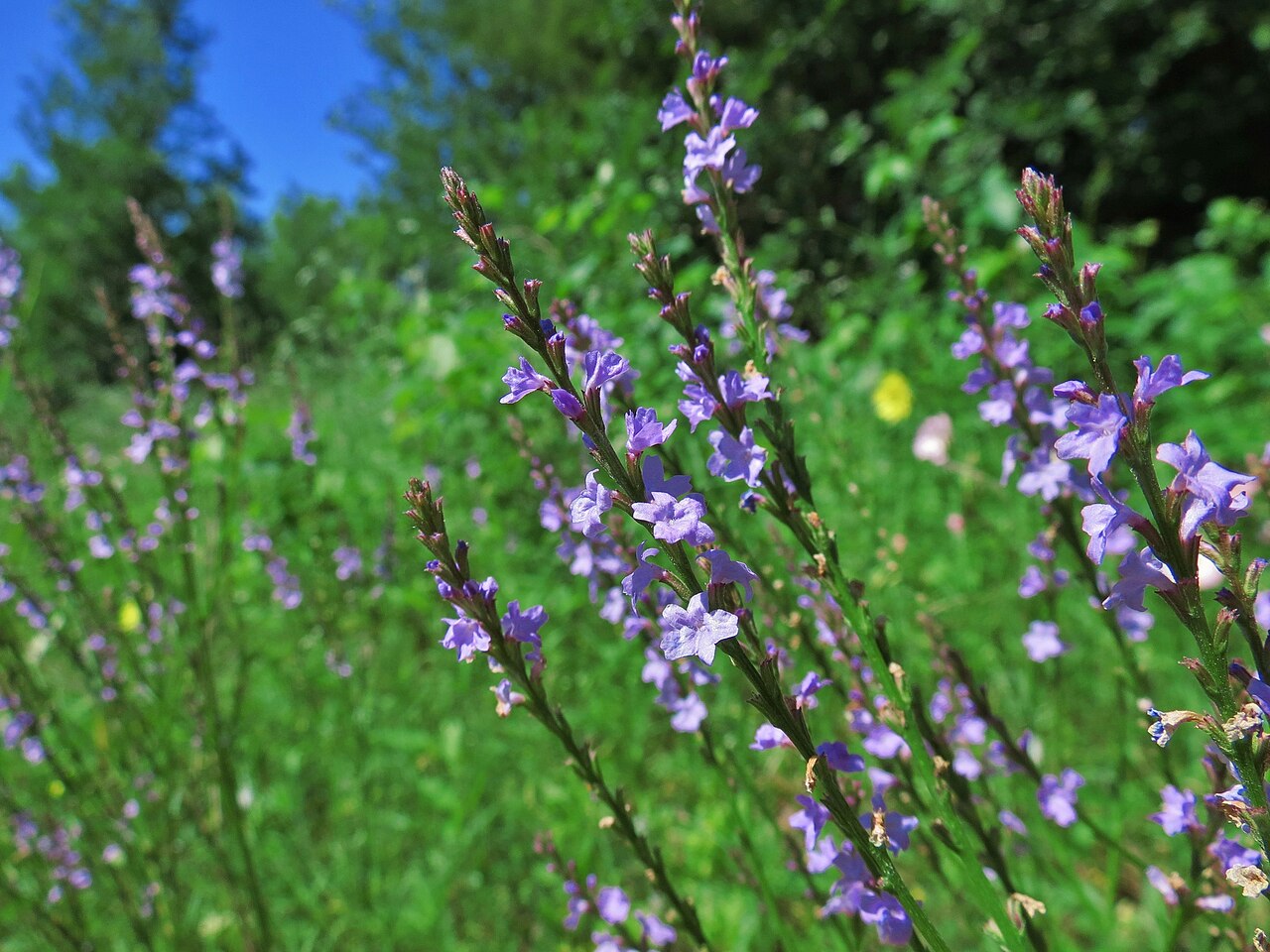
Verbena halei, known as Texas Vervain or slender vervain, is a slim, wiry native perennial of prairies, pastures, roadsides and open woods across the southern United States. From a small rosette of deeply lobed leaves it sends up stiff, square, sparsely branched stems 1 to 3 feet tall, each ending in long, pencil-thin spikes. Small lavender to blue-violet flowers open a few at a time along those spikes from early spring well into summer, giving a long, if subtle, season of color.
Texas vervain is one of the most common wildflowers of Texas roadsides and pastures in spring, often blooming among bluebonnets, Indian paintbrush and Indian blanket. Its airy habit means it rarely dominates a planting, but it weaves through grasses and taller flowers. The Lady Bird Johnson Wildflower Center notes that it is drought tolerant and suitable for xeriscaping and that it attracts butterflies.
It belongs to the verbena family (Verbenaceae), along with the other native vervains, frogfruits and mock vervains. This guide explains how to tell Texas vervain from its relatives, where it grows, how to use it in gardens and meadows, and what it offers to pollinators and birds.
Identification
Texas vervain is a plant of slender lines: thin, upright stems, long narrow flower spikes and few leaves on the upper plant. Its deeply lobed lower leaves and loosely spaced lavender flowers help separate it from other native vervains.
Stems
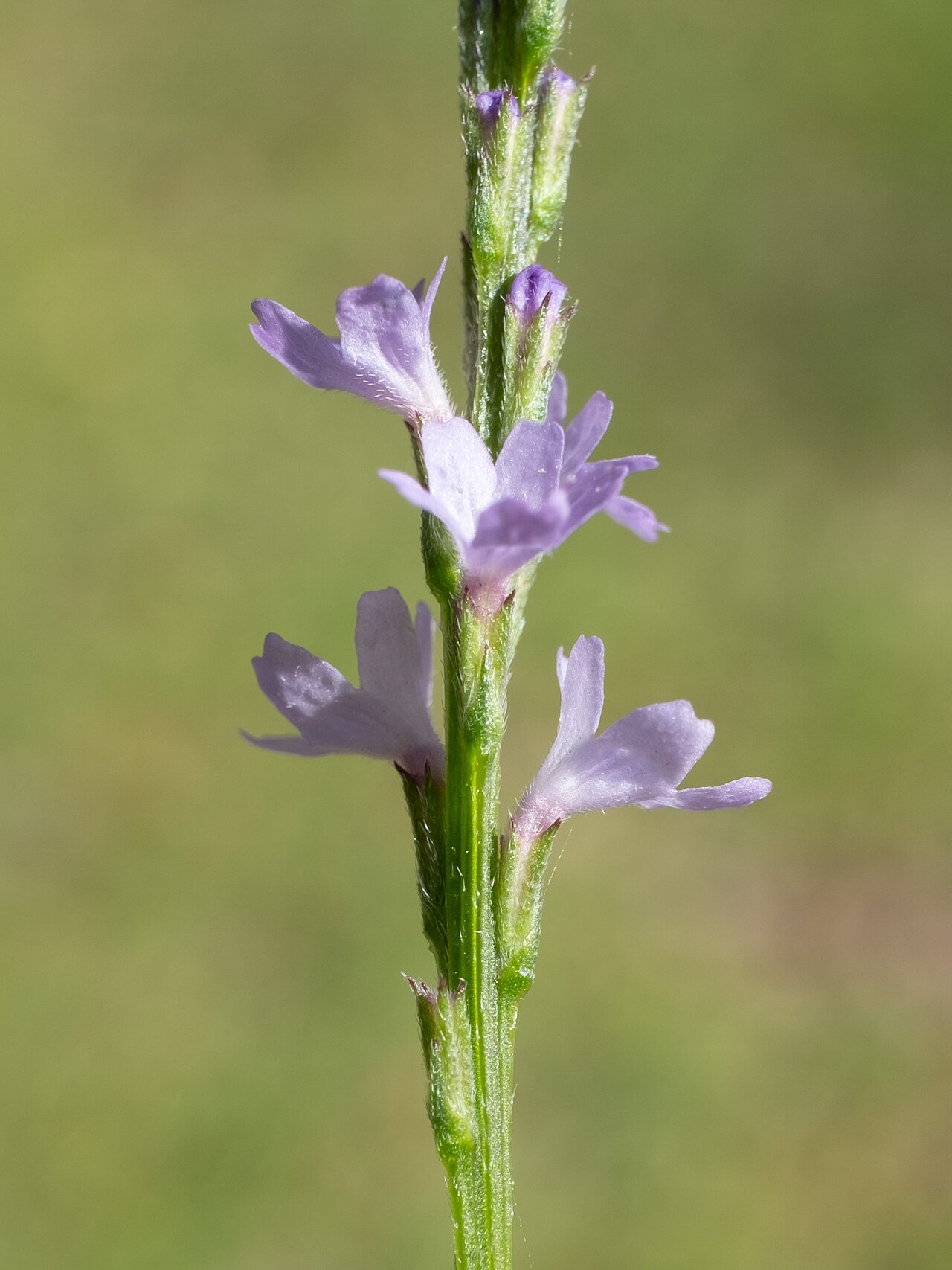
Plants grow from a short, somewhat woody base, producing one to several erect stems 1 to 3 feet tall. The stems are distinctly four-angled, like those of mints, smooth or slightly rough, and branch mainly in the upper part, where they divide into several long flower spikes.
Leaves
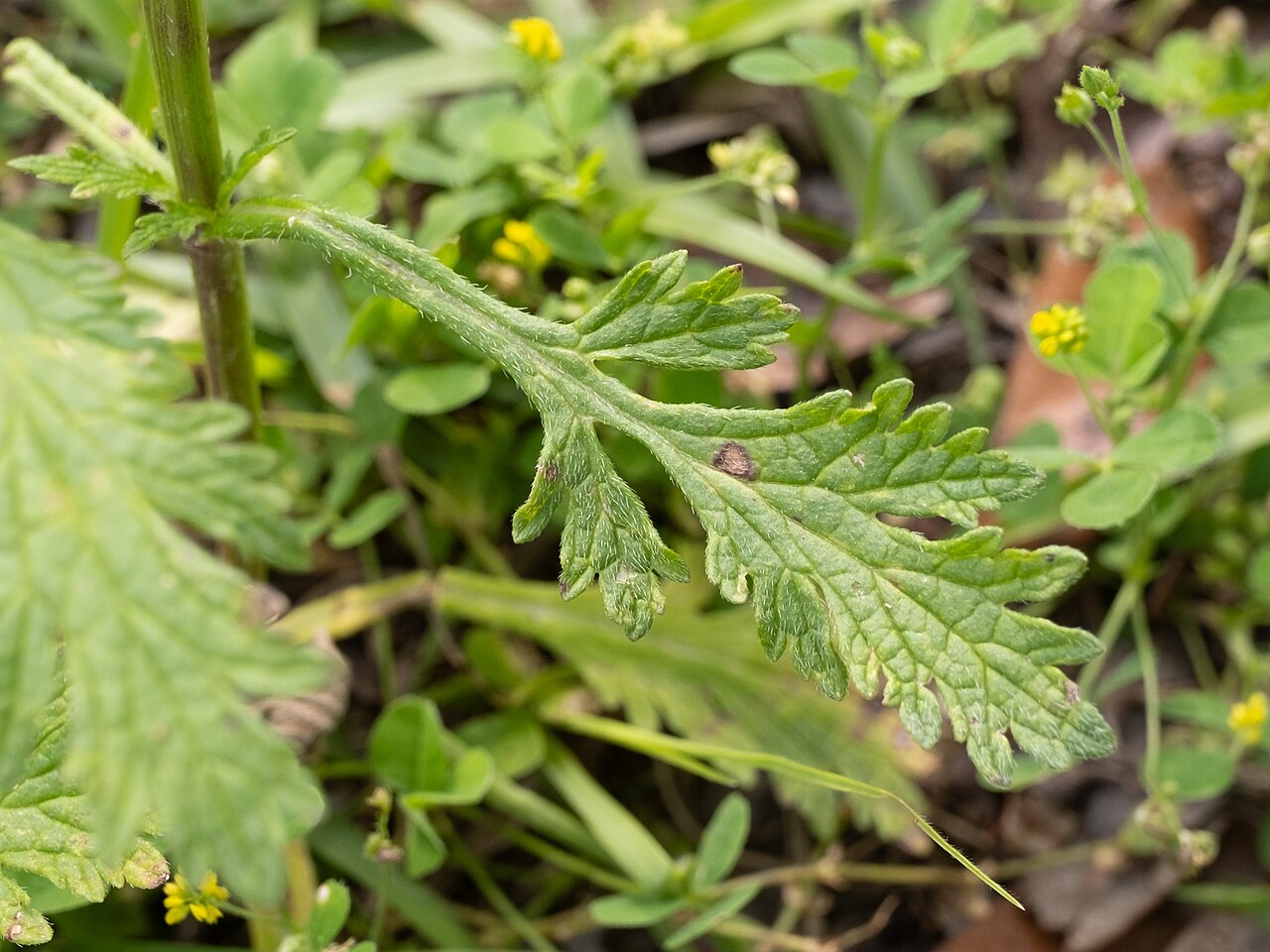
The leaves are opposite. The lower leaves, 1 to 3 inches long, are deeply divided into irregular, toothed lobes, and they often form a loose rosette early in the season. Moving up the stem, the leaves become smaller, narrower and less divided, and the uppermost leaves are linear with few or no teeth. By flowering time the plant can look nearly leafless above.
Flowers
The flowers are borne in very slender spikes 4 to 12 inches long that keep elongating through the season. Only a narrow band of flowers is open at any time, with buds above and developing fruits below. The flowers are small, about ¼ inch across, with a short tube and five spreading, slightly unequal lobes in pale lavender to blue-violet. On a single plant, bloom can continue for months, mostly from March to July and often again in fall.
Blue vervain (Verbena hastata) and hoary vervain (V. stricta) have broader, toothed but unlobed leaves and denser spikes. The European V. officinalis, with which Texas vervain was once combined, is a naturalized weed in some areas and has smaller, paler flowers.
Fruit & Seeds
After flowering, each flower leaves a small fruit enclosed in the persistent calyx. It splits into four narrow, ridged nutlets that are pressed close to the stem along the old spike. The slender spikes of ripening fruit can stay on the plant for weeks, and the seeds are eaten by birds.
Quick Facts
| Scientific Name | Verbena halei (syn. V. officinalis ssp. halei) |
| Family | Verbenaceae (verbena family) |
| Plant Type | Herbaceous perennial, sometimes short-lived |
| Mature Height | 1–3 ft |
| Mature Spread | 1–1½ ft |
| Growth Rate | Fast |
| Sun Exposure | Full sun to partial shade |
| Water Needs | Low; drought tolerant |
| Soil Type | Sandy, loam, clay loam; tolerates rocky and limestone soils |
| Soil pH | About 6.0–8.0 |
| Bloom Time | March–July, often again in fall |
| Flower Color | Pale lavender to blue-violet |
| Fall Color | None significant |
| Fruit | Four small nutlets enclosed in the calyx |
| Deer Resistant | Moderately; occasionally browsed |
| USDA Hardiness Zones | 7–10 |
Native Range
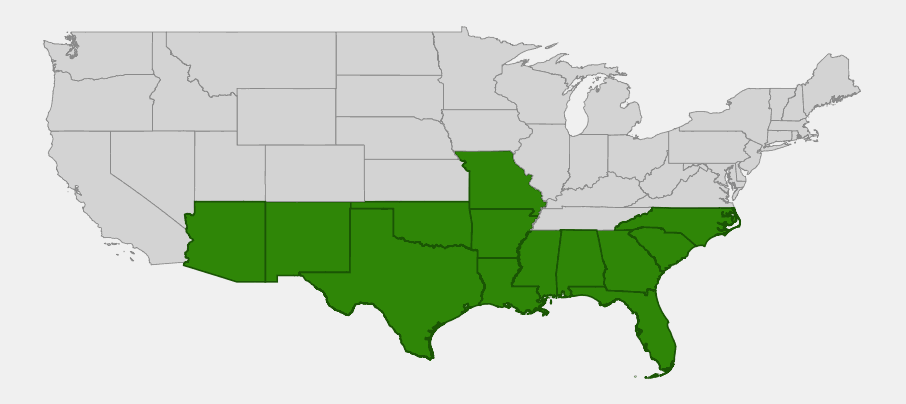
Texas vervain is a southern species. The Lady Bird Johnson Wildflower Center describes its native range as North Carolina south to Florida, west to Texas, and north to Oklahoma and Missouri. USDA PLANTS also records it in New Mexico and Arizona, for a total of 13 states, and it extends south into northern Mexico.
It is most abundant in Texas, Oklahoma and Louisiana, where it is one of the most familiar spring roadside wildflowers on the Blackland Prairie, the Cross Timbers, the Post Oak Savannah and the Gulf Coastal Prairie. Eastward it becomes more scattered across the Gulf and Atlantic Coastal Plain, reaching the Carolinas and Florida, and it is uncommon at the northern and western edges of its range.
Its habitats include prairies, pastures, old fields, open woodlands and woodland borders, sandy or rocky openings, roadsides and vacant lots. It thrives on disturbed ground and in mowed areas, and it is often among the first native perennials to appear after soil disturbance.
📋 Regional plant lists featuring Texas Vervain: Arizona & New Mexico · Illinois, Iowa & Missouri · Alabama, Georgia & Mississippi · North & South Florida
Growing & Care Guide
Texas vervain is easy to grow in sunny, well-drained sites across the South. It is best used as a supporting player in meadows, prairie gardens and naturalistic beds, where its slender spikes add a light, vertical accent and a long season of small flowers for pollinators.
Light
Full sun gives the strongest stems and longest bloom. It also grows in partial shade at woodland edges, matching the LBJ description of its habitat in thickets and woodland borders, but it flowers less there.
Soil & Water
It grows in sand, loam and clay loam and tolerates rocky, limestone-based soils. Good drainage is important. Once established it is quite drought tolerant and seldom needs watering except in prolonged dry spells. Avoid rich, heavily fertilized beds, which produce floppy growth.
Planting Tips
Plant nursery-grown plants or sow seed in fall or early spring. Because individual plants are slender, set them in groups of three or more, 12 to 18 inches apart, or scatter seed among bunchgrasses and other wildflowers so the spikes rise through neighboring plants. It is a good addition to wildflower seed mixes for Texas and the Gulf states.
Pruning & Maintenance
Cut the spikes back after the first flush of bloom to tidy the plant and encourage a second round of flowers in summer or fall. Leave some spikes to ripen seed for birds and for self-sowing. In meadows, a late-winter mowing keeps the planting open and lets seedlings establish. Plants are short-lived, so allow some to reseed.
Propagation
Grow it from seed sown in fall, or in spring after a few weeks of cold, moist stratification, which improves germination. Seed needs light to germinate, so barely cover it. Young basal shoots can also be divided in early spring, and stem cuttings root readily in summer.
Landscape Uses
- Meadows and prairie gardens: a light, vertical accent among grasses and wildflowers
- Pollinator and butterfly gardens: a long bloom season for butterflies and small bees
- Xeriscapes: drought tolerant once established
- Roadside and pasture plantings: thrives with occasional mowing
- Wildlife gardens: seeds for sparrows, cardinals and other birds
Wildlife & Ecological Value
Texas vervain is modest in appearance, but its long bloom season and abundant small seeds make it a useful plant for wildlife across the South.
For Pollinators
The small tubular flowers attract butterflies, including skippers, sulphurs, hairstreaks and swallowtails, and the Lady Bird Johnson Wildflower Center lists it as a nectar source for butterflies. Small native bees, including sweat bees and specialist bees that collect pollen from vervains, also visit. Because the spikes keep producing new flowers for months, a patch of Texas vervain offers a steady trickle of nectar from spring into summer.
For Birds
Vervain seeds are eaten by northern cardinals, sparrows, juncos and other seed-eating birds, which pick them from the old spikes or from the ground in fall and winter. Its presence in prairies and pastures also supports the insects eaten by grassland birds.
For Mammals
The bitter foliage is not a favorite of deer or livestock, which is one reason it persists in grazed pastures. Small mammals may eat the seeds.
Ecosystem Role
As a short-lived perennial that thrives on disturbed ground, Texas vervain helps stabilize bare soil and fills gaps in prairie and roadside vegetation. It often increases in heavily grazed or mowed areas, where less tolerant plants decline.
Cultural & Historical Uses
The species was named around the turn of the twentieth century by the American botanist John Kunkel Small, a specialist in the flora of the Southeast. Its epithet is generally taken to honor Josiah Hale, a nineteenth-century physician and plant collector in Louisiana. Some later botanists treated it as a subspecies of the European Verbena officinalis, but it is now generally recognized as a separate native species.
The name “vervain” and the genus name Verbena come from Latin, where verbena referred to sacred boughs used in Roman religious ceremonies. European vervain has a long history in folk medicine and folklore, and several native American vervains were used by Indigenous peoples and settlers in similar ways, generally as bitter tonics. These uses are historical and are not recommendations.
In Texas, Texas vervain is part of the familiar mix of spring wildflowers on highway rights-of-way, many of which are managed by delayed mowing to allow wildflowers to set seed. Its slender lavender spikes are a quiet but constant presence among bluebonnets, paintbrush and primroses from early spring into summer.
Frequently Asked Questions
How do I tell Texas vervain from other vervains?
Look at the leaves and spikes. Texas vervain has deeply lobed lower leaves, narrow upper leaves and very slender spikes with loosely spaced lavender flowers. Blue vervain and hoary vervain have unlobed, toothed leaves and denser spikes. Mock vervains (Glandularia) have larger flowers in flat-topped clusters.
Does Texas vervain attract butterflies?
Yes. Butterflies and small bees visit its flowers throughout its long bloom season, and the seeds are eaten by birds later in the year.
Is Texas vervain drought tolerant?
Yes. Once established it tolerates dry, poor soils and long dry spells. It is suitable for xeriscapes and dry meadows throughout its range.
How long does Texas vervain bloom?
Individual plants can bloom for months, mostly from March to July, with additional flowers in fall in many areas. Cutting back spent spikes can encourage more bloom.
Will Texas vervain spread in my garden?
It self-sows moderately in open, sunny ground, which helps it persist since individual plants are short-lived. It is not aggressive, and unwanted seedlings are easy to remove.

Looking for a nursery that carries Texas Vervain?
Browse our native plant nursery directory: Alabama, Arizona & Arkansas · Florida & Georgia · Louisiana, Mississippi & Missouri · New Mexico, North Carolina & Oklahoma · South Carolina & Texas