
Green False Hellebore (Veratrum viride)
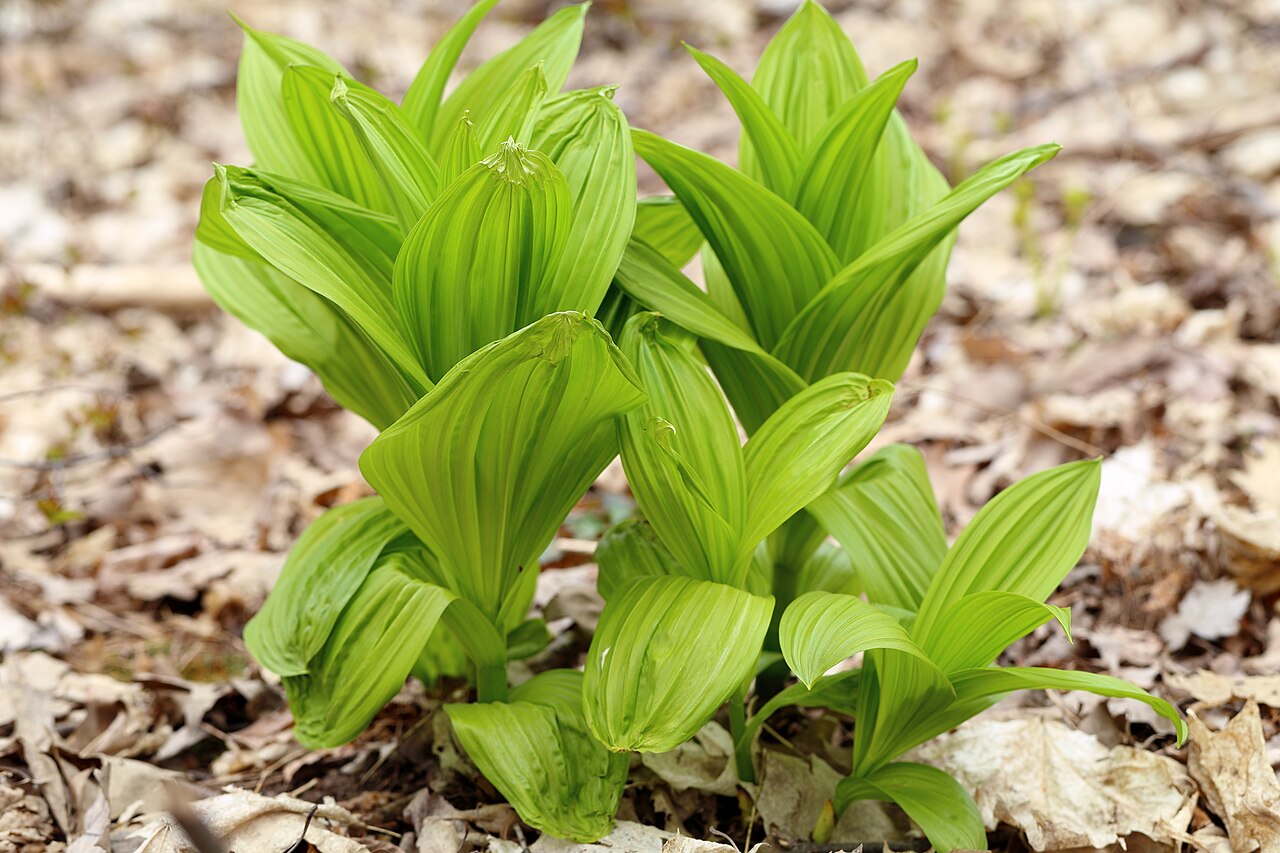
Veratrum viride, known as Green False Hellebore, American false hellebore, Indian poke or corn lily, is a bold, tall perennial of wet woods, swamps, seeps and mountain meadows. In early spring it pushes up thick shoots that unfold into large, strongly pleated, bright green leaves, and by early summer mature plants stand 2 to 6 feet tall, topped by a branching plume of small, star-shaped, yellow-green flowers. It belongs to the bunchflower family (Melanthiaceae).
Safety first: green false hellebore is one of the most poisonous plants in North America. All parts, especially the roots and young shoots, contain steroidal alkaloids that can cause severe vomiting, a dangerously slow heartbeat and low blood pressure. Every spring people are poisoned after mistaking its young leaves for ramps (wild leeks) or other wild greens. Never eat it, and do not forage wild greens unless you are completely certain of their identity.
Despite its toxicity, green false hellebore is a striking plant and an important part of wetland and mountain-meadow ecosystems. This guide covers how to identify it safely, where it grows across its unusual split range in the East, the West and Alaska, the cautious ways to grow it, and its long history in medicine and folklore.
Identification
Green false hellebore is unmistakable once you know it, but its young spring shoots can be confused with edible plants. Learn its leaf pattern and flowering stalk, and treat any unknown pleated-leaved spring shoot in wet woods as poisonous.
Rhizome & Stems
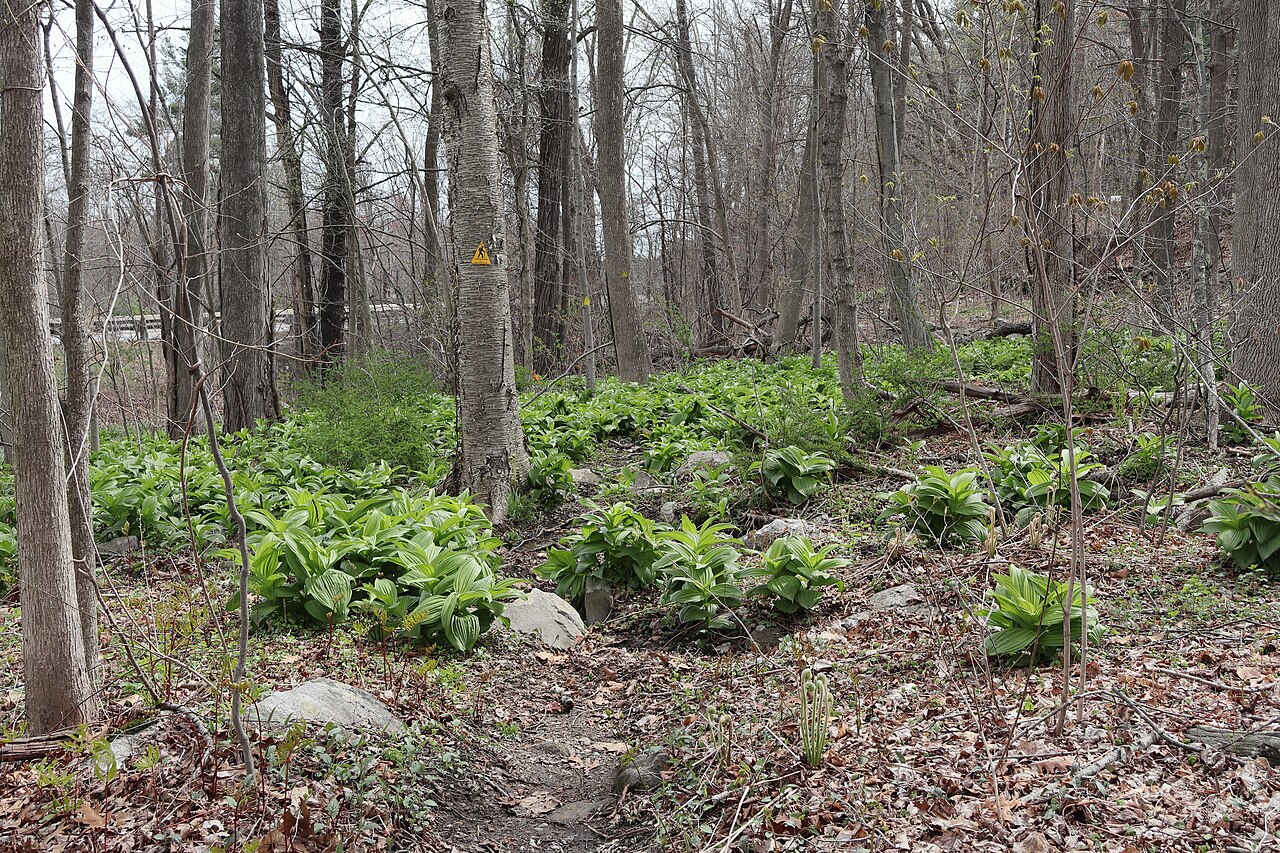
Plants grow from a short, thick, upright rhizome with many coarse roots. Each spring a single stout, unbranched, hollow stem rises from it and grows quickly to 2 to 6 feet (occasionally 7 feet) in flower. Non-flowering plants are shorter. Older rhizomes often form clumps, and large colonies are common in wet woods.
Leaves
The leaves are the most conspicuous feature. They are alternate, broadly oval to elliptic, 6 to 12 inches long and up to 6 inches wide, with prominent parallel veins and deep, accordion-like pleats. Their bases sheathe and clasp the stem. Leaves are bright yellow-green in spring, and the undersides are often finely hairy. In many areas the leaves yellow and wither by mid to late summer.
Flowers
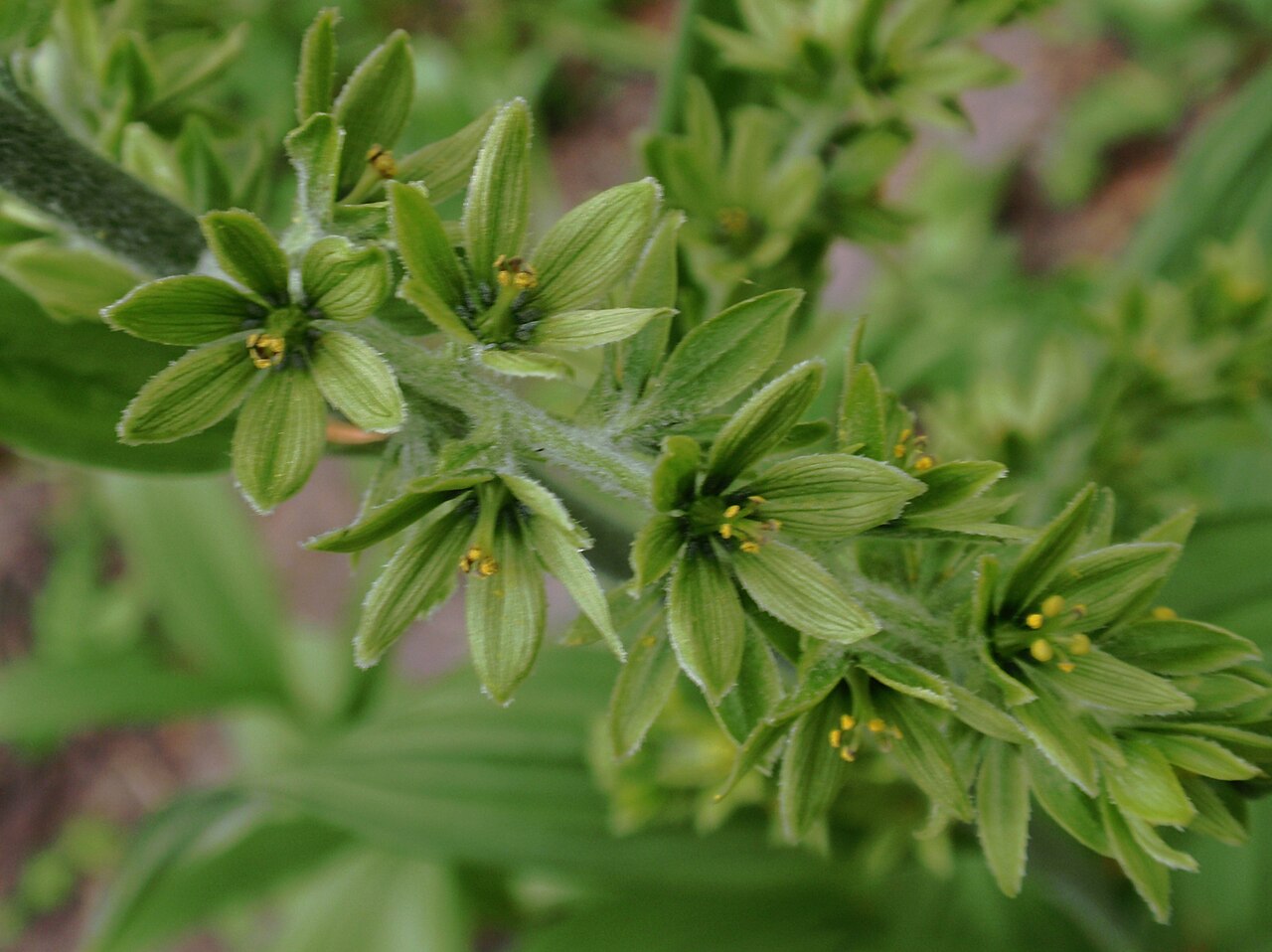
Mature plants produce a large, open panicle 8 to 24 inches long at the top of the stem, with many spreading or drooping side branches. The flowers are star-shaped, about ½ to ¾ inch across, with six yellow-green tepals with hairy, often finely toothed margins and darker green centers. Bloom time is May to July in the East, and into July and August at high elevations and in the north. Individual plants may go several years without flowering, and whole colonies often bloom heavily in some years and sparsely in others.
Fruit & Seeds
The fruits are upright, three-parted capsules about 1 inch long, containing flat, winged, papery seeds that drift short distances on the wind. Dry stalks with capsules may stand into fall.
Look-alikes
Its young shoots can be mistaken for ramps (Allium tricoccum), which have smooth, flat, unpleated leaves that smell strongly of onion or garlic. Green false hellebore has no onion smell and has strongly pleated leaves that alternate up a stout stem. Skunk cabbage, which shares its habitat, has broader, unpleated leaves in a basal clump. In the West, California corn lily (Veratrum californicum) is similar but has white flowers.
Quick Facts
| Scientific Name | Veratrum viride (incl. var. eschscholzianum) |
| Family | Melanthiaceae (bunchflower family) |
| Plant Type | Herbaceous perennial from a thick rhizome |
| Mature Height | 2–6 ft in flower |
| Mature Spread | 2–3 ft |
| Growth Rate | Slow to establish; fast spring growth |
| Sun Exposure | Part shade to full sun (with constant moisture) |
| Water Needs | High; wet to consistently moist soil |
| Soil Type | Rich, wet loam, muck or peat; seepage soils |
| Soil pH | About 5.0–7.0 |
| Bloom Time | May–July (to August at high elevations) |
| Flower Color | Yellow-green |
| Fall Color | Leaves turn yellow and wither by late summer |
| Fruit | Upright three-parted capsule with winged seeds |
| Deer Resistant | Yes; highly toxic to animals |
| USDA Hardiness Zones | 3–7 |
Native Range
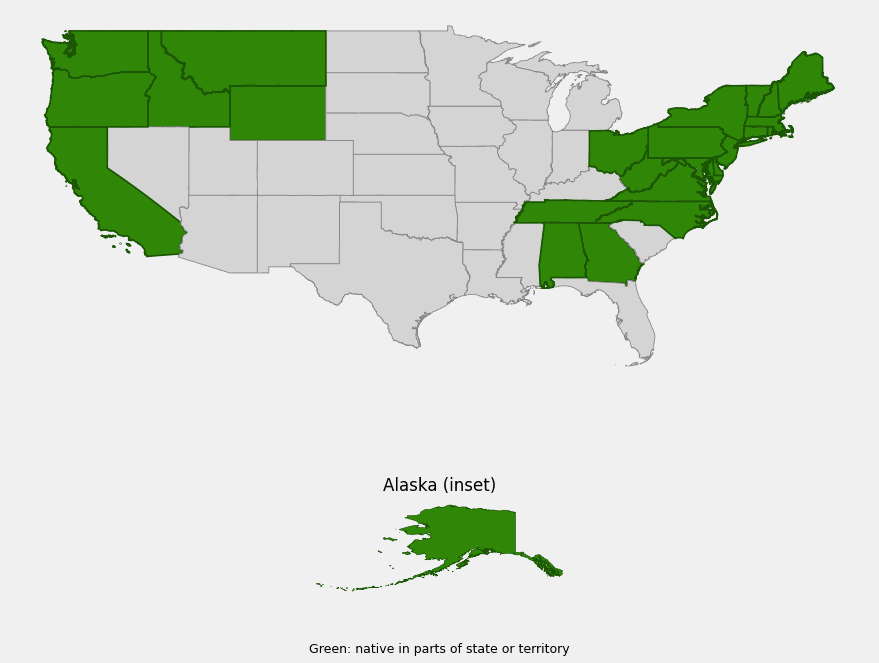
Green false hellebore has an unusual split range. In the East, USDA PLANTS records it as native from Maine, New Hampshire and Vermont south through New England, New York, New Jersey, Pennsylvania and Ohio, and down the Appalachian Mountains through Maryland, Delaware, Virginia, West Virginia, North Carolina and Tennessee to Georgia and Alabama. In the West it grows in Washington, Oregon, northern California, Idaho, Montana and Wyoming, and it is widespread in southern and central Alaska. In Canada it ranges from British Columbia, Alberta and the Yukon east to Quebec, Labrador and New Brunswick.
Eastern plants grow in swamps, wet woods, seeps, stream banks and wet meadows, from the lowlands of New England to the high mountain bogs and seepage slopes of the southern Appalachians. Western plants, often treated as var. eschscholzianum, with more drooping flower branches, grow in moist subalpine and alpine meadows, avalanche chutes, and wet forest openings in the Cascades, the northern Rockies and coastal Alaska, often in great numbers right after snowmelt.
Within this range it needs constant moisture. It often forms dense colonies in seepage areas and along small streams, and in western mountain meadows it can cover large areas because grazing animals avoid it.
📋 Regional plant lists featuring Green False Hellebore: New York, Pennsylvania & Northern New Jersey · Idaho, Eastern Oregon & Eastern Washington · Ohio & Indiana · Montana & Wyoming · Kentucky & Tennessee · Connecticut, Massachusetts & Rhode Island · New Hampshire, Maine & Vermont · Maryland, Virginia & West Virginia · Delaware, Southern New Jersey & Long Island · Alabama, Georgia & Mississippi · Alaska
Growing & Care Guide
Green false hellebore can be grown as a dramatic foliage plant in wet, partly shaded gardens, but it should be planted only where children, pets and foragers will not eat it. It is slow to establish and dislikes being moved, so start with nursery-propagated plants rather than digging wild ones, and wear gloves when handling the roots.
Light
It grows best in part shade or dappled light under deciduous trees, as in a wet woodland. In cool, northern or mountain climates it tolerates full sun if the soil stays wet. In hot summers, full sun scorches the leaves.
Soil & Water
Plant it in rich, constantly moist to wet soil: a streamside, the edge of a pond, a seep or a bog garden. It tolerates seasonal flooding but not drying out. Mulch with leaves to keep the roots cool and moist.
Planting Tips
Plant divisions or potted plants in early spring or fall, setting the crown just below the soil surface. Space plants 2 to 3 feet apart. Choose a site away from vegetable gardens, children’s play areas and paths where pets roam. Label the planting, especially if anyone in your household forages for ramps or other wild greens.
Pruning & Maintenance
Little care is needed. Remove the withered leaves in late summer if they look untidy, wearing gloves. Leave the flowering stalks if you want seed. Do not compost large amounts of the plant where animals might eat it.
Propagation
Plants can be propagated by careful division of the rhizome in early spring or fall, again wearing gloves. Seed can be sown outdoors in fall for natural cold stratification, but germination is slow, and seedlings may take many years, often five or more, to flower.
Landscape Uses
- Woodland bog and streamside gardens: a bold, architectural foliage plant for wet partial shade
- Wetland and seep restoration: within its native range, in protected natural areas
- Mountain and northern gardens: tolerates cold, wet sites and late snowmelt
- Deer-resistant plantings: deer and livestock avoid it
- Not for edible landscapes: keep it far from vegetable beds and foraging areas
Wildlife & Ecological Value
Green false hellebore is toxic to most animals, but it still plays a role in the wetland and meadow communities where it grows.
For Pollinators
The open flowers produce nectar that attracts flies, small bees, beetles and wasps. Flies are thought to be among the most frequent visitors. Some research on related false hellebores suggests the nectar itself can contain alkaloids, which may affect some visiting insects.
For Birds
Birds rarely eat any part of the plant. The dense wet thickets where it grows provide cover and insect food for wetland birds.
For Mammals
Deer, elk, livestock and most other mammals avoid it because of its toxicity, which is one reason it can dominate grazed mountain meadows. Livestock poisoning occasionally occurs, especially when animals eat young shoots in spring when other forage is scarce.
Ecosystem Role
Green false hellebore stabilizes wet soils with its thick rhizomes and dense roots, and its large leaves shade the soil along seeps and streams. Its seasonal growth adds a large amount of organic matter to wetland soils each year. In mountain meadows, its abundance can be an indicator of past heavy grazing, since animals eat the surrounding plants and leave the hellebore.
Cultural & Historical Uses
Safety note: all parts of green false hellebore are highly poisonous. The plant contains a mixture of steroidal alkaloids, including veratridine and related compounds, which interfere with nerve and heart function. Eating even a small amount can cause burning in the mouth, severe nausea and vomiting, a slow heart rate, dangerously low blood pressure and fainting. Most poisonings happen when foragers mistake its young shoots for ramps or other edible greens. If someone may have eaten it, call Poison Control (1-800-222-1222 in the U.S.) or seek emergency care right away.
Native American peoples knew the plant well and treated it with great caution. The powdered root was used in small amounts as an external treatment for lice and skin conditions and as an insecticide, which explains names such as “Indian poke” and “itchweed.” Some peoples used it in ceremonies and in carefully controlled medicinal doses. The plant should not be used for any of these purposes today.
In the nineteenth and early twentieth centuries, preparations of Veratrum viride were used by physicians to slow the heart and lower blood pressure, including in the treatment of high blood pressure and convulsions in pregnancy. Its narrow margin between a helpful and a toxic dose eventually led doctors to abandon it in favor of safer drugs. Today it is valued mainly as a striking native wetland plant and studied for its unusual alkaloids.
Frequently Asked Questions
Is green false hellebore poisonous?
Yes, it is one of the most poisonous plants in North America. All parts contain alkaloids that can cause severe vomiting, slow heart rate and very low blood pressure. Never eat any part of it, and keep children and pets away from it.
How do I tell green false hellebore from ramps?
Ramps have smooth, flat leaves without pleats, usually two or three from a small bulb, and they smell strongly of onion or garlic. Green false hellebore has deeply pleated leaves that alternate up a single stout stem, and it has no onion smell. If in doubt, do not eat it.
Is green false hellebore related to true hellebores?
No. True hellebores (Helleborus) are Eurasian members of the buttercup family. “False hellebore” refers to an old use of both plants as medicines and poisons. Green false hellebore belongs to the bunchflower family (Melanthiaceae).
Can I grow green false hellebore in my garden?
Yes, in a wet, partly shaded spot, but only where children, pets and foragers will not eat it. Use nursery-propagated plants, wear gloves when handling it, and label the planting.
Why does green false hellebore die back in summer?
Its leaves often turn yellow and wither by mid to late summer, especially in drier or warmer conditions, after the plant has stored energy in its rhizome. It returns in spring.

Looking for a nursery that carries Green False Hellebore?
Browse our native plant nursery directory: Alabama & Alaska · California · Connecticut, Delaware & Georgia · Idaho · Maine, Maryland, Massachusetts & Montana · New Hampshire, New Jersey, New York, North Carolina & Ohio · Oregon · Pennsylvania, Rhode Island, Tennessee, Vermont & Virginia · Washington · West Virginia & Wyoming