
Shining Clubmoss (Huperzia lucidula)
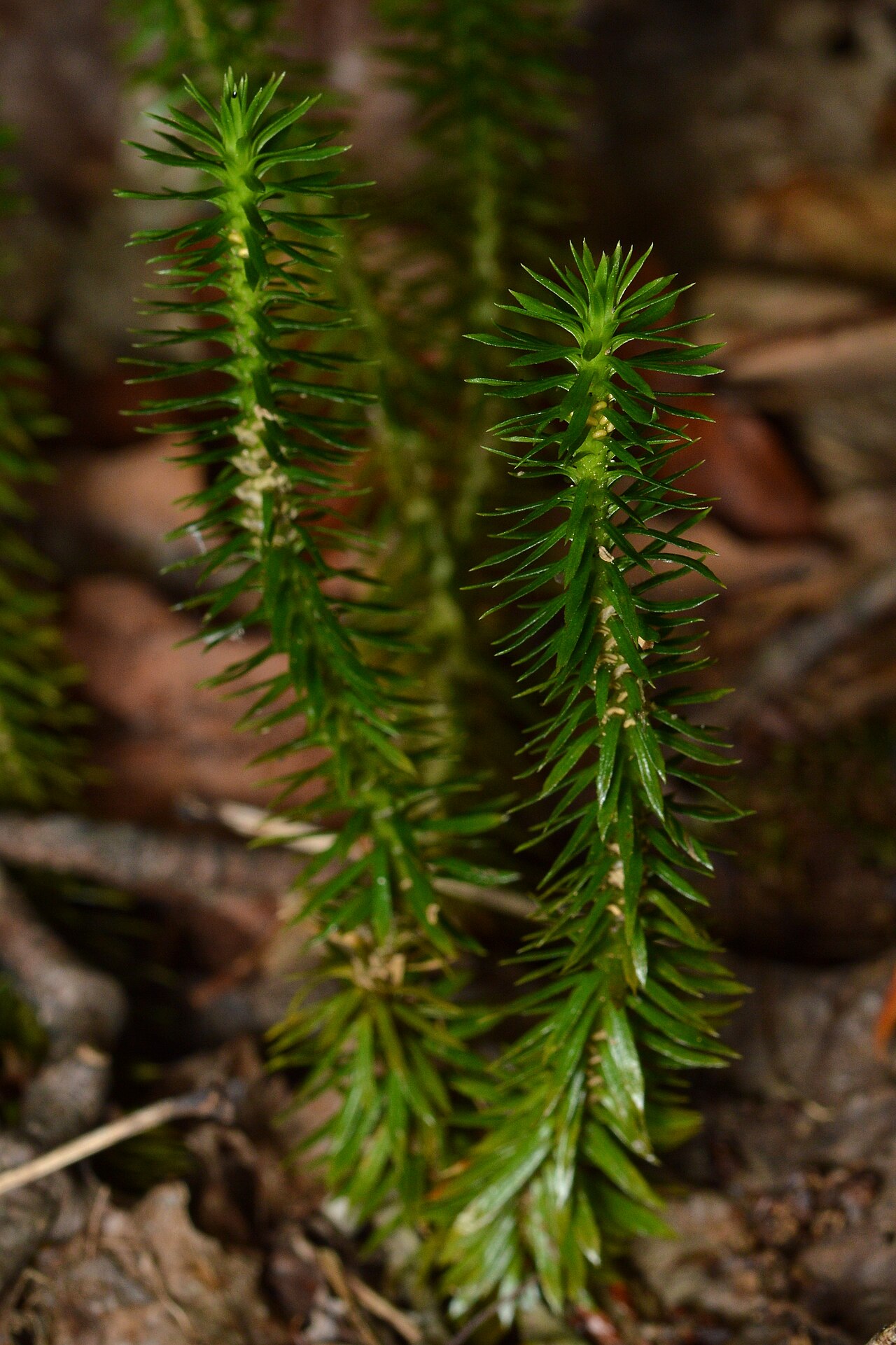
Huperzia lucidula, known as Shining Clubmoss or shining firmoss, is a small evergreen plant of cool, shady eastern forests. Its upright stems, 4 to 8 inches tall, are densely covered with glossy, dark green, finely toothed leaves and look like tiny bottlebrushes or miniature fir trees. It is not a moss at all but a lycophyte, a member of an ancient group of spore-bearing vascular plants in the clubmoss family (Lycopodiaceae). It was long known as Lycopodium lucidulum, the name still used in many field guides.
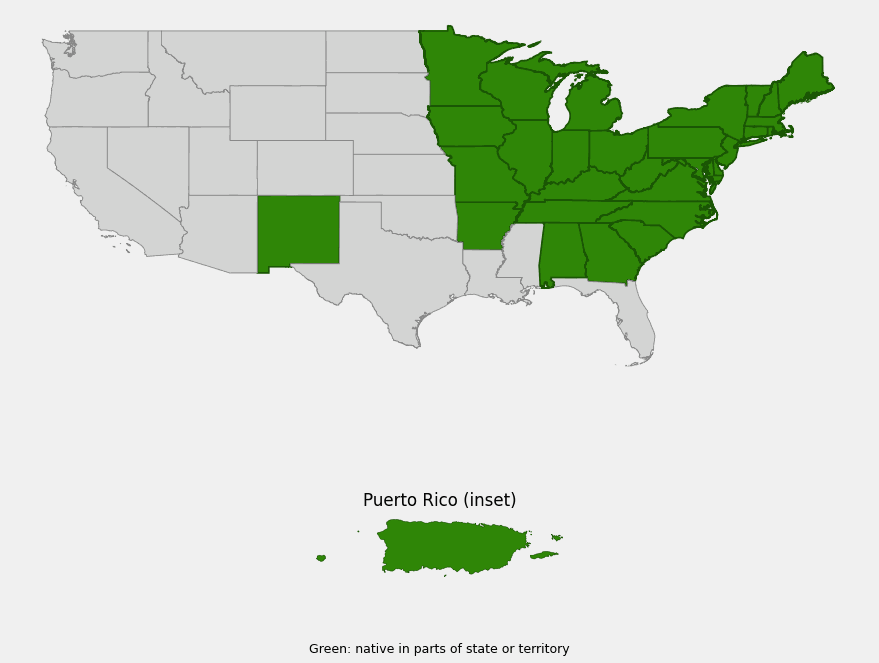
Shining clubmoss is common in moist, acidic forests from Newfoundland and the Great Lakes south through the Appalachians to Georgia and Alabama. USDA PLANTS also lists it as native in Puerto Rico, where plants of the island’s mountain forests have been recorded as Lycopodium reflexum, a name USDA treats as a synonym of this species. Unlike most clubmosses, it does not bear its spores in cones: spore cases sit at the bases of ordinary leaves, and the plant also reproduces by tiny detachable buds called gemmae.
Shining clubmoss is a beautiful plant for shaded native woodland gardens but is notoriously difficult to establish. It grows extremely slowly and depends on soil fungi in the early stages of its life. Never dig wild plants. Safety note: like other Huperzia species, shining clubmoss contains biologically active alkaloids (including huperzine A) that affect the nervous system. It should not be eaten or used as an herbal remedy, and should be kept away from children and pets.
Identification
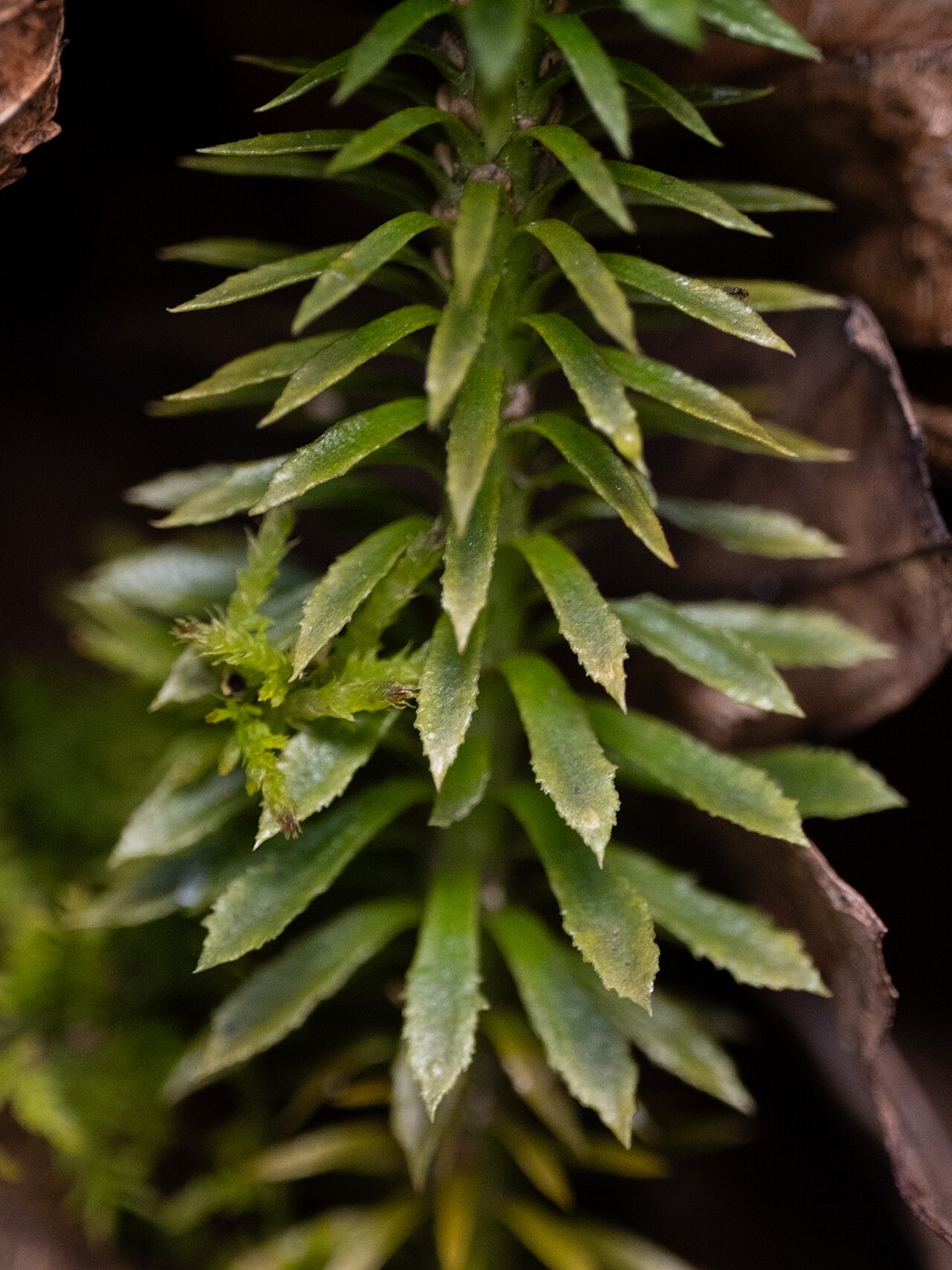
Shining clubmoss is easy to recognize among eastern clubmosses. Its leaves are noticeably shiny, wider toward the tip and toothed, and it lacks the cones that most other clubmosses carry on their stems. Look for the annual bands along its stems.
Stems
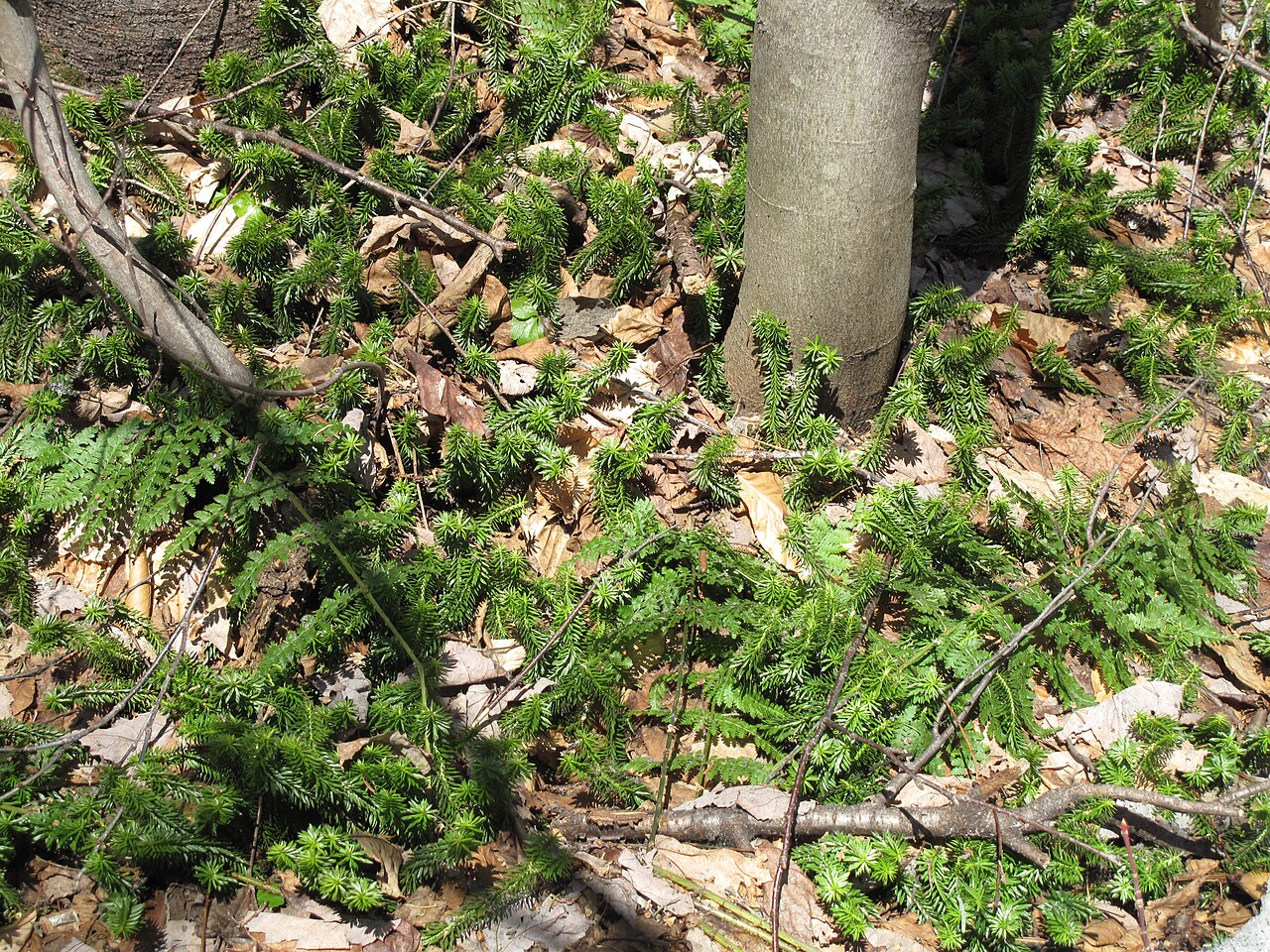
The stems lie along the ground at the base, where older growth turns brown and roots along its length, and then turn upright into erect shoots 4 to 8 inches (sometimes 10 inches) tall. Each shoot forks one to a few times, so the plant forms clumps of several upright branches. Over years a colony can spread to cover several square feet.
Leaves
The leaves are small (about a quarter to half an inch long), narrow but widest above the middle, and irregularly toothed near the tip. They are shiny, dark green and spread outward or curve slightly down, densely clothing the stem. Along each stem are alternating zones of longer and shorter leaves, which mark annual growth: each spring a new zone of short leaves forms, followed by longer leaves. These “annual constrictions” are a key identification feature.
Spores & Gemmae
There are no cones. Small, kidney-shaped, yellow spore cases (sporangia) sit in the axils of leaves, in bands along the upper stem. In late summer they release fine yellow spores. Near the tips of the stems, the plant also produces small leafy buds called gemmae. When ripe, they are flicked off by a tiny spring-like mechanism and can root nearby to form new plants. Most new shining clubmoss plants in a colony come from gemmae rather than spores.
Similar Species
Northern firmoss (Huperzia selago) and Appalachian firmoss (H. appressa) have shorter, untoothed leaves that point upward and lack shine. Rock firmoss (H. porophila) grows on cliffs and has narrower, less toothed leaves. Hybrids occur where species overlap. Other common clubmosses, such as ground pine and running cedar, form cones and have creeping, horizontal stems.
Quick Facts
| Scientific Name | Huperzia lucidula (Michx.) Trevis. (syn. Lycopodium lucidulum) |
| Family | Lycopodiaceae (clubmoss family) |
| Plant Type | Evergreen lycophyte (clubmoss); spore-bearing perennial |
| Mature Height | 4–8 in (sometimes to 10 in) |
| Mature Spread | Slowly forms colonies several feet across |
| Growth Rate | Very slow |
| Sun Exposure | Partial to full shade |
| Water Needs | Medium to high; consistently moist soil |
| Soil Type | Acidic, humus-rich forest soil; moss-covered logs and rocks |
| Soil pH | About 4.5–6.0 (acidic) |
| Bloom Time | None (no flowers); spores released late summer |
| Flower Color | None; yellow spore cases at leaf bases |
| Fall Color | Evergreen; stays glossy green all winter |
| Fruit | None; reproduces by spores and gemmae |
| Deer Resistant | Yes; rarely browsed |
| USDA Hardiness Zones | 3–7 |
Native Range
Shining clubmoss is a plant of eastern North America. USDA PLANTS lists it as native in 29 states and Puerto Rico, and in Canada from Manitoba and Ontario east to Quebec, the Maritime provinces and Newfoundland, as well as Saint Pierre and Miquelon. Its range extends from Minnesota, Wisconsin and Michigan east through New York and New England, and south through Pennsylvania, Ohio and the Appalachian states to the mountains of Georgia, Alabama and South Carolina, with scattered populations in the Ozarks of Missouri and Arkansas and in Iowa and Illinois. USDA also records it in New Mexico, a distant outlier.
It is most common in the northern hardwood and mixed forests of the Great Lakes region, New England and the Appalachians, where it can carpet moist slopes under hemlock, beech, maple and yellow birch. Farther south it is restricted mostly to cool, moist mountain coves, ravines and north-facing slopes.
In Puerto Rico, USDA includes plants of the island’s humid mountain forests under this species. Many tropical botanists treat these as a separate species (often called Huperzia reflexa or Phlegmariurus reflexus). Anyone working with Puerto Rican plants should be aware of the different names. Across its range the plant favors moist, shaded, acidic sites, often on mossy rocks, rotting logs and stream banks.
📋 Regional plant lists featuring Shining Clubmoss: New York, Pennsylvania & Northern New Jersey · Ohio & Indiana · Michigan, Wisconsin & Eastern Minnesota · Kentucky & Tennessee · Connecticut, Massachusetts & Rhode Island · New Hampshire, Maine & Vermont · Maryland, Virginia & West Virginia · Delaware, Southern New Jersey & Long Island · Illinois, Iowa & Missouri · Alabama, Georgia & Mississippi · Puerto Rico
Growing & Care Guide
Shining clubmoss is attractive in woodland gardens, but it is difficult to grow and rarely available from nurseries. Never dig plants from the wild: transplanted clubmosses usually decline, and wild colonies take decades to form. Several states restrict collecting wild clubmosses, which were historically harvested in large numbers for holiday wreaths. If you obtain nursery-propagated plants or already have a colony on your land, the tips below will help it thrive.
Light
Plant in partial to full shade, as found under hemlocks and northern hardwoods. It burns in direct sun and dries out quickly in exposed sites.
Soil & Water
It needs acidic, humus-rich, consistently moist but well-drained soil, ideally with a layer of decaying leaves or moss. It often grows best on rotting logs, mossy rocks and stream banks. Water during dry spells; drought is the most common reason garden plantings fail.
Planting Tips
Plant small clumps or gemmae-grown plants in spring or early fall, setting them at the same depth they were growing and keeping the soil surface undisturbed. Avoid heavy mulch around the stems. Shining clubmoss mixes well with ferns, mosses and low woodland wildflowers in a shaded moss garden.
Pruning & Maintenance
No pruning is needed. Keep fallen leaves light around the stems so they are not smothered, and do not fertilize. Protect colonies from foot traffic, as the stems are brittle.
Propagation
The easiest method is from gemmae, the tiny buds at the stem tips. Collected gemmae from your own plants can be pressed into moist, acidic soil or moss in a shaded spot, where they may root and grow slowly. Spores germinate into small underground gametophytes that depend on soil fungi and take many years to produce a new plant, so spore propagation is impractical for home gardeners.
Landscape Uses
- Shaded woodland and moss gardens: glossy evergreen texture year-round
- Under conifers and hemlocks: in acidic, moist shade where few other plants grow
- Winter interest: one of the few native plants that stay bright green under snow
- Stream banks and ravines: in moist, shaded, acidic soils
- Nature education: a living link to ancient plant groups that dominated forests 300 million years ago
Wildlife & Ecological Value
Shining clubmoss is a small but long-lived part of the forest floor, and its evergreen colonies are a sign of mature, undisturbed woodland.
For Pollinators
As a spore-bearing plant, shining clubmoss has no flowers and does not support pollinators. Its evergreen cover does provide shelter for small invertebrates on the forest floor.
For Birds
It has little food value for birds. Ruffed grouse and other forest-floor birds use the low evergreen cover in winter.
For Mammals
Deer and rabbits rarely eat it, likely because of its alkaloids. Small mammals use dense colonies for cover.
Ecosystem Role
Shining clubmoss belongs to the lycophytes, an ancient lineage that includes tree-sized relatives whose remains formed coal deposits. Its underground gametophytes depend on fungi for food, which ties its reproduction to healthy forest soils. Because colonies grow slowly and recover poorly from disturbance, shining clubmoss is often an indicator of old, undisturbed forest.
Cultural & Historical Uses
André Michaux described this plant in 1803 as Lycopodium lucidulum; lucidula means “shining”. It was later moved to Huperzia, a genus named for the German fern botanist Johann Peter Huperz. Clubmosses as a group were long called “ground pines” and “running pines”, and they have been harvested for Christmas wreaths and holiday decorations, which depleted wild colonies in some areas.
Clubmoss spores were once collected and sold as “lycopodium powder”, which was used as a flash powder in early photography and theaters because it ignites quickly. Most commercial lycopodium powder came from other, cone-bearing clubmoss species.
Huperzia plants have attracted scientific attention because they contain huperzine A, an alkaloid studied for its effects on memory. These compounds are potent and potentially toxic, so wild clubmoss should never be harvested or consumed. Admire shining clubmoss in the forest, where it may have been growing quietly for decades.
Frequently Asked Questions
Is shining clubmoss a moss?
No. Despite its name, it is a vascular plant with true roots, stems and leaves, related to the ancient lycophytes. Mosses are much simpler plants without true vascular tissue.
Is shining clubmoss poisonous?
Yes, it should be treated as toxic. Like other Huperzia species, it contains alkaloids, including huperzine A, that affect the nervous system. Do not eat it or use it as a home remedy, and keep children and pets away from it.
Can I transplant shining clubmoss from the woods?
No. Transplanted plants rarely survive, wild colonies take many years to form, and collection is restricted in some states. Grow it from nursery-propagated plants or from gemmae from your own plants.
Does shining clubmoss grow in Puerto Rico?
USDA PLANTS lists it as native in Puerto Rico, including plants of the island’s mountain forests recorded under the name Lycopodium reflexum. Many botanists treat the Caribbean plants as a separate species, so you may see different names in local references.
How does shining clubmoss reproduce?
Mostly by gemmae, tiny buds near the stem tips that are flicked off and root nearby. It also produces spores in yellow cases at the leaf bases, but spore-grown plants take many years to develop.

Looking for a nursery that carries Shining Clubmoss?
Browse our native plant nursery directory: Alabama & Arkansas · Connecticut, Delaware & Georgia · Illinois, Indiana & Iowa · Kentucky, Maine, Maryland, Massachusetts, Michigan, Minnesota & Missouri · New Hampshire, New Jersey, New Mexico, New York, North Carolina & Ohio · Pennsylvania, Rhode Island, South Carolina, Tennessee, Vermont & Virginia · West Virginia & Wisconsin