
Redwood Violet (Viola sempervirens)
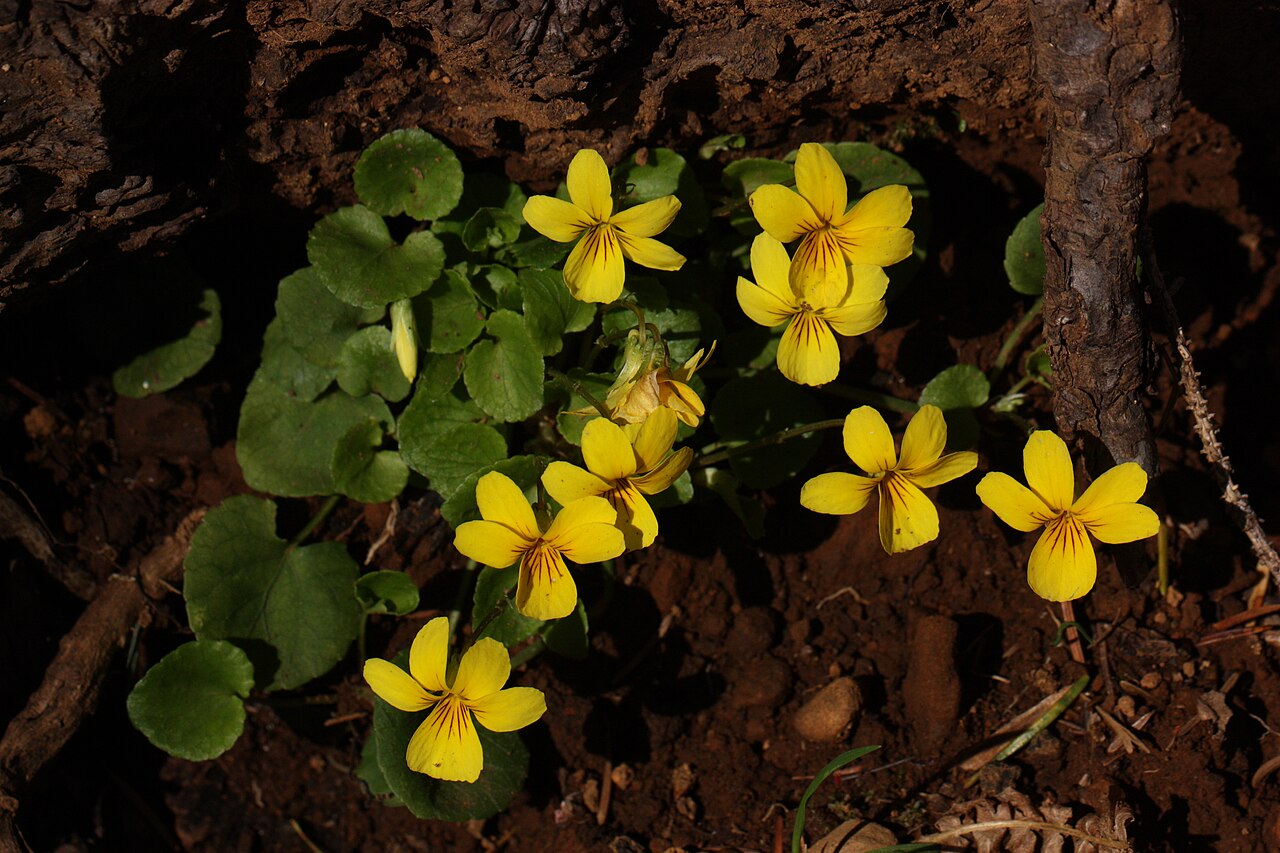
Viola sempervirens, known as Redwood Violet, evergreen violet or trailing yellow violet, is a small, mat-forming native violet of the moist conifer forests of the Pacific coast, from southeastern Alaska and British Columbia to central California. It is a member of the violet family (Violaceae). Its rounded, heart-shaped, leathery leaves stay green through the winter, and from late winter through spring it holds up cheerful yellow flowers only a few inches above the ground.
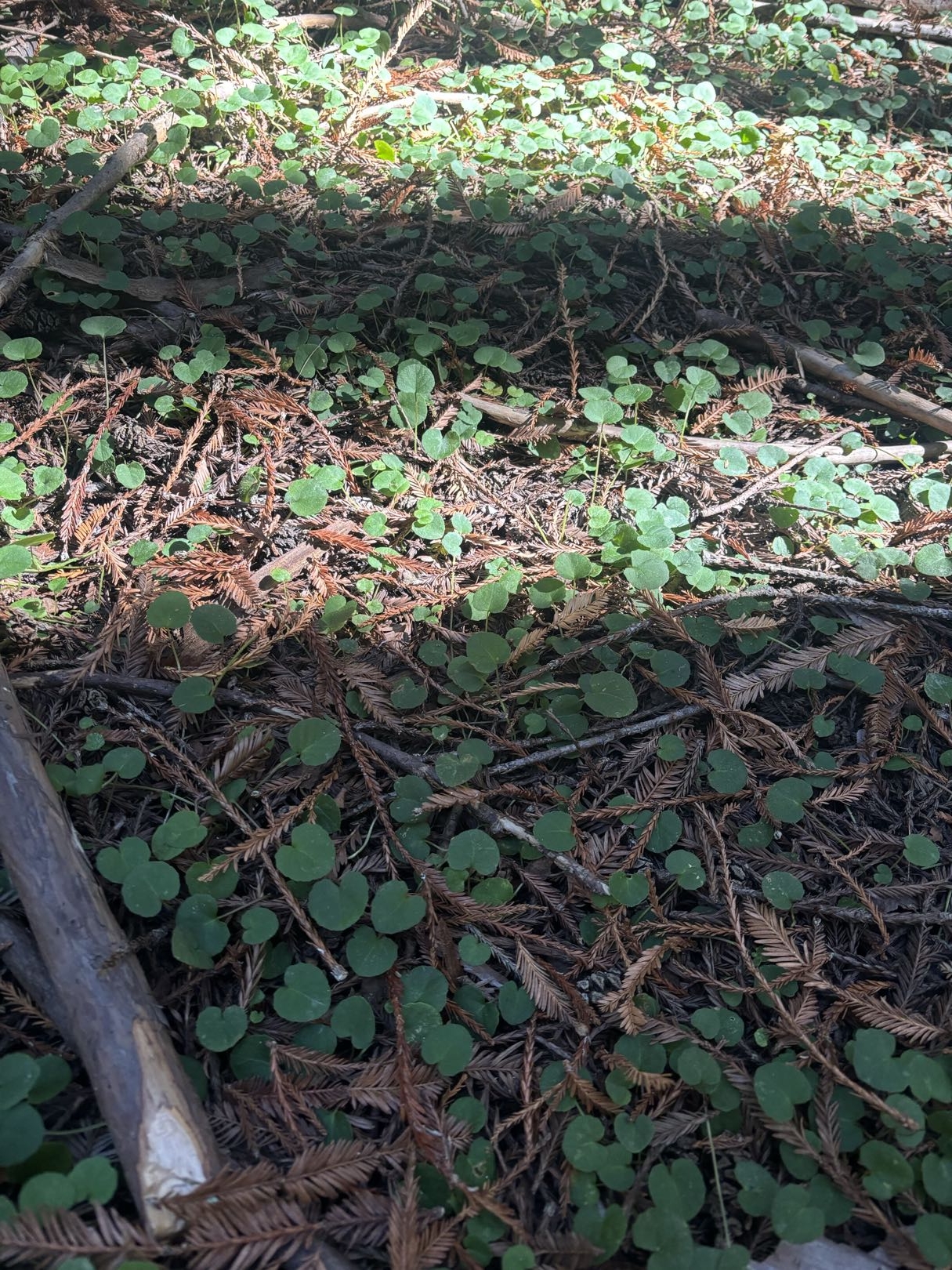
Unlike most violets, which grow as tidy clumps, redwood violet creeps across the forest floor on slender runners (stolons) that root as they go, slowly knitting into loose evergreen carpets. It is especially common in coast redwood forests, which gave it its best-known name, and in Douglas-fir and mixed evergreen forests within reach of coastal fog and rain.
For gardeners in the Pacific Northwest and coastal California it is one of the best native groundcovers for dry to moist shade under trees. This guide covers how to identify it, where it grows, how to grow it, and its role as food for fritillary butterflies and ants.
Identification
Redwood violet is one of only a few yellow-flowered violets in western forests, and its trailing habit and evergreen, leathery leaves set it apart from the others.
Growth Form
A low perennial, usually only 2 to 4 inches tall, that spreads by slender, trailing runners. The runners root at the nodes and send up new rosettes of leaves, so a single plant can form a loose patch a foot or more across over several years.
Leaves
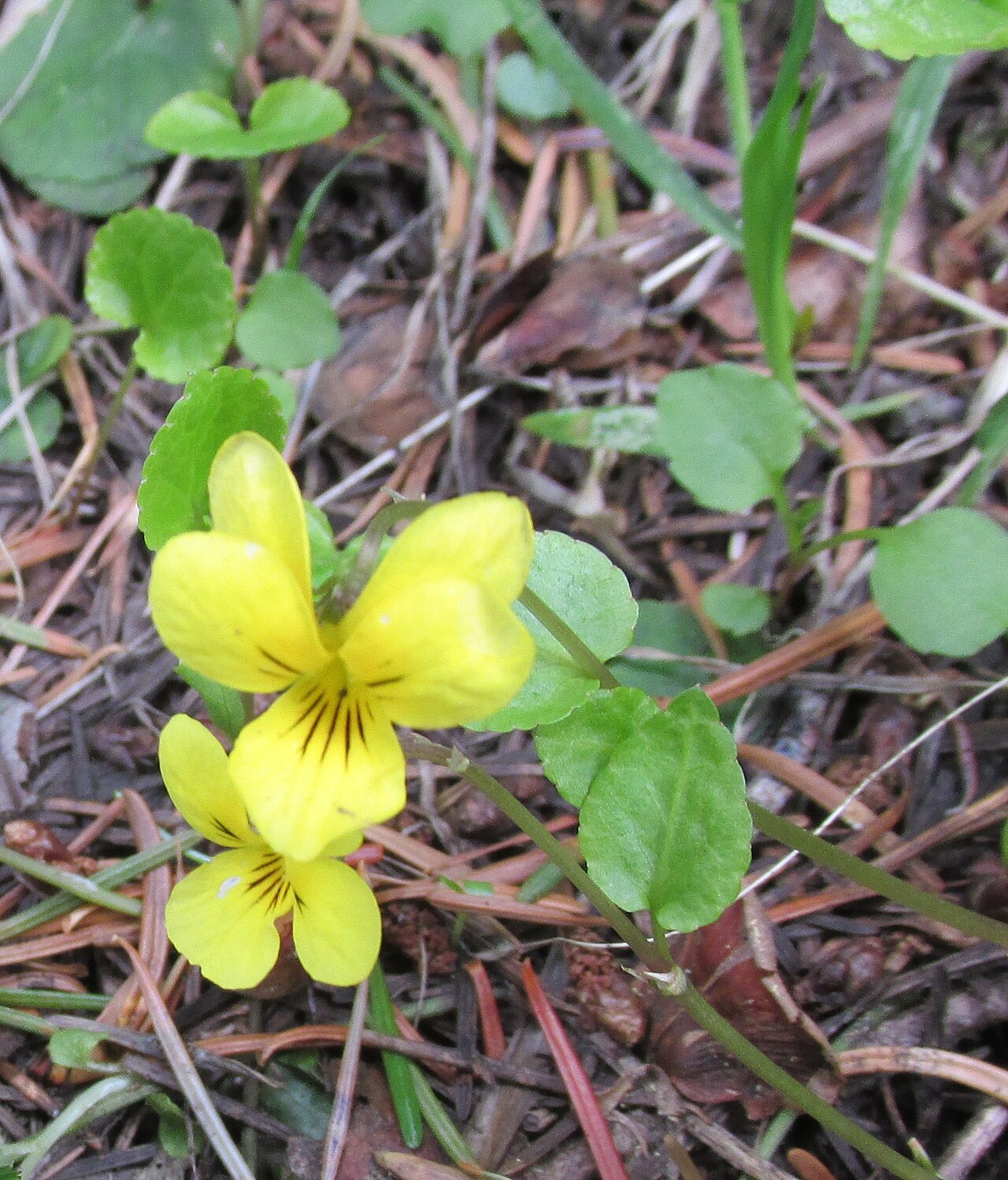
The leaves are round to broadly heart-shaped, about ½ to 1¼ inches (1–3 cm) long, with finely scalloped edges. They are thick, leathery and dark, somewhat dull green, sometimes flecked with purple, and they persist through the winter, which is the source of the name sempervirens, “always green.”
Flowers
The flowers are about ½ inch across, clear lemon yellow, and borne singly on short stalks barely taller than the leaves. The lower three petals carry fine brownish-purple lines that guide insects to the nectar, and the two side petals are bearded at the base. Flowering peaks from about February to May, starting earlier near the coast, where a few flowers can appear in almost any month.
Fruit & Seeds
After flowering it forms small capsules that split into three boat-shaped parts and squeeze out the seeds with some force. Each seed carries a small oily appendage (an elaiosome) that attracts ants, which carry the seeds away and help spread the plant.
Similar Species
Round-leaved violet (Viola orbiculata) of the Cascades and northern Rockies has similar round leaves and yellow flowers but grows as a clump without runners, and its thinner leaves lie flat on the ground. Stream violet (Viola glabella) is taller, with thin, bright green, toothed, heart-shaped leaves on upright stems. Early blue violet (Viola adunca) shares much of its range but has blue-violet flowers. In the East, round-leaved yellow violet plays a similar role.
Quick Facts
| Scientific Name | Viola sempervirens |
| Family | Violaceae (violet family) |
| Plant Type | Evergreen, creeping perennial herb |
| Mature Height | 2–4 in |
| Mature Spread | 1–2 ft by runners |
| Growth Rate | Slow to moderate |
| Sun Exposure | Part shade to full shade |
| Water Needs | Moderate; tolerates summer-dry shade once established |
| Soil Type | Humus-rich, well-drained forest soil with leaf litter |
| Soil pH | Acidic, about 5.0–6.5 |
| Bloom Time | February–May (sporadic later near the coast) |
| Flower Color | Yellow with brownish-purple veins |
| Fall Color | None; evergreen leaves |
| Fruit | Small three-parted capsules; ant-dispersed seeds |
| Deer Resistant | Moderately; occasionally nibbled |
| USDA Hardiness Zones | 6–9 |
Native Range
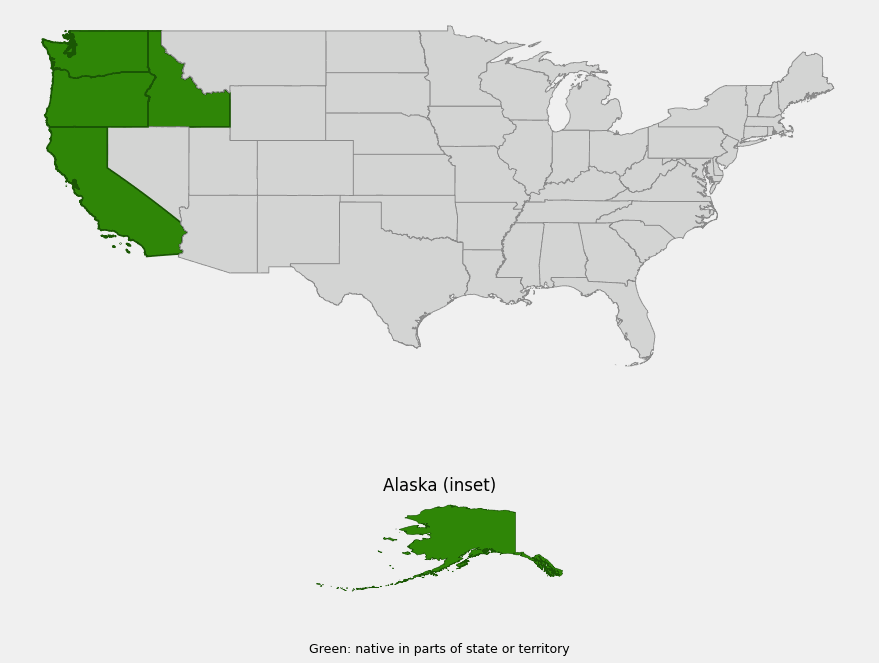
Redwood violet is native to the Pacific coast of North America. USDA PLANTS records it in Alaska, Washington, Oregon, Idaho and California, and in British Columbia in Canada. It is most common west of the Cascade crest in Washington and Oregon, including the Olympic Peninsula, Puget Trough and Coast Range, and it continues south through the redwood belt of northwestern California to about Monterey County.
At the edges of its range it is uncommon. In Alaska it reaches only the far southeastern panhandle, where NatureServe ranks it critically imperiled, and in Idaho it is known from a few moist northern forests, where it is ranked vulnerable. Most plants grow within about 60 miles of the coast.
Its home is the shaded floor of moist, mostly evergreen forests: coast redwood, Douglas-fir, western hemlock and mixed evergreen forests, along with closed-cone pine forests near the California coast. It often grows along trails and lightly disturbed banks. It ranges from near sea level to roughly 5,000 feet in the Olympic and Cascade mountains.
📋 Regional plant lists featuring Redwood Violet: Alaska · California & Nevada · Idaho, Eastern Oregon & Eastern Washington · Western Oregon & Western Washington
Growing & Care Guide
Redwood violet is a gentle, slow-spreading evergreen groundcover for shade gardens in the Pacific Northwest and coastal California. It is easy once settled, as long as it has shade, an organic mulch of leaf litter or needles, and soil that never bakes in summer sun.
Light
Give it part to full shade, such as under conifers, redwoods or deciduous trees. Morning sun is fine in cool coastal gardens, but hot afternoon sun scorches the leaves.
Soil & Water
Plant it in humus-rich, well-drained, slightly acidic soil and keep a layer of leaf litter or conifer needles over the roots, as on a forest floor. Water regularly through its first summer. Established plants in coastal gardens tolerate dry summer shade and look their best with an occasional deep watering in long droughts.
Planting Tips
Plant nursery-grown plants in fall or late winter, about 8 to 12 inches apart, where they can creep between ferns, shrubs and tree roots. It combines well with sword fern, Oregon wood sorrel, western wild ginger and fringe cups.
Pruning & Maintenance
Very little is needed. Leave fallen leaves in place as mulch. Keep vigorous groundcovers and weeds from swamping its small rosettes, and do not rake it hard.
Propagation
The easiest method is to cut rooted runners from an established patch and pot them up or replant them in fall or late winter. It can also be grown from fresh seed sown in fall outdoors, where winter cold and moisture help germination; it may self-sow lightly in good conditions.
Landscape Uses
- Woodland groundcover: evergreen carpet under conifers and redwoods
- Shade gardens: yellow flowers in late winter and spring when little else blooms
- Butterfly gardens: caterpillar food for fritillary butterflies
- Fern and rock gardens: between ferns, stones and stepping stones in shade
- Restoration of forest understory: within its coastal range
Wildlife & Ecological Value
Small as it is, redwood violet is part of a web of relationships on the forest floor, from the butterflies that depend on violets to the ants that plant its seeds.
For Pollinators
Early bees, including bumblebee queens, small native bees and flies, visit the flowers in late winter and spring. Violets are the caterpillar food plants of the greater fritillary butterflies (Speyeria), several of which live in the forests and meadows of the Pacific Northwest and lay their eggs near violets.
For Birds
Its tiny seeds are of little value to most birds, though ground-foraging birds may pick up some. It contributes to the leaf-litter layer where many birds hunt insects.
For Mammals
Deer, elk and small mammals occasionally browse the leaves, but it is not a major food source.
Ecosystem Role
Its seeds carry oily elaiosomes that ants collect, eat and discard, often in rich soil near their nests, a seed-dispersal partnership common among woodland violets. As an evergreen groundcover it also helps hold soil and leaf litter on shaded forest slopes.
Cultural & Historical Uses
The genus name Viola is the classical Latin name for violets, and sempervirens means “always green,” the same epithet given to the coast redwood, Sequoia sempervirens, with which this violet so often grows. The species was described by the California botanist Edward Lee Greene in the late nineteenth century.
An older name for the plant, Viola sarmentosa, refers to its runners (sarmentose means bearing long runners). Many older Pacific Northwest guides use that name.
Redwood violet is a familiar sight to hikers in coastal forests, often one of the first flowers of the year along shaded trails. It is secure across most of its range, but rare in Alaska and Idaho, so collect only seed or a few rooted runners from garden plants, and never dig plants from the wild.
Frequently Asked Questions
Is redwood violet evergreen?
Yes. Its thick, leathery leaves stay green through the winter, which is why it is also called evergreen violet and is named sempervirens, “always green.”
Does redwood violet only grow under redwoods?
No. It is common in redwood forests, but it also grows in Douglas-fir, hemlock and mixed evergreen forests from southeastern Alaska and British Columbia to central California.
Will redwood violet spread in my garden?
Slowly. It creeps by rooting runners and forms loose carpets over several years, but it is not aggressive and is easy to keep in bounds.
Can redwood violet grow in dry shade?
In coastal Pacific gardens, established plants tolerate dry summer shade under trees, especially with a mulch of leaf litter. Water it through its first summer and during long droughts.
Are redwood violets good for butterflies?
Yes. Violets are the caterpillar food plants of fritillary butterflies, and early bees visit the flowers.

Looking for a nursery that carries Redwood Violet?
Browse our native plant nursery directory: Alaska · California · Idaho · Oregon · Washington